How to Register for E-Commerce Tax as an Online Seller in Pakistan
FBR requires every online seller in Pakistan to register, and gateways and couriers withhold 1% to 2% before you get paid. Rates, registration and penalties.
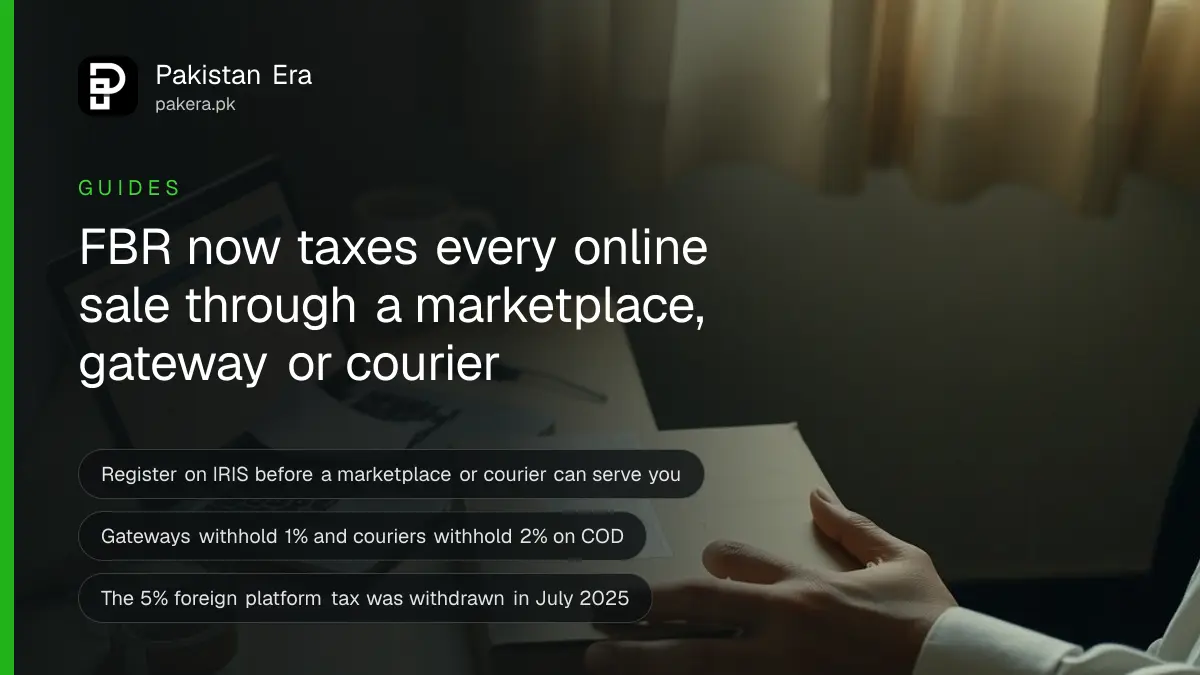
If you sell online in Pakistan, through your own website, Daraz, or social media, you must register with FBR for income tax, and for sales tax if you sell taxable goods. Payment gateways and banks withhold 1% on online payments, and couriers withhold 2% on cash on delivery, before the money reaches you. Those are the filer rates; non-filers pay 2% and 4%.
A seller running a Facebook page out of a spare room used to sit outside the tax system entirely. That changed with the Finance Act 2025 and a set of FBR circulars that turned marketplaces, payment gateways and couriers into tax collectors on the seller's behalf. We read FBR's Sales Tax and Federal Excise Circular No. 02 of 2025-26 on 4 October 2026, fetched through a text proxy because the PDF on FBR's own server renders as a scanned image, and cross-checked the withholding figures against three independent reports of FBR's matching Income Tax Circular.
Who has to register, and for what
Every e-commerce seller, resident or not, must be on FBR's books. A domestic seller needs an income tax registration, and a sales tax registration if selling taxable goods. FBR's circular says new sub-sections, 1A and 1B, were added to section 14 of the Sales Tax Act for this, covering registration of an e-commerce vendor including a non-resident person selling digitally ordered goods from or within Pakistan. That closes the gap that let a seller with no Pakistani office stay unregistered while still delivering here.
Register through FBR's IRIS portal at iris.fbr.gov.pk, the same system used for an ordinary National Tax Number and Sales Tax Registration Number. There is no separate e-commerce-only form; you register as any business would and declare e-commerce as your activity.
If you already sell on Daraz, check our breakdown of what Daraz actually deducts from a seller's payout before assuming the withheld tax is the only cut your sale takes.
Marketplaces and couriers cannot carry an unregistered seller
From 1 July 2025, a marketplace or courier is barred from serving a seller who is not registered with FBR. A platform that keeps listing an unregistered seller's products, or a courier that keeps delivering for one, is itself in breach, which is what actually forces registration, since it used to be the seller's problem alone.
| Party | New obligation |
|---|---|
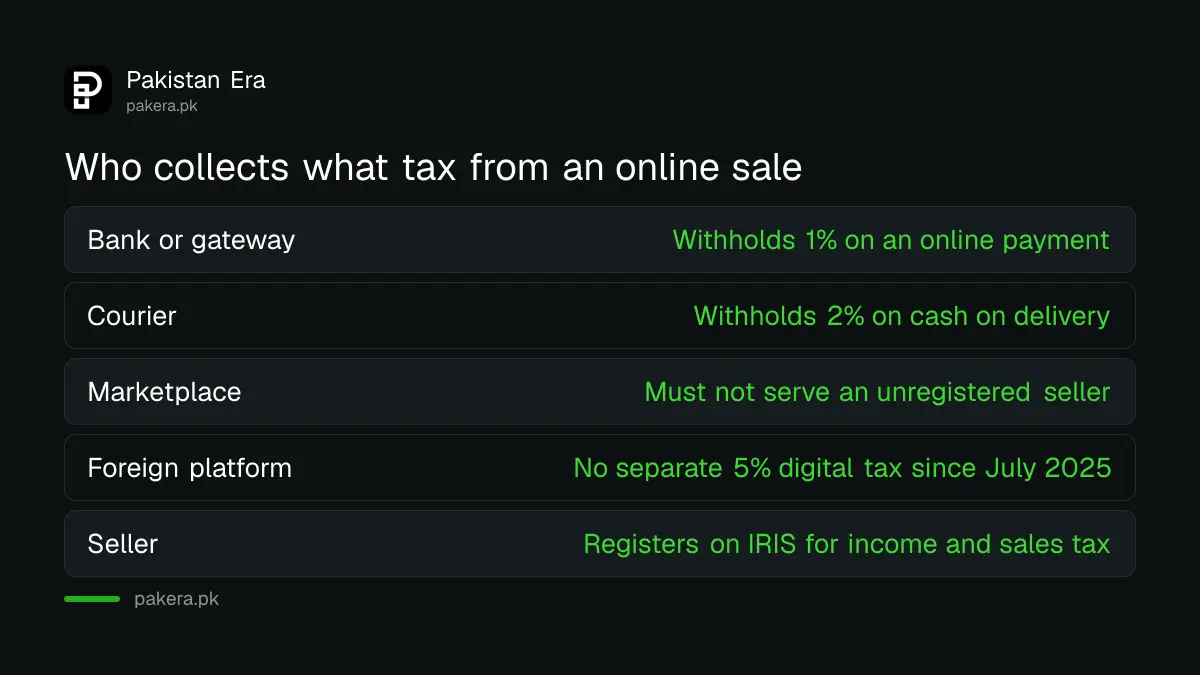
| Online marketplace | Must not onboard or continue serving an unregistered seller |
| Courier | Must not deliver for an unregistered seller; now defined to include logistics and ride-hailing services doing e-commerce deliveries |
| Both | File a monthly sales tax statement listing supplier-wise amounts paid and tax due |
Withholding tax is deducted before you see the money
Two different parties withhold tax, depending on how the customer paid. The rates are in section 153(2A) of the Income Tax Ordinance, and we read them in FBR's Withholding Income Tax Rate Card, updated up to 30 June 2026 under the Finance Act 2026, for tax year 2027.
- Online payment, by card, wallet or bank transfer: the bank, financial institution or payment gateway handling the transfer withholds 1% of the gross amount if you are on the Active Taxpayers List, and 2% if you are not.
- Cash on delivery: the courier collecting the cash withholds 2% of the gross amount if you are on the Active Taxpayers List, and 4% if you are not.
- Both sit under a new charging provision, reported as section 6A, covering payments for digitally ordered goods or services through a marketplace or website.
The tax is reported as final, meaning it settles the liability on that transaction rather than sitting as an advance you adjust later. Keep every settlement statement the marketplace, gateway or courier sends you, since that is your proof if FBR's number does not match your own books.
Cash on delivery now has a ceiling
FBR's Income Tax Circular No. 02 of 2025-26, announced 16 August 2025, set a limit of Rs 200,000 on cash payments for tax purposes under section 21(s) of the Income Tax Ordinance 2001. A cash payment above that is not admissible as a deductible business expense, which pushes high-value COD orders toward bank transfer, card or mobile wallet.
Foreign platforms do not currently pay a separate digital tax
The Finance Act 2025 also created the Digital Presence Proceeds Tax Act 2025, a flat 5% income tax aimed at foreign platforms such as Amazon, AliExpress and Temu selling to Pakistani buyers without a local office, effective 1 July 2025.
It did not last a month. FBR issued SRO 1366(I)/2025 on 30 July 2025, stating the Digital Presence Proceeds Tax shall not apply to digitally ordered goods and services supplied from outside Pakistan, backdated to 1 July 2025. So as of today, a Pakistani buyer ordering from a foreign platform is not paying that 5% tax, and the platform is not withholding it. We mention this because the 5% figure still circulates online as if current, and it is not, based on FBR's own notification.
Penalties for not complying
FBR's circular confirms new penalty entries were added to section 33 of the Sales Tax Act for marketplaces and couriers that fail to meet their new duties, such as filing the monthly statement or dealing with an unregistered seller, and we read that reference in the circular text itself.
What we could not read in the circular is the exact rupee amount of each penalty. Press summaries mention penalties without a confirmed figure attached, so we report that penalties exist without repeating an unconfirmed number as settled. A bank or gateway that fails to withhold the required tax also faces exposure under the Income Tax Ordinance's general withholding default rules, which can make the bank itself liable for the tax it should have deducted.
What this means for a small seller this week
If you sell through Daraz or a marketplace, check whether it has already asked for your NTN; most large platforms began enforcing this from mid to late 2025, and an unregistered account risks suspension by the platform itself. If you sell through your own site or social media and get paid through a bank account or gateway, register first. Check your status with our guide on verifying an NTN online, or start fresh with our walkthrough on registering a sole proprietorship with FBR, which covers the same IRIS steps an online seller follows. If your turnover needs a Sales Tax Registration Number too, our guide to the documents FBR asks for at sales tax registration lists what to have ready.
Keep records the way a bank or marketplace reports them
Because the payment intermediary or courier now files a monthly statement naming you by transaction, your own invoice and bank records need to match what they report, or you risk a reconciliation notice. Make sure your invoices are the kind FBR recognises; we cover why a fake or non-POS invoice gets flagged, which applies to an online seller's paperwork as much as a shop's till receipt. Banks already report account activity to FBR as routine, and a payout account is not invisible; our explainer on what banks report to FBR covers the thresholds that draw attention.
Common questions
Do I need to register if I only sell on Instagram or WhatsApp?
Yes, if a bank, payment gateway or courier handles the payment or cash collection on your behalf. The rule targets the payment and delivery chain, not the platform you post on.
Is the withholding tax the only tax I pay?
It is reported as a final tax on that transaction's income, but you may still owe sales tax separately if you sell taxable goods, and you still file an annual income tax return.
What happens if Daraz or a courier keeps serving me without an NTN?
FBR's circular makes the marketplace or courier responsible for checking registration from 1 July 2025, and the platform risks its own penalty, so most now ask for an NTN before payout.
Do foreign sellers like AliExpress or Temu pay Pakistani tax on what I buy from them?
Not the 5% Digital Presence Proceeds Tax, which FBR withdrew for goods supplied from outside Pakistan from 1 July 2025 through SRO 1366(I)/2025. Customs duty on the imported parcel is a separate matter outside this guide.
Can I deduct a large cash on delivery payment as a business expense?
Not above Rs 200,000 in a single cash payment. FBR's Circular No. 02 of 2025-26 makes cash above that limit inadmissible under section 21(s) of the Income Tax Ordinance.
How we verified this
What we checked, where we read it, and what we could not confirm.
Last checked 7 October 2026. The sales tax registration requirement for e-commerce vendors, including non-resident sellers, under new sub-sections 1A and 1B of section 14, the bar on marketplaces and couriers serving unregistered sellers, the monthly supplier-wise statement requirement, and the reference to new penalty entries in section 33 are read directly from FBR's Sales Tax and Federal Excise Circular No. 02 of 2025-26, fetched as text on 4 October 2026 since the PDF on download1.fbr.gov.pk is a scanned image file. The withholding rates under section 153(2A), 1% on online payments and 2% on cash on delivery for filers, and 2% and 4% for non-filers, are read directly from FBR's Withholding Income Tax Rate Card, updated up to 30 June 2026 as per the Finance Act 2026, on 7 October 2026. The section 6A reference and the final tax treatment are still reported from independent summaries of FBR's Income Tax Circular No. 01 of 2025-26, which we could not render as readable text from FBR's own server. The Rs 200,000 cash limit under section 21(s), announced 16 August 2025, is reported from a summary citing FBR's Circular No. 02 of 2025-26 (Income Tax). The Digital Presence Proceeds Tax Act 2025, its 5% rate, its 1 July 2025 start, and its withdrawal for goods and services supplied from outside Pakistan through SRO 1366(I)/2025 dated 30 July 2025 are reported across multiple independent news summaries that agree on the SRO number and date; we did not locate SRO 1366(I)/2025 itself in readable form on FBR's site. NOT VERIFIED: the exact rupee penalty amounts in the amended section 33 of the Sales Tax Act, which the circular confirms exist but does not itself state figures for; the customs duty treatment of low-value imported parcels, which sources give conflicting thresholds for and which this article deliberately leaves out rather than state a wrong number.
About the author

Senior Writer, Public Services and Technology
Shahid joined us in 2024 as an author. He is a senior contributor to Pakistan's leading technology websites. He writes detailed articles, mostly covering his expertise in the latest tech, mobiles, apps, gadgets, and step-by-step guides. His ideology is to help people understand the latest trends and explain complex methods through very easy-to-understand guides.