Pakistan's $1 Billion AI Plan: 1,000 PhD Scholarships Promised by 2030
Pakistan's AI plan promises 1,000 PhD scholarships by 2030. We checked Ignite and HEC to find out what a student or AI startup can actually apply for today.
Pakistan's $1 billion AI plan promises 1,000 fully funded PhD scholarships by 2030, but no PhD scholarship form tied to that plan exists yet. What is open today is Ignite's Pakistan Startup Fund, which backs AI startups and researchers with up to $1 million, plus HEC's existing PhD schemes a computer science or AI student can apply to right now.
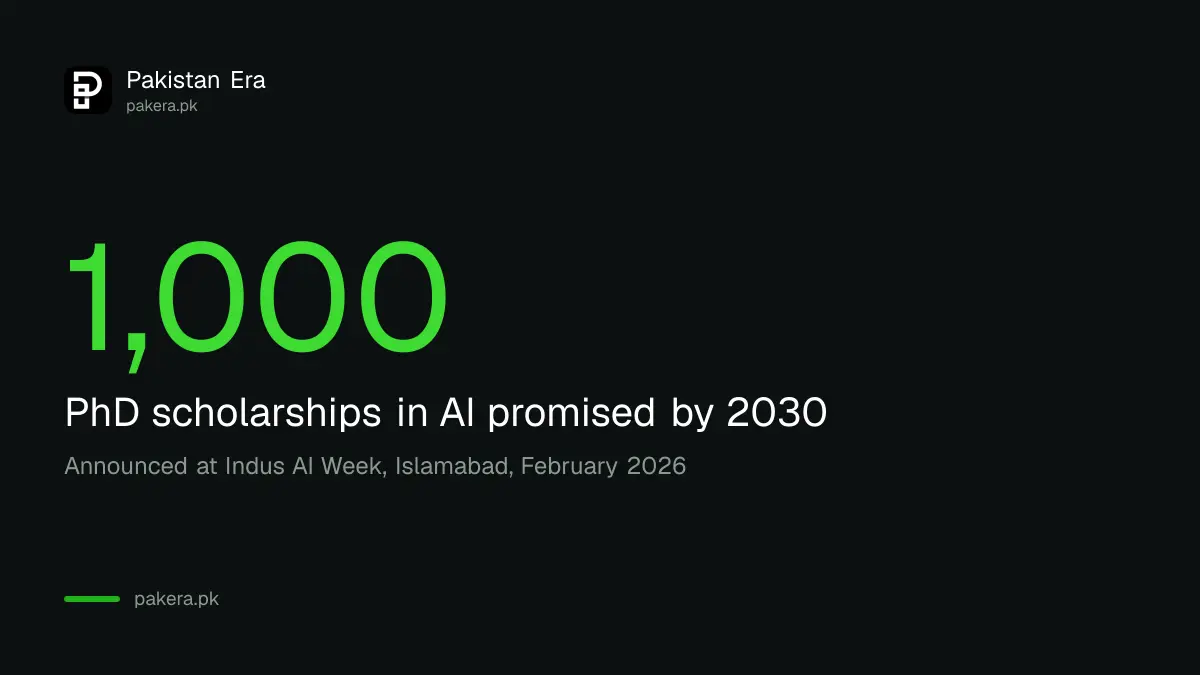
Prime Minister Shehbaz Sharif stood up at Indus AI Week 2026 in Islamabad in February and promised a national AI push: $1 billion by 2030, a thousand PhD scholarships in artificial intelligence, and a plan to train one million people who are not already in IT. Eight months on, we went looking for the form. There isn't one, not for the PhD scholarships.
We read the announcement on the Ministry of IT and Telecom's own Digital Pakistan platform, checked Ignite National Technology Fund's site for anything AI-specific since February, and looked at what HEC already runs for PhD students in computer science and related fields. Below is what is real today and what is still a promise on a page.
Pakistan's AI plan promises 1,000 PhD scholarships by 2030, not an open call yet
The 1,000 PhD scholarships are a 2030 target announced at Indus AI Week, not a scheme with a form, a portal or a deadline. Ignite's own site carries no PhD scholarship page tied to the plan, and HEC has not opened one under that name either.
Digital Pakistan, the Ministry of IT and Telecom's own platform, describes the plan as a package: $1 billion in AI investment by 2030, one thousand fully funded PhD scholarships in artificial intelligence over the same period, and AI curriculum across federally run schools, including in Azad Jammu and Kashmir, Gilgit Baltistan and remote parts of Balochistan. That is the announcement, word for word as the government itself has published it.
What the announcement does not carry is a mechanism. No eligibility list, no university partner, no intake date. Indus AI Week was billed as the start of a conversation on policy and talent, and eight months later that is still mostly what it is. We checked Ignite's news page in October 2026 and found nothing from the period since February naming a PhD scholarship, a selection committee or an application window for this specific promise.
The plan also promises school AI lessons and training for one million workers
Beyond the PhD scholarships, the plan promises an AI curriculum in federal schools and a programme to train one million people outside the IT sector in AI skills. Neither has a public rollout date, a training portal or a registration page as of October 2026.
The training target covers people already working in agriculture, trade, mining and other sectors the government wants AI to touch, not just office workers learning to code. Officials have named agriculture, mines and minerals, industry and youth employment as the priority areas. None of that changes what a reader can do about it today, which is close to nothing, because the programme has not opened registration anywhere we could find.
A National AI Fund has also been proposed, a fund of funds running from 2026 to 2031 with an initial allocation reported for the 2026-27 budget year. It would sit inside Ignite's research and development fund rather than beside it. As of our check, it is a budget line and a plan, not a fund making grants to named projects yet.
Ignite's Pakistan Startup Fund is open now, and AI startups qualify
While the PhD scholarships wait, Ignite's Pakistan Startup Fund is live and accepting applications on a rolling basis. It is sector agnostic, so an AI, machine learning or data science startup qualifies on the same terms as a fintech or an edtech company.
The fund, run under the Ministry of IT and Telecom, gives non-equity grants of $50,000 to $1 million, capped at 30 percent of a startup's total investment round. It is not free money on its own. A startup needs a term sheet, a funding agreement or a letter of intent from a private investor before Ignite will grant alongside that round. The company must be incorporated in Pakistan for ten years or less and be an active tax filer with the Federal Board of Revenue.
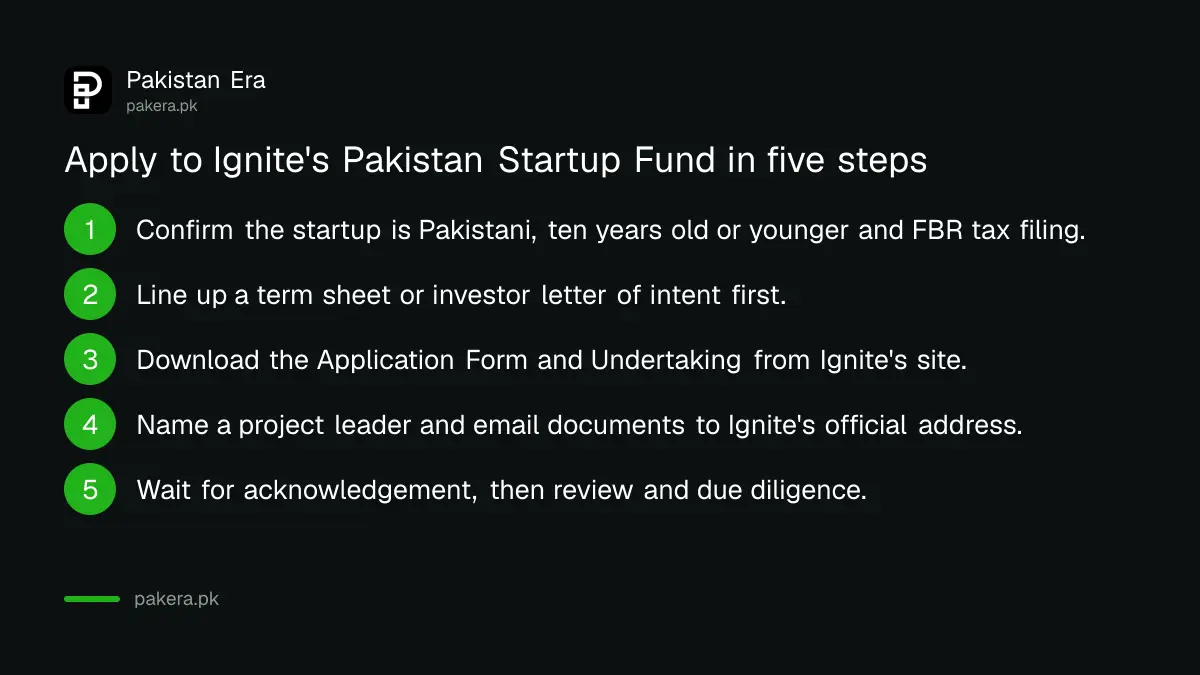
- Confirm the startup is Pakistani, ten years old or younger, and filing tax returns with the FBR.
- Line up a term sheet, signed funding agreement or investor letter of intent first.
- Download the Application Form, Undertaking and Investor Pitch Template from Ignite's site.
- Name one project leader with authority to represent the company, then email the full set of documents to pakistanstartupfund@ignite.org.pk.
- Wait for an acknowledgement, then the internal review, due diligence and investor pitch stages that follow.
Ignite charges nothing at any stage and says it has not engaged any third party to collect applications on its behalf, so an agent asking for a processing fee is not working for Ignite. A review committee answers concerns within five working days of a submission to the official address.
HEC already runs PhD scholarships open to computer science and AI students
A reader who wants to start a PhD in AI or computer science does not have to wait for the 2030 promise. HEC runs several scholarship routes, some open to any field including computer science, that a student can apply to under existing rules.
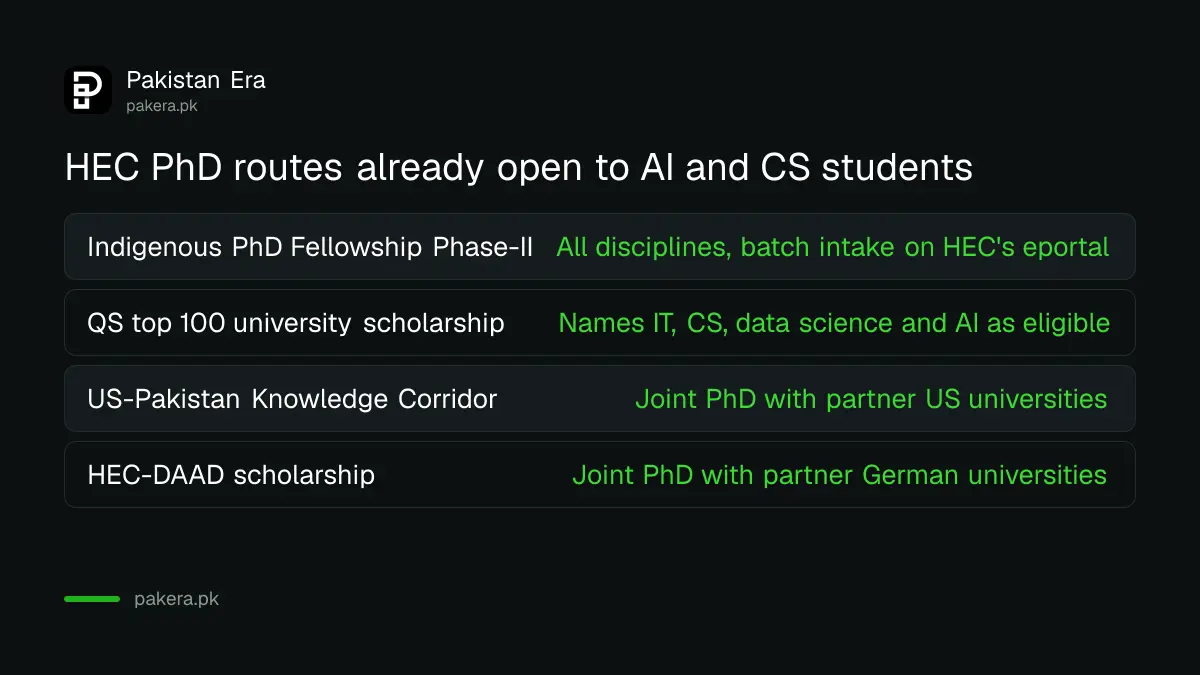
The Indigenous PhD Fellowship Phase-II covers every field of science and technology, including computer science, and releases new batches through HEC's eportal rather than on a fixed annual date. HEC also runs scholarships for study at QS world top 100 universities that name information technology, computer science, software engineering, data science and AI as eligible fields, plus joint PhD routes with specific countries.
| Scheme | Covers AI or CS | How it runs |
|---|---|---|
| Indigenous PhD Fellowship Phase-II | Yes, open to all disciplines | Batch intake through HEC's eportal |
| Scholarships for QS top 100 universities | Named field: IT, CS, software engineering, data science, AI | Overseas study, periodic intake |
| US-Pakistan Knowledge Corridor | Open to science and technology fields | Joint PhD with partner US universities |
| HEC-DAAD scholarship | Open to science and technology fields | Joint PhD with partner German universities |
None of these schemes is branded as the 1,000 AI scholarships from Indus AI Week. They are HEC's standing programmes, and a computer science or AI thesis proposal competes for them like any other proposal does. A student aiming at a joint PhD can look at HEC's route with partner universities in the United States or at the matching scheme run with German institutions, since both accept strong science and technology proposals now, AI included.
Watch HEC and Ignite directly, not a forwarded post
When the 1,000 scholarships do open, HEC or Ignite will publish the form on their own sites first, because that is how every other scholarship on both bodies' sites has launched. A WhatsApp forward or a private consultant offering early access is not a source.
Bookmark HEC's scholarships and grants page and Ignite's news page rather than trusting a third party's summary. Government scholarships in Pakistan do not charge an application fee beyond small processing costs that HEC itself states on its own portal, so a demand for a large advance payment for "guaranteed" selection is a warning sign on its own.
Common questions
Is Pakistan's 1,000 PhD AI scholarship application open yet?
No. As of October 2026 it is a 2030 target announced at Indus AI Week 2026, with no application form, eligibility list or intake date published by HEC or Ignite.
Who is running Pakistan's $1 billion AI plan?
The Ministry of IT and Telecom announced it, with Ignite National Technology Fund handling industry and startup funding and HEC expected to handle the academic scholarship side.
Can an AI startup get funding from the government right now?
Yes. Ignite's Pakistan Startup Fund is open on a rolling basis and funds AI, machine learning and data science startups the same way it funds any other sector.
Can I start a PhD in AI in Pakistan without waiting for the new scholarships?
Yes. HEC's Indigenous PhD Fellowship and its scholarships for top 100 QS universities already accept computer science and AI proposals under their existing rules.
Is the National AI Fund giving out grants yet?
No. As of our check it is a proposed fund of funds for 2026 to 2031 with an initial budget allocation reported for 2026-27, not yet making grants to named projects.
How we verified this
What we checked, where we read it, and what we could not confirm.
Last checked on 4 October 2026. The announcement details, including the $1 billion figure, the 1,000 PhD scholarships, the one million worker training target and the school curriculum plan, are read on the Ministry of IT and Telecom's Digital Pakistan platform. The Pakistan Startup Fund's grant size, eligibility and application steps are read on Ignite National Technology Fund's own site. HEC's PhD scholarship schemes are read on HEC's scholarships and grants pages. We found no PhD scholarship form, portal or intake date tied to the AI plan on either Ignite's or HEC's site, and no AI-specific news item on Ignite's news page between February and October 2026 announcing one. The National AI Fund's proposed status and 2026-27 budget allocation are reported, not confirmed on a government budget document we read directly, and are stated as reported for that reason.
About the author

Tax, Bills and Technology Writer
Ali Akhtar is a young and curious voice here at Pakistan Era. He is currently pursuing his A-Levels and has a growing interest in Pakistan’s changing industrial landscape and educational trends. Ali likes to write in a way that helps him explain and explore the world around him. His writing reflects the perspective of the new generation navigating the evolving trends of Pakistan where technology, youth innovation, and shifting opportunities are reshaping the country’s future.