Prize Bonds in Pakistan: How They Work, How to Check, and the Tax When You Win
Which denominations still exist, when the quarterly draws fall, the 60 day rule, the six year claim window, and the filer tax difference.
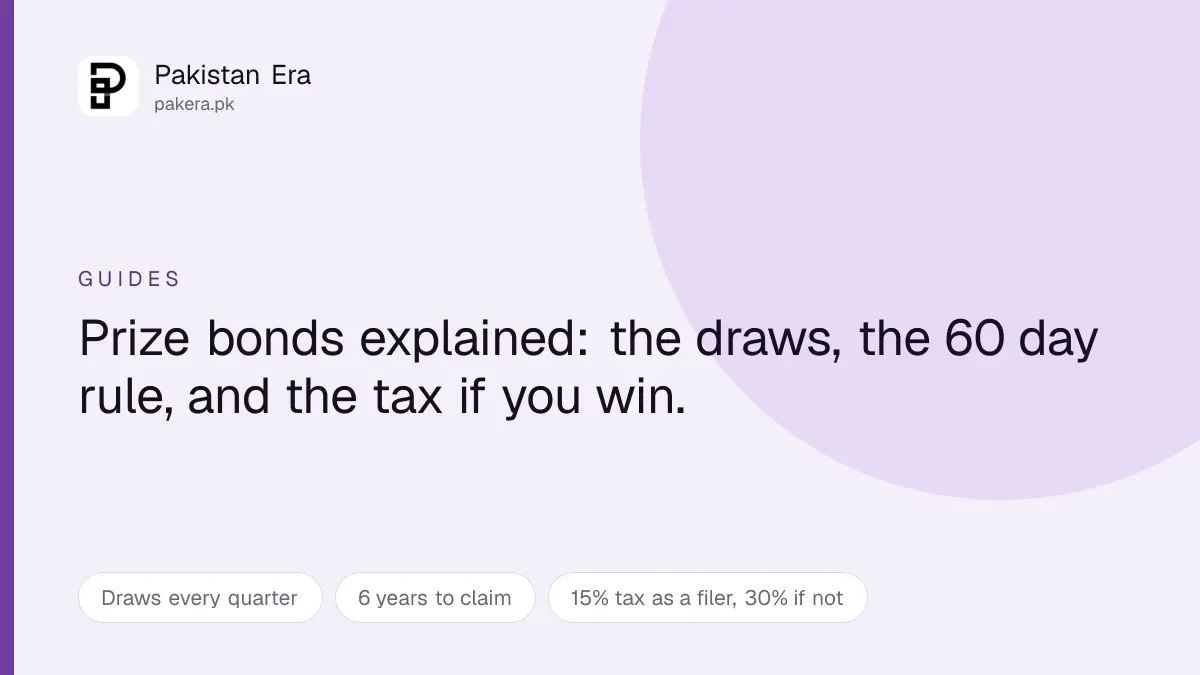
Somewhere in most Pakistani households there is an envelope with a few prize bonds in it, bought years ago and checked never. The next draw for the Rs 100 and Rs 1,500 denominations is reported for 17 August, so this is a reasonable week to explain how the whole system actually works.
Update, 11 October 2026: A prize can be claimed with a form and CNIC within six years.
Update, 10 October 2026: The Rs 750 prize bond draw is on 15 October 2026 in Rawalpindi. See the draw details.
We went through the rules before writing this, and two of them surprise almost everyone: a bond bought less than 60 days before a draw is not in that draw, and winning as a non filer costs you double the tax.
What a prize bond actually is
A prize bond is a government savings instrument that pays no interest. Instead, every bond number is entered into a quarterly draw, and the prize fund is distributed to the numbers drawn. Your capital stays intact: a Rs 1,500 bond is always worth Rs 1,500 back, whenever you encash it.
That makes it something between saving and a lottery, with one important difference from a lottery ticket: you never lose the stake. What you give up is the profit the money would have earned anywhere else. That forgone profit is the price of the ticket.
The denominations that still exist
| Bond | Type | What that means |
|---|---|---|
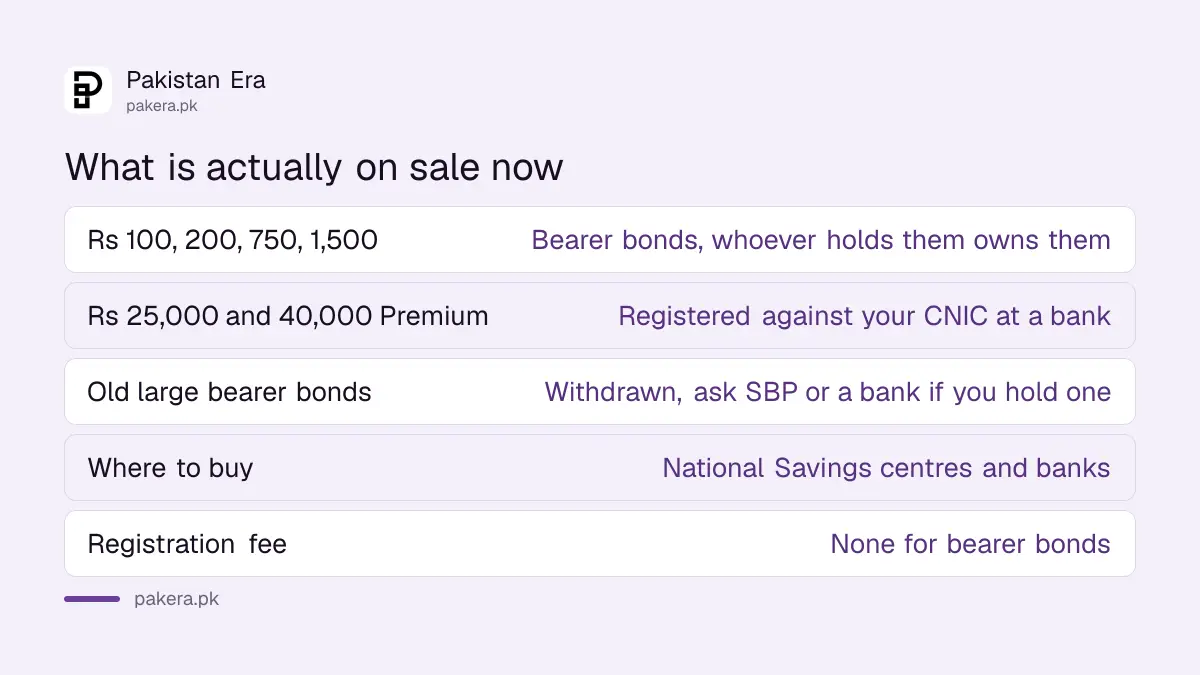
| Rs 100, 200, 750, 1,500 | Bearer | Whoever physically holds it owns it. No registration |
| Rs 25,000 Premium | Registered | Tied to your CNIC at a bank, pays a profit as well as draws |
| Rs 40,000 Premium | Registered | Same, larger denomination |
The government withdrew the larger bearer denominations in phases over recent years, directing holders to convert or encash them. If you are holding an old Rs 7,500, 15,000, 25,000 or 40,000 bearer bond from that era, do not throw it away and do not assume it is dead money: take it to a commercial bank or a State Bank Banking Services office and ask what the current conversion position is.
Bearer bonds cut both ways. No registration means no paperwork, and it also means a lost or stolen bond is simply gone, like cash. Premium bonds are registered against your CNIC, so they survive being lost, and they pay a periodic profit on top of the draw entry, with tax withheld on that profit.
When the draws happen, and the rule that catches people
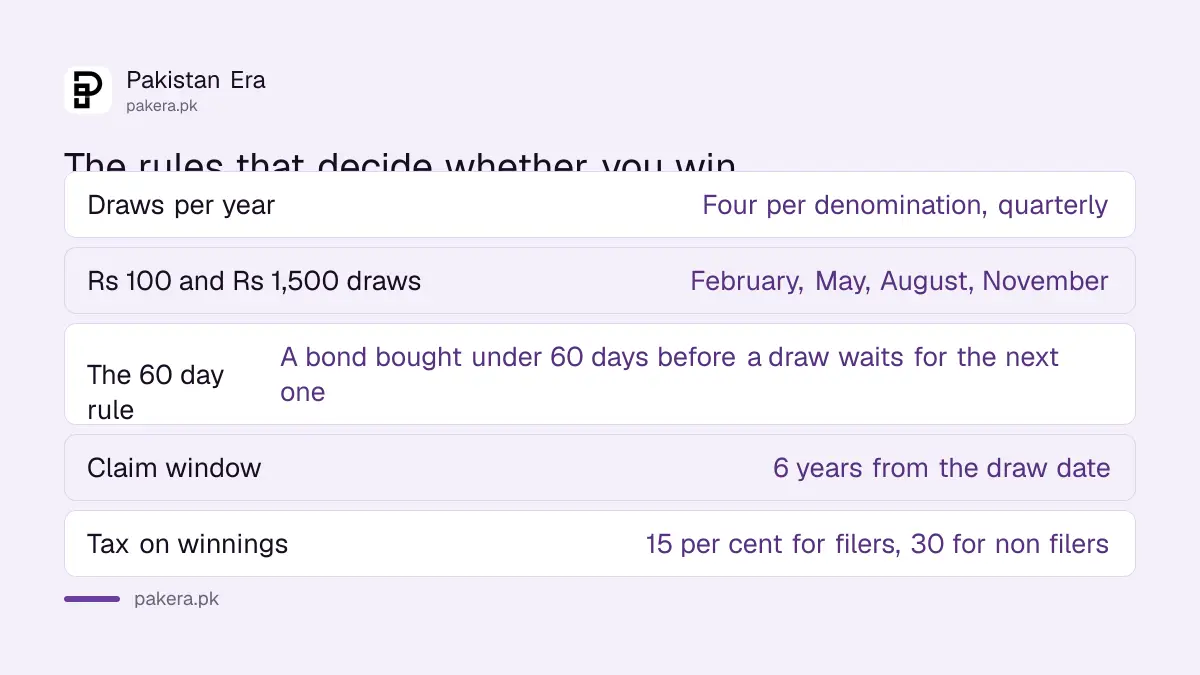
Each denomination is drawn four times a year. The Rs 100 and Rs 1,500 draws fall in February, May, August and November, and the next one is reported for 17 August 2026. Draws are held in rotating cities, Karachi one quarter, Lahore or Peshawar another, but the city only decides where the ceremony happens, not who can win.
The rule that catches people is the 60 day rule. A bond has to have been purchased at least 60 days before a draw to be entered in it. Buy a bond this week and it is not in the August draw at all; its first draw is November. Sellers rarely mention this, and a lot of disappointment traces back to it.
How to check whether you have won
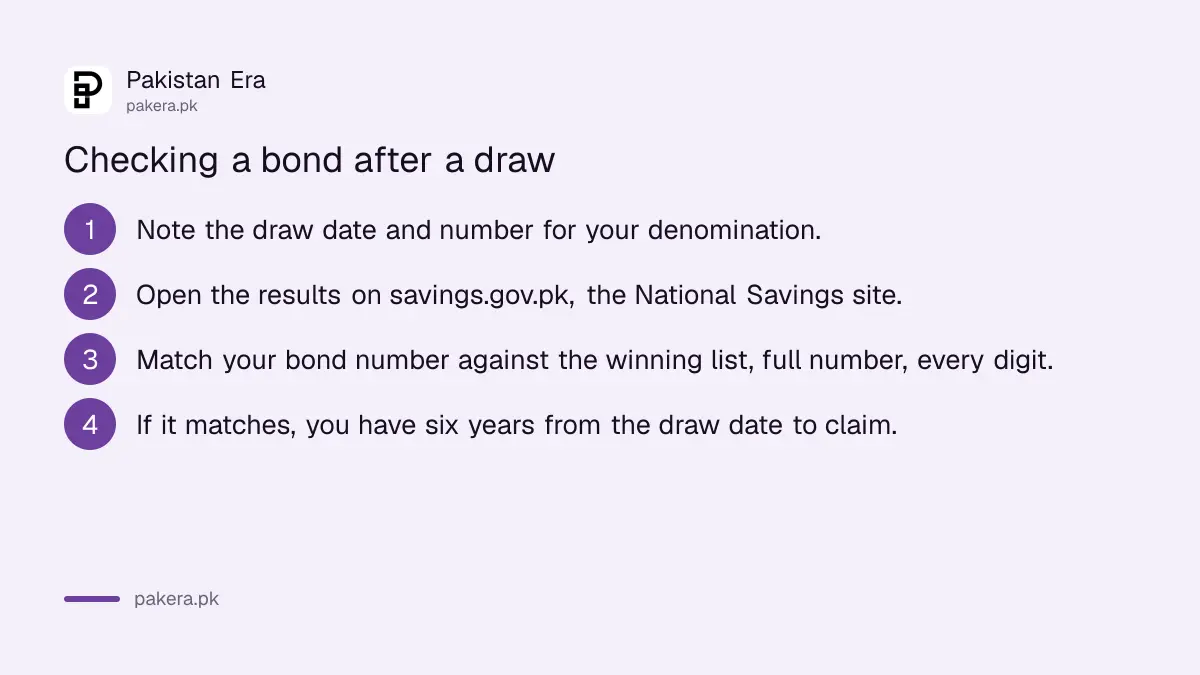
- Know your denomination and the draw date. Results are published per denomination, per draw.
- Open the official list on savings.gov.pk, the National Savings site, which publishes results after each draw. The State Bank also carries them.
- Match the full bond number. Every digit. Adjacent numbers win nothing, whatever family lore says.
- Check old draws too. You have six years, so a bond bought in 2021 has around twenty draws behind it that you may never have checked.
That last point is the practical one. If there is an envelope of old bonds in your house, the useful afternoon is checking them against the last six years of lists, because prizes do expire: six years from the draw date, and after that the money returns to the government.
Be careful where you check. The search results for prize bond queries are full of unofficial sites, and while most are harmless list mirrors, the official list is the only one worth trusting with a claim decision. This is the same advice we gave for checking SIMs on your CNIC and tracking a passport: the government's own page is the authority, everything else is a copy of it.
What the prizes are
National Savings publishes a fixed prize structure per denomination. For the two denominations drawn this month, the published first prizes are Rs 700,000 on the Rs 100 bond and Rs 3,000,000 on the Rs 1,500 bond, with second and third tiers below them reaching thousands of winners per draw. Confirm the current structure on savings.gov.pk before planning around it, since these figures are revised from time to time.
The tax, and why your filer status suddenly matters
Prize money is taxed at source, and the rate depends entirely on whether you are on the Active Taxpayer List.
| Filer | Non filer | |
|---|---|---|
| Tax withheld on prize money | 15 per cent | 30 per cent |
| On a Rs 700,000 first prize | Rs 105,000 | Rs 210,000 |
| On a Rs 3,000,000 first prize | Rs 450,000 | Rs 900,000 |
Read that middle row again. Not being a filer costs Rs 105,000 on a single Rs 100 bond win. The return that would fix it takes an evening, and the 30 September deadline is close enough that filing now puts you on the list before you would ever claim. Our guide to becoming a filer covers the process and checking your status takes one SMS.
Claiming a win
Small prizes are paid at National Savings centres and designated bank branches against the bond and your original CNIC. Larger prizes involve a claim form and processing time rather than cash across the counter, and the bond is surrendered as part of the claim.
Three practical points. Take the original CNIC, not a copy, because payment is identity checked. Do not sign or write on the bond before the counter asks you to. And if the win is large, expect the payment to arrive through a payable order or bank credit rather than notes.
Are they worth holding
An honest framing rather than a recommendation: the expected return on prize bonds is below what a savings certificate or a bank deposit pays, because most bonds never win anything. What you are buying is a capital-safe ticket with a small chance of a large outcome, and for money that would otherwise sit in a drawer as cash, that is not a bad trade. For money that should be earning, it is a poor one.
The one group for whom the arithmetic clearly works is people already holding old bonds: checking six years of draws is free, and the only losing move is the envelope staying unopened until the claims expire.
Questions readers are asking
When is the next prize bond draw?
The next Rs 100 and Rs 1,500 draws are reported for 17 August 2026. Each denomination is drawn quarterly, with these two falling in February, May, August and November.
How do I check my prize bond numbers?
Against the official lists on savings.gov.pk after each draw. Match the complete bond number for your denomination and draw, and check past draws too, since claims stay valid for six years.
Why is my new bond not in this draw?
Because of the 60 day rule. A bond bought less than 60 days before a draw enters the following quarter's draw instead.
How long do I have to claim a prize?
Six years from the draw date. After that the prize lapses and the money returns to the government.
How much tax is taken from prize bond winnings?
15 per cent if you are on the Active Taxpayer List, 30 per cent if you are not. On a Rs 3,000,000 first prize that difference is Rs 450,000, which is a strong argument for filing a return before you claim.
What is the difference between a bearer bond and a premium bond?
A bearer bond belongs to whoever holds the paper and needs no registration. A premium bond is registered against your CNIC at a bank, survives being lost, and pays a periodic profit in addition to entering draws.
About the author

Public Services and Education Journalist
Fajr Riaz is a journalist and content writer at Pakistan Era, based in Lahore. She covers the questions people meet in everyday life in Pakistan: how a public service works, what a change in the rules means, and where to find a reliable answer.