Check Whether Your Pakistan Website Breaks Google's Site Reputation Policy
Google's site reputation policy targets outside pages that borrow a site's rank. Learn the four signals Google reviews and audit your Pakistan website today.
Short answer: Google's site reputation policy targets pages written by someone else and placed on your site mainly to borrow your site's ranking strength. Pakistani sites sit outside the European Economic Area, so a manual action here hits those pages in the results Pakistani users see. Find such pages, then remove them or bring them fully under your own editing.
A Lahore news site sells a corner of its domain to a casino affiliate. A Karachi loan comparison blog lets an agency drop in "best loan apps" pages, copied word for word on ten other sites. Nobody thinks twice because the payment arrives. Then a message appears in Search Console.
We read Google's spam policies page and its policy update of 28 August 2026. We have not received a manual action ourselves, so we cannot describe the message screen.
The policy targets third-party pages that borrow your site's rank
The policy applies when third-party content sits on a host site mainly because of that host's established ranking signals. Google says the aim is for the content to rank better than it could alone. Third-party content by itself is not the problem. The purpose is.
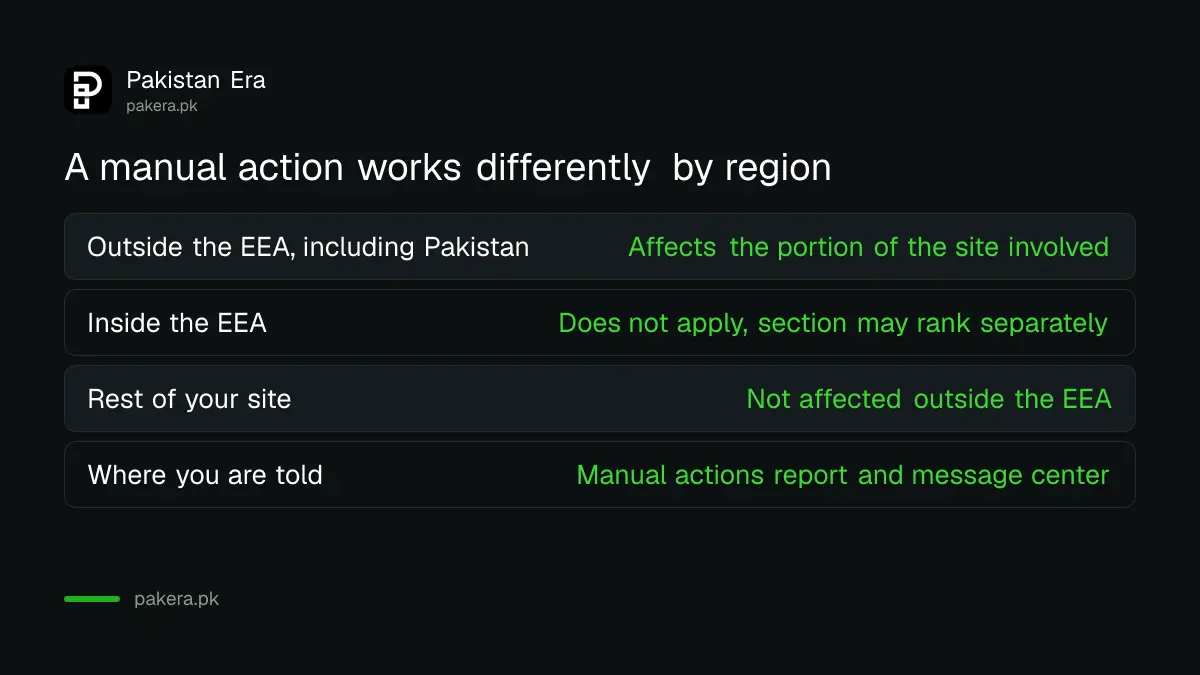
Google first introduced the policy in 2024. On 28 August 2026 it changed how a manual action works inside the European Economic Area, from 30 August 2026. That change does not soften anything for Pakistan. For users outside the EEA, a manual action directly affects search results for the part of the site involved. The rest of the site is not affected.
| Region of the searcher | What a site reputation manual action does |
|---|---|
| Outside the EEA, including Pakistan | Affects results for the portion of the site involved. The rest of the site is not affected. |
| Inside the EEA | The action does not apply. The section may be separated so it ranks on its own over time. |
Some third-party content is allowed under the policy
Google lists several kinds of outside content that do not break the policy. These include wire and press release services, syndicated news, forums and comment sections, editorial columns, and advertorial pages that share content directly with readers. Affiliate links and ad units are also fine when handled properly.
The examples Google gives of a violation are specific. One is an educational site hosting sponsored payday loan reviews written by a third party who spreads the same page across many sites. Another is a medical site hosting a low-quality "best casinos" page that is not integrated with the site.
So a guest column you edited is safe. A page you never read, placed there so a partner can rank, is not. Google also notes that these examples are not a full list.
Google reviews four signals to judge whether a page is integrated
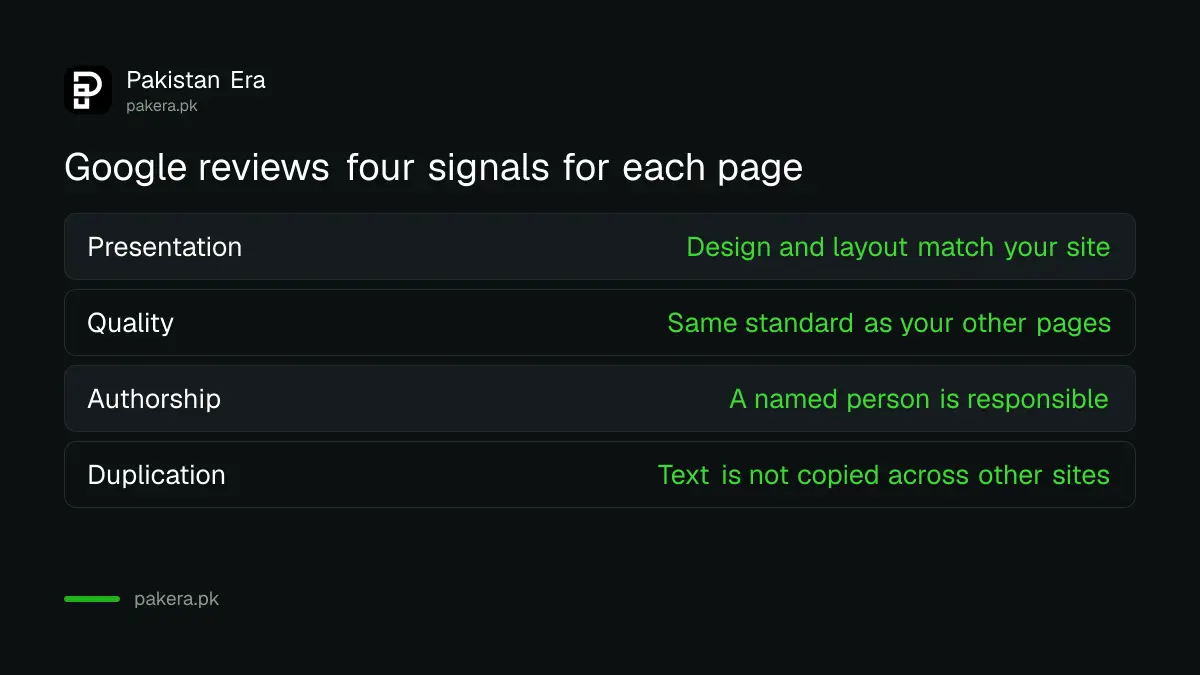
When a human review happens, Google asks whether the host site had enough input, editorial oversight or contribution to treat the content as fully integrated. It looks at presentation, quality, authorship and whether the same content appears on other sites. No single signal decides the case.
| Signal Google reviews | What to ask about your page |
|---|---|
| Presentation | Do the design, formatting and layout match the rest of your site? |
| Quality | Is the quality lower than your normal pages? |
| Authorship | Does the page name who is responsible for it? |
| Duplication | Does the same or near-identical text sit on other sites? |
Google also gives worked examples. A coupons section built with a partner, linked from the home page, with a named editorial owner and a contact point, is unlikely to draw action. An unauthored affiliate article with no link from the main sections, copied from another seller, is likely to.
Audit your own site in six steps
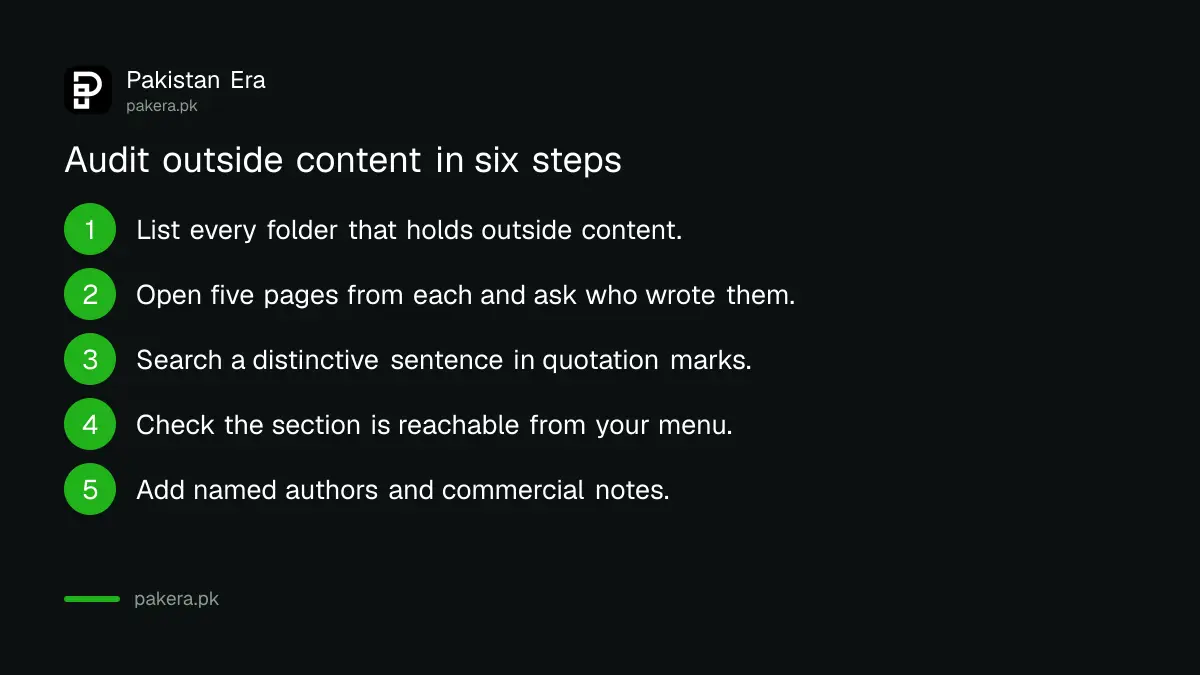
List every section or page on your domain that someone else supplies, then test each against the four signals. Start with anything that is paid, affiliate, loan, betting or health related, because Google's own examples sit in those areas. Do this before Google does.
- Open your sitemap and list every folder or subdomain that holds outside content: coupons, loans, casinos, "partner" pages and agency articles.
- Open five pages from each folder. Ask who wrote them, a person or an AI tool, and whether you would stand behind them.
- Paste a distinctive sentence from each page into Google in quotation marks. If other sites carry the same text, mark the page.
- Check whether the section can be reached from your menu or home page. A page that only exists to rank, with no route to it, is a warning sign.
- Add a named author or editor, a note that the content is commercial where it is, and a way for readers to report problems.
- Remove any page that still has no editorial input from you. Pages you keep should be ones you would defend to a reader.
Treat this as housekeeping, not a rescue. Google says it generally presumes new pages match the quality of the rest of the domain. That presumption helps you only if the pages really do.
Check Search Console for a manual action and respond if you get one
Google says it notifies owners in the Manual actions report and in the Search Console message center. Open both. If you have a notice, fix the pages, then submit a reconsideration request. Eligible sites can then also take a dispute to mediation.
The steps for the request are in fixing a Google manual action with a reconsideration request. If you would rather check the wider picture first, Google's latest spam update is covered in the September 2026 spam update site check.
One more point from Google's FAQ: a manual action taken outside the EEA does not affect how the same content ranks inside the EEA. For a Pakistani site that wants European visitors, that is a small comfort, not a plan.
Common questions
Does this policy ban guest posts on my Pakistani site?
No. Google says third-party content alone does not break the policy. It breaks it when the content is hosted mainly to use your site's ranking strength.
Will a manual action hurt my whole website?
Not under this policy outside the EEA. Google says it affects results for the portion of the site involved, and the rest of the site is not affected.
Are affiliate links on my pages a violation?
No. Google lists affiliate links used throughout a page, with links treated appropriately, as not inconsistent with the policy.
How will I know if I have a manual action?
Google says it notifies site owners in the Manual actions report and the Search Console message center. Check both.
Can I appeal if Google got it wrong?
Yes. You can send a reconsideration request, and eligible sites can then bring a dispute to mediation, according to Google.
Does a user comment section count as third-party content?
It can, but Google lists sites designed to allow user-generated content, such as forums and comments, as not inconsistent with the policy.
How we verified this
What we checked, where we read it, and what we could not confirm.
Last checked on Sunday 11 October 2026. We read the Google Search spam policies page, including the site reputation policy section and FAQ, and the Search Central policy update of 28 August 2026. We could not test a live manual action, so the notice screens are described only as Google states them. Policy text can change.
About the author

Founder and Editor
Umer Kureshi founded Pakistan Era in July 2024 and runs it as administrator, SEO lead and writer, overseeing website operations, search growth, content strategy and coverage of technology and current affairs.