Check Your Mobile Network Against the Speed Targets in Pakistan's 5G Licences: 20 Mbps on 4G, 50 on 5G
What PTA's 5G licences promise: median 20 Mbps on 4G and 50 Mbps on 5G in two years, rising to 50 and 100 by year nine, plus latency and how to test your speed.
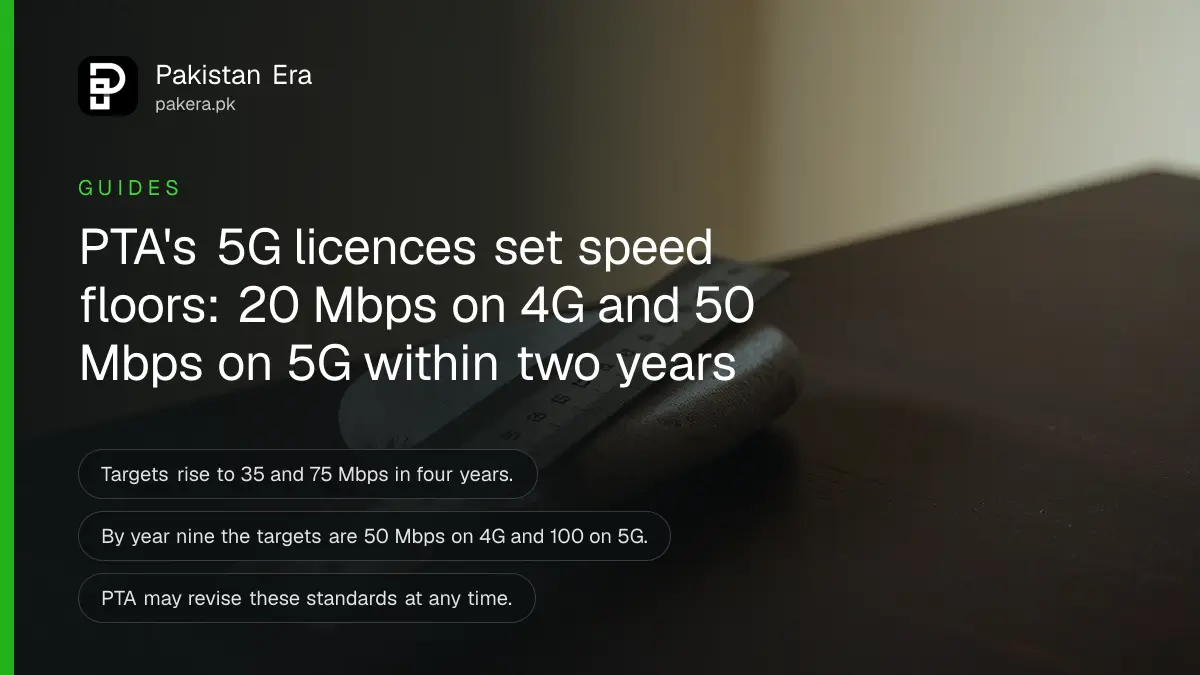
Short answer: The 5G spectrum licences that PTA granted in March 2026 set a speed floor. Within two years of the licence start date, an operator must reach a median download speed of 20 Mbps on 4G and 50 Mbps on 5G. The targets rise to 35 and 75 Mbps in four years, and to 50 and 100 Mbps in nine.
Most people never see these numbers, because they sit in a licence template, not in a customer contract. They matter because they are what PTA will measure operators against. If your 4G today is slower than 20 Mbps, you now know the yardstick for your complaint.
We read PTA's Information Memorandum for the 2026 spectrum auction (9 January 2026), PTA's notice of changes to it (13 February 2026) and the licence template attached to that notice, on PTA's website on 13 October 2026. This page explains the speed and quality targets. We did not see each operator's signed licence.
Three speed steps apply over nine years
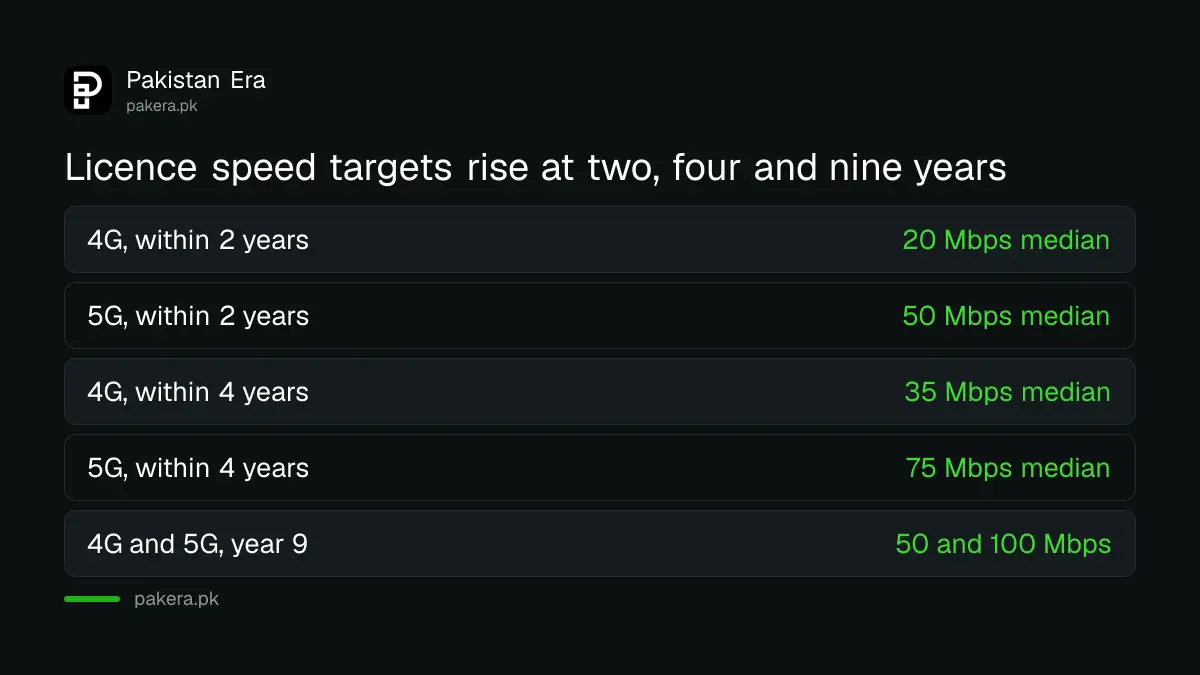
Each licence has three speed targets, all measured as a median, the middle value of many tests. They are counted from the licence effective date: two years, four years and nine years. The 4G target goes from 20 to 35 to 50 Mbps. The 5G target goes from 50 to 75 to 100 Mbps.
| Time from licence effective date | 4G median download | 5G median download | Upload |
|---|---|---|---|
| Within 2 years | 20 Mbps | 50 Mbps | At least 20% of download |
| Within 4 years | 35 Mbps | 75 Mbps | At least 20% of download |
| Within 9 years | 50 Mbps | 100 Mbps | At least 20% of download |
PTA's page for the auction shows licences were granted on 19 March 2026. We did not see the exact effective date in each licence, so the first step falls due around 2028.
The February 2026 notice changed the first draft in two ways. The speeds were first written as a "minimum", and the notice changed them to a "median". The upload share was changed from 25 percent to 20 percent of the download speed.
Other quality targets cover signal, delay and page loading
The licence template also sets targets for signal strength, latency and web page loading. A minimum outdoor signal of minus 100 dBm must be reached with 90 percent confidence. For 4G, latency is 75 milliseconds and a web page must load in 5 seconds.
For 5G the targets are tighter and also improve over time. Latency (round trip delay) must be 50 ms in 2026 to 2028, 40 ms in 2028 to 2030 and 35 ms in 2030 to 2032. A web page must load in 5, 4 and 3 seconds in the same periods. Video quality must score 3 on average, jitter must be 30 ms or less and packet loss 1 percent or less.
The speed target is measured at random locations under PTA's quality of service verification method. For 5G, the tests are done at random places inside the operator's claimed coverage area. The licence also says the operator must not give priority to test traffic in surveyed areas, to keep the test fair.
PTA reserves the right to revise these targets at any time, and operators must follow any future rules it makes.
Where today's speeds stand against the targets
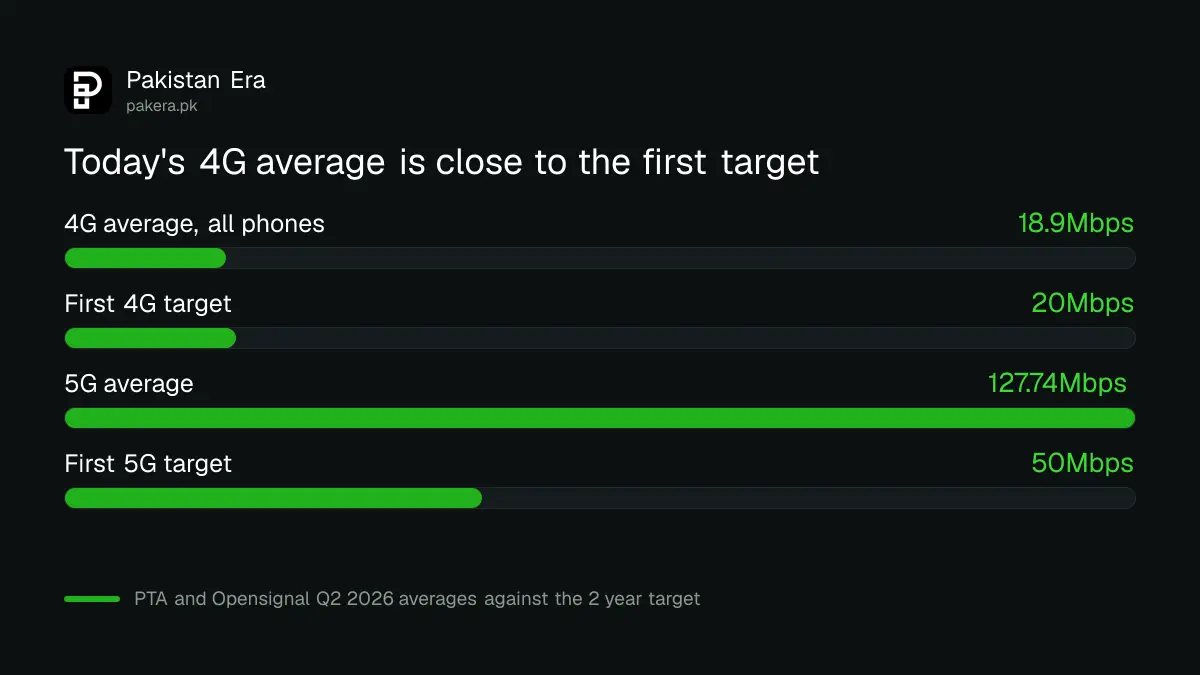
PTA's Q2 2026 benchmarking report put the national 4G average at 18.9 Mbps for all phones and 31.3 Mbps for high end phones. That is near the first 20 Mbps step. But it is an average from crowd data, not PTA's median test, so the two cannot be compared directly.
By operator, the same report showed Zong at 18.55 Mbps, Jazz at 17.61, Ufone at 12.82 and Telenor at 7.5. The gap between the top two and Telenor is wide. Only operators that hold the new licences are bound by these targets, and we did not check which of the four that is for each step.
On 5G, the report found an average download of 127.74 Mbps, well above the 50 Mbps step, but users were on 5G for only 3.95 percent of the time. PTA calls those results indicative only, because 5G is early. For where the signal is, see 5G coverage in Pakistan.
Test your own network and keep the evidence
You cannot enforce the licence yourself, but you can bring PTA a record of slow service. A clean record of tests at the same place and time, over several days, makes a complaint stronger than one screenshot.
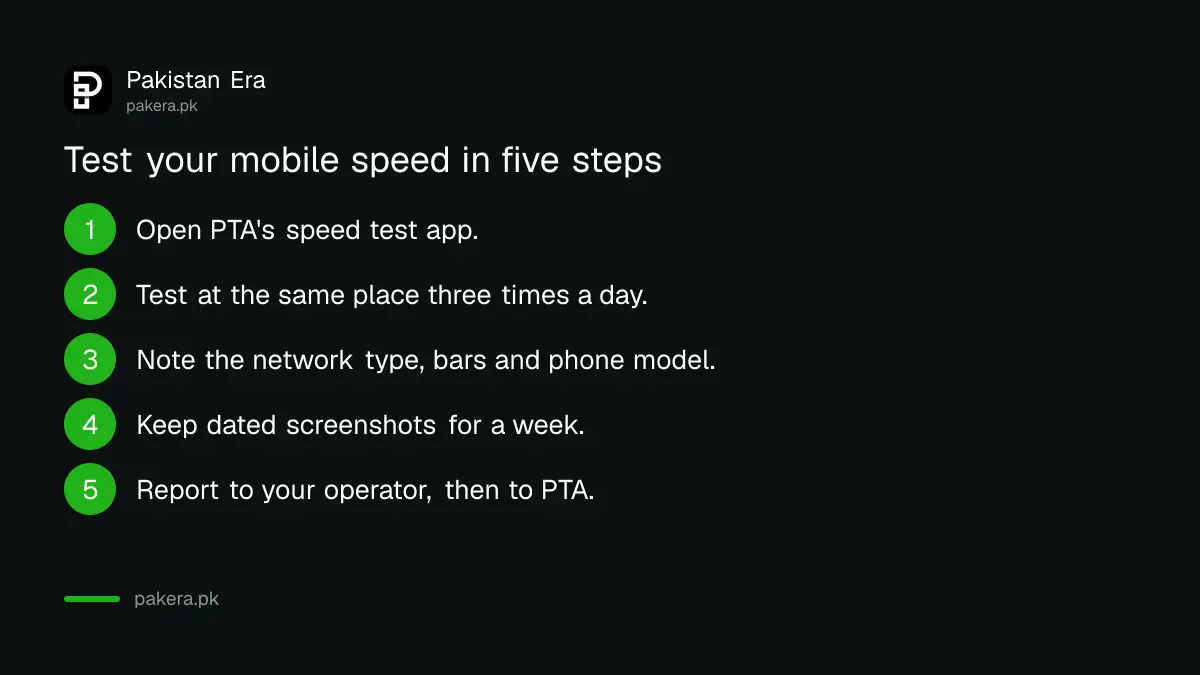
- Use PTA's own speed test, explained in our page on the PTA speed test app.
- Test at the same place at three times of the day: morning, afternoon and evening.
- Test on 4G and, if you have it, 5G, and note the signal bars and the phone model.
- Keep screenshots with the date, time and place for at least a week.
- Report the pattern to your operator first, then to PTA using the steps in the PTA telecom complaint guide.
Operators that advertise 5G must also publish a 5G coverage map with clear boundaries on their websites, in addition to existing maps, under the auction memorandum. If an operator sells 5G in your area but the map does not show it, tell PTA.
Know what else the licences require
Each licence runs for 15 years and can be renewed on the terms in force at that time. The operator must build at least 1,000 sites a year in each rollout phase, and at least 200 of them must be at completely new places. Its share of sites linked by fibre must grow from 20 to 35 percent.
In Phase 1, the operator must bring 5G to Islamabad and Rawalpindi, Karachi, Lahore, Peshawar and Quetta. We cover the tower side in PTA's 5G rollout orders.
Common questions
What speed must operators reach under the 5G licences?
A median download of 20 Mbps on 4G and 50 Mbps on 5G within two years of the licence effective date. Later steps are 35 and 75 Mbps after four years, then 50 and 100 Mbps after nine.
Does this mean my 4G will be 20 Mbps in 2028?
Not for every user. The target is a median measured at random places under PTA's method. Your own speed depends on where you are, your phone and the crowd on the tower.
Which operators hold these licences?
PTA's auction page says three applications were received and licences were granted on 19 March 2026. We did not read the signed licences, so we do not name each operator's terms here.
Can I sue an operator if it misses the target?
We have not verified any right for a customer to enforce the licence. The practical route is to complain to your operator and then to PTA with test records.
Are the targets final?
The template says PTA may revise the standards at any time. We read the version attached to PTA's notice of 13 February 2026.
Does 5G need a new SIM?
Check our page on whether you need a new SIM for 5G. It depends on your operator and phone.
How we verified this
What we checked, where we read it, and what we could not confirm.
Last checked on 13 October 2026, Pakistan time. We read PTA's Information Memorandum for the 2026 spectrum auction, the notification of changes of 13 February 2026 with the licence template, and PTA's benchmarking report for Q2 2026. We did not see the licences as signed, or any later amendment.
About the author

Technology Journalist & Multimedia Producer
Ahmad Ali is a technology journalist and multimedia producer at Pakistan Era, joining the team in October 2026. He covers consumer technology and digital life for Pakistani readers, combining research with hands-on product testing.