Grounds for a Wife to Seek Divorce in Pakistan: 11 Grounds in the 1939 Act
The 1939 Act lists 11 grounds a Pakistani wife can use for a court divorce, from a missing husband to cruelty. See the conditions, Rs 15 court fee and dower.
The Dissolution of Muslim Marriages Act, 1939 lists 11 grounds on which a Muslim wife in Pakistan can ask a court for a decree ending her marriage. They include a husband missing for four years, no maintenance for two years, a prison term of seven years or more, and cruelty.
Many women hear only one word for ending a marriage in court: khula. It is not the only door. The 1939 Act, which extends to the whole of Pakistan, gives a wife a list of grounds that do not depend on the husband's consent. We read the Act on the Pakistan Code website on 15 October 2026, and the Family Courts Act beside it. This is general information, not legal advice, and a lawyer should check how a court is likely to treat your facts.
Section 2 of the 1939 Act lists 11 grounds for a decree
Section 2 says a woman married under Muslim law is entitled to a decree on any listed ground. They run from a husband whose whereabouts are unknown to cruelty, and the last item covers any other ground valid under Muslim law.
| Ground | What the Act says |
|---|---|
| (i) Whereabouts unknown | Not known for four years |
| (ii) No maintenance | Neglected or failed to provide for two years |
| (iia) Additional wife | Taken in contravention of the Muslim Family Laws Ordinance, 1961 |
| (iii) Imprisonment | Sentenced to seven years or upwards |
| (iv) Marital obligations | Failed to perform them without reasonable cause for three years |
| (v) Impotence | Impotent at the time of marriage and still so |
| (vi) Illness | Insane for two years, or leprosy, or a virulent venereal disease |
| (vii) Repudiation of a child marriage | Given in marriage before the age stated, repudiated before 18, not consummated |
| (viia) Lian | Husband accused her of zina and she does not accept it as true |
| (viii) Cruelty | Six forms listed in the Act |
| (ix) Any other valid ground | Any ground recognised under Muslim law |
The text on the Pakistan Code says the repudiated marriage must have been given before the age of sixteen. Marriage age laws have since moved in some places, and the marriage age in Punjab is now 18. Ask your lawyer which age applies to you.
Three grounds carry conditions that can delay or defeat a decree
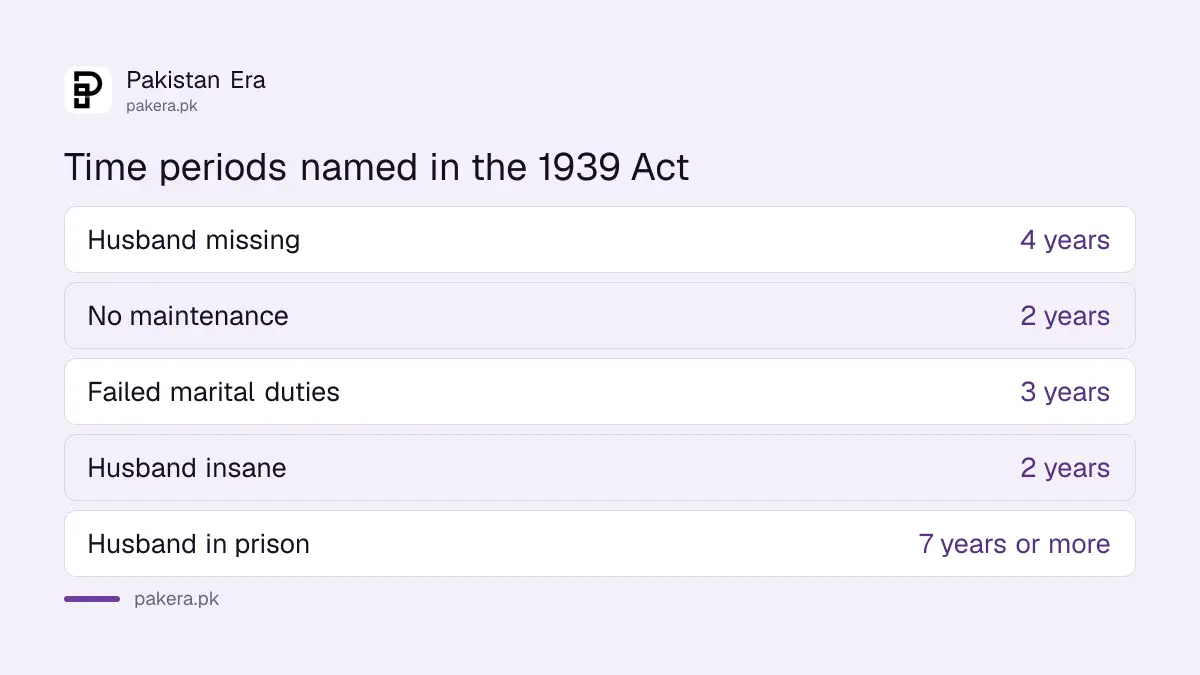
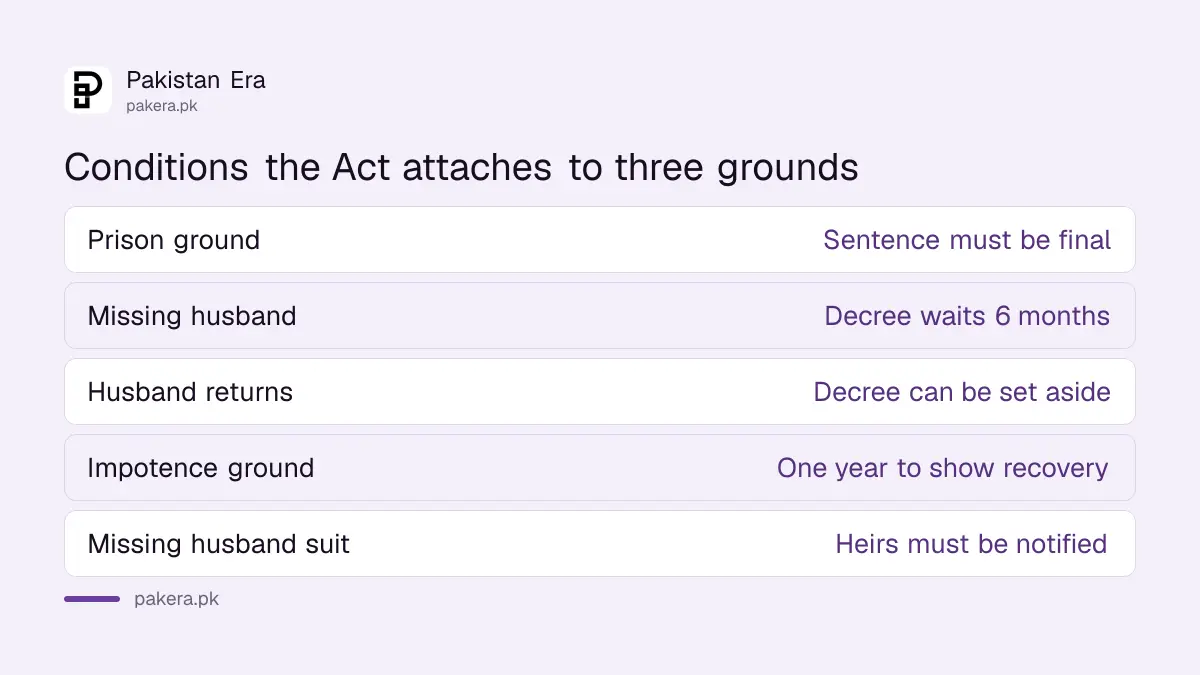
The Act adds provisos to three grounds. A decree on the prison ground waits until the sentence is final. A decree on the missing husband ground takes effect only after six months. On impotence, the husband can apply for a year to show recovery.
On the missing husband ground, if the husband appears within the six months, in person or through an authorised agent, and satisfies the court that he is ready to perform his conjugal duties, the court shall set the decree aside. The Act also requires the plaint to name the people who would have been his heirs, and notice must go to them. Section 3 says his paternal uncle and brother must be made parties even if they are not heirs.
Cruelty covers more than physical harm
The Act defines cruelty in six parts. They include habitual assault or making her life miserable by conduct even without physical ill-treatment, forcing her to lead an immoral life, disposing of her property or blocking her legal rights over it, and obstructing her religious practice.
The other two parts are the husband associating with women of evil repute or leading an infamous life, and, where he has more than one wife, not treating them equitably in line with the Quran. Courts decide on evidence, so keep records: messages, medical papers, witness names and anything that shows dates. If you are in danger today, the steps in how to get a protection order against violence in Punjab deal with immediate safety.
A decree on grounds is not the same as khula
With a ground proved, the wife asks the court to dissolve the marriage because of the husband's conduct or condition. Khula is a request by the wife without proving fault. The Family Courts Act links the return of Haq Mehr to khula decrees.
Section 10 of the Family Courts Act, in its proviso, says that if reconciliation fails the court shall pass the decree forthwith and restore the Haq Mehr to the husband, and Section 9(1b) ties that proviso to khula. Because the Act's wording does not spell out its use for fault-based decrees, ask a lawyer how it applies to your ground. The method for the no-fault route is in the khula guide.
File in the Family Court and claim everything in one plaint
The Family Courts Act lets a plaint for dissolution of marriage include all claims about dowry, maintenance, dower, the wife's personal property and belongings, custody of children and visitation rights. It sets a court fee of Rs 15 and a six month target to decide.
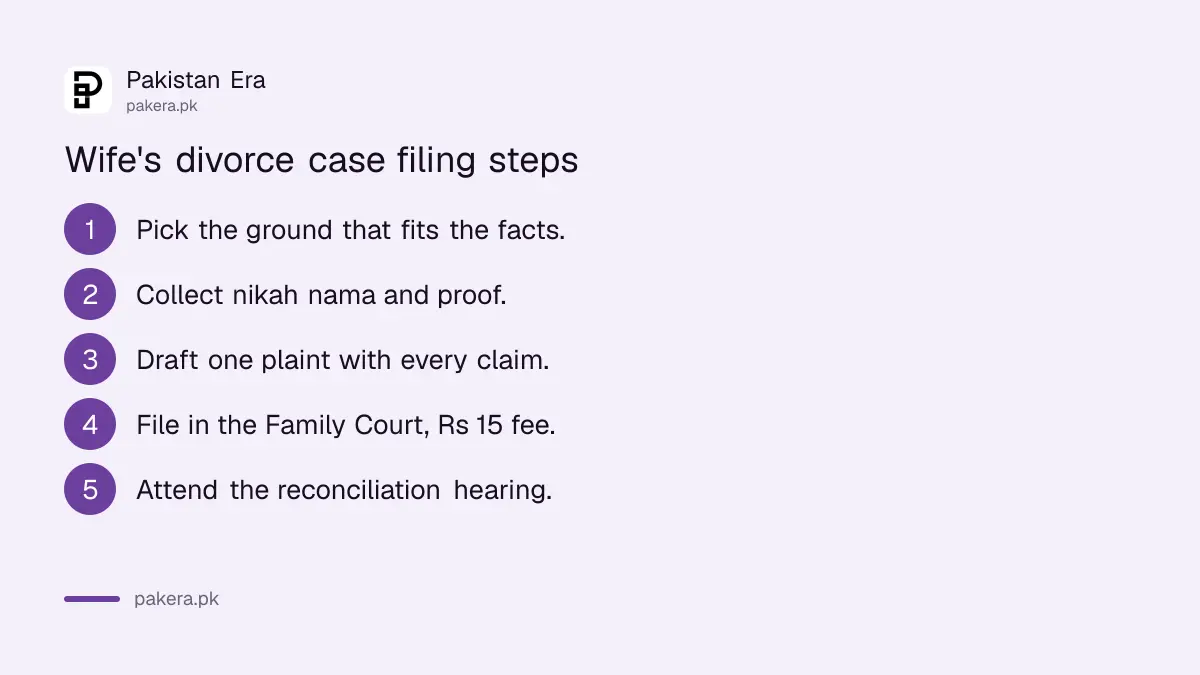
- Pick the ground that fits your facts and gather proof for each fact.
- Collect the nikah nama, CNICs, and any papers on maintenance, imprisonment or the husband's absence.
- Ask a lawyer to draft one plaint covering dissolution and every related claim.
- File it in the Family Court and pay the Rs 15 court fee stated in the Act.
- Attend the pretrial hearing, where the court first tries reconciliation.
- Keep a certified copy of the decree.
Related claims have their own guides, such as claiming maintenance in a Punjab Family Court, recovering Haq Mehr and dowry and child custody and guardianship. After the decree, getting a NADRA divorce certificate updates the record.
The wife's dower rights stay protected
Section 5 of the 1939 Act says nothing in it affects any right a married woman has under Muslim law to her dower, or any part of it, on dissolution of her marriage. A decree on a ground does not cancel the dower claim.
Section 4 adds that renunciation of Islam by a married Muslim woman does not by itself dissolve her marriage, but she may then seek a decree on the Section 2 grounds. Keep the nikah nama safe, because the dower amount is written in it.
Common questions about grounds for divorce for a wife
Can a wife get a divorce without the husband's consent?
Yes. A court can pass a decree on any Section 2 ground, or on khula, even if the husband does not agree.
How long must a husband be missing?
Four years. Even then, the decree does not take effect for six months, and it can be set aside if he returns.
How long without maintenance gives a ground?
Two years of neglect or failure to provide for the wife.
Does the husband's second marriage give a ground?
Yes, ground (iia), if he took an additional wife in contravention of the Muslim Family Laws Ordinance, 1961.
What does a Family Court charge?
The Family Courts Act sets a court fee of Rs 15 on a plaint. Lawyer fees are separate.
Does the wife lose her dower?
No. Section 5 says her right to dower is not affected by a dissolution under the Act.
How we verified this
What we checked, where we read it, and what we could not confirm.
Last checked 15 October 2026. We read the text of the Dissolution of Muslim Marriages Act, 1939 and the West Pakistan Family Courts Act, 1964 on the Pakistan Code website. The Act's PDF is dated 29 May 2024, so later amendments may exist. We did not file a case, and courts decide each case on its facts.
About the author

Senior Writer, Public Services and Technology
Shahid joined us in 2024 as an author. He is a senior contributor to Pakistan's leading technology websites. He writes detailed articles, mostly covering his expertise in the latest tech, mobiles, apps, gadgets, and step-by-step guides. His ideology is to help people understand the latest trends and explain complex methods through very easy-to-understand guides.