The Marriage Age in Punjab Is Now 18 for Everyone
The Punjab Child Marriage Restraint Act 2026 came into force on 11 May and repealed the 1929 law, which set a lower age for girls.
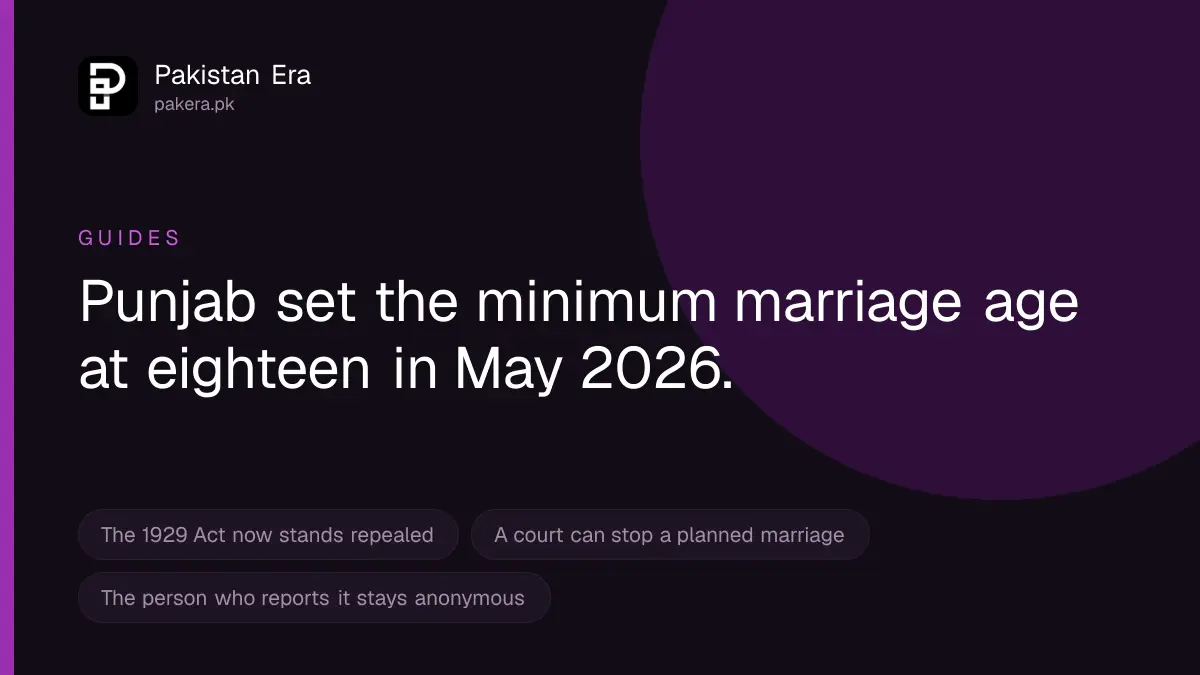
The minimum age for marriage in Punjab is now eighteen for both men and women. The Punjab Child Marriage Restraint Act 2026 came into force on 11 May 2026 and repealed the Child Marriage Restraint Act 1929, which had set a lower age for girls.
A Nikah registrar who registers a child marriage commits an offence. So does a guardian who permits one, or who negligently fails to prevent it.
We read the Act on 6 September 2026 in the text published by the Law and Parliamentary Affairs Department, Government of the Punjab.
What the Act sets
| Person | Punishment in the Act |
|---|---|
| Nikah registrar who registers it | Up to one year simple imprisonment, fine one hundred thousand rupees |
| Adult who marries a child | Two to three years rigorous imprisonment, fine up to five hundred thousand rupees |
| Guardian who permits or fails to prevent | Two to three years rigorous imprisonment, fine up to five hundred thousand rupees |
| Cohabitation before eighteen | Five to seven years, fine not less than one million rupees |
| Taking a child out of Punjab to evade the Act | Five to seven years, fine up to one million rupees |
| Disobeying a court injunction | Up to one year or one hundred thousand rupees or both |
A child is defined as a person, male or female, under eighteen years of age. Child marriage means an act of Nikah or solemnising a marriage where either or both of the contracting parties is a child.
A marriage can be stopped before it happens
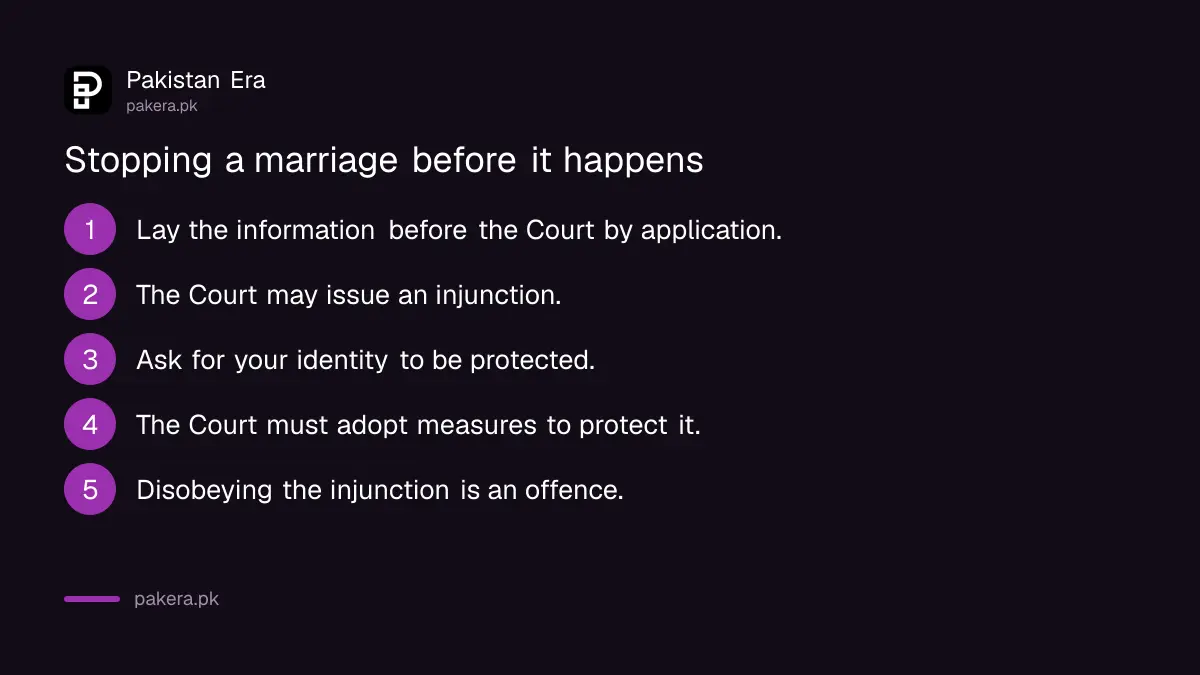
This is the part of the Act that can actually protect a child, and it works before the Nikah rather than after it.
Section 9 says the Court may, if satisfied by information laid before it through an application that a child marriage is going to be arranged, issue an injunction.
Then comes the proviso that makes it usable. Where the person who laid the information asks for their identity to be kept hidden from the contracting parties, or from a parent or guardian of a contracting party, or from the other parent, the Court shall adopt appropriate measures to protect that person's identity.
So a relative, a teacher or a neighbour can report a planned marriage and ask the Court to protect who they are.
The Court must normally give notice to the person the injunction is against and let them show cause, but it may dispense with that notice if it deems it necessary. Disobeying an injunction, knowing it was issued, carries up to one year or a fine up to one hundred thousand rupees or both.
Cohabitation is treated as child abuse
Section 5 states it plainly. Any form of cohabitation before the age of eighteen, with or without consent, resulting from a child marriage is child abuse under the Act.
Anyone who induces, forces, persuades, entices or coerces a child bride or child groom into that, or commits it, faces five to seven years and a fine of not less than one million rupees.
The words with or without consent are doing deliberate work. Consent is not a defence, because the Act treats a person under eighteen as unable to give it for this purpose.
Moving a child out of Punjab is trafficking
Section 6 anticipates the obvious way around a provincial law.
Anyone who induces, forces, persuades, entices, compels or coerces a child to leave, or takes a child beyond the territorial boundary of the Punjab, for the purpose of defeating or evading the Act for a child marriage, commits the offence of child trafficking. That carries five to seven years and a fine up to one million rupees.
Recruiting, harbouring, transporting, providing or obtaining a child for that purpose is a separate offence carrying up to three years and a fine up to five hundred thousand rupees.
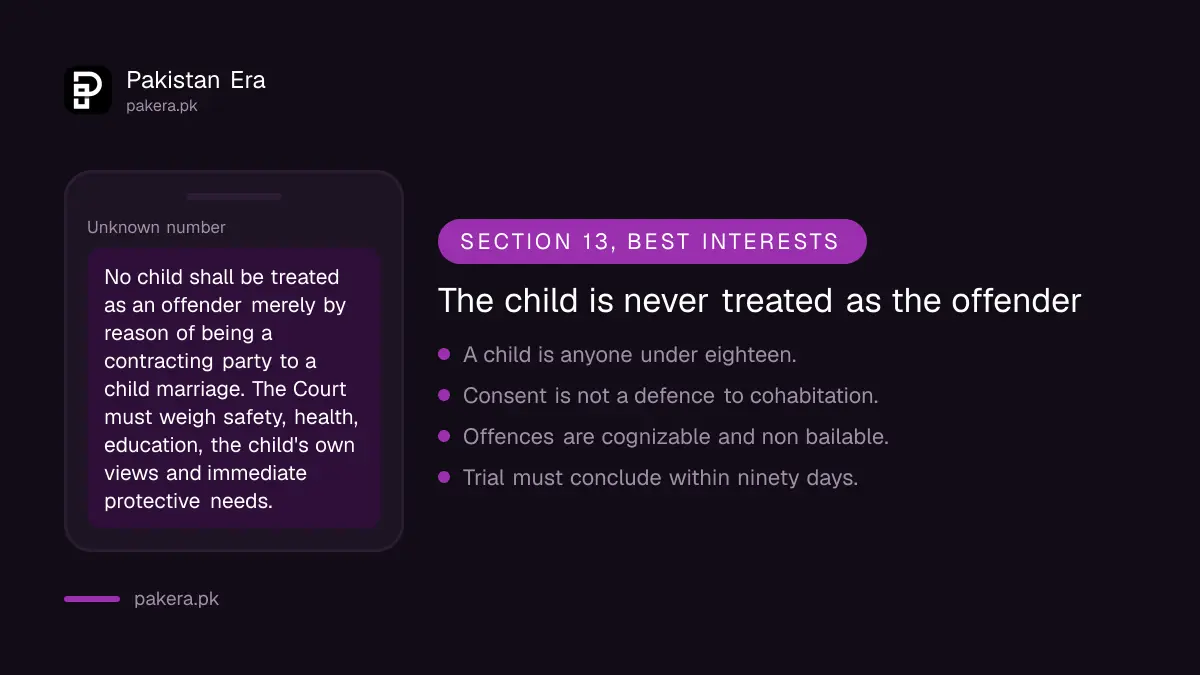
The child is not the offender
Section 13 requires the best interests of the child to be a primary consideration in every action under the Act, including prevention, investigation, prosecution, bail, sentencing and protective injunctions.
The Court is directed to consider the child's safety and protection from violence, intimidation, retaliation and social stigma. Physical and mental health, including risks arising from cohabitation or pregnancy. The right to education and development. The child's own views, having regard to age and evolving capacities. And immediate protective needs, including safe shelter and supervised custody where required.
Subsection 3 then says it directly. No child shall be treated as an offender merely by reason of being a contracting party to a child marriage.
How a case runs
- Only the Court of Sessions may take cognizance of or try an offence under the Act.
- Offences are cognizable, non bailable and non compoundable.
- The Court must conclude the trial within ninety days of taking cognizance.
- An injunction application can be made before any marriage takes place.
- The Government may prescribe child friendly procedures for recording a child's statement.
Non compoundable means the case cannot be settled between the families and withdrawn, which is what usually ended these matters under the old law.
Our guide to registering a Nikah covers the registration process, our guide to getting a NADRA marriage certificate covers the document that follows, and our guide to child custody in the family court covers a related family law route.
Common questions
What is the legal marriage age in Punjab now?
Eighteen, for both male and female. The Act defines a child as a person under eighteen years of age.
When did this start?
The Act was assented to and published in the Punjab Gazette on 11 May 2026 and came into force at once.
What happened to the 1929 law?
Section 15 repeals the Child Marriage Restraint Act 1929 and the Punjab Child Marriage Restraint Ordinance 2026, saving orders already made.
Can a planned marriage be stopped?
Yes. The Court may issue an injunction, and may protect the identity of the person who reported it.
Is the child punished?
No. No child is to be treated as an offender merely for being a contracting party to a child marriage.
Can the case be withdrawn by agreement?
No. Offences under the Act are non compoundable, as well as cognizable and non bailable.
How we verified this
What we checked, where we read it, and what we could not confirm.
Last checked 6 September 2026. We downloaded the Punjab Child Marriage Restraint Act 2026 from the Punjab Code portal at punjablaws.punjab.gov.pk, in the text published by the Law and Parliamentary Affairs Department, Government of the Punjab, and read it. The Act was passed by the Provincial Assembly of the Punjab on 27 April 2026, assented to by the Governor on 11 May 2026, and published in the Punjab Gazette (Extraordinary) dated 11 May 2026. The definition of a child as a person, male or female, under eighteen years of age and of child marriage as a Nikah or solemnisation where either or both contracting parties is a child; section 3 barring a Nikah registrar from registering a child marriage and setting up to one year simple imprisonment with a fine of one hundred thousand rupees; section 4 setting two to three years rigorous imprisonment and a fine up to five hundred thousand rupees for an adult who marries a child; section 5 treating cohabitation before eighteen resulting from a child marriage as child abuse with five to seven years and a fine of not less than one million rupees; section 6 on child trafficking; section 7 on a guardian who promotes, permits or negligently fails to prevent a child marriage; section 8 restricting cognizance to the Court of Sessions; section 9 on injunctions and protection of the informant's identity, with up to one year or a fine up to one hundred thousand rupees for disobedience; section 10 making offences cognizable, non bailable and non compoundable; section 11 requiring the trial to conclude within ninety days; section 13 on the best interests of the child and the direction that no child be treated as an offender merely for being a contracting party; and section 15 repealing the Child Marriage Restraint Act 1929 and the Punjab Child Marriage Restraint Ordinance 2026, are all taken from that text. This is the Punjab Act and applies in the Punjab. Other provinces have their own law on the subject, so check the one that applies where you live. Nothing here is legal advice.
About the author

Public Services and Education Journalist
Fajr Riaz is a journalist and content writer at Pakistan Era, based in Lahore. She covers the questions people meet in everyday life in Pakistan: how a public service works, what a change in the rules means, and where to find a reliable answer.