Anthropic's New Claude Usage Policy Starts 12 November 2026: What Pakistani Businesses Must Check
Anthropic's new Claude Usage Policy starts 12 November 2026. See the six changes, the human review rule for hiring, credit and health uses, and a 5 step check.
Short answer: Anthropic's new Usage Policy takes effect on 12 November 2026. It adds rules on deceptive campaigns, elections, weapons, surveillance and machines. For health, money, legal and hiring uses of Claude, a qualified person must review the AI's advice, and affected people must be told AI was involved.
A Karachi lending startup uses Claude to draft loan notes. An HR team in Lahore uses it to rank job applicants. Both are what the policy calls high-risk uses. Anthropic announced the update on 8 October 2026, and it gives users until 12 November to adjust.
We read Anthropic's announcement and the policy page itself on 13 October 2026. This guide covers what they say. It is not legal advice. If your business relies on Claude, read the full policy once.
The new policy starts on 12 November 2026
Anthropic's announcement and its policy page both give 12 November 2026 as the effective date. The policy applies to all users, including developers, businesses and API customers. Most of the changes clarify older rules, according to the announcement.
The policy has three parts. Universal Usage Standards are prohibitions for everyone. High-risk Use Case Requirements cover sensitive fields. Additional Use Case Guidelines cover contexts such as chatbots and minors.
Anthropic's Safeguards Team monitors compliance. The policy says it may suspend access for violations. A business that builds on Claude should treat the date as a deadline for its own checks.
Six areas changed or were added
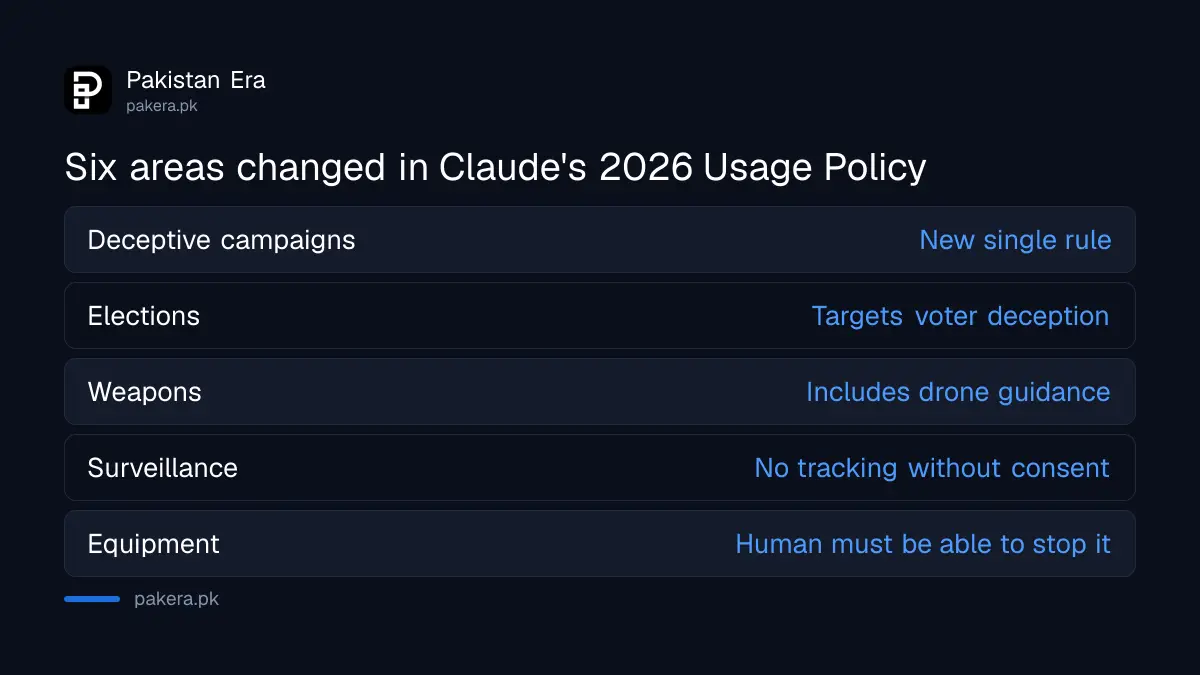
Anthropic lists six changes: a new section on deceptive campaigns, revised election rules, wider weapons rules, tighter surveillance limits, a rule about equipment that can cause injury, and a rule against extreme abuse of the model. The table below sums each one in plain words.
| Area | What Anthropic says |
|---|---|
| Deceptive campaigns | One rule against deceptive activity, political or commercial, including fake accounts and fabricated news sites |
| Elections | Focus on stopping voter deception, and allows civic work such as multilingual voter information |
| Weapons | Also covers software and components that make weapons work, including drone guidance systems |
| Surveillance | No tracking individuals without consent, no law enforcement advice on arrests or charges |
| Equipment | A qualified operator must be able to watch the equipment and stop it |
| Abuse of the model | Bans sustained and needless cruel behaviour in extreme cases |
The deceptive campaigns rule matters to marketers. Fake reviews, fake accounts and made-up news sites would break it. The guide on removing fake or paid reviews shows why such tricks also hurt you with Google.
High-risk uses need a human reviewer and a disclosure
For medical advice, legal counsel, financial recommendations, employment decisions and credit approval, the policy says a qualified person must meaningfully review a high-risk AI recommendation. It also requires clear disclosure to affected people that AI was involved.
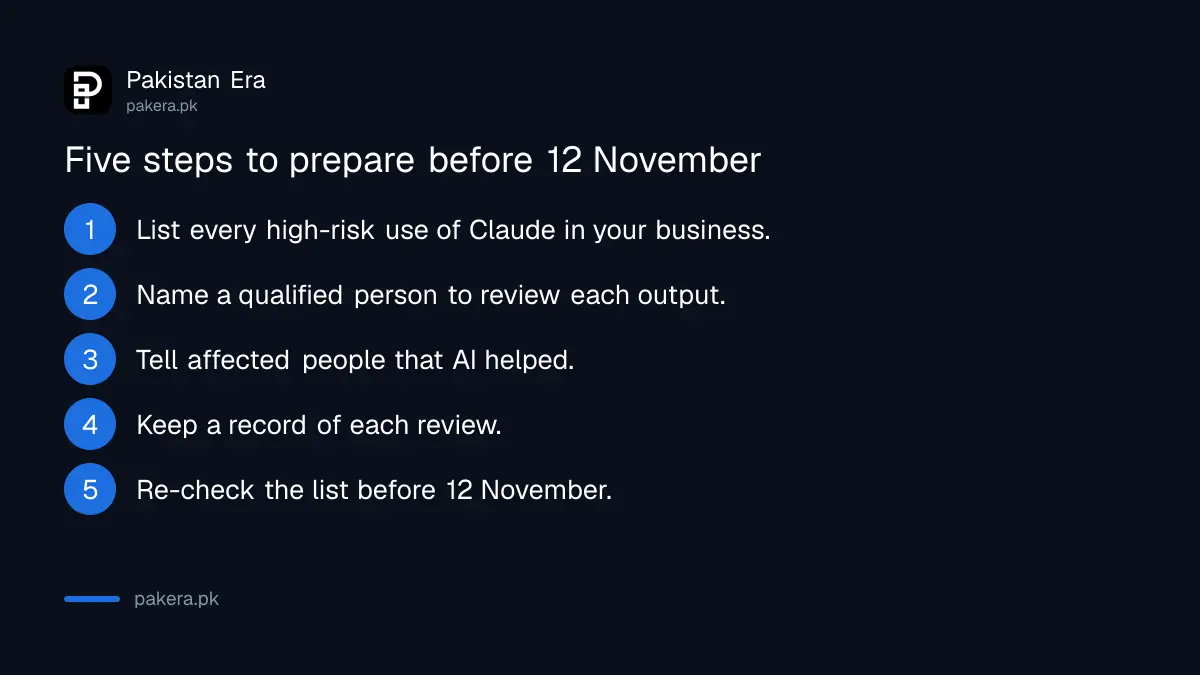
- List every place your business uses Claude for advice about health, money, law, hiring or credit.
- Name a qualified person who reviews each AI output before it reaches a customer or applicant.
- Add a line telling affected people that AI helped prepare the decision.
- Keep a record of who reviewed what and when.
- Re-check the list before 12 November.
The policy does not ban these industries. Anthropic says its restrictions do not categorically prohibit use by any particular industry or line of business, so long as you comply. A human check is the price of using AI in high-stakes work.
Check how your team uses Claude today
Most Pakistani small firms use Claude for writing and study, which is low risk. The risk starts when its output is used to decide something about a person. Ranking job applicants, deciding who gets credit and giving health advice are the clearest cases.
Check your staff habits too. The rules in using ChatGPT and AI chatbots safely at work from PKCERT are a good base for any workplace. If you use Claude on the web, also review your data setting in how to turn off Claude training on your chats.
Students and personal users are covered by the same policy. The page on AI tools for students in Pakistan helps compare options.
What the announcement does not tell you
The announcement does not say how Anthropic will check a human review in practice. It does not say how Pakistan's own laws interact with the policy. For legal questions about your business, ask a lawyer. Where Pakistani law and the policy differ, you must follow both.
We also did not read the policy's wording on minors and chatbots in full. If your product talks to children or acts as a public chatbot, read that section before November.
Common questions
When does Anthropic's new Usage Policy start?
On 12 November 2026, according to Anthropic's announcement and its policy page.
Does the policy ban businesses in Pakistan from using Claude?
No. Anthropic says its restrictions do not categorically prohibit use by any industry or line of business, as long as you follow the rules.
What counts as a high-risk use?
The policy names medical advice, legal counsel, financial recommendations, employment decisions and credit approval. A qualified person must meaningfully review the AI recommendation.
Do I have to tell customers I use AI?
For high-risk uses, the policy asks for clear disclosure to affected individuals that AI was involved. For low-risk uses, read the full policy.
What happens if I break the policy?
Anthropic's Safeguards Team monitors compliance and may suspend access for violations, according to the policy page.
How we verified this
What we checked, where we read it, and what we could not confirm.
Last checked on 13 October 2026, Pakistan time. We read Anthropic's announcement of the 2026 Usage Policy update and the Usage Policy page. We did not read every clause. This is a plain summary, not legal advice.
About the author

Founder and Editor
Umer Kureshi founded Pakistan Era in July 2024 and runs it as administrator, SEO lead and writer, overseeing website operations, search growth, content strategy and coverage of technology and current affairs.