Use ChatGPT and AI Chatbots Safely at Work in Pakistan: PKCERT's 8 Rules
PKCERT's 1 October advisory tells offices to keep sensitive data out of public AI tools. What not to paste into ChatGPT and the two settings to change today.
Before you paste office work into ChatGPT or any AI chatbot, strip out names, CNIC numbers, passwords, client data and source code. Pakistan's National CERT (PKCERT) issued advisory NCA-18 on 1 October 2026 telling organisations to stop sensitive data going into public AI tools. In ChatGPT, turn off "Improve the model for everyone" or use a Temporary chat.
AI chatbots are now part of daily office life in Pakistan. A clerk drafts a letter in ChatGPT, a developer pastes code into an assistant, an accountant asks a chatbot to tidy a spreadsheet. Each of those pastes leaves the building.
We read PKCERT's advisory and OpenAI's own help pages on data controls on 10 October 2026. Here is what the advisory asks for, what it means for an ordinary employee, and the two ChatGPT settings worth changing today.
PKCERT's advisory NCA-18 targets "Shadow AI" at work
PKCERT advisory NCA-18, dated 1 October 2026, warns that unapproved use of AI chatbots, coding assistants and AI browser extensions can leak sensitive data, passwords, source code and intellectual property. It calls this "Shadow AI" and lists eight controls for organisations.
Shadow AI simply means staff using AI tools the employer has not approved or checked. The advisory names the risks plainly: leaked data, prompt injection (hidden instructions in a document or web page that trick an AI into doing something harmful), insecure AI-written code, malicious plugins and wrong answers.
The advisory is written for organisations, and its wording is strong. It says organisations should "strictly prohibit" putting classified, confidential, personal or credential-related information into public or unapproved AI platforms. Read as an employee, that is a clear signal of where your employer's rules are heading.
The eight controls PKCERT wants every organisation to adopt
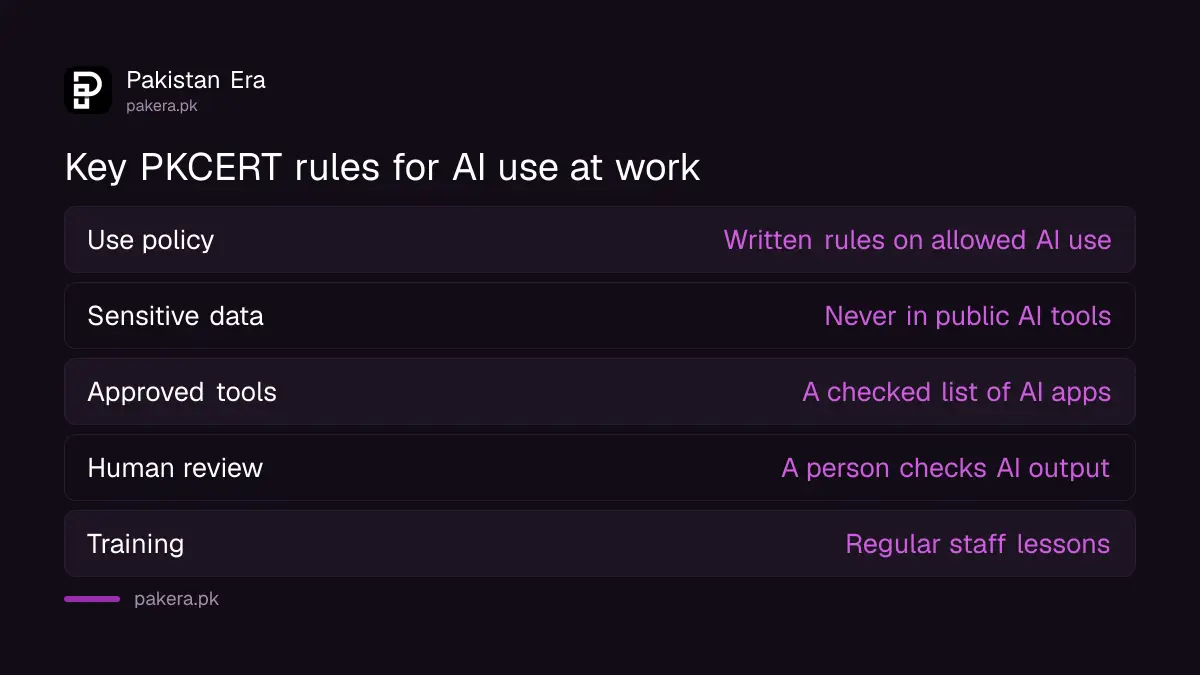
PKCERT lists eight actions: an AI use policy, a ban on sensitive data in public AI tools, a list of approved tools, human review of AI output, data loss monitoring, alignment with NIST and OWASP frameworks, staff training and audit logs of AI use.
| PKCERT control | What it means in plain words |
|---|---|
| AI acceptable use policy | Written rules on which AI uses are allowed, limited or banned |
| Protect sensitive information | No confidential, personal or password data in public AI tools |
| Approved AI tool registry | A checked list of allowed tools, plugins and extensions |
| Human review of AI output | A qualified person checks AI code and key documents before use |
| DLP and AI monitoring | Data loss prevention tools watch what goes into AI sites |
| Recognised frameworks | Follow NIST AI RMF and the OWASP Top 10 for LLM apps |
| Staff training | Regular lessons on safe prompts, deepfakes and AI errors |
| Audit trails | Logs of who used which AI tool, for investigations |
NIST AI RMF is a US risk framework for AI, and OWASP publishes lists of common security flaws in AI apps. You do not need either to follow the basics below.
What not to paste into ChatGPT, Gemini or any AI chatbot
Never paste passwords, OTPs, CNIC or passport numbers, bank details, customer lists, salary sheets, unreleased financial figures, legal case files or private source code into a public AI chatbot. Replace real names and numbers with placeholders before you ask for help.
A simple test works well. If you would not post it in a WhatsApp group with 200 strangers, do not paste it into a public chatbot. Some practical swaps:
- "Draft a reminder to customer Ahmed Raza, CNIC 35202-..." becomes "Draft a reminder to a customer about an overdue payment".
- A full salary sheet becomes a five-row sample with made-up figures, just to get the formula.
- Code with API keys or database passwords gets those lines deleted first.
- A legal notice keeps its structure but loses the names, plot numbers and amounts.
Be careful with AI browser extensions too. PKCERT names them as a risk, because an extension that reads every page can also read your bank portal or HR system. Install only what your office has approved.
Turn off model training and use Temporary chat in ChatGPT
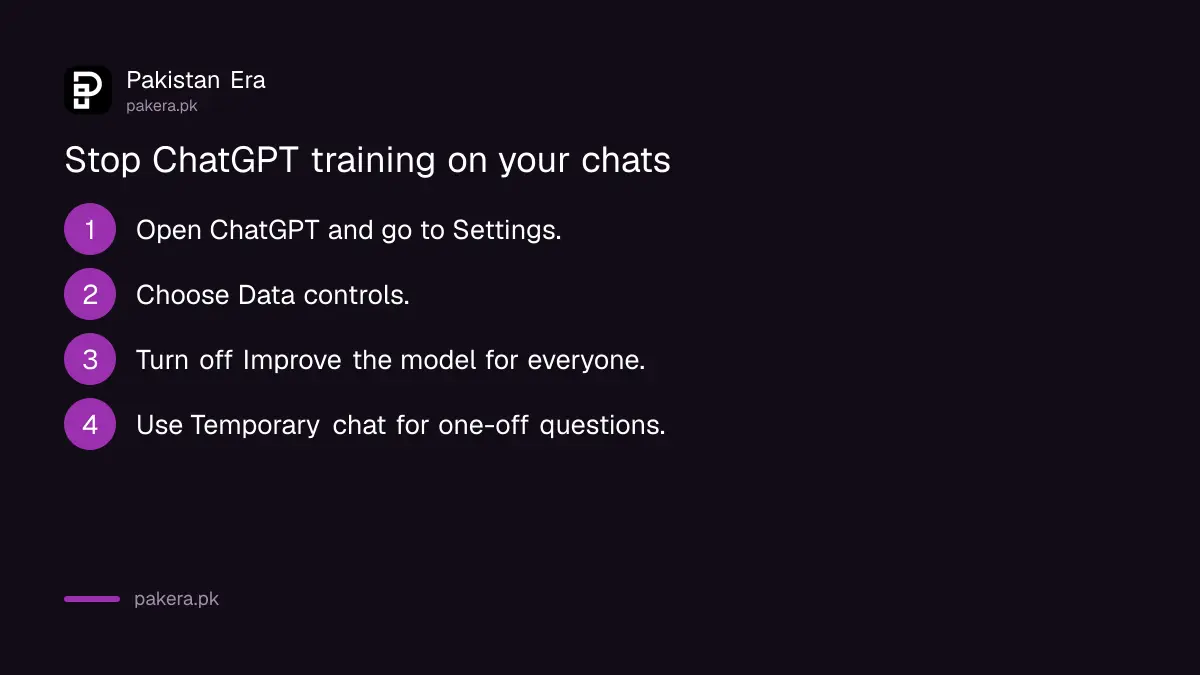
In ChatGPT, open Settings, then Data controls, and switch off "Improve the model for everyone". OpenAI says new chats will then not be used to train its models. For one-off sensitive questions, start a Temporary chat, which stays out of your history.
OpenAI's help centre gives the exact steps:
- On the web, open your account menu and select Settings.
- Select Data controls.
- Turn off "Improve the model for everyone" and select Done.
- On Android or iPhone, open the sidebar, tap your profile icon, then Data controls, and turn it off there.
- For a Temporary chat, open a new chat and select Temporary before your first message.
Know the limits. OpenAI says Temporary chats are not used for training and do not appear in history, but they may be kept for up to 30 days for safety reasons. Turning off training also does not delete your old chats. So these settings reduce exposure. They do not make it safe to paste a client's CNIC.
Your ChatGPT account itself is worth locking down as well. Checking for strange logins is covered in checking ChatGPT login activity, and the differences between paid and free tiers are in ChatGPT and Gemini free plans.
Check AI answers before you use them at work
PKCERT asks for human review of all AI-generated code and important documents before they are used or published. AI tools can produce confident but wrong figures, laws and code. Treat every AI answer as a first draft that a person must check.
For Pakistani offices this matters most with tax rates, legal sections and fees, which change often and which chatbots get wrong. Check figures against the FBR, SBP or the department's own website. For code, run it in a test environment first and have a colleague read it.
PKCERT also flags deepfakes in its training list. A voice note or video that looks like your boss asking for an urgent transfer is now easy to fake, and the warning signs are set out in spotting a deepfake scam video.
If sensitive data has already gone into an AI tool, or you suspect an AI-related breach, PKCERT asks organisations to contain it, keep the logs, change any exposed passwords or API keys, and report it. Its reporting portal is pkcert.gov.pk/report-incident, email cert@pkcert.gov.pk, phone +92 51 9203412.
Common questions
Has Pakistan banned ChatGPT in government offices?
No, PKCERT's advisory NCA-18 does not ban any tool. It tells organisations to keep a list of approved AI tools, block unapproved ones and keep sensitive data out of public AI platforms. Each department sets its own policy.
Does ChatGPT use my chats for training?
It can, unless you turn off "Improve the model for everyone" in Settings, then Data controls. OpenAI says new chats are then not used to train its models. The setting follows your account across devices when you are signed in.
Is a Temporary chat in ChatGPT fully private?
Not fully. OpenAI says Temporary chats are kept out of your history and are not used for training, but may be retained for up to 30 days for safety purposes. Do not treat it as a safe place for passwords or CNIC numbers.
What is prompt injection?
Prompt injection is a hidden instruction placed in a document, email or web page that an AI tool reads and then obeys. It can make an AI assistant leak data or take actions you did not ask for. PKCERT lists it among the main AI risks.
Where do I report an AI-related data leak in Pakistan?
Report it to PKCERT through pkcert.gov.pk/report-incident or cert@pkcert.gov.pk. If money was lost through fraud, file a complaint with the National Cyber Crime Investigation Agency (NCCIA) as well.
How we verified this
What we checked, where we read it, and what we could not confirm.
We last checked these sources on 10 October 2026:
- PKCERT advisory NCA-18, "Safe and Secure Use of Generative Artificial Intelligence (GenAI) Tools and Platforms", dated 1 October 2026, on pkcert.gov.pk (advisory 18 of 2026).
- OpenAI Help Center, "Data controls in ChatGPT", for the Improve the model for everyone steps and what happens to saved chats.
- OpenAI Help Center, "Temporary chat in ChatGPT", for how to start one and the 30-day retention.
The advisory is guidance for organisations, not a law. Your employer's own AI policy, where one exists, is the rule you must follow at work.
About the author

Technology Journalist & Multimedia Producer
Ahmad Ali is a technology journalist and multimedia producer at Pakistan Era, joining the team in October 2026. He covers consumer technology and digital life for Pakistani readers, combining research with hands-on product testing.