How to File a Family Court Case in Pakistan: Rs 15 Court Fee and a 6 Month Limit
File a Family Court case in Pakistan for a Rs 15 court fee. See the nine matters it hears, notice in 3 days, the 6 month decision limit and the High Court step.
A Family Court in Pakistan charges a court fee of Rs 15 on a plaint, sends your opponent a notice within three days, and must decide the case within six months of filing. If it does not, either side can apply to the High Court for directions. These rules are in the Family Courts Act, 1964.
Most people picture a family case as years of corridor waiting. The Family Courts Act was written to prevent that, and it sets hard numbers for the court. We read its text on the Pakistan Code website on 15 October 2026. The printed text carries amendments up to 2002, so ask the court office whether a provincial rule has changed anything. This is general information, not legal advice.
The Family Court hears nine kinds of dispute
Part I of the Schedule gives Family Courts exclusive jurisdiction over nine matters: dissolution of marriage including khula, dower, maintenance, restitution of conjugal rights, custody, guardianship, jactitation of marriage, dowry, and the personal property of a wife and a child living with his mother.
| Matter in Part I | Example |
|---|---|
| Dissolution of marriage, including khula | A wife asks the court to end the marriage |
| Dower and dowry | Recovering Haq Mehr or dowry articles |
| Maintenance | Monthly support for a wife or child |
| Restitution of conjugal rights | A husband asks his wife to return |
| Custody and visitation | Where a child lives and when a parent visits |
| Guardianship | Who manages a child's affairs |
| Jactitation of marriage | A false claim that a marriage exists |
| Personal property of a wife | Her belongings, and a child's living with his mother |
Part II lets a Family Court try some offences between spouses, where one spouse is the victim of the other. The listed Pakistan Penal Code sections include 337A(i), 337F(i), 341 to 346, 352 and 509. Related guides cover claiming maintenance, recovering Haq Mehr and dowry and child custody and guardianship.
Every district has a Family Court with at least one woman judge
Section 3 says the government shall establish one or more Family Courts in each district. At least one court in each district must be presided over by a woman judge. A woman judge may serve more than one district, sitting at places the province names.
File where the court for your district sits. If the judge's seat is empty or the judge is absent for more than 30 days, except for vacations, Section 25A lets the District Court transfer your case to another Family Court, on your application or on its own.
The plaint must list witnesses and attach your documents
Section 7 says the plaint must state all material facts and carry a schedule of witnesses with their names, addresses and a short summary of each one's evidence. Documents you rely on must be produced with the plaint, with copies for each defendant.
If you rely on a document that is not in your possession, list it with reasons why it matters. A plaint for dissolution of marriage may include every related claim in one filing: dowry, maintenance, dower, personal property, custody and visitation. That saves a second case.
The court fee is Rs 15, and the defendant gets notice within three days
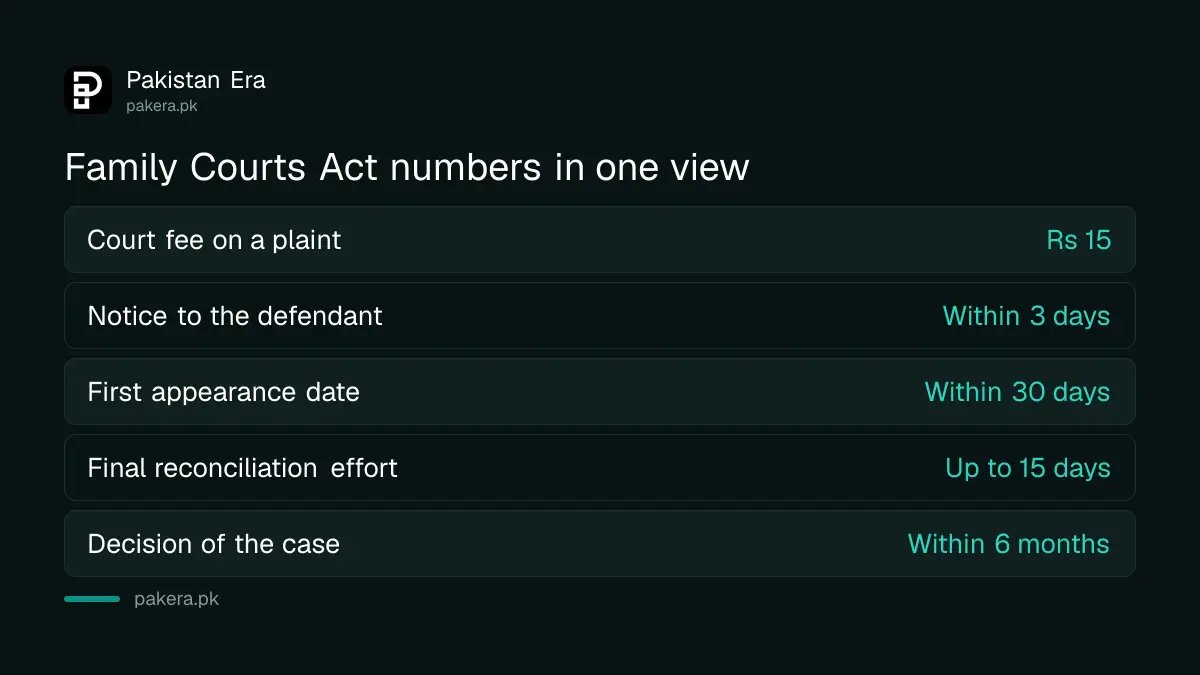
Section 19 sets the fee at Rs 15 on any plaint or appeal memorandum under the Act. Section 8 says the court fixes an appearance date within thirty days and sends notice within three days of filing, at the plaintiff's expense.
You pay the postal or courier charges when you file. If the defendant does not appear and service is proved, the court may proceed ex parte, meaning without him. A decree passed that way can be challenged within 30 days of the notice of the decree.
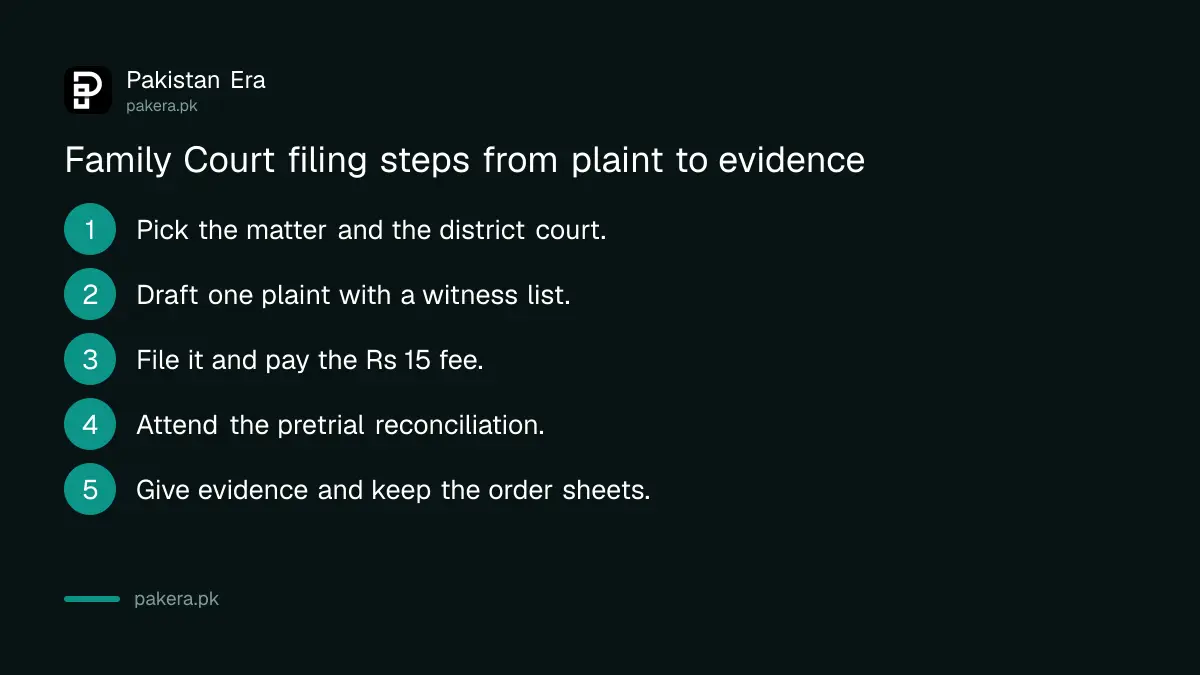
- Choose the right matter from the nine in Part I and confirm the district court.
- Draft one plaint with all material facts, the witness schedule and the document list.
- Prepare copies for each defendant and keep a set for yourself.
- File the plaint, pay the Rs 15 fee and deposit the postal charges.
- Attend on the appearance date, when the defendant files a written statement.
- Take part in the pretrial hearing and the reconciliation effort.
- Give evidence, which the court may accept by affidavit, and keep every order sheet.
The court must try reconciliation before it decides
At the pretrial stage the court must ascertain the points at issue and try to effect a compromise or reconciliation. After the evidence closes, Section 12 requires another effort within a period not exceeding fifteen days. Only then does the court announce its judgment.
Come ready for both hearings. Section 10 also says that in a suit for dissolution of marriage, if reconciliation fails, the court shall pass the decree forthwith and restore the Haq Mehr received by the wife to the husband, and Section 9(1b) ties this to khula. The method for that route is in the khula guide.
A case not decided in six months can go to the High Court
Section 12A says the Family Court shall dispose of a case, including a suit for dissolution of marriage, within six months of institution. If it does not, either party may apply to the High Court for the directions it deems fit.
Keep the date-stamped plaint receipt, because six months run from filing. When the six months pass, apply with a certified copy of the order sheet, and how to get a certified copy in Punjab describes that step. The court office can tell you the form your province uses.
Interim orders protect maintenance and property while the case runs
Section 17A lets the court pass an interim maintenance order at any stage, with payment due by the fourteenth of each month. If it is not paid, the court may strike off the defence of the defendant and decree the suit.
Section 21A lets the court preserve and protect property in dispute and other property of a party that may be needed to satisfy the decree. No appeal or revision lies against an interim order, Section 14(3) says, so ask for what you need in the first hearing.
| No appeal from a decree for | Limit in Section 14(2) |
|---|---|
| Dower or dowry | Not exceeding Rs 30,000 |
| Maintenance | Rs 1,000 or less per month |
| Dissolution of marriage | No appeal, except for the cruelty ground in clause (a) of item (viii) of the 1939 Act |
Common questions about filing a Family Court case in Pakistan
How much is the court fee in a Family Court?
Rs 15 on any plaint or memorandum of appeal, under Section 19 of the Family Courts Act. Lawyer fees are separate.
Do I need a lawyer?
The Act text we read does not say a lawyer is compulsory, but the plaint must carry a witness schedule and documents. Free legal aid is described in the Supreme Court 1818 helpline guide.
How long does a Family Court case take?
Section 12A sets six months from filing. If the court misses it, either party can apply to the High Court.
Can the defendant refuse to come?
If service is proved and he does not appear, the court may proceed ex parte. He can apply to set the decree aside within 30 days of notice.
Which court hears an appeal?
Section 14 says the High Court if a District Judge level officer presided, and otherwise the District Court. The appellate court must decide within four months.
Can the court order interim maintenance?
Yes. Section 17A allows it at any stage, with payment by the fourteenth of each month.
How we verified this
What we checked, where we read it, and what we could not confirm.
Last checked 15 October 2026. We read the text of the West Pakistan Family Courts Act, 1964 on the Pakistan Code website. Court fee, notice, time limits and the list of matters come from that text. We did not file a case or visit a court, and provincial rules may add forms and fees.
About the author

Senior Writer, Public Services and Technology
Shahid joined us in 2024 as an author. He is a senior contributor to Pakistan's leading technology websites. He writes detailed articles, mostly covering his expertise in the latest tech, mobiles, apps, gadgets, and step-by-step guides. His ideology is to help people understand the latest trends and explain complex methods through very easy-to-understand guides.