NEPRA to Hear 10 Power Companies' 2027 Tariff Requests on 13 to 15 October
Ten power companies want their 2027 tariffs reset. NEPRA hears them from 13 to 15 October and will review fixed charges. Dates, claims and how to comment.
All ten government-owned electricity companies have asked NEPRA to reset their tariff for 2027, and the regulator will hear them in three days of public hearings from 13 to 15 October 2026. Any consumer can send comments or speak at the hearing. NEPRA posted the hearing notices between 24 and 27 September.
Update, 10 October 2026: NEPRA holds tariff hearings from 13 to 15 October 2026. Any consumer can take part. See how to take part.
One question on NEPRA's list stands out for ordinary households. For every company it has read, the regulator will consider whether the fixed charges on bills, and the way they apply to different kinds of consumers, need to be revised. Nothing has been decided. But that is the part of this process most likely to show up on a home bill.
Ten power companies filed 2027 tariff requests with NEPRA
Lahore, Islamabad, Faisalabad, Gujranwala, Multan, Peshawar, Hyderabad, Sukkur, Quetta and the tribal areas' companies have each filed a request for calendar year 2027. They ask NEPRA to update, or index, the cost parts of their multi-year tariff and to allow other adjustments in the consumer tariff.
A multi-year tariff (MYT) is a rate formula NEPRA sets for several years at a time. Each year, the company asks NEPRA to update the numbers inside it for inflation, salaries, pensions, repairs, the power it buys and past shortfalls. That yearly update is what these hearings are about.
K-Electric, which serves Karachi, is not part of this round. Its tariff runs on a separate determination.
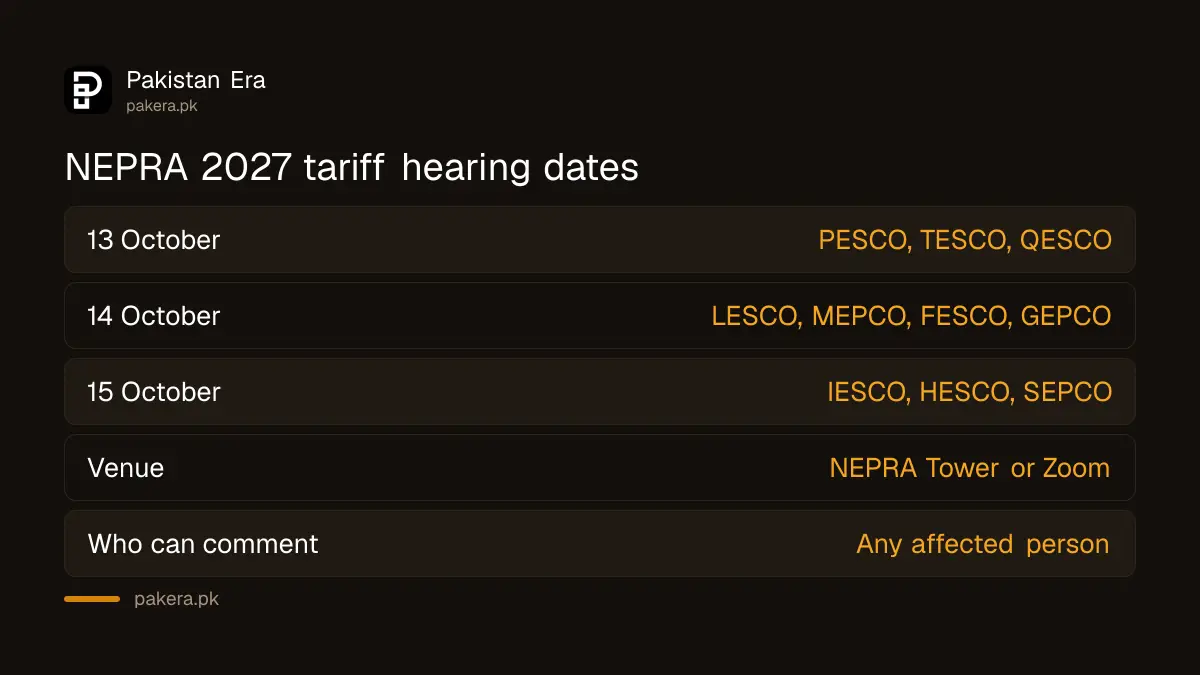
NEPRA hears the requests from 13 to 15 October 2026
NEPRA will hear three or four companies each afternoon, from 13 to 15 October 2026, at NEPRA Tower in Islamabad and on Zoom. Each company has its own time slot. The Zoom link and meeting ID are printed on each company's notice on the NEPRA website.
| Company | Hearing date | Time | Prior year adjustment claimed |
|---|---|---|---|
| PESCO (Peshawar) | Tuesday 13 October | 2:00 pm | 22,556 |
| TESCO (tribal areas) | Tuesday 13 October | 2:30 pm | 15,555 |
| QESCO (Quetta) | Tuesday 13 October | 3:00 pm | 17,818 |
| LESCO (Lahore) | Wednesday 14 October | 2:00 pm | 32,783 |
| MEPCO (Multan) | Wednesday 14 October | 2:30 pm | 51,480 |
| FESCO (Faisalabad) | Wednesday 14 October | 3:00 pm | 56,973 |
| GEPCO (Gujranwala) | Wednesday 14 October | 3:30 pm | 16,958 |
| IESCO (Islamabad) | Thursday 15 October | 2:00 pm | 157,864 |
| HESCO (Hyderabad) | Thursday 15 October | 2:30 pm | 7,019 |
| SEPCO (Sukkur) | Thursday 15 October | 3:00 pm | 36,296 |
The prior year adjustment (PYA) is money a company says it was owed from earlier years but did not recover through bills. NEPRA's notices print these figures without a unit. NEPRA's tariff tables are normally in million rupees, which would put IESCO's claim at about Rs 158 billion. We could not confirm the unit on the notices themselves.
The companies' total revenue requests are not comparable in one column. Some notices give the total including the cost of buying power, and some give it without. LESCO's notice, for example, puts its requested revenue including power purchase at 758,682.
Fixed charges are on the list of issues for every company
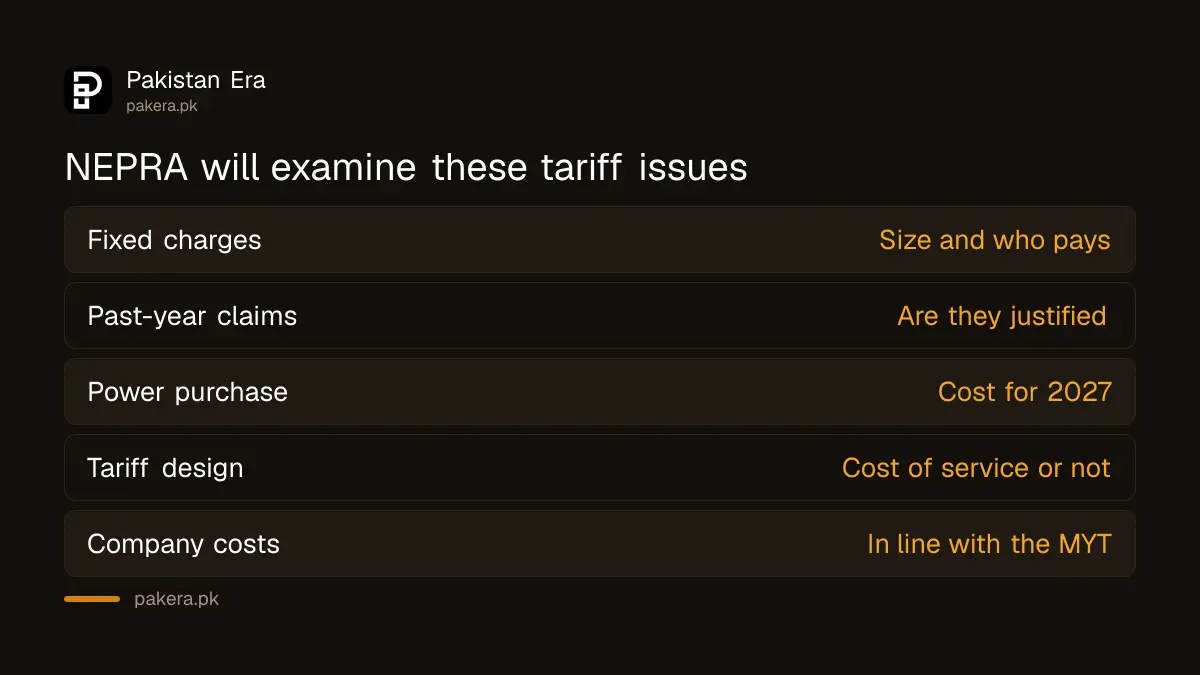
For each company we read, NEPRA has framed the same question: should the existing fixed charges, and how they apply to different consumer categories, be revised so companies recover their fixed costs? The notices link this to the strategic directives in the National Electricity Plan.
Fixed charges are the part of a bill you pay whatever you use, unlike the per-unit rate. A change to who pays them, or how much, would hit low-use homes hardest, because they have fewer units to spread the charge over. NEPRA has not proposed a figure.
The other common issues are whether each request fits the multi-year tariff, whether the PYA is justified, what power each company expects to buy in 2027, and whether the tariff schedule should be set on a cost-of-service basis. Cost of service means each type of consumer pays roughly what it costs to supply them, with fewer cross-subsidies.
Some companies face their own questions too:
- LESCO: whether a transport policy for staff vehicles and a write-off of unrecoverable electricity dues fit within the tariff.
- MEPCO: whether costs for a line loss study, third-party hiring, outsourced security and a unified service agreement are justified.
- PESCO: whether outsourced staff, turnover tax, working capital and capacity charges for the Jabori and Machi hydropower plants are justified.
Your bill does not change until the government notifies a decision
Nothing changes on bills now. NEPRA first hears the requests, then issues a decision for each company. Under the NEPRA Act, the federal government then notifies the consumer tariff. Only a notified tariff reaches your bill.
That makes this different from the monthly fuel charge. The October fuel charge on electricity bills is a short, one-month adjustment. The 2027 requests set the base rate that the whole year's bills are built on.
NEPRA is also taking public comments this month on separate changes to detection bills for tampered meters, posted on 25 September. That is a different process with its own deadline.
How to send comments or speak at the hearing
Any interested or affected person can send written comments or speak at the hearing, the notices say. You can write to the NEPRA Registrar or join on Zoom at your company's time. Comments should address the issues NEPRA has framed.
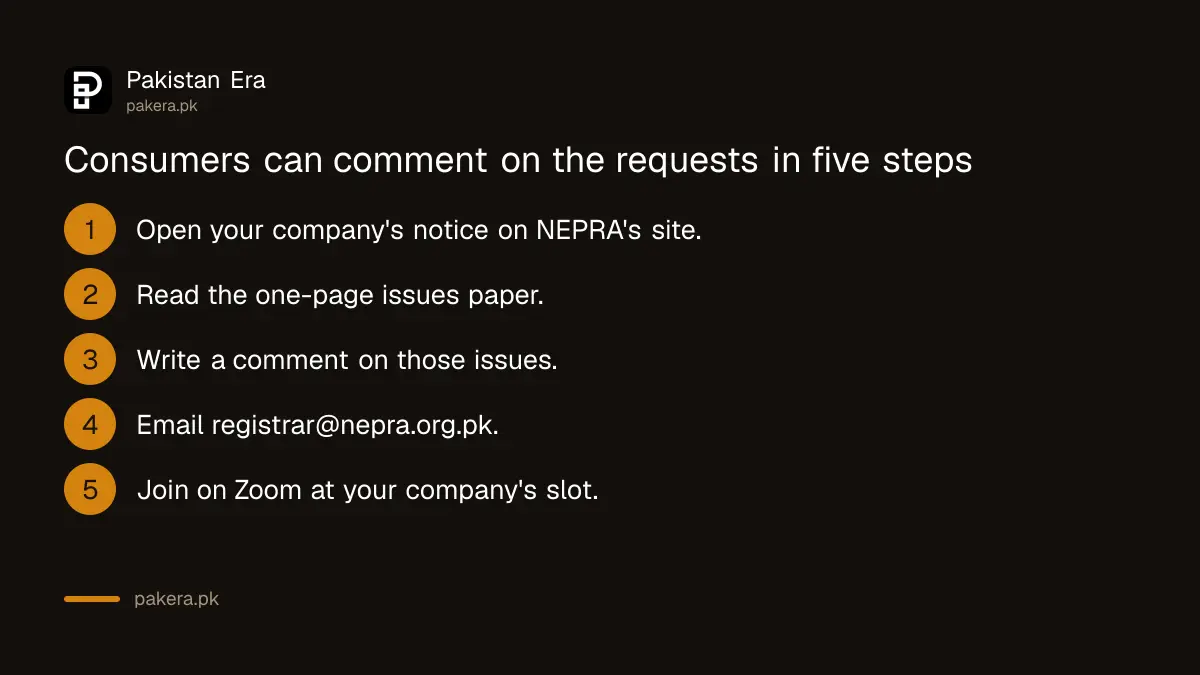
- Find your company's notice under the latest news on the NEPRA website. It lists the request, the issues and the Zoom link.
- Read the issues paper for your company, a one-page list of what NEPRA will examine.
- Write your comment. Keep it to the issues, for example fixed charges or a specific cost you think is wrong.
- Email it to registrar@nepra.org.pk, or post it to the Registrar, NEPRA Tower, Ataturk Avenue (East), G-5/1, Islamabad, before the hearing.
- To speak, join the Zoom meeting at your company's time or attend at NEPRA Tower. The phone number on the notices is 051-2013200.
If your complaint is about your own bill rather than the tariff, the hearing is the wrong place. Use the company or NEPRA complaint route instead, starting with a complaint about a wrong electricity bill.
Common questions
When are NEPRA's 2027 tariff hearings?
From 13 to 15 October 2026, in the afternoons, at NEPRA Tower, Islamabad and on Zoom. Each company has its own slot.
Will electricity prices go up in 2027?
Not decided. The companies have filed requests. NEPRA decides after the hearings, and the federal government notifies the final tariff.
Can an ordinary consumer take part in a NEPRA hearing?
Yes. The notices invite all interested or affected parties to send written comments or speak, in person or on Zoom.
Is K-Electric part of these hearings?
No. These hearings cover the ten former WAPDA companies. K-Electric's Karachi tariff is set separately.
What are fixed charges on an electricity bill?
A charge you pay whatever units you use. NEPRA will consider whether their size and application to consumer categories should change.
How we verified this
What we checked, where we read it, and what we could not confirm.
Last checked at 12:50 PKT on 28 September 2026. The hearing dates, times, venue, PYA figures, LESCO's requested revenue, the invitation to comment and the Registrar's contact details are from NEPRA's notices of hearing for all ten companies, posted on the NEPRA website between 24 and 27 September 2026, for example the LESCO notice. The framed issues are from NEPRA's issues papers for LESCO, IESCO, MEPCO and PESCO, which we read in full. The unit of the notice figures is not printed; the million-rupee reading is our assumption from NEPRA's usual tables and is flagged as such.
About the author

Senior Writer, Public Services and Technology
Shahid joined us in 2024 as an author. He is a senior contributor to Pakistan's leading technology websites. He writes detailed articles, mostly covering his expertise in the latest tech, mobiles, apps, gadgets, and step-by-step guides. His ideology is to help people understand the latest trends and explain complex methods through very easy-to-understand guides.