Hajj 2027 Will Cost Rs 1.2 Million, First Payment From 18 August
What Hajj 2027 costs from Pakistan. Two government packages at Rs 1.2m and Rs 1.3m, what the price covers, and how instalments are paid.
Update, 2 October 2026: The ministry says the second instalment for the government scheme is collected from 5 October to 20 October 2026, after the medical fitness certificate is uploaded. Read the update.
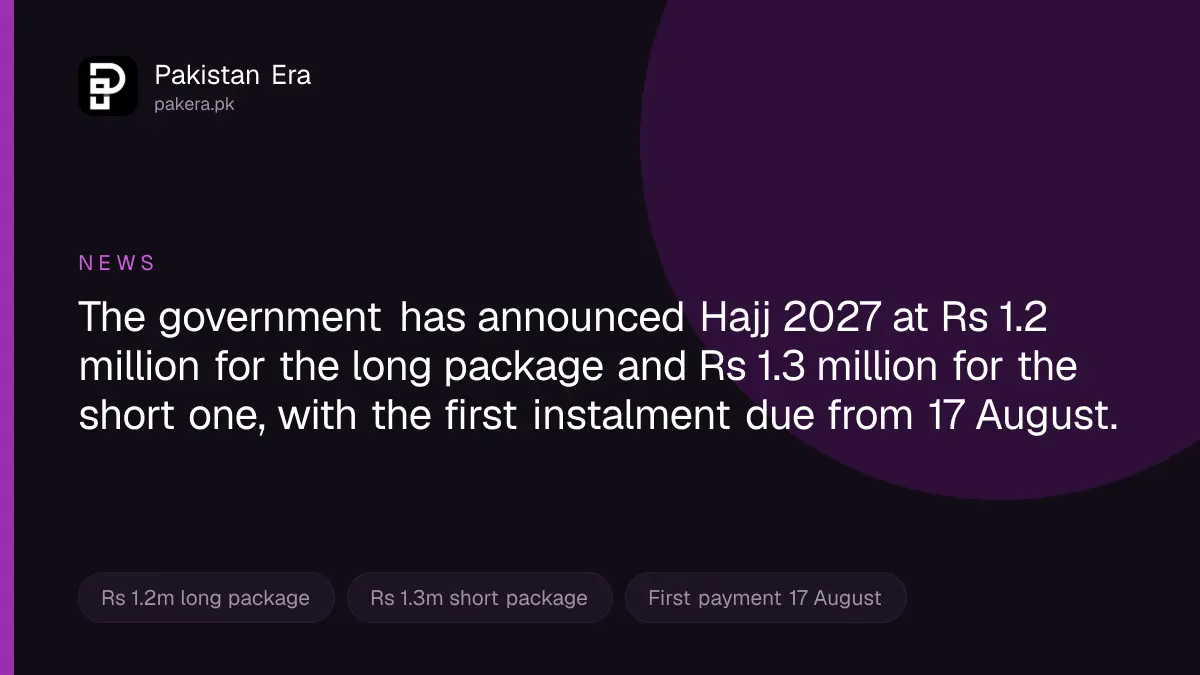
Pakistan has announced what Hajj will cost in 2027. The Minister for Religious Affairs, Sardar Muhammad Yousuf, gave two government package prices at a press conference in Islamabad on 10 August 2026.
Rs 1.2 million for the long package. Rs 1.3 million for the short one. The short package is more expensive because it packs the same obligations into fewer days with tighter logistics.
The date to act on is 18 August, when the first instalment starts being collected.
What was announced
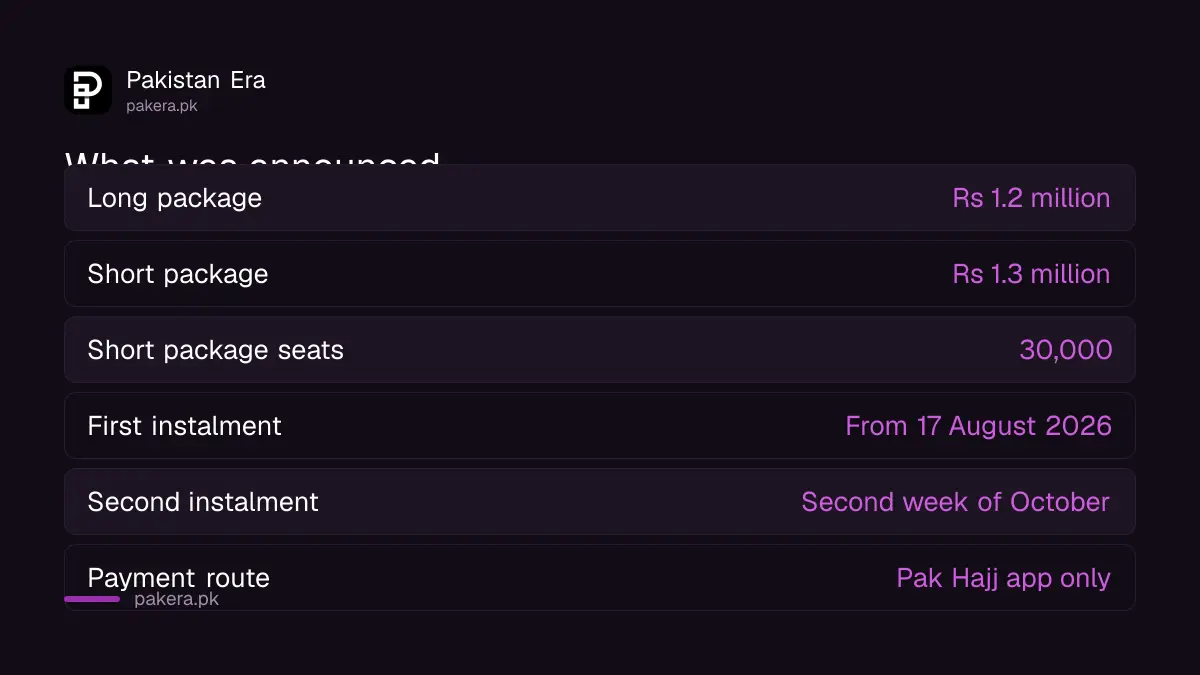
| Item | Detail |
|---|---|
| Long package | Rs 1.2 million |
| Short package | Rs 1.3 million |
| Seats on the short package | 30,000 |
| First instalment | From 18 August 2026 |
| Second instalment | Second week of October 2026 |
| Registered pilgrims in process | Around 400,000 |
| Banking partner | Habib Bank Islamic |
Anyone who cannot perform Hajj in 2027 goes onto the waiting list for the following year rather than losing their place.
One note on the prices. These are the figures the minister gave at a press conference. The policy says package dues are notified by the ministry separately, so if you are budgeting to the rupee, wait for the notification. The scale is not in doubt.
Payment moves to the app, and only the app
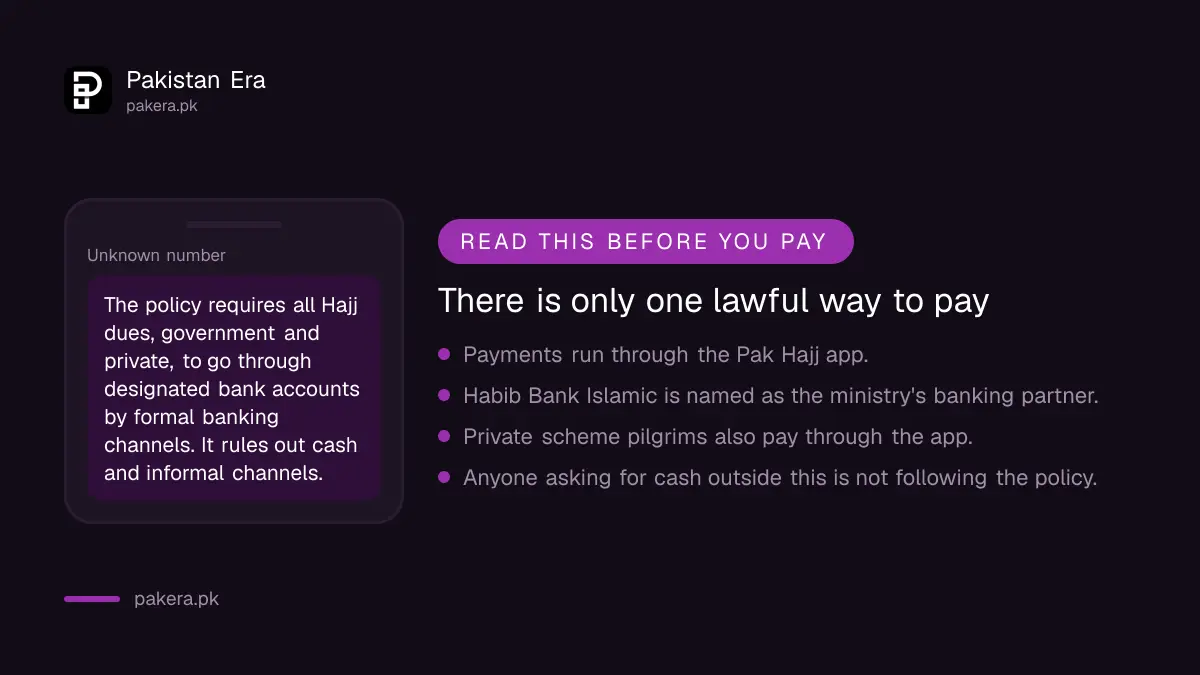
Applications and payments shift to the Pak Hajj app. The minister said financial transactions related to Hajj will not be conducted by any other method.
That applies to the private scheme too. Private pilgrims pay through the app and choose a service provider from the approved companies listed online.
On why one bank was chosen, the minister said all banks were invited, several applied, and only Habib Bank met the criteria, particularly on digital payments.
This matters for a practical reason. The policy document requires all Hajj dues, for both the government and private schemes, to be deposited in designated bank accounts through formal banking channels only, in line with State Bank regulations, and it rules out cash and informal channels.
So if anyone asks you for Hajj money in cash, or into a personal account, they are outside the policy. That is the sentence to remember from this article.
We read the policy document, not just the press conference
The Hajj Policy and Plan 2027 to 2030 is published as a PDF on the ministry's own website. We downloaded it and read it on 10 August 2026. Several things in it did not come up at the press conference.
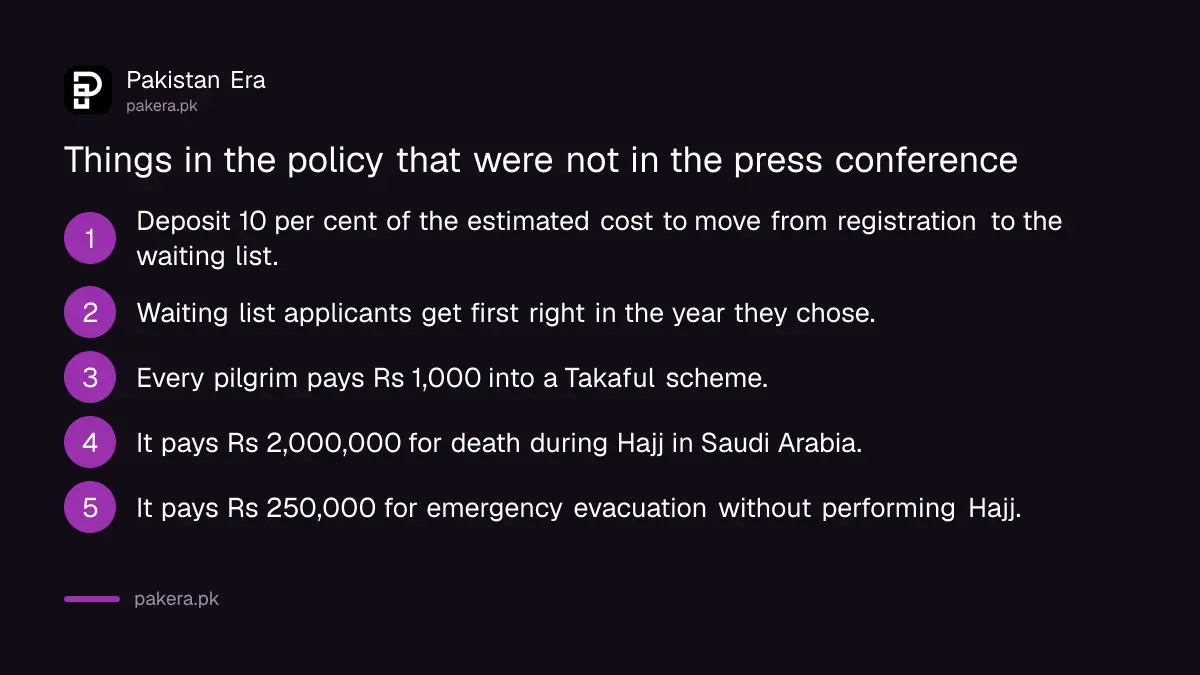
The ten per cent rule. Registration is free, but a pilgrim who deposits 10 per cent of the estimated cost after registering moves from the registration list to the waiting list. Those on the waiting list have first right when applications open for the year they chose, on a first come first served basis. In practice, that deposit is what converts an intention into a queue position.
There is an insurance scheme, and almost nobody mentions it. Every pilgrim and welfare staff member contributes a non-refundable Rs 1,000 to a Takaful scheme. It pays:
- Rs 2,000,000 for death during Hajj in Saudi Arabia
- Rs 250,000 for emergency evacuation without performing Hajj due to illness
- Injury compensation per a schedule in the policy guidelines
For a Rs 1,000 contribution on a Rs 1.2 million journey, that is worth knowing exists, particularly for older pilgrims and the families paying for them.
The package lengths do not quite match the reporting
This is small but it is the kind of thing that matters when you are booking leave from work.
The reporting has described the packages as 40 to 42 days and 20 to 22 days. The policy document says approximately 38 to 42 days for the long package and approximately 20 to 25 days for the short one.
We are giving both rather than choosing. If you are planning around the maximum, the policy's 25 days is the number to plan against, not 22.
What is actually changing about Hajj
The 2027 cycle is the first under a four year framework rather than a single year policy. The structural changes the policy lists include multi-year registration where you pick your year, multi-year contracts for accommodation, catering, transport and air travel, full digitalisation with the National Information Technology Board, a gradual shift of quota toward the private sector with the government moving into a regulator role, and a Hajj savings scheme so people can build the money over years.
We went through that framework when it was approved, in our explainer on the four year Hajj policy. If you have not registered at all yet, the free registration process is in how to register for Hajj from Pakistan. Registration for 2027 opened on 22 June 2026, which the ministry's own homepage confirms.
What to do now
- If you are registered and want 2027, be ready for the first instalment from 18 August.
- Install the Pak Hajj app and use it for the application and the payment. There is no alternative route this cycle.
- Pay through the banking channel only. No cash, no personal accounts, no agent holding your money.
- If you are on the private scheme, pick your service provider from the approved list in the app rather than from a shop front.
- Budget for the notified figure, not the press figure, once the ministry publishes it.
August and September carry other deadlines too, and the running list is in our Pakistan deadlines calendar.
Questions readers are asking
How much will Hajj cost from Pakistan in 2027?
The government announced Rs 1.2 million for the long package and Rs 1.3 million for the short package on 10 August 2026. The ministry notifies the formal dues separately, so treat these as the announced figures.
Why is the short package more expensive?
It compresses the same obligations into fewer days, which means tighter accommodation and transport arrangements closer to the holy sites. There are 30,000 seats on it.
When is the first Hajj payment due?
The first instalment is collected from 18 August 2026. The second is due in the first week of October, according to the ministry notice.
How do I pay for Hajj 2027?
Through the Pak Hajj app. Habib Bank Islamic is the ministry's banking partner. The policy requires all dues to go through designated accounts by formal banking channels, and rules out cash.
How long is the Hajj package?
The policy states approximately 38 to 42 days for the long package and approximately 20 to 25 days for the short one. Press reports have given narrower ranges of 40 to 42 and 20 to 22.
Is there insurance for Hajj pilgrims?
Yes. The policy sets up a Takaful scheme funded by a non-refundable Rs 1,000 per pilgrim, paying Rs 2,000,000 for death during Hajj in Saudi Arabia and Rs 250,000 for emergency evacuation without performing Hajj due to illness.
What happens if I do not get a place in 2027?
You go onto the waiting list for the following year. Depositing 10 per cent of the estimated cost after registration moves you from the registration list to the waiting list, which carries first right for your chosen year.
About the author

Tax, Bills and Technology Writer
Ali Akhtar is a young and curious voice here at Pakistan Era. He is currently pursuing his A-Levels and has a growing interest in Pakistan’s changing industrial landscape and educational trends. Ali likes to write in a way that helps him explain and explore the world around him. His writing reflects the perspective of the new generation navigating the evolving trends of Pakistan where technology, youth innovation, and shifting opportunities are reshaping the country’s future.