PM Approves Interest-Free Hajj Savings Plan, Rules Due Within 2 Months
The PM approved an interest-free Hajj Savings Plan on 9 October 2026 with monthly digital deposits. What is known, what is not, and what to save each month.
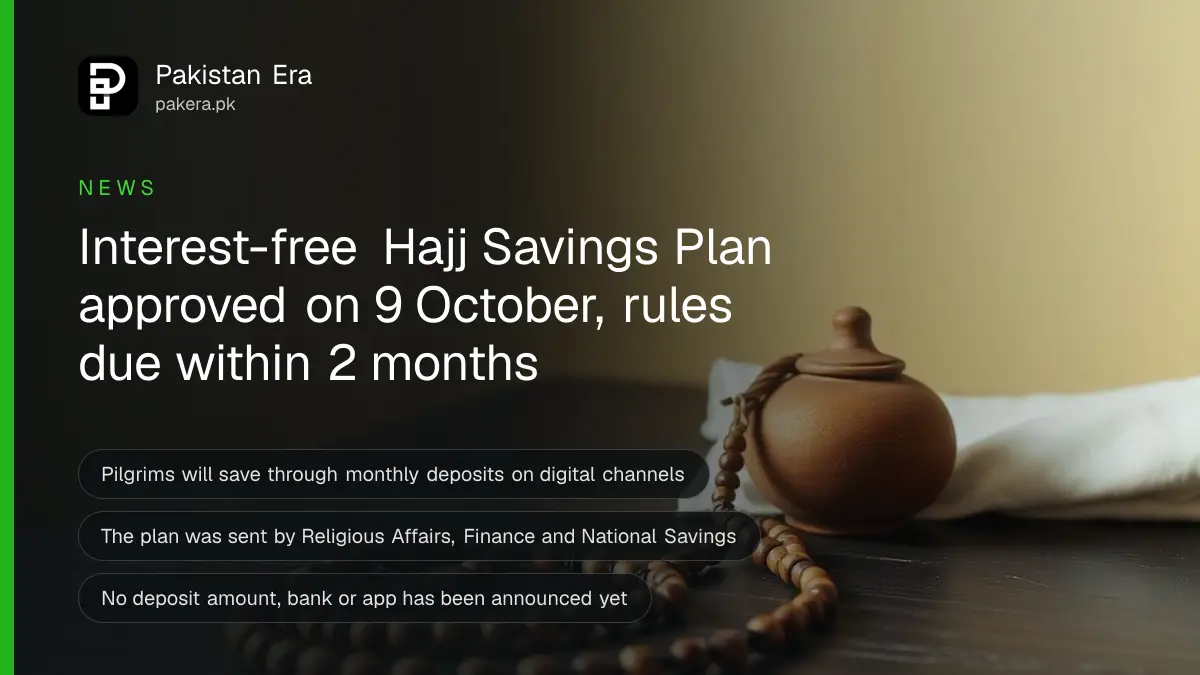
Prime Minister Shehbaz Sharif has approved an interest-free Hajj Savings Plan. Pakistanis who want to perform Hajj will be able to save for it in monthly deposits through digital channels. The Ministry of Religious Affairs announced the approval on 9 October 2026, but the rules are not written yet, so you cannot open an account today.
The ministry says the relevant offices have two months to finalise the rules. Until then there is no deposit amount, no app and no bank to sign up with. Anyone asking you for money "for the new Hajj savings scheme" now is not acting for the government.
The Prime Minister approved the Hajj Savings Plan on 9 October 2026
According to the ministry's statement, carried by Radio Pakistan, the Prime Minister approved a summary sent jointly by three bodies. These were the Ministry of Religious Affairs and Interfaith Harmony, the Finance Ministry and National Savings. National Savings is the government's own savings organisation, known for products such as prize bonds and savings certificates.
The ministry described the plan in five points:
- It is long-term and interest-free.
- It will be a Sharia-compliant digital financial mechanism.
- Intending pilgrims will deposit money on a monthly basis through digital channels.
- Its aim is to help people plan, and to reduce the effect of rising prices on Hajj costs.
- The authorities must finalise its rules and regulations within two months.
What is known and what is still missing
The approval sets the shape of the scheme, not its details. We read the statement and the Hajj Policy and Plan 2027 to 2030 and list here what each one actually says.
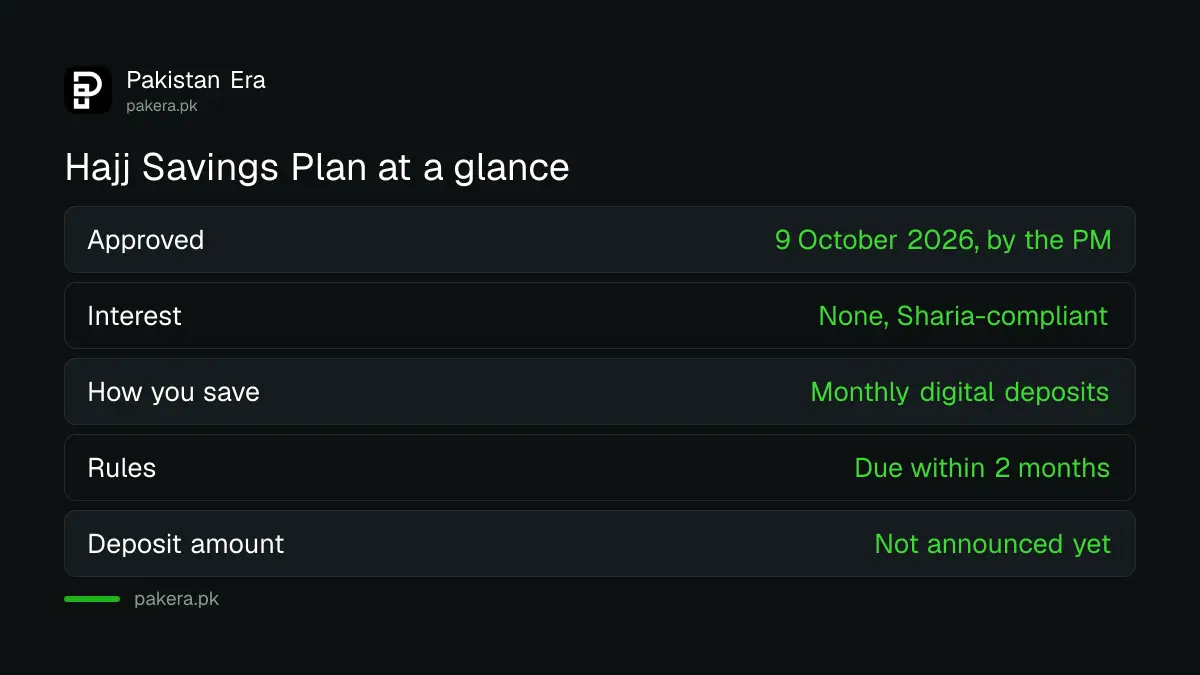
| Question | Answer on 10 October 2026 |
|---|---|
| Is it approved? | Yes, by the Prime Minister on 9 October 2026 |
| Does it pay interest? | No, the ministry calls it interest-free and Sharia-compliant |
| How do you pay? | Monthly deposits through digital channels |
| Minimum monthly deposit | Not announced |
| Which bank or app | Not announced |
| Does saving guarantee a Hajj seat? | Not stated |
| When do the rules come out? | Within two months of approval |
Two questions matter most to savers. First, whether the money earns any Sharia-compliant profit, since "interest-free" does not tell you that. Second, whether your savings link to the Hajj queue. Neither has been answered yet.
The savings plan was promised in the Hajj Policy 2027 to 2030
This is not a sudden idea. The ministry's Hajj Policy and Plan 2027 to 2030 lists six key reforms. The sixth is the "initiation of Hajj saving scheme" so that pilgrims can "plan and arrange resources for their pilgrimage years before their actual journey". The approval on 9 October is the first step to make that real.
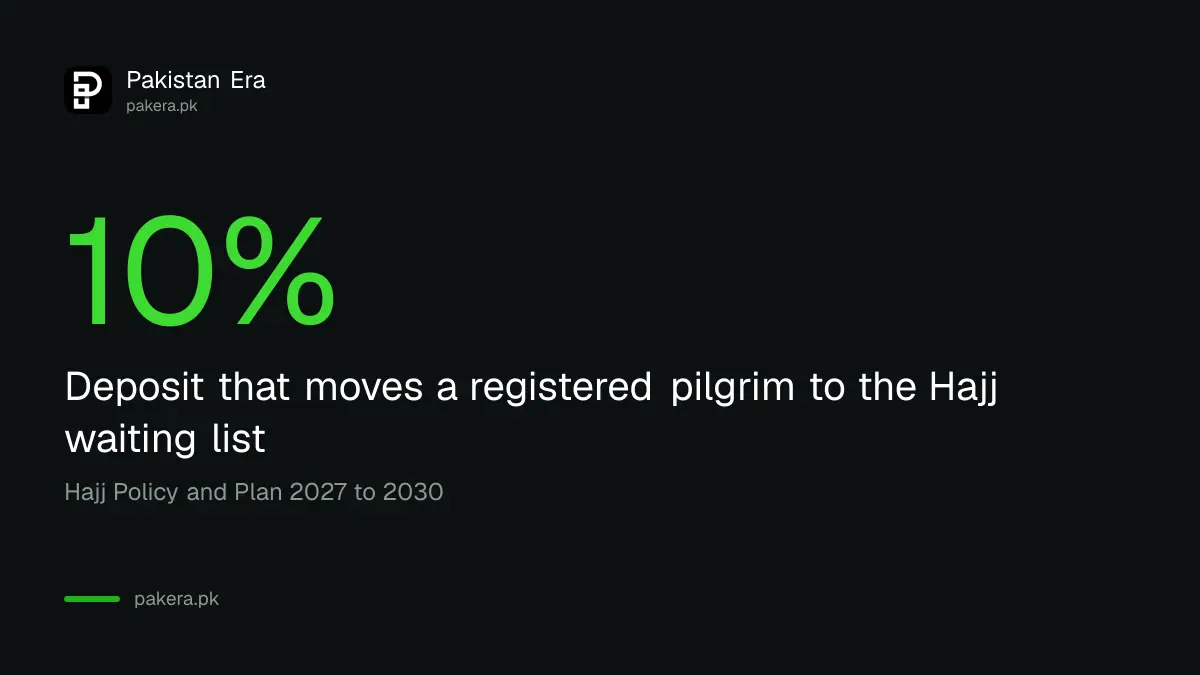
The same policy creates a multi-year registration and waiting list. Under it, a pilgrim who deposits 10 per cent of the estimated Hajj cost after registering moves from the registration list to the waiting list. People on the waiting list get first right, first come first served, when applications open for the year they choose.
That waiting list is the reason there was no Hajj 2027 balloting. Whether money in the new savings plan will count towards that 10 per cent deposit is the most useful detail to watch for in the rules.
How much you would need to save each month
The ministry's notice of 16 August 2026 put the Government Hajj Scheme 2027 at Rs 1.2 million for the long package of about 38 to 42 days, and Rs 1.3 million for the short package of about 20 to 25 days. Those are this year's prices, and they change every year.
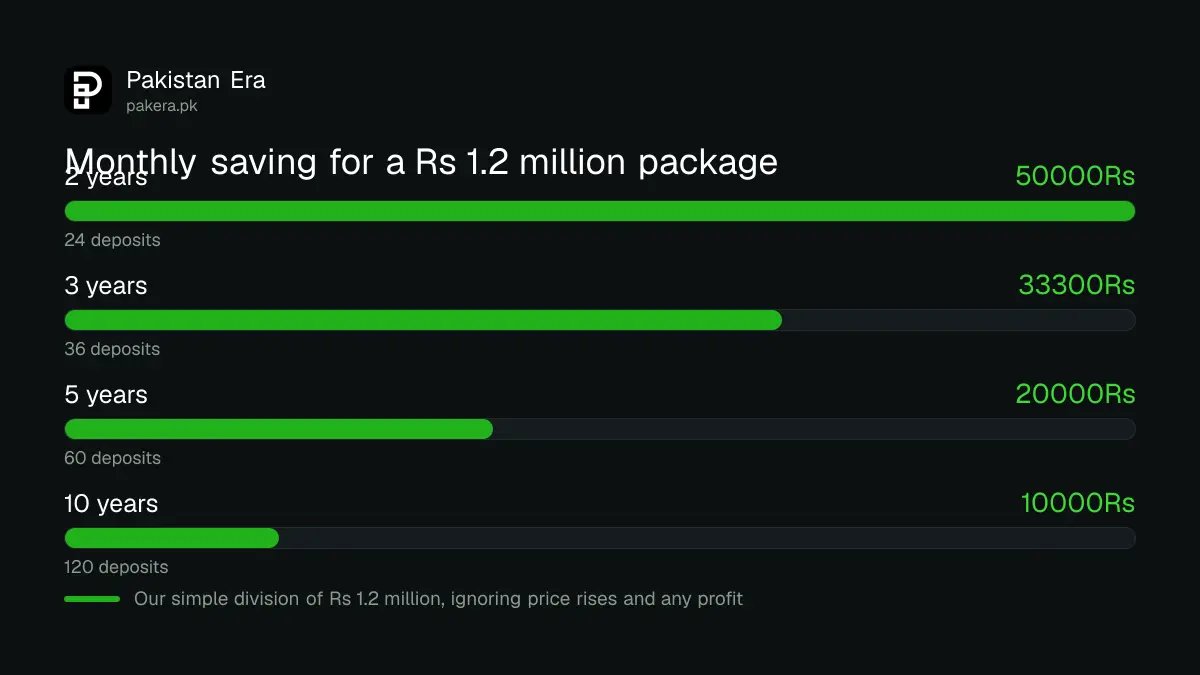
Using the Rs 1.2 million long package, simple division gives these monthly amounts. This is our arithmetic, not a ministry figure, and it ignores any future price rise or profit.
- Save over 2 years: about Rs 50,000 a month.
- Save over 3 years: about Rs 33,300 a month.
- Save over 5 years: about Rs 20,000 a month.
- Save over 10 years: about Rs 10,000 a month.
Hajj packages tend to rise with the riyal exchange rate and Saudi charges, so a longer plan needs a cushion on top. That is exactly the price pressure the ministry says the scheme is meant to soften.
What to do before the rules are published
Do nothing with your money yet. The plan has no account to open. Watch the Ministry of Religious Affairs website and the Pak Hajj app, which is where the ministry already takes Hajj 2027 instalments.
- Do not pay any agent, group or caller who says they can enrol you early.
- Expect enrolment through official digital channels, not cash.
- If you are already a Hajj 2027 applicant, keep paying your instalments on time. This plan does not change them.
- Check the Hajj 2027 package costs before you decide on a monthly target.
The Hajj Policy also says all Hajj dues go into designated bank accounts through formal banking channels only. A savings scheme from the same ministry will follow that rule. Cash requests are a warning sign.
Common questions
What is the Hajj Savings Plan?
It is an interest-free, Sharia-compliant scheme approved on 9 October 2026 that will let Pakistanis save for Hajj in monthly digital deposits.
Can I join the Hajj Savings Plan now?
No. The rules must be finalised within two months, and no enrolment channel has been announced.
Who approved the Hajj Savings Plan?
Prime Minister Shehbaz Sharif, on a joint summary from the Religious Affairs Ministry, the Finance Ministry and National Savings.
Will the savings plan guarantee me a Hajj seat?
That has not been stated. The Hajj Policy gives first right to people on the waiting list, but the link to the savings plan is not yet known.
Does the plan pay profit?
The ministry calls it interest-free. It has not said whether savers earn any Sharia-compliant return.
How we verified this
What we checked, where we read it, and what we could not confirm.
Last checked 10 October 2026, about 6:15 am PKT. The approval and its features are from the Ministry of Religious Affairs statement of 9 October 2026, carried by Radio Pakistan. The ministry's own news page had not posted it when we checked. The savings scheme reform, the 10 per cent waiting list rule and the banking rule are from the Hajj Policy and Plan 2027 to 2030, which we downloaded and read. Package prices are from the ministry's notice of 16 August 2026.
About the author

Global Affairs & Political Economy Writer
Muhammad Hatim is a book lover who started writing because he enjoys it. At Pakistan Era he writes about international relations, geopolitics and the global economy, with a particular interest in South Asia and the forces behind current events.