Pakistan's First Four Year Hajj Policy Lets You Book a Year and Pay in Instalments
The 2027 to 2030 policy adds a digital waiting list, instalment payments and a 10 per cent deposit. Registration is open until the quota fills.
Pakistan has published its first four year Hajj policy, covering 2027 through 2030. The reporting so far has focused on the cost going up, which is true and is also the least interesting thing about it.
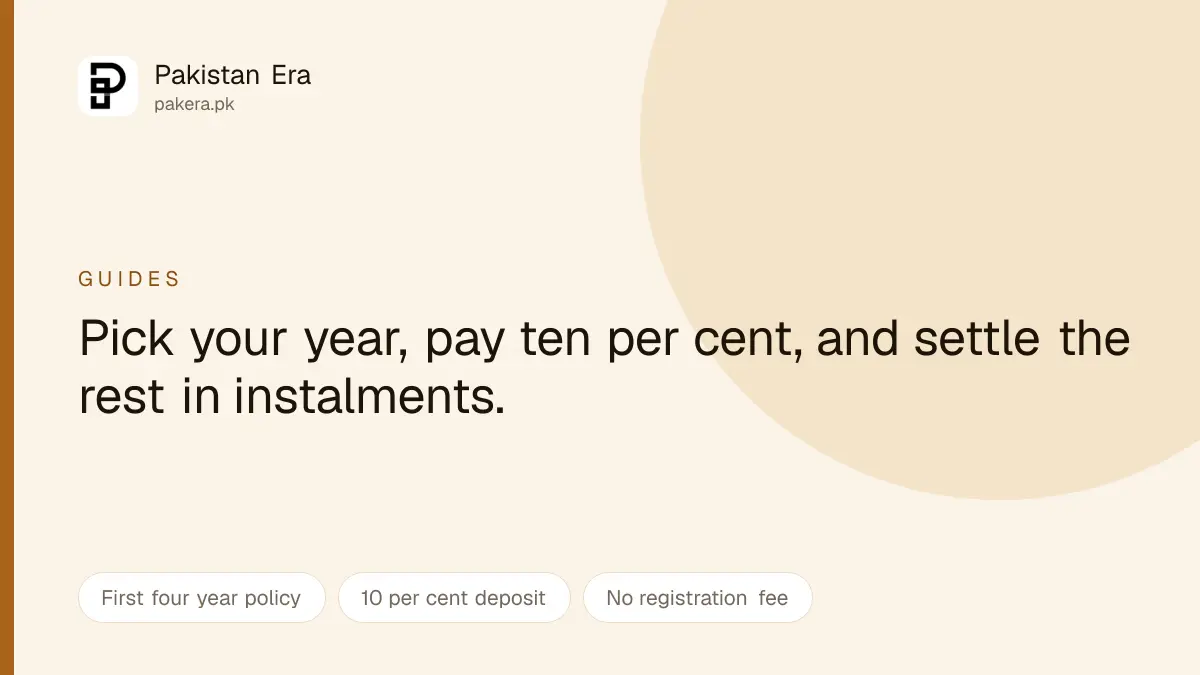
The change worth understanding is structural. You can now register, say which year you intend to go, put down ten per cent, and pay the rest in instalments.
What actually changed
For as long as most people can remember, Hajj in Pakistan worked in one year cycles. A policy was announced, applications opened for a few weeks, a ballot ran if demand exceeded the quota, and if you were unlucky you started again the following year knowing nothing about your chances.
The 2027 to 2030 policy replaces that with something closer to a queue.
| What | Now |
|---|---|
| Planning horizon | Four years, 2027 to 2030 |
| Waiting list | Digital, rather than an annual scramble |
| Choosing your year | You nominate it at registration |
| Payment | Ten per cent deposit, balance in instalments |
| Registration fee | None |
| Quota split | 60 per cent government scheme, 40 per cent private operators |
The instalment provision is the one that changes who can realistically go. A package costing over a million rupees, payable in full at short notice, ruled out a great many households who could manage the same amount spread across two or three years. That is a different affordability question, and for a lot of people it is the difference between going and not going.
How to register
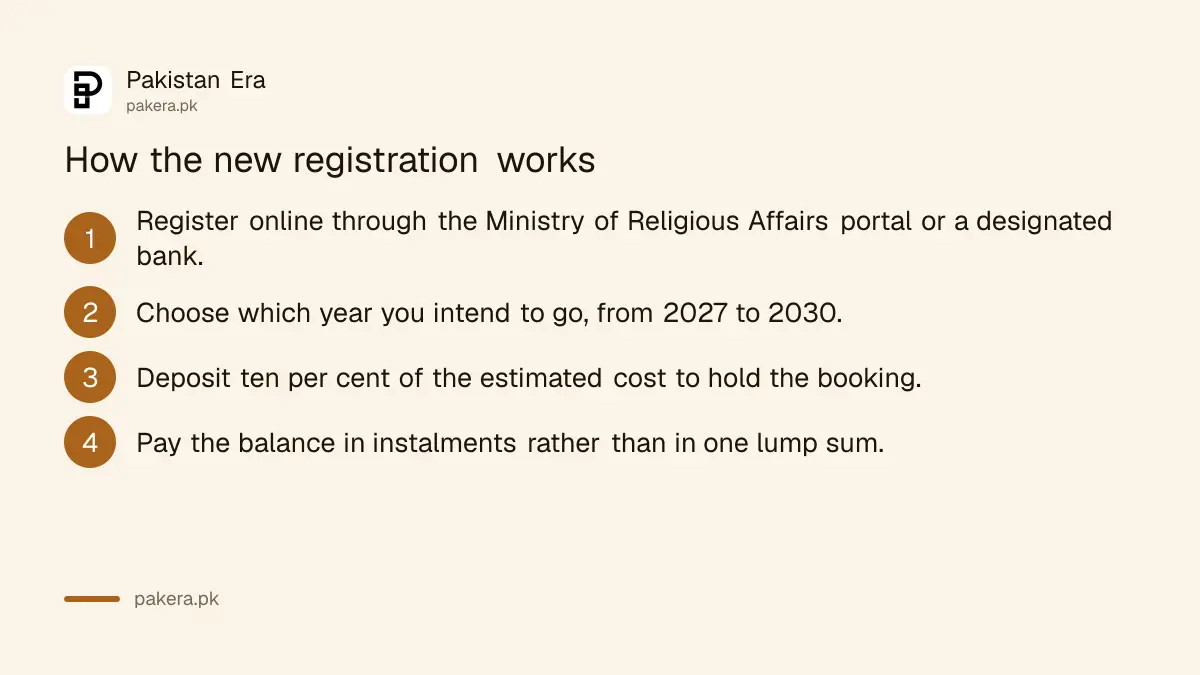
- Register online through the Ministry of Religious Affairs and Interfaith Harmony portal, or through one of the designated banks.
- Choose your year, anywhere from 2027 to 2030.
- Deposit ten per cent of the estimated cost to hold the booking.
- Pay the balance in instalments ahead of the year you selected.
Registration opened on 22 June 2026 and is processed first come, first served until the quota fills. That is the detail to act on: this is not a window that closes on a published date, it is a queue that fills. Registering late in the cycle and registering after the quota is gone look the same from the outside.
You will need a valid machine readable passport before any of this is useful. Our guides cover applying for a passport and tracking one that is already in process, and it is worth checking the expiry now rather than in the month before you travel.
What the deposit actually commits you to
The policy's real change on money is not the total. It is that you no longer have to produce it all at once.
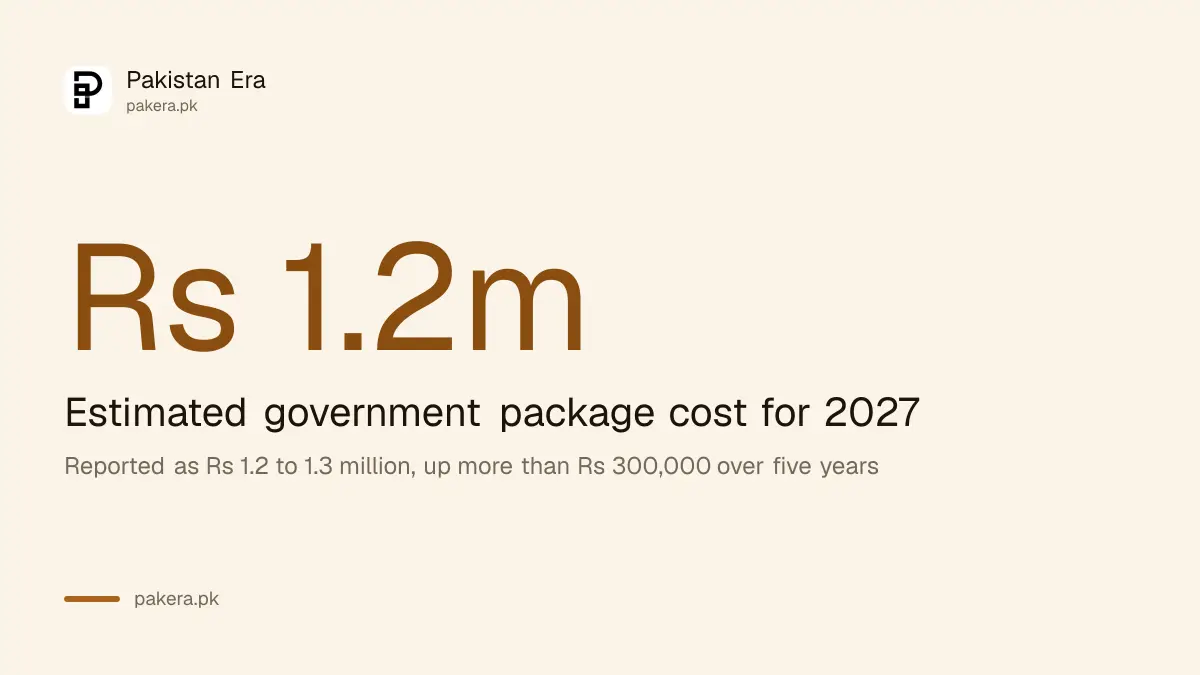
You deposit ten per cent at registration and pay the balance in instalments before your year comes round. On a package near Rs 1.2 million that is roughly Rs 120,000 to hold a place.
The package figures have since moved from estimate to announcement, and we keep them, with the instalment dates, in what Hajj 2027 costs from Pakistan. That is the page to check for the price, because it is the one we update.
One caution about paying years ahead. A package quoted three years out is exposed to airfare, Saudi charges and the exchange rate, and the policy does not appear to guarantee the figure against any of them.
If you are choosing between the government scheme and a private operator, the 60/40 quota split matters: the government scheme holds the larger share, and private packages are generally dearer but offer more control over dates and accommodation.
The choose your year feature is worth thinking about carefully
Being able to nominate 2029 rather than 2027 sounds like pure flexibility, and mostly it is. There is a trade in it though.
Booking further out gives you longer to pay, which is the point. It also means committing to an estimated cost for a year that is a long way off, and locking in a plan around health, work and family circumstances that are harder to predict at three years than at one.
The instalment structure is genuinely useful for anyone who was priced out by the lump sum. It is less obviously useful as a way of gambling that costs will not rise, because the estimate is not a fixed price.
Where this connects to the wider picture
Hajj costs from Pakistan are largely a currency and airfare story rather than a Saudi pricing one. A package quoted in rupees for a trip paid for in riyals moves with the exchange rate, and the rupee has had a difficult few weeks.
The regional backdrop is not helping either. The disruption in the Gulf that we covered in the RLNG price increase has pushed fuel costs up across the region, and aviation fuel is a direct input into the airfare component of any package.
None of that is a reason to delay registering, since registering costs nothing and the deposit holds a place in a queue. It is a reason to treat the estimate as an estimate.
If you were planning on Hajj 2026
That cycle has been and gone. Our Hajj 2026 registration guide covers what happened there, and the general registration guide covers the documents and process that have not changed.
For the visa side, which is handled separately and later, our guide to applying for a Saudi visa covers the categories.
Questions readers are asking
When did Hajj 2027 registration open?
On 22 June 2026, through the Ministry of Religious Affairs and Interfaith Harmony portal. It is first come, first served and stays open until the quota fills.
How much will Hajj 2027 cost from Pakistan?
Two government packages have been announced. We keep the figures and the instalment dates in the Hajj 2027 cost guide rather than repeating them here, so there is one page to trust.
Can I pay for Hajj in instalments now?
Yes. Under the new policy you deposit ten per cent of the estimated cost at registration and pay the balance in instalments before the year you selected.
Is there a registration fee?
No. Registration itself is free. The ten per cent deposit is part of the package cost, not a separate charge.
Can I choose which year I go?
Yes, anywhere from 2027 to 2030. That is the central change in the new four year policy, alongside the digital waiting list.
How is the quota divided?
Sixty per cent to the government scheme and forty per cent to private Hajj operators.
About the author
Public Services and Education Journalist
Fajr Riaz is a journalist and content writer at Pakistan Era, based in Lahore. She covers the questions people meet in everyday life in Pakistan: how a public service works, what a change in the rules means, and where to find a reliable answer.