The March 2025 Electricity Price Cut, and What Came After
Karachi got Rs 3 a unit off and the rest of Pakistan Rs 2.12, in March 2025 bills only. Why it was temporary, and where tariffs went next.
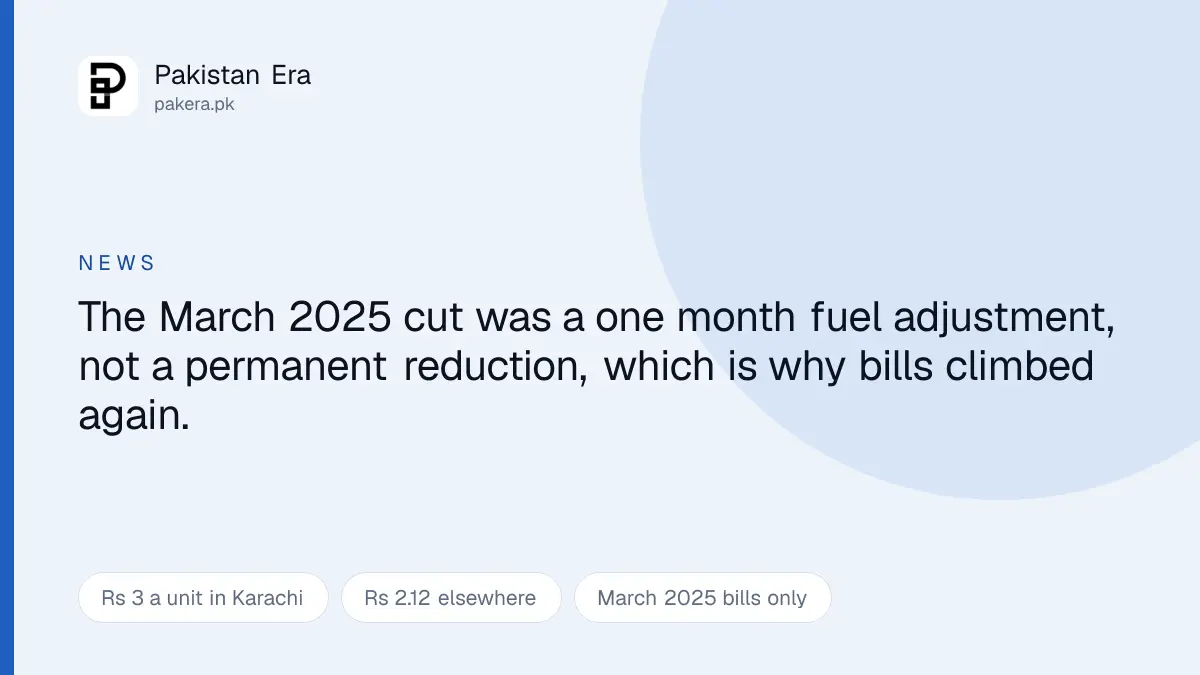
In March 2025, electricity bills in Pakistan fell. Karachi consumers got Rs 3 per unit off. Everyone else got Rs 2.12 per unit.
Then bills went back up, and a lot of people concluded they had been misled. They had not been. The reduction did exactly what it was designed to do, and the reason it did not last is in the mechanism, not in anyone's promise.
This page is a record of that month and of what followed. If you are looking for what your bill is doing right now, we have linked the current coverage further down.
What the March 2025 cut actually was
It was a monthly fuel cost adjustment. Not a base tariff cut.
| Consumers | Reduction | Derived from |
|---|---|---|
| Karachi, K-Electric | Rs 3.00 per unit | December 2024 monthly adjustment |
| Rest of Pakistan | Rs 2.12 per unit | January 2025 monthly adjustment |
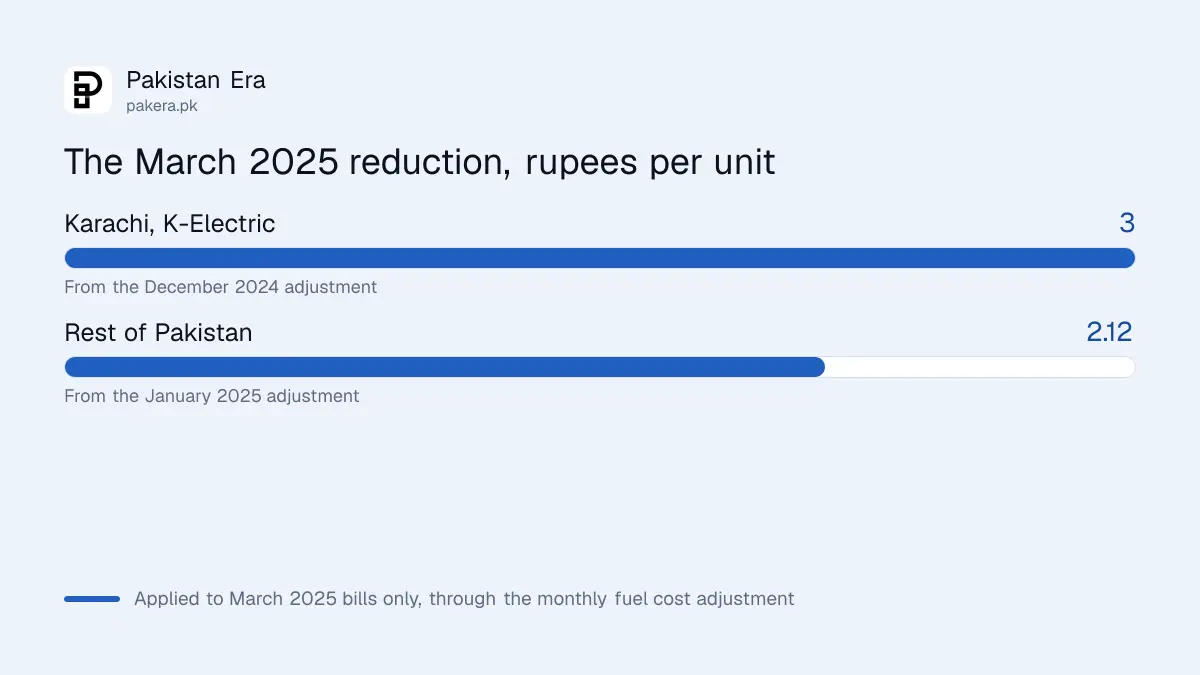
Both were applied to March 2025 bills. One month. When April's bills arrived, that line was gone, because a monthly adjustment is by definition monthly.
Three different things move your tariff, and they are not the same
This is the single most useful thing to understand about a Pakistani electricity bill, and it explains almost every "why did my bill jump" question.
- Monthly fuel cost adjustment. NEPRA reconciles what fuel actually cost against what was assumed, and passes the difference on in one month's bills. It can be negative, as in March 2025, or positive. It disappears the following month.
- Quarterly tariff adjustment. A larger true up, spread across the next three months of bills.
- Base tariff. The standing rate. This is the one that changes what you pay in a lasting way, and it moves through a formal determination.
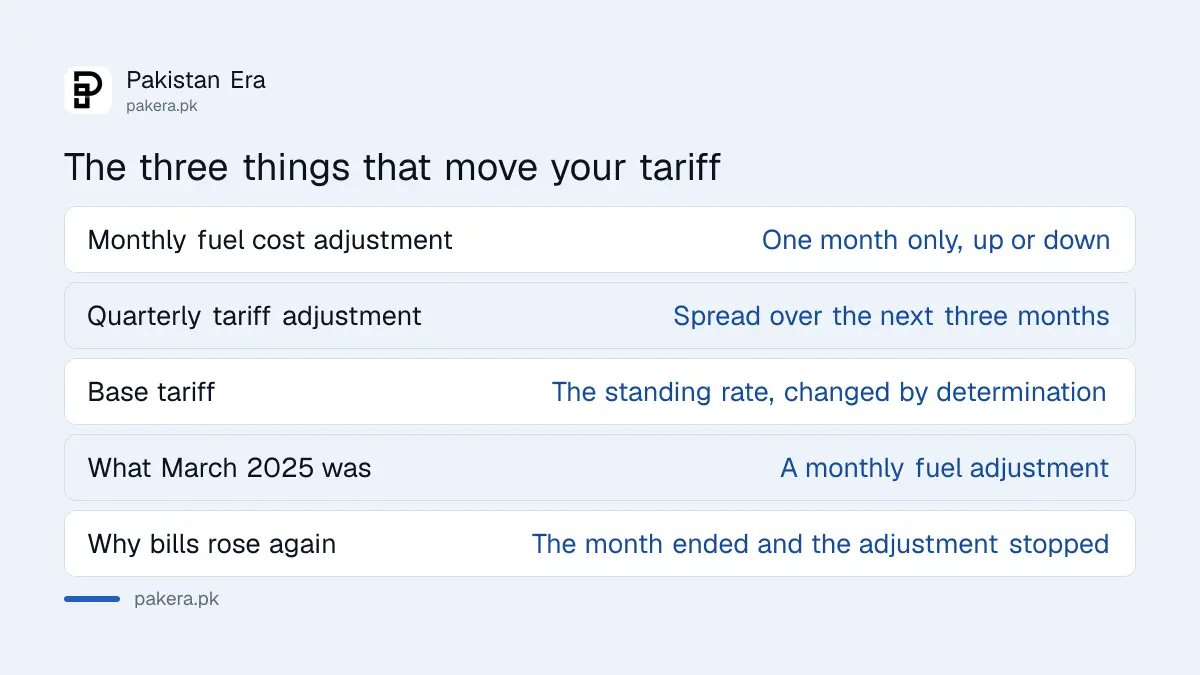
Headlines rarely distinguish between them. "Electricity prices reduced" reads the same whether the change lasts one month or several years, and the original version of this article did not make the distinction either. It should have. That is the correction this update exists to make.
What happened after March 2025
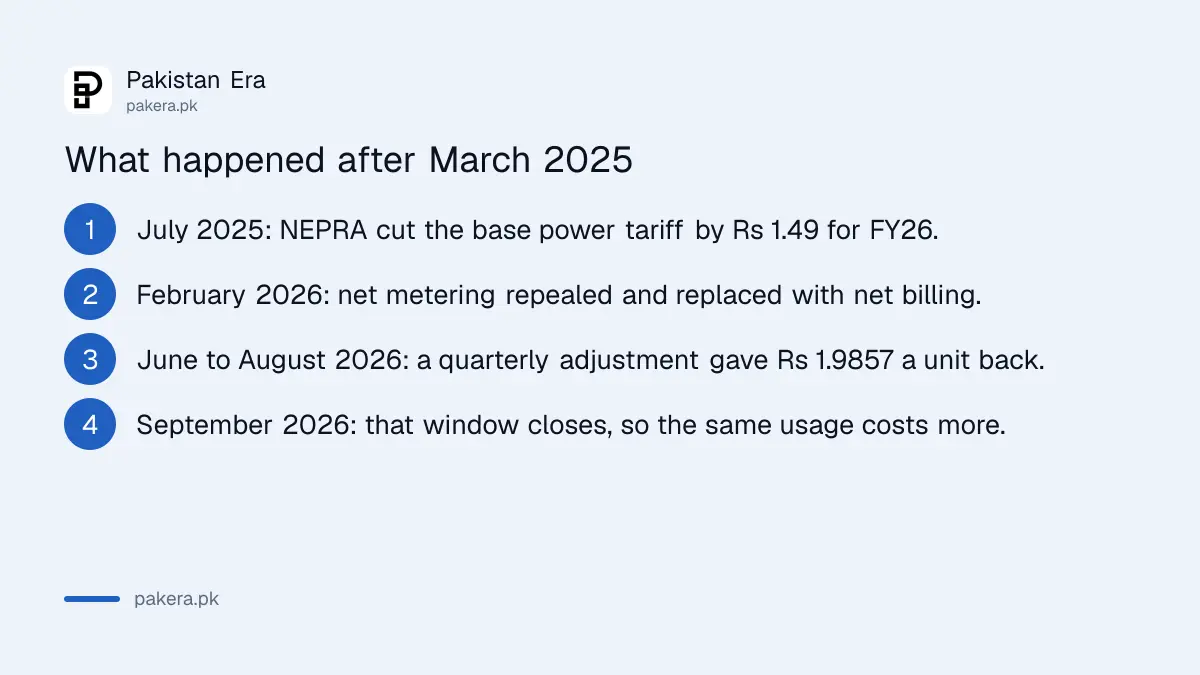
- July 2025. NEPRA cut the base power tariff by Rs 1.49 per unit for FY26. This one was a base change, so it lasted rather than expiring after a month.
- February 2026. NEPRA repealed net metering and replaced it with net billing. Solar owners stopped swapping exported units at par and started selling them at a wholesale rate.
- June to August 2026. A negative quarterly adjustment of Rs 1.9857 per unit, worth Rs 67.173 billion, applied across three months of bills.
- September 2026. That three month window closes. For the same units, a September bill costs more than an August one unless a fresh adjustment replaces it.
Where to look now
If your bill has just gone up and you are trying to work out whether it is an error or a policy change, the relief ending is the most likely explanation this month, and we set out what it is worth on different usage levels in the piece on the Rs 1.9857 discount ending with the August bill.
If you have solar or are thinking about it, the February 2026 change matters far more than any monthly adjustment, because it altered what your exported units are worth for the life of the agreement. That is covered in the guide to what solar export pays now.
How to read your own bill for this
The adjustments appear as their own lines, separate from the units and the taxes. Reading the lines rather than the total is the only way to see what changed.
- Find your units consumed, and compare that number month to month rather than comparing totals.
- Look for the fuel adjustment line. A negative figure is money off, a positive figure is money on.
- Look for the quarterly adjustment line separately. They are different entries.
- Then look at the total. If your units are flat and the total moved, the answer is in those lines.
Every distribution company publishes bills online against the reference number, and we walked through each portal in the guide to checking your electricity bill online.
The lesson from March 2025
A one month reduction is real money and worth having. It is just not a change in what electricity costs.
When you next see a headline announcing a cut, the question worth asking is which of the three mechanisms it came from. If it is a monthly fuel adjustment, plan for one month. If it is a quarterly adjustment, plan for three. If it is the base tariff, that is the one that actually changes your household budget.
Questions readers are asking
How much did electricity prices fall in March 2025?
Rs 3 per unit for Karachi consumers and Rs 2.12 per unit for consumers in the rest of Pakistan, applied to March 2025 bills.
Why did my bill go back up after March 2025?
Because it was a monthly fuel cost adjustment, which applies to a single billing month. When March's bills were done, the adjustment ended.
What is a monthly fuel cost adjustment?
NEPRA reconciles the actual cost of fuel used to generate electricity against what was assumed in the tariff, and passes the difference to consumers in one month's bills. It can reduce or increase the bill.
What is the difference between that and a base tariff cut?
A base tariff change alters the standing rate and lasts until it is changed again. A monthly adjustment lasts one month.
Are electricity prices lower now than in March 2025?
The base tariff was cut by Rs 1.49 per unit for FY26 in July 2025. Since then adjustments have moved in both directions, and the relief applied from June to August 2026 ends with the August bill.
Where can I see the current rate?
On your own bill, in the adjustment lines rather than the total, and through your distribution company's online bill portal.
About the author

Tax, Bills and Technology Writer
Ali Akhtar is a young and curious voice here at Pakistan Era. He is currently pursuing his A-Levels and has a growing interest in Pakistan’s changing industrial landscape and educational trends. Ali likes to write in a way that helps him explain and explore the world around him. His writing reflects the perspective of the new generation navigating the evolving trends of Pakistan where technology, youth innovation, and shifting opportunities are reshaping the country’s future.