Prepaid Electricity Meter Rate Per Unit in Pakistan 2026: All 5 Rates, and When Prepaid Is Cheaper
Prepaid electricity meter rate in Pakistan 2026: homes pay Rs 42.13 a unit flat, shops Rs 42.38. See all 5 prepaid rates and when prepaid beats normal slabs.
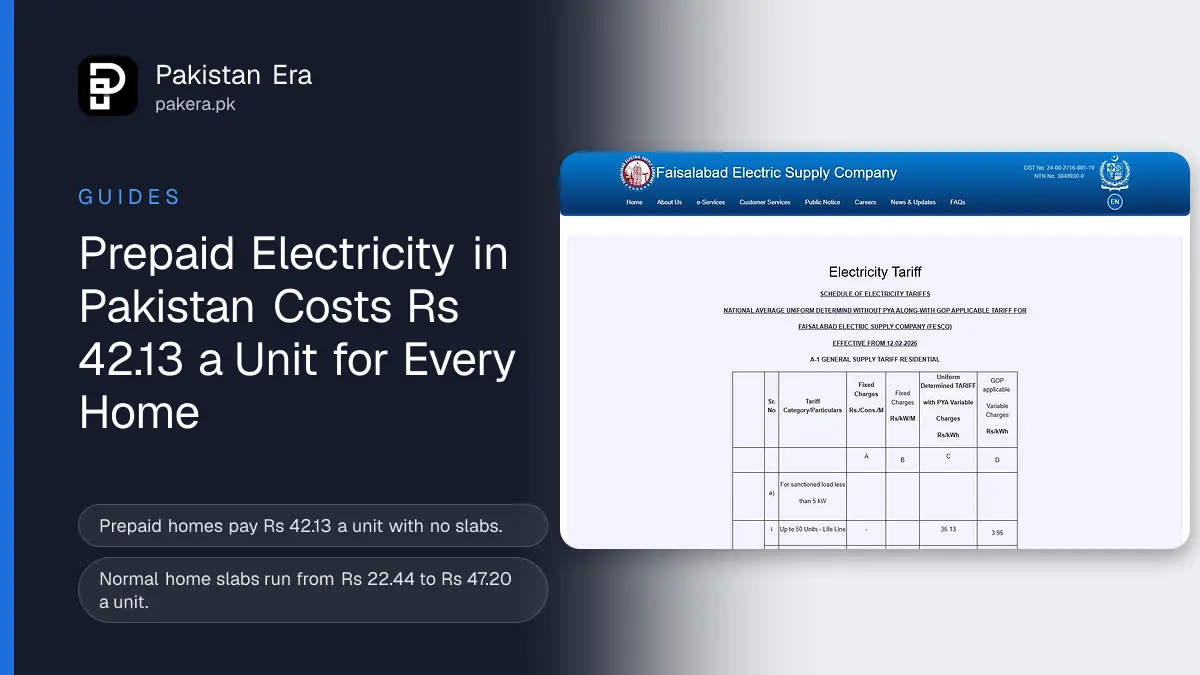
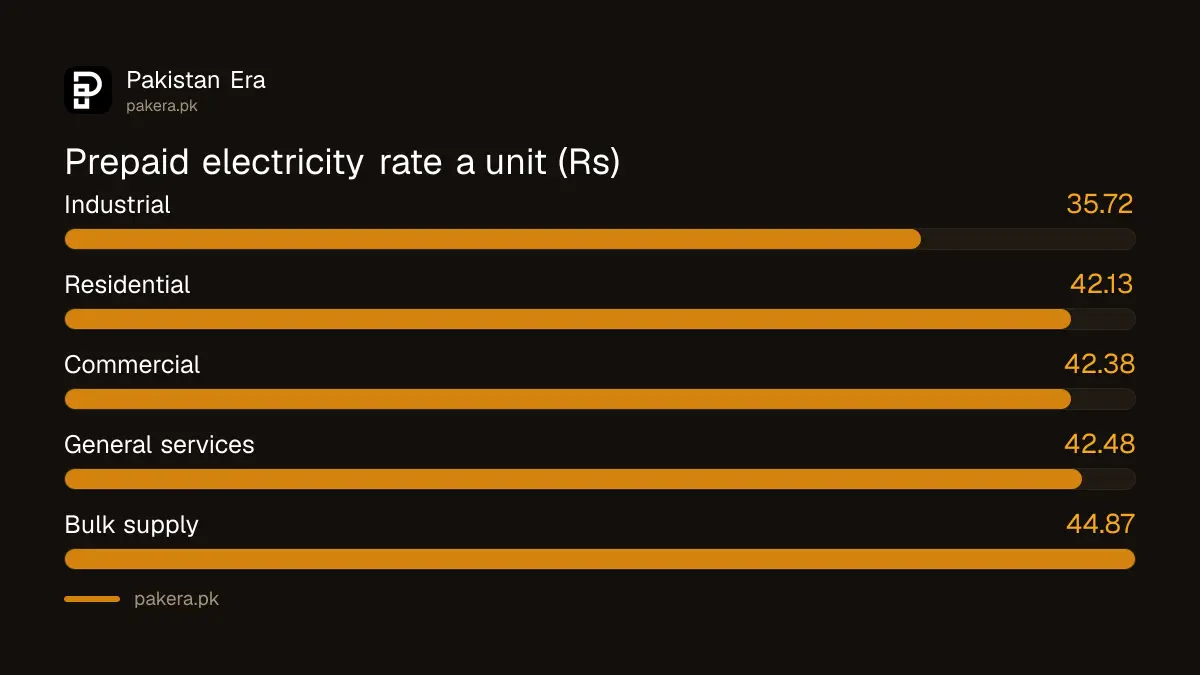
A prepaid electricity meter in Pakistan is charged a flat Rs 42.13 a unit for homes, Rs 42.38 for shops and Rs 42.48 for general services, on the government tariff schedule we read on FESCO's website on 8 November 2026. There are no slabs on a prepaid tariff. Every unit costs the same, whether you use 50 units or 900.
That one fact decides whether prepaid helps you. A normal home bill climbs through slabs from Rs 22.44 to Rs 47.20 a unit. A prepaid home pays Rs 42.13 for every unit. So prepaid costs more for most families and less only for very heavy users. Below are all five prepaid rates, the normal rates beside them, and worked bills at 250 and 800 units.
Prepaid electricity rates for every category in 2026
The schedule lists five prepaid tariffs. Homes pay Rs 42.13 a unit, shops Rs 42.38, general services Rs 42.48, industry Rs 35.72 and bulk supply Rs 44.87. Fixed charges still apply each month. These are the rates the government applies, before taxes and adjustments.
| Prepaid tariff | Rate a unit (Rs) | Fixed charge a month (Rs) |
|---|---|---|
| A-1(c) Residential | 42.13 | 675 per kW |
| A-2(e) Commercial | 42.38 | 1,250 per kW |
| A-3(b) General services | 42.48 | 1,000 |
| B Industrial | 35.72 | 1,250 per kW |
| C Bulk supply | 44.87 | 1,250 per kW |
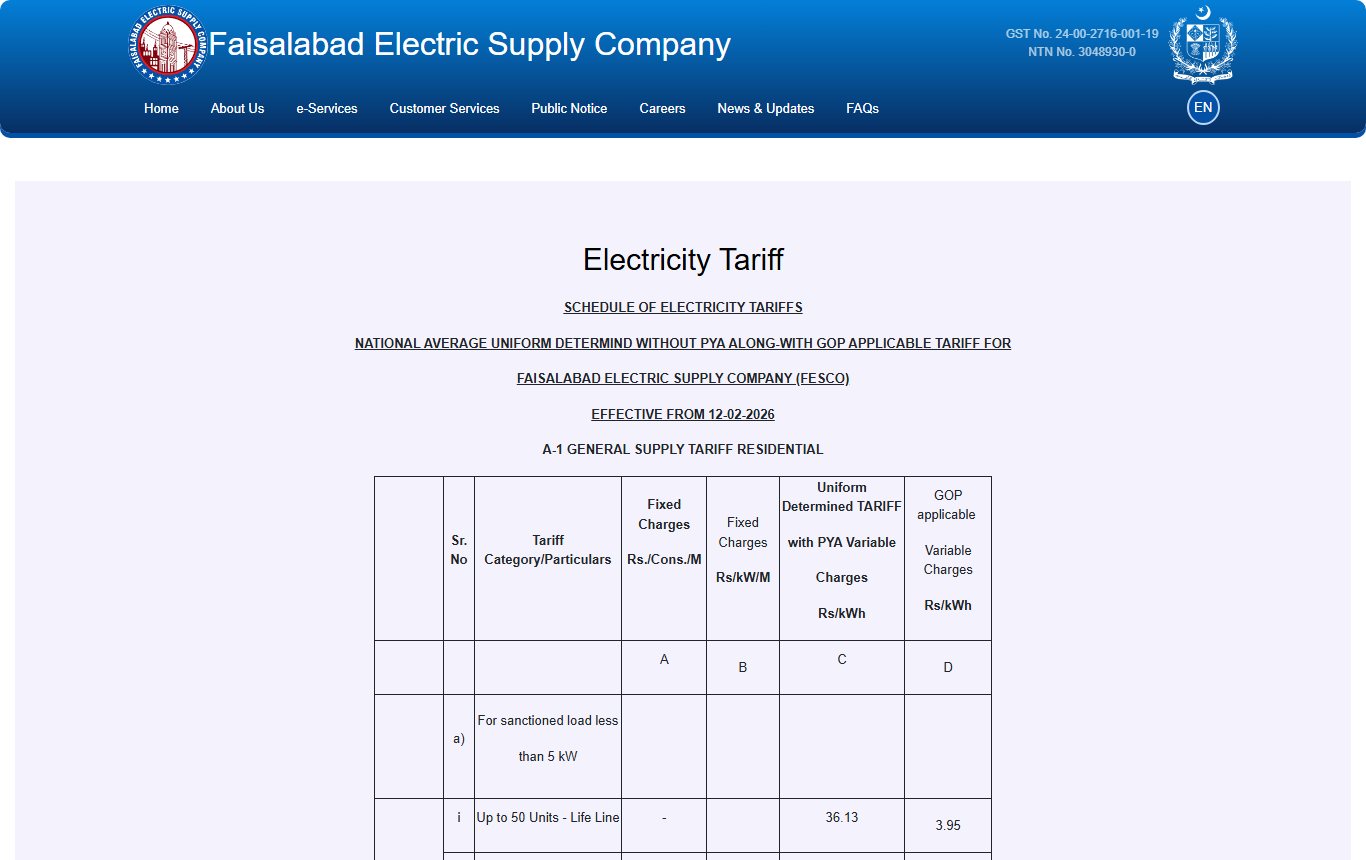
The schedule is titled "National average uniform determined without PYA along with GOP applicable tariff" and is effective from 12 February 2026. GOP applicable means the rate the government has told the company to charge. A second column on the page shows NEPRA's determined cost, which is lower for prepaid homes at Rs 35.03. You pay the GOP rate.
One small error sits on the page itself. The commercial prepaid row is labelled "Pre-Paid Residential Tariff" again, inside the A-2 commercial table. We read it as the commercial prepaid rate because of where it sits and its Rs 1,250 per kW fixed charge, which matches the other commercial rows.
Prepaid against normal slabs for a home
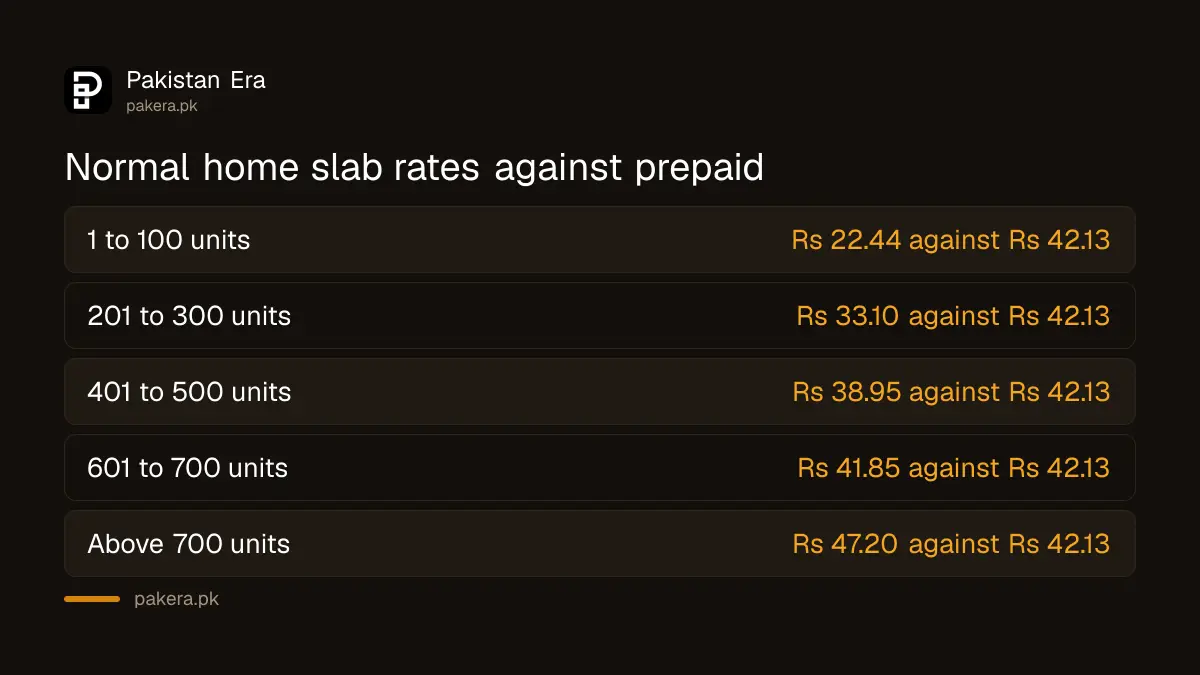
A normal home bill charges Rs 22.44 to Rs 47.20 a unit by slab, while a prepaid home pays Rs 42.13 flat. Prepaid is dearer in every slab up to 700 units, and cheaper only above 700 units a month, where the normal rate jumps to Rs 47.20.
These are the unprotected residential slabs from the same schedule, for homes with less than 5 kW sanctioned load. Unprotected homes pay one rate on all units, set by the slab their month falls in.
| Units in the month | Normal rate (Rs a unit) | Prepaid rate (Rs a unit) | Cheaper |
|---|---|---|---|
| 1 to 100 | 22.44 | 42.13 | Normal |
| 101 to 200 | 28.91 | 42.13 | Normal |
| 201 to 300 | 33.10 | 42.13 | Normal |
| 301 to 400 | 36.46 | 42.13 | Normal |
| 401 to 500 | 38.95 | 42.13 | Normal |
| 501 to 600 | 40.22 | 42.13 | Normal |
| 601 to 700 | 41.85 | 42.13 | Normal |
| Above 700 | 47.20 | 42.13 | Prepaid |
Protected homes have it even clearer. They pay Rs 10.54 to Rs 13.01 a unit on the normal tariff, so a protected home that moved to prepaid would pay more than three times as much a unit. You can read how protected status works in our 200 unit protected guide, and the full slab list in our electricity unit price guide.
Two worked bills at 250 and 800 units
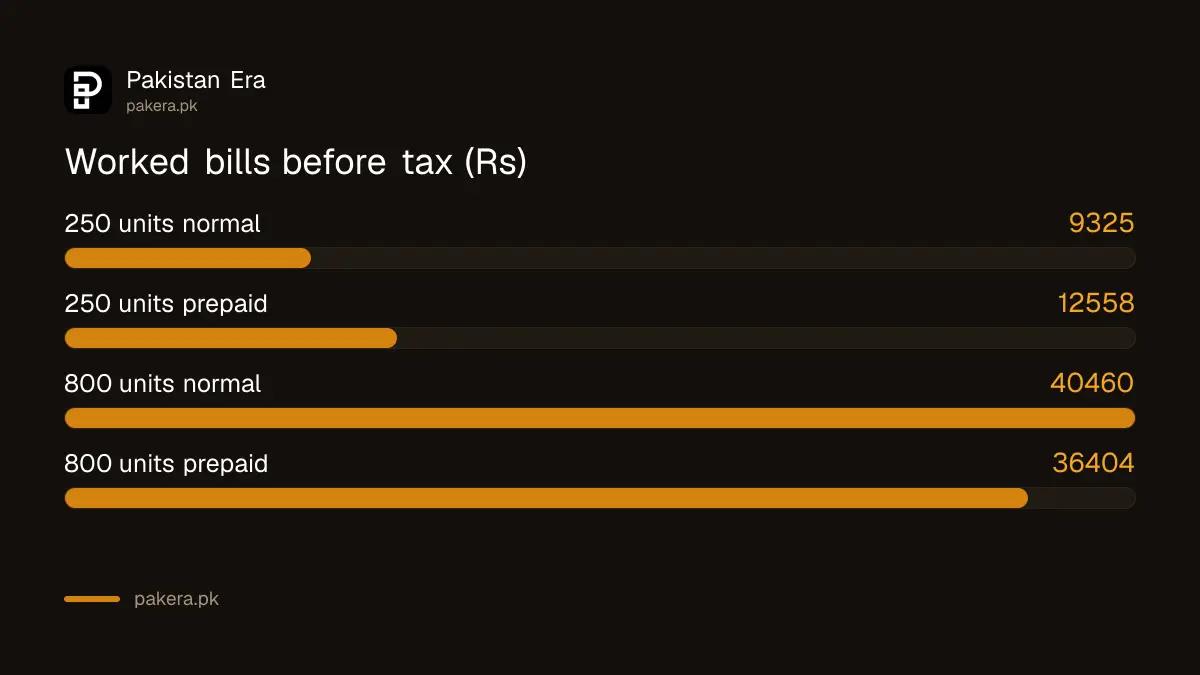
At 250 units with 3 kW sanctioned, a normal bill is about Rs 9,325 before tax and a prepaid one about Rs 12,558. At 800 units with 4 kW, prepaid is about Rs 4,056 cheaper. These sums are ours, from the schedule rates.
Here is how we worked them out, using only the energy charge and the fixed charge:
- 250 units, 3 kW, normal tariff: 250 units at Rs 33.10 is Rs 8,275. The fixed charge is Rs 350 a kW, so Rs 1,050. Total Rs 9,325.
- 250 units, 3 kW, prepaid: 250 units at Rs 42.13 is Rs 10,532.50. The fixed charge is Rs 675 a kW, so Rs 2,025. Total Rs 12,557.50.
- 800 units, 4 kW, normal tariff: 800 units at Rs 47.20 is Rs 37,760. The fixed charge is Rs 675 a kW, so Rs 2,700. Total Rs 40,460.
- 800 units, 4 kW, prepaid: 800 units at Rs 42.13 is Rs 33,704. The same Rs 2,700 fixed charge gives Rs 36,404.
So the family on 250 units would pay about Rs 3,233 more a month on prepaid. The family on 800 units would save about Rs 4,056. Real bills also carry fuel adjustment, quarterly adjustment, electricity duty, sales tax and, for non-filers, income tax. Our bill line items guide explains each one.
What the schedule says about fixed and minimum charges
Prepaid homes pay a Rs 675 per kW fixed charge each month, the same as the top normal slabs. Normal homes on the lower slabs pay Rs 200 to Rs 500 a kW. Fixed charges are based on sanctioned load, so a lower load means a lower charge.
The schedule adds a few rules that matter here:
- Fixed charges for normal homes are charged on sanctioned load.
- Where a home pays fixed charges, the minimum monthly charge of Rs 75 (single phase) or Rs 150 (three phase) does not apply.
- For commercial and industrial rows billed per kW, the charge is on 25 per cent of sanctioned load or the actual maximum demand, whichever is higher.
- Only protected homes get the benefit of one previous slab. Lifeline homes get no slab benefit.
If your sanctioned load is higher than you need, cutting it lowers the fixed charge on either tariff. Our guide to reducing sanctioned load shows how to apply.
How to get a prepaid meter, and what we could not confirm
FESCO's tariff page sets the prepaid rates but does not explain how a home switches to prepaid. We found no public application form for it. Ask your sub-division office whether prepaid metering is offered on your feeder before you plan around it.
Prepaid billing works with the newer smart meters, called AMI meters, which read and switch remotely. Our AMI smart meter guide covers what changes when one is installed. Before you ask for prepaid, do three checks:
- Add up your last 12 bills and find your average units a month.
- If the average is under 700 units, prepaid will cost you more on these rates.
- If you are a protected consumer, stay on the normal tariff.
We have not used a prepaid meter ourselves, and we have not confirmed how top-ups are sold. The rates above are as listed on 8 November 2026. They change when the government notifies a new schedule, so check the date on the tariff page before you decide.
Questions people ask about prepaid electricity rates
What is the prepaid electricity rate per unit in Pakistan?
For homes it is Rs 42.13 a unit, flat, on the schedule effective from 12 February 2026. Shops pay Rs 42.38 and general services Rs 42.48.
Is a prepaid meter cheaper than a normal meter?
Only for homes using more than 700 units a month. Below that, every normal slab rate is lower than Rs 42.13.
Do prepaid consumers pay fixed charges?
Yes. Prepaid homes pay Rs 675 per kW a month and prepaid shops Rs 1,250 per kW, on the same schedule.
Can a protected consumer use a prepaid meter?
The schedule does not say a protected home cannot. But the protected rates of Rs 10.54 and Rs 13.01 are far below the prepaid Rs 42.13, so it would cost much more.
Are prepaid rates the same in every company?
The schedule is called national average uniform, so the government rate is the same across the former WAPDA companies. K-Electric has its own rate page.
Do taxes apply on top of the prepaid rate?
The schedule lists only the energy and fixed charges. Taxes, duty and adjustments are added on the bill, as they are for normal meters.
Last checked 8 November 2026. Source: Faisalabad Electric Supply Company, Electricity Tariff page, schedule effective from 12 February 2026.
About the author

Tax, Bills and Technology Writer
Ali Akhtar is a young and curious voice here at Pakistan Era. He is currently pursuing his A-Levels and has a growing interest in Pakistan’s changing industrial landscape and educational trends. Ali likes to write in a way that helps him explain and explore the world around him. His writing reflects the perspective of the new generation navigating the evolving trends of Pakistan where technology, youth innovation, and shifting opportunities are reshaping the country’s future.