K-Electric Per Unit Price 2026: Every Slab Rate for Homes and Shops in Karachi (Full List)
K-Electric's 2026 home rates run from Rs 22.44 to Rs 47.20 a unit, with Rs 10.54 for protected users. See every slab, shop rates and what is added to your bill.
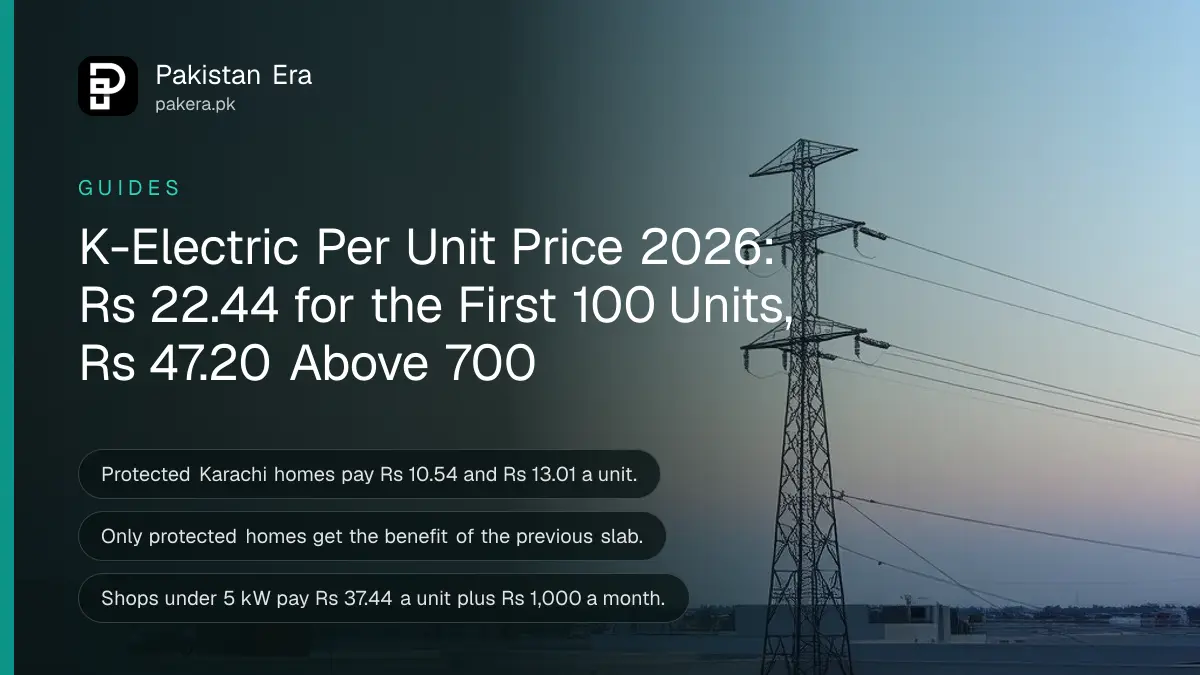
K-Electric's per unit price for homes in 2026 runs from Rs 22.44 for the first 100 units to Rs 47.20 above 700 units, while protected homes pay Rs 10.54 and Rs 13.01 and lifeline homes Rs 3.95 and Rs 7.74. These are the base rates in the federal government's February 2026 tariff notification, before fuel charges, taxes and duty. Karachi pays exactly the same base rates as the rest of Pakistan.
We read the K-Electric schedule ourselves in S.R.O. 279(I)/2026 of 12 February 2026, Annex-C, titled "GoP Applicable Schedule of Tariff for K-Electric Consumers". K-Electric's own tariff page links the same notification. Every slab, the commercial rates and what gets added on top are below.
K-Electric's home slab rates for 2026
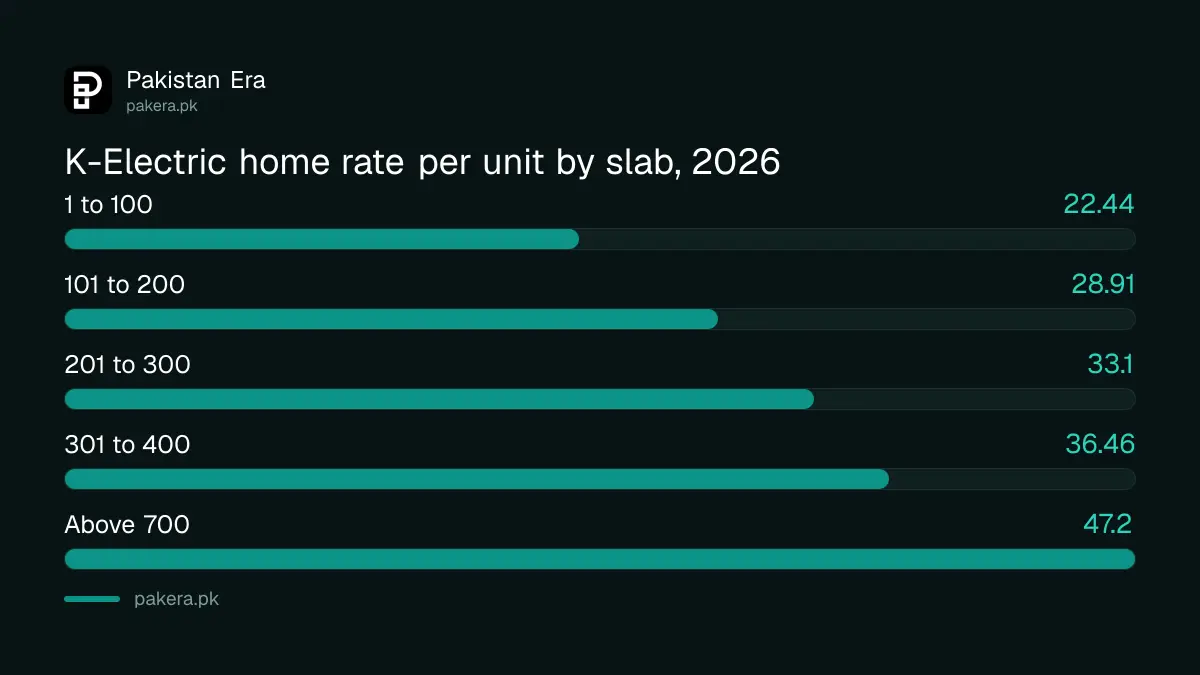
An unprotected Karachi home pays Rs 22.44 a unit up to 100 units, rising slab by slab to Rs 47.20 above 700 units. Protected homes pay Rs 10.54 or Rs 13.01. Fixed charges of Rs 200 to Rs 675 per kW of sanctioned load are added each month.
| Units in the month | Rate per unit | Fixed charge per kW a month |
|---|---|---|
| Lifeline, up to 50 | Rs 3.95 | none |
| Lifeline, 51 to 100 | Rs 7.74 | none |
| Protected, 1 to 100 | Rs 10.54 | Rs 200 |
| Protected, 101 to 200 | Rs 13.01 | Rs 300 |
| 1 to 100 | Rs 22.44 | Rs 275 |
| 101 to 200 | Rs 28.91 | Rs 300 |
| 201 to 300 | Rs 33.10 | Rs 350 |
| 301 to 400 | Rs 36.46 | Rs 400 |
| 401 to 500 | Rs 38.95 | Rs 500 |
| 501 to 600 | Rs 40.22 | Rs 675 |
| 601 to 700 | Rs 41.85 | Rs 675 |
| Above 700 | Rs 47.20 | Rs 675 |
| Time of Use, peak | Rs 46.85 | |
| Time of Use, off-peak | Rs 34.53 | Rs 675 |
| Temporary residential | Rs 52.89 | Rs 675 |
The rates are the same as the national schedule in electricity unit price in Pakistan 2026. That is not a coincidence. The government applies one uniform tariff across the country, and why Karachi is billed this way is explained in K-Electric's uniform tariff.
Unprotected homes pay every unit at the rate of their slab
Only protected homes get the benefit of the previous slab. An unprotected home that uses 250 units pays all 250 at Rs 33.10, not the first 100 at Rs 22.44. So crossing a slab line by one unit can raise the whole bill sharply.
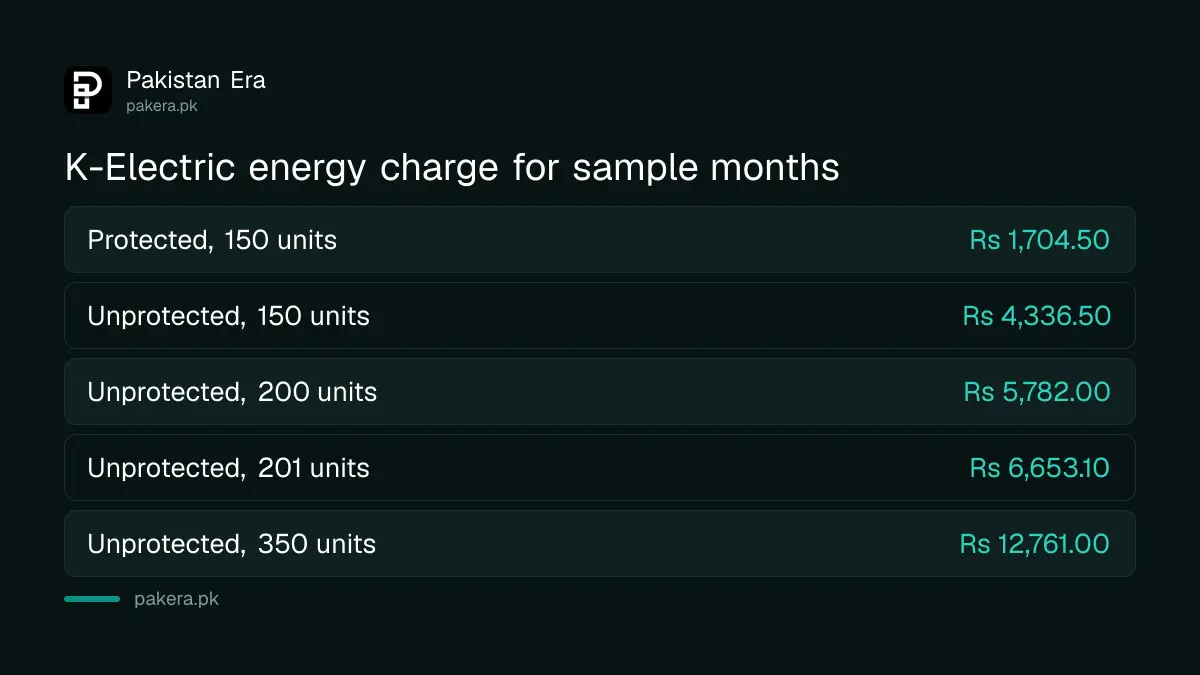
That rule is printed under the residential schedule in the February 2026 notification: only protected residential consumers get the benefit of one previous slab. Here is what it means in rupees, before fixed charges, tax and adjustments:
| Example month | How it is worked out | Energy charge |
|---|---|---|
| Protected, 150 units | 100 x Rs 10.54 + 50 x Rs 13.01 | Rs 1,704.50 |
| Unprotected, 150 units | 150 x Rs 28.91 | Rs 4,336.50 |
| Unprotected, 200 units | 200 x Rs 28.91 | Rs 5,782.00 |
| Unprotected, 201 units | 201 x Rs 33.10 | Rs 6,653.10 |
| Unprotected, 350 units | 350 x Rs 36.46 | Rs 12,761.00 |
Look at 200 against 201 units. One extra unit adds Rs 871.10 to the energy charge, by our arithmetic. If your meter is close to 200, 300 or 400 near the reading date, switching off a heater or a geyser for a few days is real money.
Who counts as protected or lifeline on a K-Electric bill
K-Electric's tariff terms define a protected home as a non Time of Use residential consumer using 200 units or less every month for the past six months. A lifeline home has a single phase connection with sanctioned load up to 1 kW and at most 100 units a month.
The lifeline test looks back a full year. Under K-Electric's terms, the highest month of the last twelve and the current month must both stay at or under 100 units. One month at 101 units and the cheap lifeline rate is gone for a year.
Homes with a sanctioned load of 5 kW or more go on a Time of Use meter. They pay Rs 46.85 in peak hours and Rs 34.53 off-peak. From November to March, K-Electric's peak runs from 6 pm to 10 pm, as set out in K-Electric peak hours. Losing protected status, and how the six month rule works, is covered in the 200 unit protected rule.
Shops and offices pay Rs 37.44 to Rs 39.76 a unit
A Karachi shop or office with sanctioned load under 5 kW pays Rs 37.44 a unit plus a fixed Rs 1,000 a month. At 5 kW and above the rate is Rs 39.76, or Rs 43.82 peak and Rs 35.15 off-peak on a Time of Use meter, with Rs 1,250 per kW.
| Commercial and other categories | Rate per unit | Fixed charge |
|---|---|---|
| Commercial, under 5 kW | Rs 37.44 | Rs 1,000 a month |
| Commercial, 5 kW and above | Rs 39.76 | Rs 1,250 per kW |
| Commercial Time of Use, peak / off-peak | Rs 43.82 / Rs 35.15 | Rs 1,250 per kW |
| Temporary commercial | Rs 53.44 | Rs 5,000 a month |
| EV charging station | Rs 23.57 | none |
| General services | Rs 42.48 | Rs 1,000 a month |
Fuel charges, duty and tax are added on top
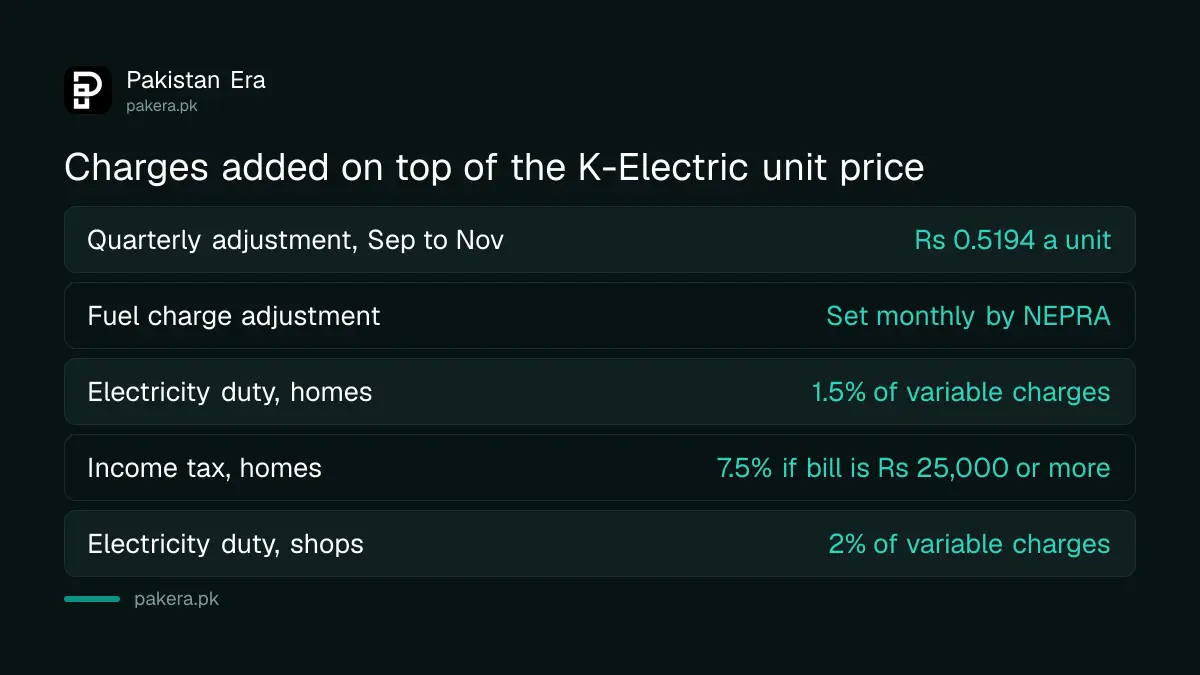
The slab rate is only the base. A K-Electric bill also carries the monthly fuel charge adjustment, the quarterly adjustment, electricity duty, sales tax and, for some homes, income tax. Each is worked out separately and shown as its own line.
- Quarterly adjustment: NEPRA's S.R.O. 1501(I)/2026 adds Rs 0.5194 a unit to K-Electric bills for September, October and November 2026. Lifeline homes are exempt.
- Fuel charge adjustment: NEPRA sets one figure for K-Electric and the state companies each month. Lifeline homes are exempt. The history is in FCA in electricity bills for 2026.
- Electricity duty: K-Electric's tariff page lists 1.5 per cent of variable charges for homes and 2 per cent for commercial users.
- Income tax: homes pay 7.5 per cent when the monthly bill is Rs 25,000 or more, unless the consumer is on FBR's active taxpayer list.
- Sales tax: charged under the Sales Tax Act, 1990. K-Electric's page does not print the rate.
For a 250 unit unprotected month, the energy charge is Rs 8,275. The quarterly adjustment adds Rs 129.85 and electricity duty about Rs 124 on top, by our arithmetic, before sales tax and fixed charges.
Common questions
What is the K-Electric per unit price in 2026?
For unprotected homes, Rs 22.44 for 1 to 100 units up to Rs 47.20 above 700 units, before taxes and adjustments.
Is the K-Electric unit price different from LESCO or IESCO?
No. The February 2026 notification gives K-Electric the same uniform base rates as the state companies.
What is the K-Electric rate for 200 units?
Rs 13.01 for the 101 to 200 slab if you are protected, and Rs 28.91 for every unit if you are not.
What is the K-Electric commercial unit price?
Rs 37.44 a unit for loads under 5 kW and Rs 39.76 for 5 kW and above, plus fixed charges.
Do lifeline consumers pay the fuel charge?
No. NEPRA's fuel charge decisions and the current quarterly adjustment exclude lifeline consumers.
Has the K-Electric tariff changed since February 2026?
The base slab rates have not. Monthly fuel charges and quarterly adjustments have been added on top.
How we verified this
What we checked, where we read it, and what we could not confirm.
On 1 November 2026 we read Annex-C of S.R.O. 279(I)/2026 of 12 February 2026, a scanned notification posted on K-Electric's site, page by page. We also read the slab benefit note under its residential schedule, K-Electric's tariff structure page for duty, income tax and peak hours, K-Electric's posted tariff terms (Annex-VI) for the protected and lifeline definitions, NEPRA's S.R.O. 1501(I)/2026 of 7 September 2026 for the quarterly adjustment and NEPRA's August 2026 fuel charge decision for its exclusions. Every worked example is our own arithmetic. We could not confirm the sales tax rate from K-Electric's page.
About the author

Global Affairs & Political Economy Writer
Muhammad Hatim is a book lover who started writing because he enjoys it. At Pakistan Era he writes about international relations, geopolitics and the global economy, with a particular interest in South Asia and the forces behind current events.