How to Search the Registration Office and Get a Certified Copy of a Property Deed in Pakistan
Anyone can inspect Book 1 of a registration office after paying the fee and get a signed, sealed copy of a deed. Learn what you can see, and what stays private.
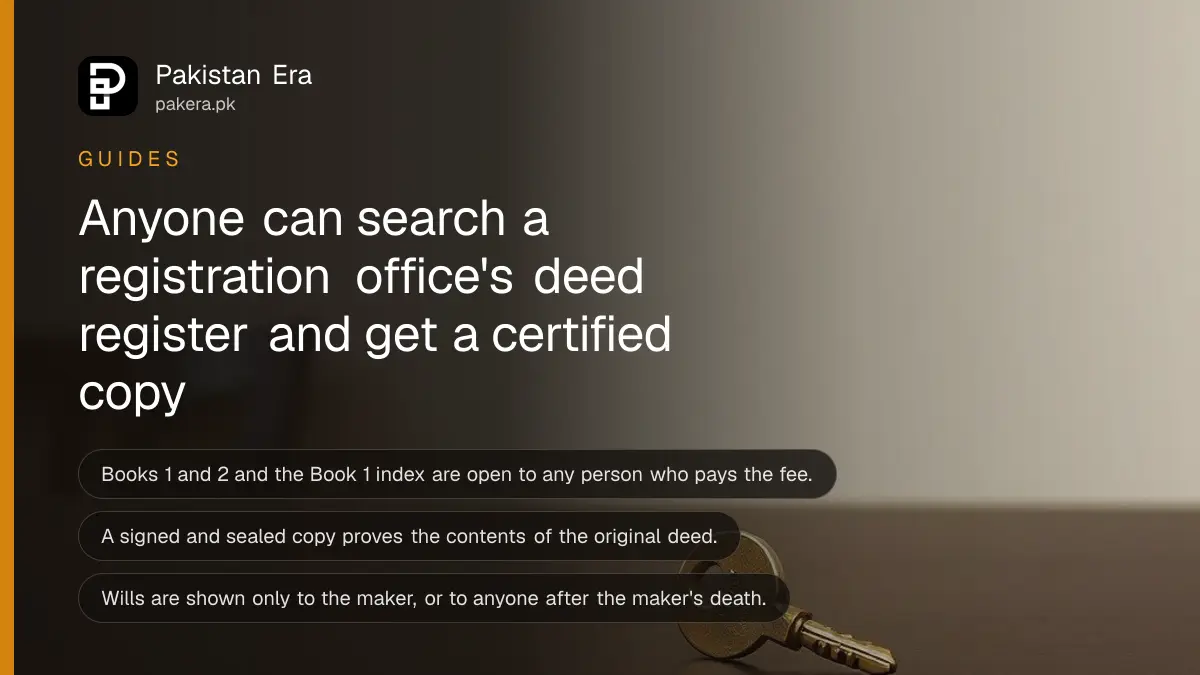
Short answer: Under section 57 of the Registration Act, 1908, anyone can inspect Book No. 1 of a registration office, which holds registered property deeds, and its index, after paying the fee. The registering officer gives a signed and sealed copy of any entry that you can use as proof of the original.
Before you buy a plot, a quick search of the register can show whether the seller already sold or mortgaged it. After you buy, a certified copy replaces a lost deed. Both rights come from the same section of the Registration Act.
We read the Registration Act, 1908 on the Pakistan Code (pakistancode.gov.pk), the federal text, on 14 October 2026. The Act sets who can look and what they get. Each province sets the fee, and some provinces now offer online copies. For Punjab's online route, read how to download an old property registry in Punjab.
The office keeps five books for deeds, wills and refusals
Section 51 says every registration office keeps Book 1 for non-will deeds about immovable property, Book 2 for reasons of refusal, Book 3 for wills, and Book 4 for a miscellaneous register. Registrar offices also keep Book 5, the register of deposited wills.
Book 1 is the one buyers care about. Every deed registered about immovable property is copied or filed there, numbered in a series that starts afresh each year (section 53). Each entry has a number such as 1234 of 2024, which you can quote when you ask for a copy.
The office also keeps four indexes. Index No. I lists the names of all persons executing and claiming under each Book 1 deed. Index No. II lists property details. Section 54 says indexes are kept up to date as entries are made.
Book 1, Book 2 and their index are open to anyone
Section 57(1) says Books No. 1 and 2 and the indexes relating to Book 1 are at all times open to inspection by any person who applies, after paying the fee. Copies of entries in those books are given to all persons who ask.
That means you do not need to be a party to the deed. A buyer, a bank officer or a neighbour can ask. You do not need the seller's consent to search, which is why a search is a strong check. Book 2 shows deeds that were refused, with the reasons.
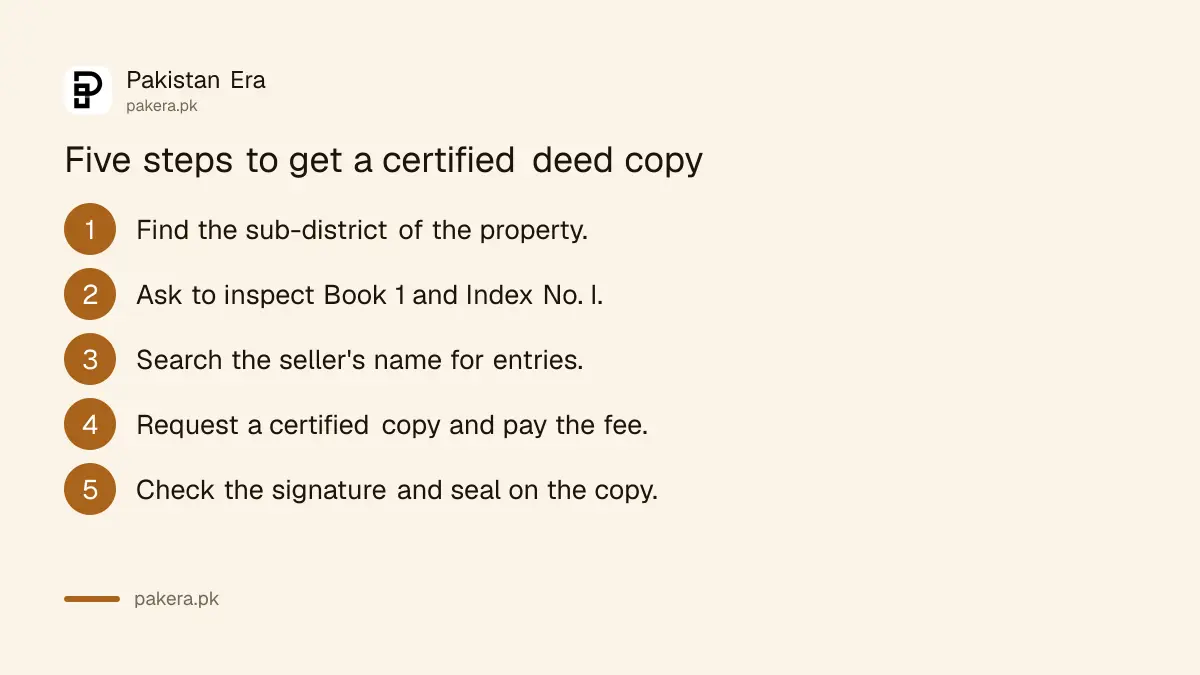
- Find out which sub-district the property is in, since land deeds go to the office of that sub-district.
- Go to the Sub-Registrar's office and ask to inspect Book 1 and Index No. I.
- Search the seller's name, and note any entry number that touches the property.
- Ask for a certified copy of each entry you need, and pay the posted fee.
- Check the copy carries the officer's signature and seal.
A certified copy proves the original deed
Section 57(5) says every copy given under the section is signed and sealed by the registering officer and is admissible to prove the contents of the original document. A certified copy therefore works in a bank, a land office or a court when the original is lost.
Ask for the copy to carry the entry number, the Book number and the year. A photocopy of your own copy is not the same. Only the sealed copy from the registering officer counts under the Act.
If your own deed is in your hands, compare it with the entry. The Act requires that every document admitted to registration be copied in the book without unnecessary delay, in order of admission (section 52). A deed with no matching entry deserves a close look. Our page on how to verify a property's title before you buy lists the other checks.
Wills are treated differently
Entries in Book 3 are not open to everyone. Section 57(2) gives copies to the persons who executed the will or their agents. After the maker has died, but not before, copies go to any person who applies. Book 4 entries go only to those executing or claiming under them.
For Books 3 and 4 the search must be made only by the registering officer himself (section 57(4)). Index No. III names the executors of a will, and names of persons claiming under it only after the testator's death. A stranger cannot find out what you left to whom while you live.
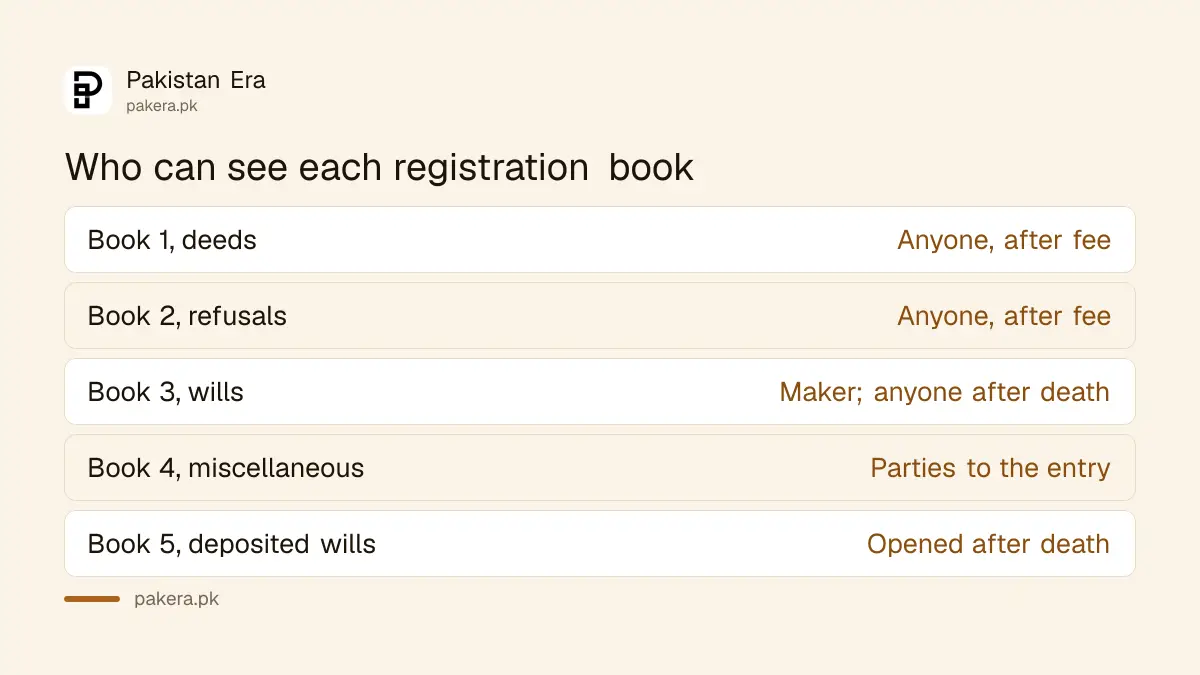
| Book | What it holds | Who can inspect or get copies |
|---|---|---|
| Book 1 | Registered deeds about immovable property | Anyone, after paying the fee |
| Book 2 | Reasons for refusal to register | Anyone, after paying the fee |
| Book 3 | Wills and authorities to adopt | The maker or agent; anyone after the maker's death |
| Book 4 | Miscellaneous documents | Persons executing or claiming under the entry |
| Book 5 | Deposited wills, at Registrar offices | Opened only on application after death |
What a register search cannot tell you
A clean Book 1 does not prove that the seller owns the land. Land records such as the fard and the mutation entries live in the revenue office, not the registration office. A deed shows a transaction took place. It does not show the current owner on its own.
Check both. For the revenue side, read how to read a land fard. For other provinces, see our pages on KP land records and land records in Balochistan.
An unregistered agreement will not appear in Book 1 at all. Under section 49, a document that must be registered but is not does not create a right in immovable property. A buyer may still hold a claim in a court, so a missing entry is not the whole story.
Fees and online options differ by province
Section 78 leaves the fee table for searches and copies to each provincial government, and section 79 requires the table to be published and displayed in every registration office. We did not find a single national figure. Ask to see the displayed table before you pay.
The Act dates from 1908 and speaks of inspection at the office. Some provinces and the Islamabad capital now run online services on top of it. For Islamabad, see how to start a sale deed registration on the PAK App.
Common questions
Can I search a property's registry record without the owner's consent?
Yes. Section 57(1) opens Books 1 and 2 and the Book 1 index to any person who applies and pays the fee. You need no link to the property.
How do I get a certified copy of a lost sale deed?
Apply at the Sub-Registrar's office where it was registered, quoting the entry number, year and names. Pay the fee. The officer gives a signed and sealed copy that proves the original's contents.
Is a certified copy accepted in court?
Section 57(5) says it is admissible to prove the contents of the original document. A court may still ask about other matters, such as ownership.
Can I see someone's will in the register?
Not while the maker is alive. Copies of Book 3 entries go to the maker or his agent, and after death to any person who applies.
Does the register show who owns the land now?
No, only registered deeds. The revenue record shows the owner on record. Check both before you pay.
What does the search cost?
It depends on the province. The Act leaves the fee table to each provincial government and requires it to be displayed in the office. We did not find a single figure.
How we verified this
What we checked, where we read it, and what we could not confirm.
Last checked 14 October 2026. We read sections 49, 51 to 55, 57, 78 and 79 of the Registration Act, 1908 on pakistancode.gov.pk. This is the federal text. We did not find current search or copy fees for any province, and we did not test any online portal for this step. Confirm both at your Sub-Registrar's office.
About the author

Tax, Bills and Technology Writer
Ali Akhtar is a young and curious voice here at Pakistan Era. He is currently pursuing his A-Levels and has a growing interest in Pakistan’s changing industrial landscape and educational trends. Ali likes to write in a way that helps him explain and explore the world around him. His writing reflects the perspective of the new generation navigating the evolving trends of Pakistan where technology, youth innovation, and shifting opportunities are reshaping the country’s future.