How to Read a Land Fard in Pakistan: Khewat, Khatooni, Khasra and Intiqal
Learn what Fard, Khewat, Khatooni, Khasra and Intiqal mean on a Pakistani land record, how to read it in five steps and which red flags to check before you buy.
Short answer: A Fard is the certified extract of the land register. Read five things on it first: the Khewat number, which holds the ownership share, the Khatooni number, which shows who holds and uses the land, the Khasra number, which is the field or plot itself, the Intiqal number of the last transfer, and the area in kanal and marla.
A seller hands you a Fard and says everything is clear. You look at the page and see a grid of numbers and Urdu terms. Without knowing them, you cannot tell a clean record from a risky one.
This guide explains the terms in plain English. The National IT Board (NITB) names the Khewat, Khatooni and Khasra numbers as the land details a digital Fard carries in Islamabad, and its own notice explains Fard and Mutation (Intiqal). We read those notices on 12 October 2026. The detailed meanings below come from standard revenue practice, which can differ a little between provinces, so check your own Fard against them.
The five terms on a Fard that matter most
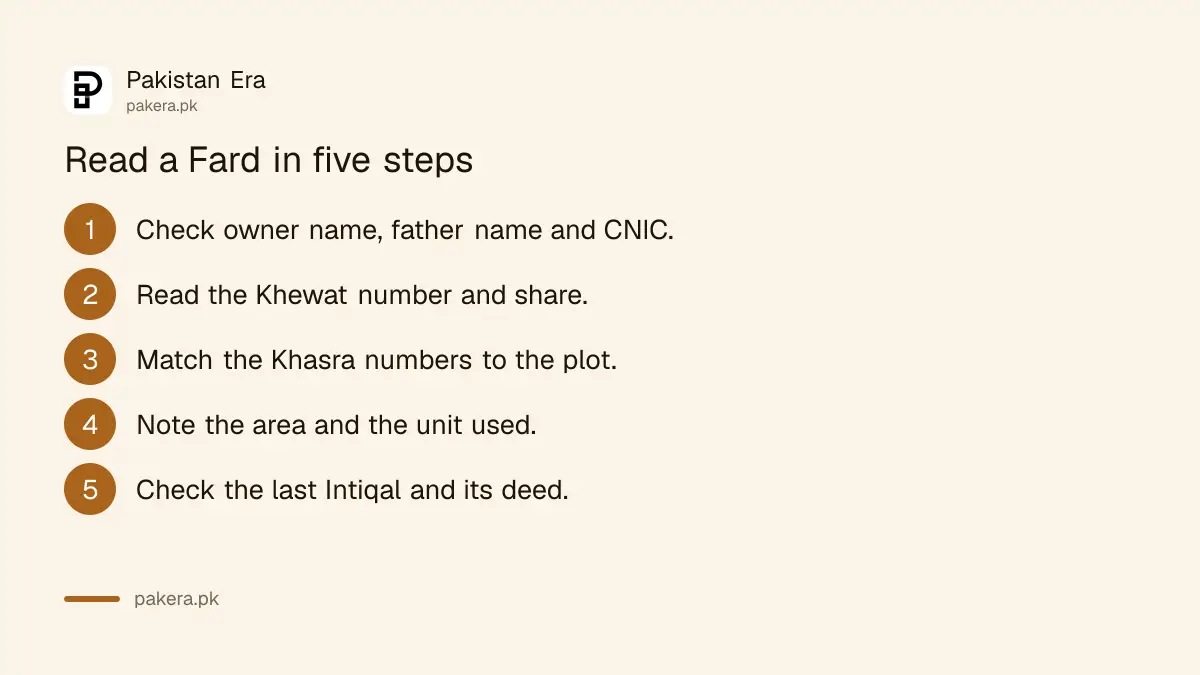
Khewat is the owner's entry in the register. Khatooni is the holding entry that shows who possesses and uses the land. Khasra is the number of the individual field or plot. Intiqal is the mutation, the record of a change in ownership. Fard is the extract that shows them together.
| Term | Plain meaning | Why it matters to a buyer |
|---|---|---|
| Fard | Certified extract of the land register for one owner or plot | The paper banks and offices ask for |
| Khewat | Owner's entry and share in the register | Shows who owns and in what share |
| Khatooni | Holding entry: who possesses and cultivates | Shows who is actually on the land |
| Khasra | Number of the field or plot on the map | Ties the paper to one piece of ground |
| Intiqal | Mutation, the entry of a transfer | Shows when and how the owner changed |
How to read a Fard in five steps
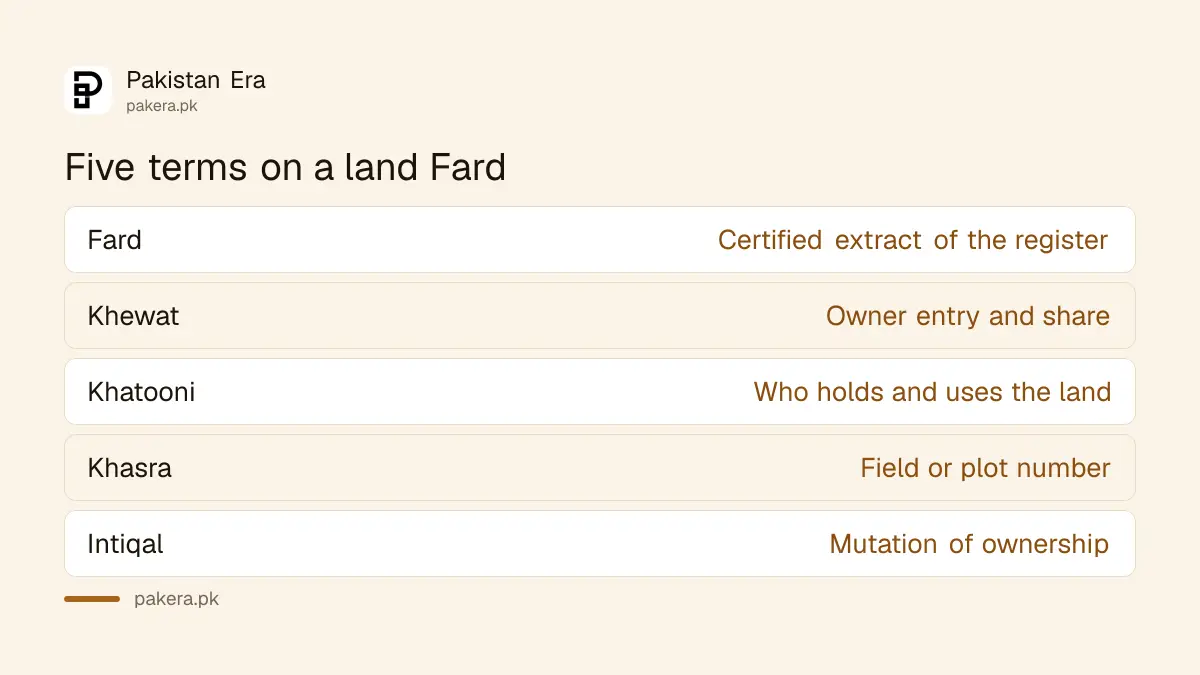
Start with the owner's name and CNIC, then the Khewat share, then the Khasra numbers, then the area, then the last Intiqal. Match each one with the papers the seller shows you. A single mismatch is a reason to stop and ask before you pay.
- Read the owner's name, father's name and CNIC. They must match the seller's CNIC.
- Read the Khewat number and the share. A share such as 1/2 means a joint owner exists who must also agree to a sale.
- Read the Khasra numbers and check them against the plot you are visiting.
- Read the area. Note whether it is written in kanal and marla or in acres.
- Read the last Intiqal number and date. Ask for the registered deed that supports it.
Area units: kanal, marla and acre
In Punjab land records, 1 kanal is 20 marla, and 1 acre is 8 kanal. A revenue marla is 272.25 square feet, so a kanal is 5,445 square feet. Housing societies and some cities use a different marla, so always ask which one a quoted area uses.
| Unit | Square feet | Relation |
|---|---|---|
| 1 marla | 272.25 | One twentieth of a kanal |
| 1 kanal | 5,445 | 20 marla |
| 1 acre | 43,560 | 8 kanal |
A seller who sells "5 marla" in a private scheme may mean 225 square feet each. That is 1,125 square feet instead of 1,361. Ask for the figure in square feet and write it on the agreement.
Common red flags on a Fard
Three signs should slow you down: a joint owner who is not at the table, a Khatooni that names a different person in possession, and a recent Intiqal with no deed behind it. Each can mean a dispute, a tenant or a pending sale to someone else.
Our guide on verifying land records before you pay adds the portal checks. If you find a spelling or area mistake, correcting a land record in Punjab is free. For how an inherited share reaches the register, see transferring inherited land in Punjab.
A Fard shows the register, not the ground. Visit the plot, speak to neighbours, and ask who is farming or living on it.
Where to get a Fard in each part of Pakistan
Each province runs its own system. Punjab uses the Punjab Land Records Authority, Sindh has its online land record portal, Khyber Pakhtunkhwa has its own record service, Balochistan issues a Fard through district offices, and Islamabad has a digital Fard on PAK App.
- Punjab: see how to get a Fard of your land in Punjab.
- Sindh: see checking Sindh land records online.
- Khyber Pakhtunkhwa: see checking KP land records online.
- Balochistan: see checking land records in Balochistan.
- Islamabad: see getting a Fard on PAK App.
Common questions
What is the difference between Khewat and Khatooni?
Khewat is the owner's entry and share. Khatooni is the holding entry that shows who possesses and uses the land. The owner and the user can be different people.
What is a Khasra number?
It is the number of one field or plot on the revenue map. It ties the paper record to one piece of ground.
What does Intiqal mean on a Fard?
Intiqal means mutation. It is the entry that records a change of ownership, whether by sale, gift or inheritance.
Is a Fard proof of ownership?
No, not on its own. It shows what the register says. Ownership rests on a registered deed or a valid inheritance, so ask for the deed behind the entry.
Is a marla always 272.25 square feet?
No. 272.25 is the revenue marla. Some housing societies and cities use other sizes, so ask for the area in square feet.
How we verified this
What we checked, where we read it, and what we could not confirm.
We read NITB's notices on Islamabad land records on 12 October 2026, at nitb.gov.pk. They name the Khewat, Khatooni and Khasra numbers and the terms Fard and Mutation (Intiqal). The meanings and unit conversions above reflect standard revenue practice, and we could not read a definition list on an official page. Terms and layouts differ by province, so read your own Fard and ask the revenue office.
About the author

Public Services and Education Journalist
Fajr Riaz is a journalist and content writer at Pakistan Era, based in Lahore. She covers the questions people meet in everyday life in Pakistan: how a public service works, what a change in the rules means, and where to find a reliable answer.