SBP Cuts Home Loan Paperwork in Pakistan: Banks Can Ask Only Listed Property Papers
SBP's 9 October 2026 circular limits home loan property papers to a fixed list, allows solar loans with no security and accepts Green Property Certificates.
Short answer: on 9 October 2026 the State Bank of Pakistan (SBP) told banks they may ask a home loan customer for only the property documents on a fixed SBP list, not "all" title papers. The same circular lets banks give solar and other renewable-energy finance with no security at all, and confirms that a property with a Punjab Green Property Certificate needs no extra ancestral ownership papers.
The change came in SH&SFD Circular No. 06 of 2026, which amends Regulation HF-7 of the housing finance rules. We read the circular and its two-page Annexure B on the SBP website on 10 October 2026, and compared the new wording line by line with the version SBP issued on 18 August 2026. Here is what changed for borrowers.
SBP limits home loan paperwork to a fixed list from 9 October 2026
Banks and DFIs (development finance institutions) must now collect only the title and ownership documents listed in Annexure B of the circular. Until now the rule said "all" title documents, which left each bank free to add its own demands. The new list sets the papers by property type and stage.
That one word matters more than it looks. Home loan applicants in Pakistan have long complained about banks asking for old chains of sale deeds, extra NOCs and papers the land office no longer issues. Under the new HF-7, the list is the ceiling.
The circular is signed by Dr. Muhammad Saleem, Director of SBP's SME, Housing and Sustainable Finance Department, and is addressed to the heads of all banks and DFIs. It does not give a later start date, so it applies from the date of issue, 9 October 2026. Paragraph 4 says all other instructions stay the same.
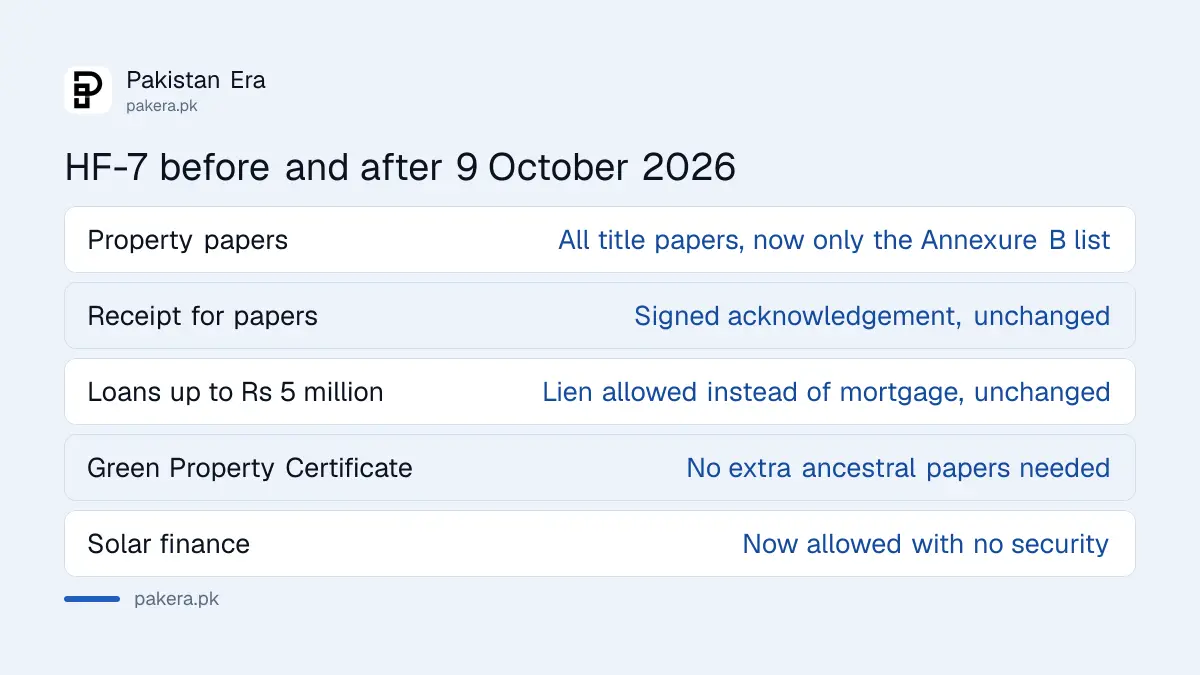
Four rules changed or were confirmed in the new HF-7
The new HF-7 changes the document demand, frees renewable-energy loans from security, and widens the Green Property Certificate route. Two rules stay as they were: the signed receipt for your papers, and the Rs 5 million lien option.
| Rule | HF-7 of 18 August 2026 | HF-7 from 9 October 2026 |
|---|---|---|
| Property documents | Bank takes "all" title and ownership documents | Bank takes only the documents listed in Annexure B |
| Receipt for documents | Signed acknowledgement listing every paper | Same, still required |
| Loans up to Rs 5 million | Lien in the land record allowed instead of a full mortgage | Same, still allowed |
| Green Property Certificate | Mentioned for loans up to Rs 5 million | Accepted, and no extra ancestral or separate ownership papers needed |
| Solar and renewable-energy finance | Against the installed equipment or another security the bank accepts | Without any security, or against the installed equipment |
A lien is a note placed on the property in the land record office's books. It stops the owner selling or mortgaging the property again until the bank is paid. It is cheaper and quicker than a registered mortgage, which is why SBP allows it for smaller loans.
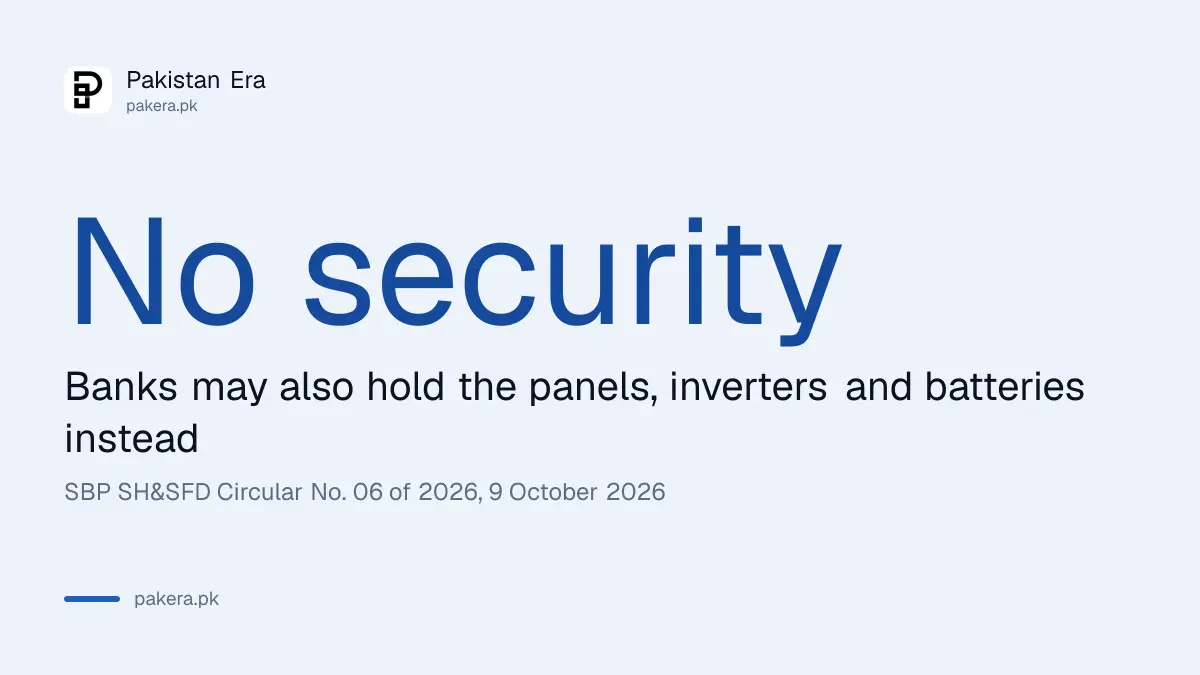
Solar loans can now be given with no security
Renewable-energy finance under the housing rules may now be extended without any security. Banks can still choose to hypothecate the panels, inverters and batteries, meaning they hold a charge over that equipment. The old fallback of "any other alternate security" is gone.
This is a permission, not an order. A bank can still decline a solar loan, or ask for the equipment as security. But a bank can no longer point to SBP rules as the reason it needs your house papers or a guarantor for a small rooftop system.
If you are comparing offers, the rates and limits banks publish for solar finance are in solar loans from Pakistani banks compared. Expect banks to update their own product rules over the coming weeks.
Annexure B sets the papers for 10 property types
Annexure B, titled "Standardized and Simplified Documentation for Housing Finance", lists the papers for 10 kinds of property. Each has three columns: an open plot to build on, a house under construction, and a completed house or flat.
The 10 property types are:
- Urban development authority property
- Urban housing society
- Urban private housing scheme
- Urban revenue or freehold land
- Urban special or legacy record property
- DHA plot, house or apartment
- Cantonment or Military Estates Office (MEO) leasehold
- Rural revenue property
- Government housing scheme
- Evacuee Trust Property
A typical open plot in a development authority scheme needs five papers: the allotment or transfer letter, possession certificate, site plan, permission to mortgage (PTM) and a lien marking letter. For a built house, the approved building plan is added, plus a completion certificate where one applies. Revenue land swaps the allotment letter for the registered sale deed, the fard (ownership record) and a "fard for loan".
We have set out every column in the home loan document list for each property type, so you can match it against what your bank asks for.
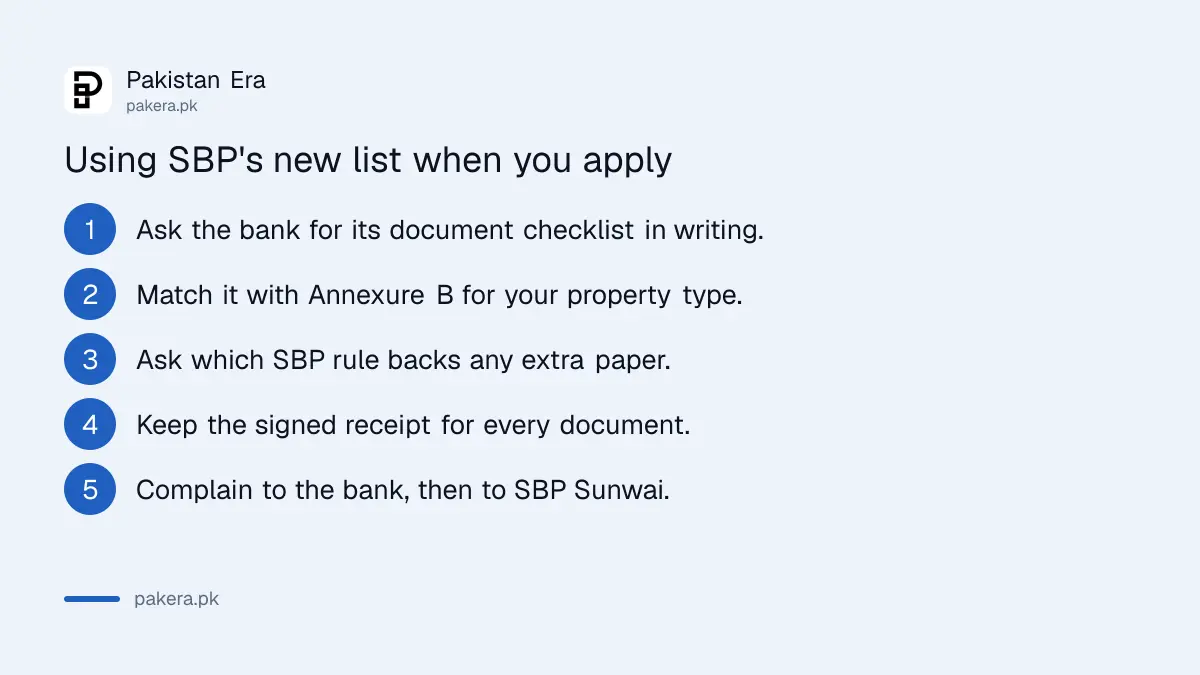
What home loan applicants should do now
Ask your bank for its document checklist in writing, then compare it with Annexure B for your property type. If the bank wants papers outside the list, ask which SBP rule it relies on. Keep the signed acknowledgement it must give you for every document.
A few practical points. The rule covers title and property documents only. Income proof, the application form and the credit report are governed by other regulations, which we explained in SBP's home loan eligibility rules. Those did not change on 9 October.
Annexure B also lets a bank ask a Military Estates Office for "any other document" needed to perfect a mortgage on cantonment land. So the list is not completely closed for that one type.
If a bank refuses to follow the list, complain to the bank first. If it does not resolve the matter, you can take it to SBP through the SBP Sunwai complaint portal. Quote "SH&SFD Circular No. 06 of 2026" so the complaint is routed correctly.
The change also helps anyone using the government's subsidised scheme. The Apna Ghar programme rules already relaxed some housing finance regulations, and the new HF-7 applies to all housing finance, scheme or not.
Common questions
When does SBP's new home loan document rule start?
It applies from 9 October 2026, the date of SH&SFD Circular No. 06 of 2026. The circular gives no later start date and tells banks to comply.
Can my bank still ask for extra property papers?
For title and ownership papers, the bank should ask only for what Annexure B lists for your property type. The one stated exception is cantonment land, where the Military Estates Office may need other documents.
Do I need a mortgage for a home loan under Rs 5 million?
Not always. For housing finance up to Rs 5 million, banks may mark a lien in the land record instead of a full mortgage. The bank decides which route to use.
What is a Green Property Certificate?
It is a certificate issued by the Government of Punjab that verifies title, ownership and possession. SBP says a property with one needs no extra ancestral or separate ownership documents for a home loan.
Will every bank give a solar loan without security now?
No. SBP now allows it, but each bank still sets its own credit policy. Some may keep asking for the panels and inverters as security.
How we verified this
What we checked, where we read it, and what we could not confirm.
Last checked on 10 October 2026. We read SH&SFD Circular No. 06 of 2026 of 9 October 2026 and its Annexure B on the State Bank of Pakistan website, and compared it with Regulation HF-7 in the Housing Finance Prudential Regulations 2026 issued with SH&SFD Circular No. 04 of 2026 on 18 August 2026. Bank product terms are not covered by the circular and may change separately.
About the author

Senior Writer, Public Services and Technology
Shahid joined us in 2024 as an author. He is a senior contributor to Pakistan's leading technology websites. He writes detailed articles, mostly covering his expertise in the latest tech, mobiles, apps, gadgets, and step-by-step guides. His ideology is to help people understand the latest trends and explain complex methods through very easy-to-understand guides.