Home Loan Documents in Pakistan: SBP's Fixed List for Every Property Type
SBP's Annexure B fixes the property papers a bank can ask for a home loan in Pakistan. See the list for plots, houses, DHA, revenue and cantonment land.
Short answer: since 9 October 2026, a bank in Pakistan should ask for only the property papers on the State Bank's Annexure B list for your type of property. For an open plot in a development authority or housing society, that is five papers: allotment or transfer letter, possession certificate, site plan, permission to mortgage and a lien marking letter. A built house adds the approved building plan and, where it applies, a completion certificate.
The list comes from SH&SFD Circular No. 06 of 2026, which rewrote Regulation HF-7 of the housing finance rules. We read its two-page annexure on the State Bank of Pakistan (SBP) website on 10 October 2026 and set it out below by property type, so you can gather the right papers before you apply.
The SBP list covers 10 property types and 3 stages
Annexure B sorts property into 10 types, from development authority plots to Evacuee Trust land. For each it gives three columns: an open plot to build on, a house under construction, and a completed house or flat. Your bank should use the column that fits your loan.
Start by placing your property. A plot in a city development authority scheme, a cooperative society or a private scheme with an allotment letter is usually in the first three types. Land held through the revenue record, with a fard and a registered sale deed, is "revenue or freehold". DHA, cantonment and Evacuee Trust property each have their own rows.
The rule covers title and ownership papers only. Your income proof, application form and credit report sit under other rules, which we explained in SBP's home loan eligibility rules.
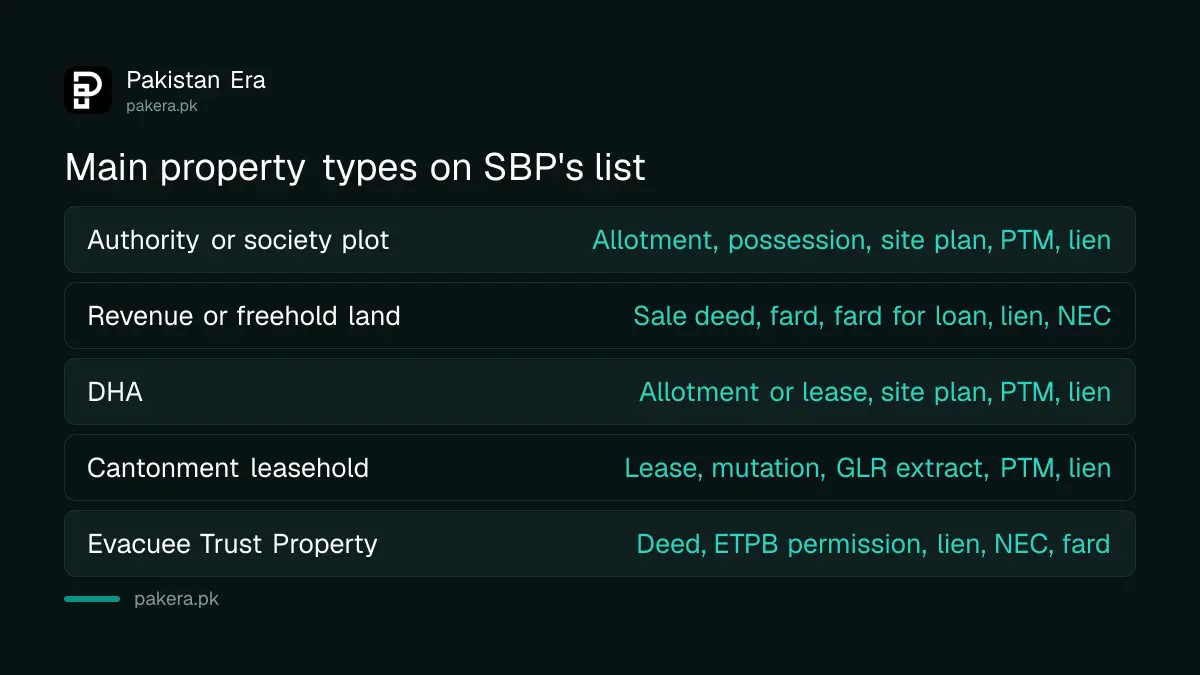
Papers needed for an open plot, by property type
For an open plot, most scheme-based property needs five papers, while revenue land needs six, built around the fard and the sale deed. The table follows Annexure B's open plot column. "Where applicable" means only if that paper exists for your property.
| Property type | Papers for an open plot |
|---|---|
| Development authority or housing society | Allotment letter (first owner) or transfer letter, possession certificate, site plan, permission to mortgage (PTM), lien marking letter |
| Private housing scheme | The same five, plus registered sale deed and a non encumbrance certificate (NEC) where applicable |
| Urban revenue or freehold | Registered title or sale deed, fard (ownership record), site plan or aks-e-shajra, fard for loan, lien marking letter, NEC |
| Urban legacy record | Title document in the present owner's name, city survey record, possession or property identification, succession papers where applicable, PTM, NEC where applicable |
| DHA | Allotment, transfer or lease document, site plan where applicable, PTM, lien marking letter |
| Cantonment or MEO leasehold | Lease or sub-lease, mutation or transfer record, sale or transfer deed, PTM where required, General Land Register (GLR) extract, lien marking letter, site plan |
| Rural revenue property | Latest title or sale deed, current revenue record, aks-e-shajra, demarcation report, fard for loan, lien marking letter, NEC |
| Government housing scheme | Allotment order, possession order or certificate, site plan, PTM, lien marking letter |
| Evacuee Trust Property | Allotment order, sale, title or transfer deed, Evacuee Trust Property Board permission to mortgage, lien marking letter, site plan, NEC, fard |
Annexure B's columns are printed tightly and some rows share entries marked "-do-" (ditto). We read the development authority and housing society rows as sharing one list. If your bank reads it differently, ask it to show you the annexure line it relies on.
A house under construction or a finished house adds two papers
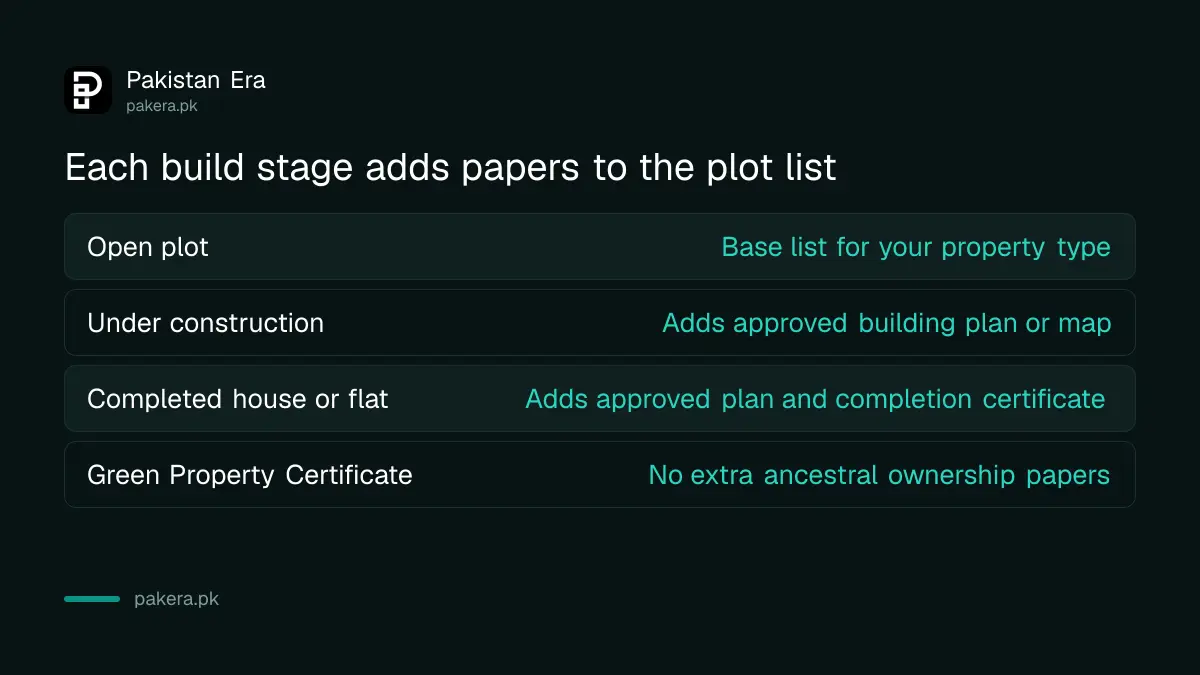
For a house under construction, the bank adds the approved building plan or map. For a completed house or flat, it adds the approved plan and a completion certificate where the authority issues one. The rest of the list stays the same as the open plot column.
Some rows add one more item for built property. Rural revenue property in the completed column lists a demarcation or qabza (possession) report for a joint khata, meaning land shared by several owners in one record. Cantonment property may also need any further document the Military Estates Office (MEO) asks for to perfect the mortgage.
Short names on the list, explained
Most of the confusing items are short forms. PTM is the owner's permission from the authority or society to mortgage the property. NEC confirms no loan or charge already sits on it. A lien marking letter records the bank's claim in the land record.
- Fard is the land ownership extract from the revenue record. In Punjab you can get a fard online or at a land record centre.
- Fard for loan (fard baraye rehn) is a fard issued specifically so the land can be pledged to a lender.
- Aks-e-shajra is the copy of the field map that shows where your plot sits.
- GLR extract is the General Land Register entry for cantonment land.
- Green Property Certificate is a Government of Punjab certificate that verifies title, ownership and possession together.
If your property has a Green Property Certificate, SBP says no extra ancestral, historical or separate ownership papers are needed. Other provinces can issue an equivalent certificate.
How to use the list before you apply
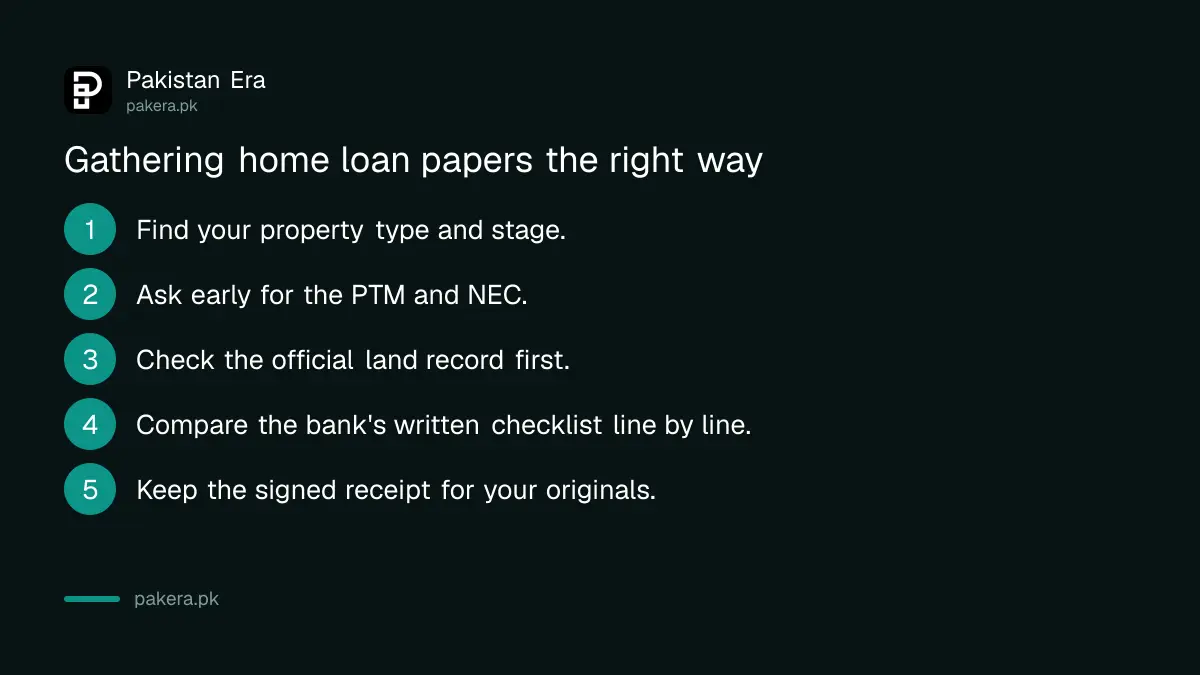
Gather the papers for your type and stage first, then ask the bank for its checklist in writing and compare. Anything outside Annexure B needs a reason. The bank must also give you a signed receipt listing every document it takes.
- Find your property type and stage in the table above.
- Collect the papers from the society, authority or land record office that issues them. Ask for the PTM and NEC early, since they come from a third party.
- For land records outside Punjab, check the record first: Sindh land records online and the KP land record check show what the official file says.
- Ask the bank for its written checklist and compare it line by line.
- Get the signed acknowledgement when you hand over originals, and keep it safe.
For loans up to Rs 5 million, the bank may simply mark a lien in the land record instead of a full mortgage, which saves time and registration cost. That choice is the bank's.
If the bank keeps asking for papers outside the list, raise a complaint with it first and then with SBP. What changed on 9 October, including solar loans without security, is set out in SBP's new HF-7 home loan rule.
Common questions
How many property documents does a home loan need in Pakistan?
Usually five to eight, depending on property type and stage. A development authority open plot needs five; a completed house adds the approved plan and a completion certificate where applicable.
Is a registry required for a home loan on a society plot?
Not for development authority or housing society plots on SBP's list, which use the allotment or transfer letter. A registered sale deed is listed for private schemes and revenue land.
What is a lien marking letter?
It is the letter recording the bank's claim on the property in the authority's or land office's record. It stops a second sale or loan until the bank is repaid.
Does the SBP list include salary slips and bank statements?
No. Annexure B covers title and ownership papers only. Income documents are set by a different housing finance regulation.
Can a bank refuse a loan even if I have every paper?
Yes. The list limits which property papers a bank can demand. It does not force a bank to lend, and credit checks still apply.
How we verified this
What we checked, where we read it, and what we could not confirm.
Last checked on 10 October 2026. We read SH&SFD Circular No. 06 of 2026 of 9 October 2026 and its Annexure B, "Standardized and Simplified Documentation for Housing Finance", on the State Bank of Pakistan website. The table is our transcription of the annexure's open plot column; where the printed layout was unclear we say so above. The plain-English meaning of each short form is our explanation, not SBP's wording.
About the author

Senior Writer, Public Services and Technology
Shahid joined us in 2024 as an author. He is a senior contributor to Pakistan's leading technology websites. He writes detailed articles, mostly covering his expertise in the latest tech, mobiles, apps, gadgets, and step-by-step guides. His ideology is to help people understand the latest trends and explain complex methods through very easy-to-understand guides.