How to File a 22-A Petition in Pakistan When Police Refuse Your FIR
How to file a 22-A petition in Pakistan: the three grounds in Section 22-A(6) CrPC, who hears it, the documents to attach and why petitions get dismissed.
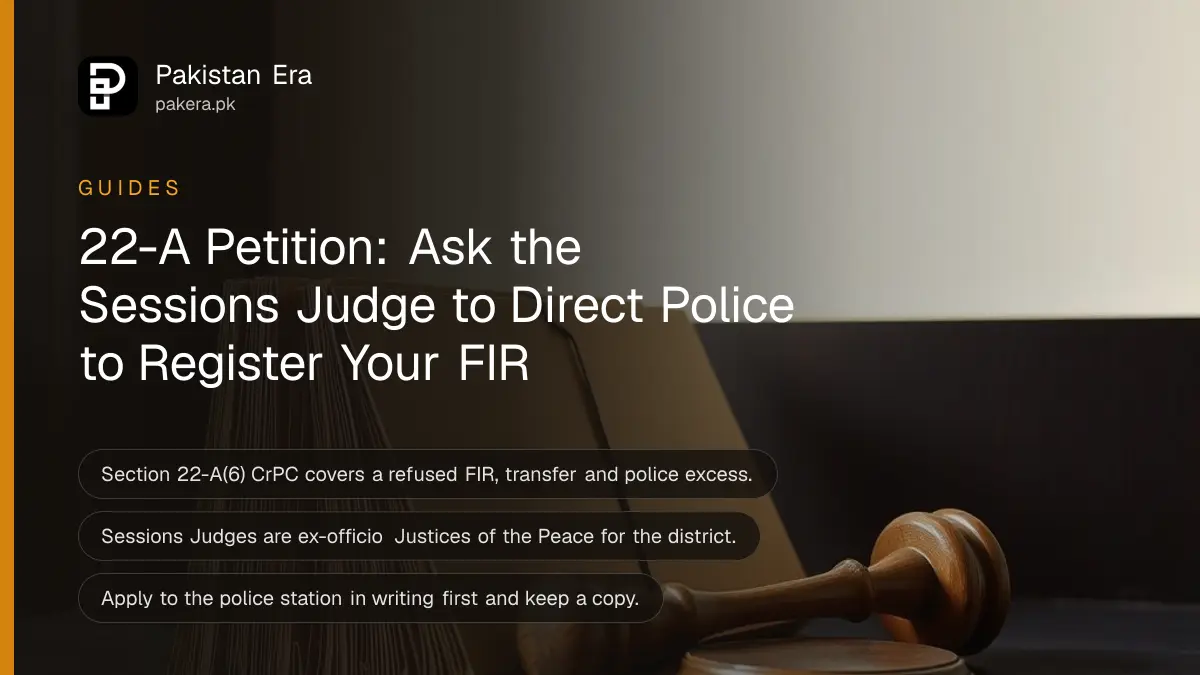
A 22-A petition is a written complaint to the Sessions Judge, acting as ex-officio Justice of the Peace, under Section 22-A(6) of the Code of Criminal Procedure (CrPC). It covers three problems: the police will not register your FIR, you want the investigation moved to another officer, or a police officer has neglected his duty or used excess. You file it in the district courts of the district where the police station is.
Most people reach this point after days of going back to the same police station. The 22-A route takes the matter out of the station and puts it before a judge, who can send directions to the police. It does not decide your case. It only gets the police moving.
Section 22-A(6) gives the Justice of the Peace three powers
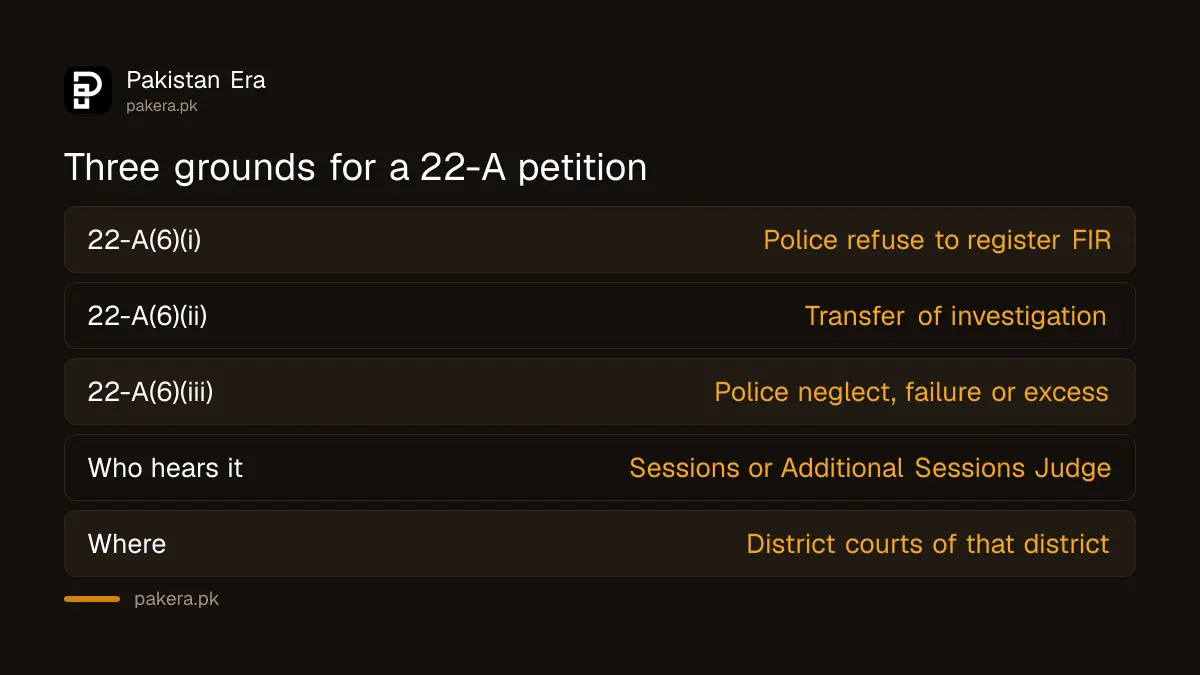
Section 22-A(6) lets an ex-officio Justice of the Peace issue "appropriate directions to the police authorities concerned" on a complaint about non-registration of a criminal case, transfer of investigation, or neglect, failure or excess by a police authority.
The exact words of the Code matter, because your petition has to fit one of them:
| Clause | What the Code says | Typical situation |
|---|---|---|
| 22-A(6)(i) | Non-registration of a criminal case | The SHO refuses to write your FIR for a cognizable offence |
| 22-A(6)(ii) | Transfer of investigation from one police officer to another | The investigation officer is siding with the other party |
| 22-A(6)(iii) | Neglect, failure or excess by a police authority | Illegal detention, harassment, or refusal to act on a complaint |
Section 25 of the CrPC names who the ex-officio Justices of the Peace are. Sessions Judges are, by virtue of their office, and Additional Sessions Judges are too, on nomination by the Sessions Judge. Each acts for the whole district where he serves. In practice the Sessions Judge marks your petition to an Additional Sessions Judge.
Go to the police and senior officers first
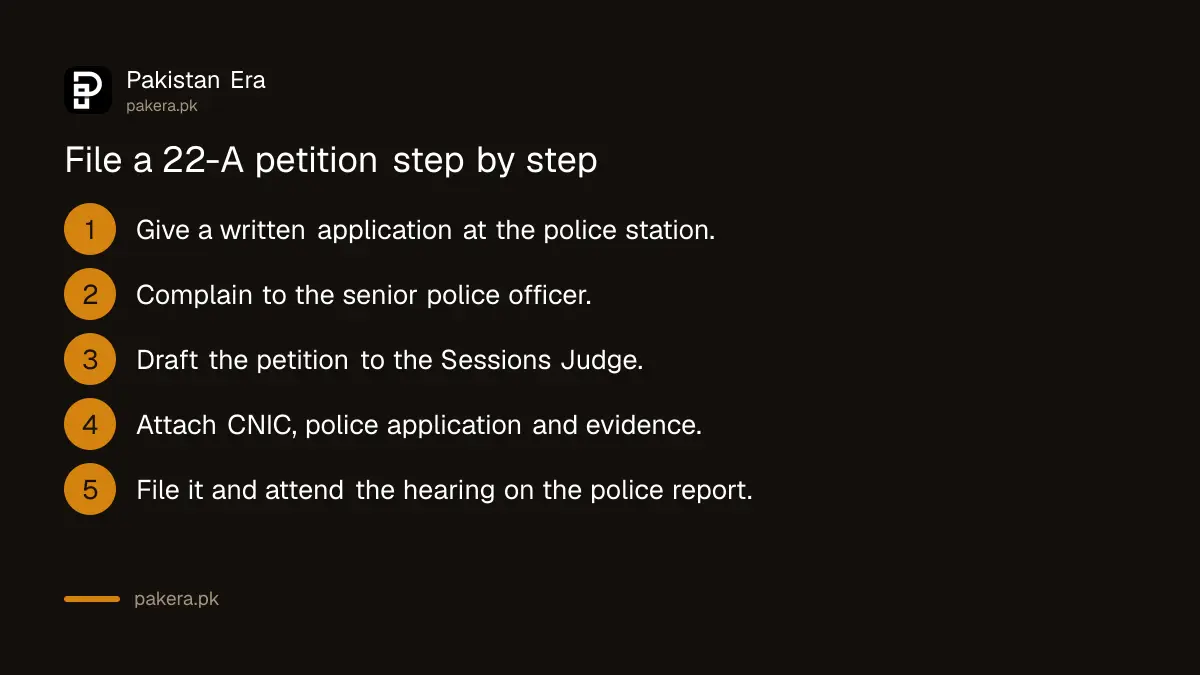
A 22-A petition is stronger when you can show you went to the police first. Give a written application at the station, keep a stamped or signed copy, then complain to the senior police officer before you go to court.
Section 154 of the CrPC says every information about a cognizable offence given to the officer in charge of a police station "shall be reduced to writing". A cognizable offence is one where police can arrest without a warrant, such as theft, cheating under Section 420 or attempt to murder. If the offence is non-cognizable, Section 155 tells the police to enter it in a book and send you to the Magistrate instead, and a 22-A petition will not change that. If police have told you the matter is non-cognizable, the route is different, and a Magistrate's order under Section 155 is the next step.
In Punjab, the IGP complaint line can also push the station. A complaint to the Punjab Police 1787 complaint centre goes to senior officers and leaves a record you can attach to your petition.
How to file a 22-A petition step by step
You file the petition at the district courts, with the Sessions Judge's office or the branch that receives criminal petitions. A lawyer usually drafts it, but the steps are the same either way.
- Write the petition. Head it to the Sessions Judge, ex-officio Justice of the Peace, of your district, under Section 22-A and 22-B CrPC.
- Name the respondents. Usually the SHO of the police station, and often the District Police Officer and the person you accuse.
- Set out the facts. Date, time and place of the incident, what happened, and the offence it makes out.
- Show what you did. The date you went to the police station and what they said, plus any complaint to senior officers.
- Say what you want. For example, a direction to the SHO to record your statement under Section 154 and proceed under the law.
- Attach the documents. Your CNIC copy, the application given to police, a medico-legal report if anyone was hurt, and any photos or receipts.
- Sign the affidavit. The facts in the petition are usually supported by your affidavit.
- File and note the date. The judge calls a report from the police and fixes a hearing.
Free legal help is available if you cannot pay a lawyer. In Punjab, the district legal aid system can assign one, and free legal aid in Punjab lists who qualifies.
What happens at the hearing
At the hearing the Justice of the Peace reads the police report, hears you and the police, and then either issues directions to the police or dismisses the petition. The order is a direction to the police, not a finding that anyone is guilty.
The police report often says the matter is a civil dispute, or that an inquiry found nothing. Be ready to answer that with facts. Bring your witnesses' names and any documents that show a crime, not only a money or land disagreement.
If the order goes your way, take a certified copy to the police station. The SHO then records your statement and registers the FIR. Keep the FIR number. You can then check its progress, as set out in checking FIR status and delays in Punjab.
Transfer of investigation through 22-A
Clause (ii) lets you ask for the investigation to be moved. In Punjab, the Police Order 2002 also gives a separate police route, an application to the Head of District Police, who decides within seven working days after the District Standing Board's opinion. Say in your petition whether you have already used that route and what came of it.
Common reasons a 22-A petition is dismissed
A 22-A petition is usually dismissed when the facts show no cognizable offence, when the dispute is plainly civil, when the same incident already has an FIR, or when the petitioner skipped the police station altogether.
- No cognizable offence: the facts describe a non-cognizable matter, such as a simple insult.
- Civil dispute: an unpaid loan or a boundary row with no criminal act. A bounced cheque is different, because Section 489-F makes it an offence.
- FIR already exists: the incident is already registered. Your own version of events then goes to the investigation officer of that case as a statement.
- No approach to police: the petition shows no written application at the station.
If the petition is dismissed, another route is a private criminal complaint under Section 200, where the court itself examines you and your witnesses. A lawyer can tell you which route suits your facts.
Common questions
What is a 22-A petition in Pakistan?
It is a complaint to the Sessions Judge, acting as ex-officio Justice of the Peace, under Section 22-A(6) CrPC. It asks for directions to the police on a refused FIR, a transfer of investigation or police neglect.
Who hears a 22-A application?
The Sessions Judge or an Additional Sessions Judge of the district. Section 25 CrPC makes them ex-officio Justices of the Peace for the whole district.
Can I file a 22-A petition without a lawyer?
Yes. The law does not require a lawyer, but drafting matters. Most people use one, and free legal aid is available to those who cannot pay.
Can the Justice of the Peace register the FIR himself?
No. He directs the police. The SHO records the statement and registers the FIR under Section 154 after the order.
Does a 22-A order mean the accused is guilty?
No. It only starts the police process. The investigation and the trial decide guilt later.
What if the offence is non-cognizable?
Then police enter it in a book under Section 155 and refer you to the Magistrate. A 22-A petition for an FIR does not fit that case.
How we verified this
What we checked and where we read it.
Sections 22, 22-A, 22-B, 25, 154 and 155 are from the Code of Criminal Procedure 1898 PDF on the Ministry of Law's Pakistan Code website, the edition that carries 2025 amendments. Section 22-A(6) was added by Ordinance CXXXI of 2002. The Punjab transfer of investigation rule is Article 18A of the Police Order 2002 on the Punjab Code website. This page explains the procedure and is not legal advice.
Last checked 15 November 2026.
About the author

Global Affairs & Political Economy Writer
Muhammad Hatim is a book lover who started writing because he enjoys it. At Pakistan Era he writes about international relations, geopolitics and the global economy, with a particular interest in South Asia and the forces behind current events.