Police Say Your Case Is Non-Cognizable in Pakistan: What Section 155 Means and What to Do
Told your case is non-cognizable in Pakistan? Section 155 says police must record it and send you to a Magistrate. See what that means and the steps to take.
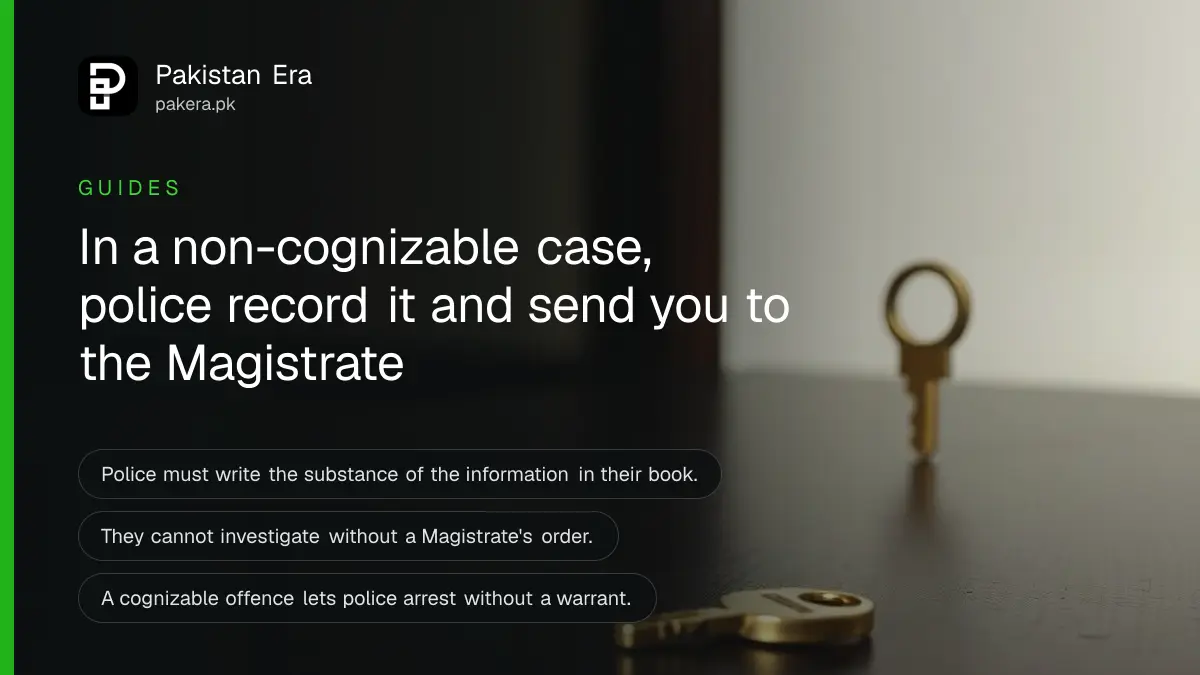
Short answer: If the offence is non-cognizable, section 155 of the Code of Criminal Procedure says the police officer must write the substance of your information in the station book and refer you to a Magistrate. The police cannot investigate it without the Magistrate's order.
You go to the police station, and the officer says it is not a case for an FIR. Sometimes that is wrong. Sometimes it is true, and the law has a different route for you.
We read the Code of Criminal Procedure on the Pakistan Code website on 14 October 2026. The text was last amended on 16 February 2017. We did not read the list of offences in the Second Schedule, so we cannot tell you which offence is which.
A cognizable offence is one where police may arrest without a warrant
The Code calls an offence cognizable when a police officer may arrest without a warrant under the Second Schedule or another law. Section 154 says information about it must be written down, read to you, signed and entered in the book.
That written entry is the FIR. It is the first information report. If the offence is cognizable, section 156 says the officer in charge of the station can investigate without any order from a Magistrate.
If police delay or refuse in such a case, see what to do when police refuse or delay your FIR in Punjab. For women, section 154 has special rules. See how a woman reports an offence with a female officer or at home.
In a non-cognizable case the police refer you to the Magistrate
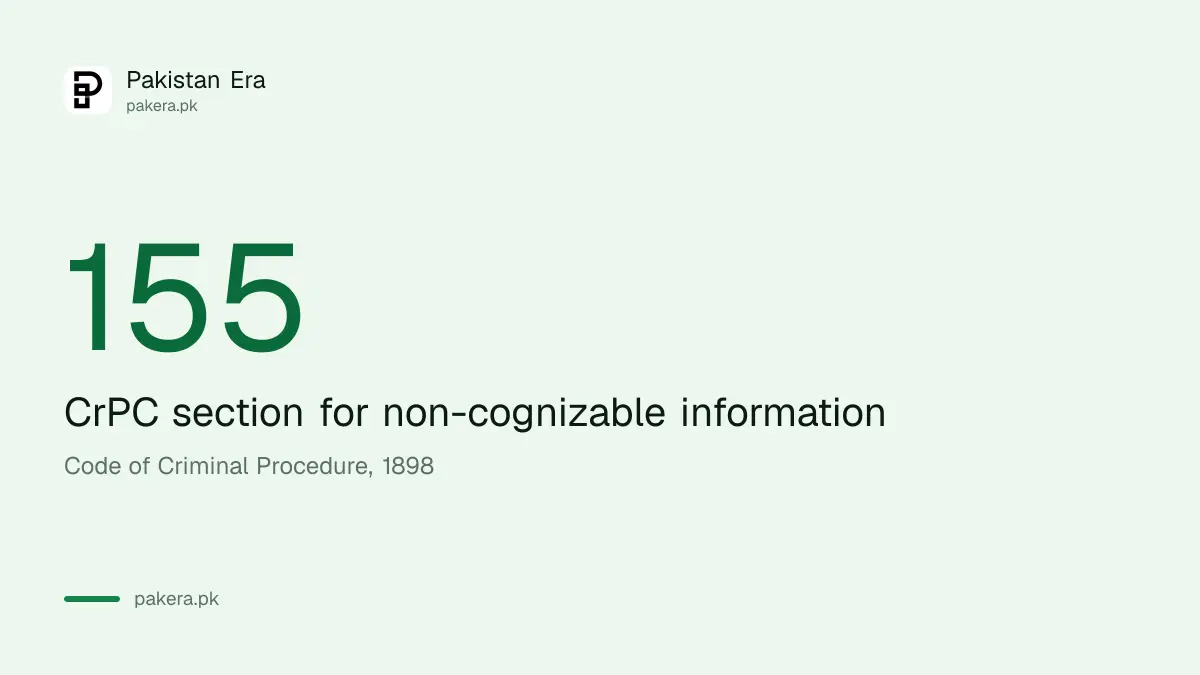
Section 155(1) says that when information is given about a non-cognizable offence within the station's limits, the officer must enter its substance in the book and refer the informant to the Magistrate. So the answer is not a plain refusal.
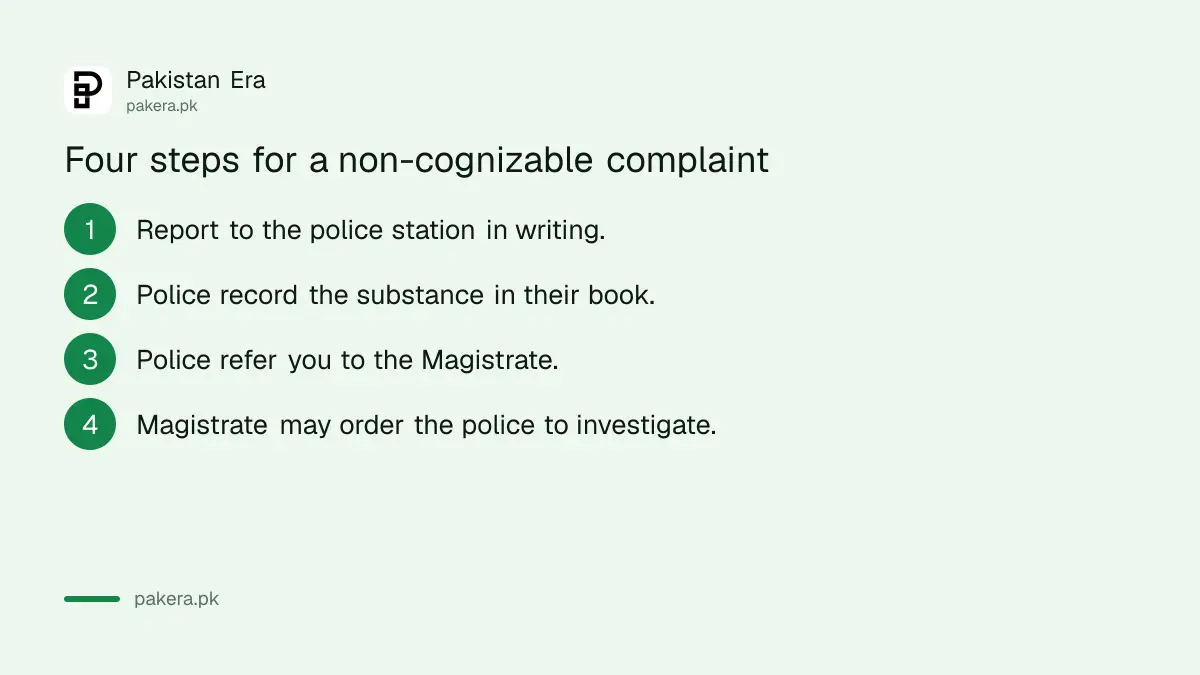
- Go to the station of the area where it happened, and give your information in writing.
- Ask the officer to enter its substance in the station book, as section 155(1) requires.
- Ask for a copy or the entry number, and note the date and the name of the officer.
- Go to the Magistrate, as the officer must refer you.
- Ask the Magistrate to order an investigation, or file a complaint directly.
Keep a copy of every paper you hand over. If the officer says the offence is non-cognizable, ask which offence he means, and note his answer. Write the officer's name, the station and the time of your visit in your own notebook. A clear record helps the Magistrate see that you acted at once and that the police were told.
The police need a Magistrate's order to investigate
Section 155(2) says no police officer can investigate a non-cognizable case without the order of a Magistrate of the first or second class who has power to try it, or to send it for trial to the Court of Session.
Section 155(3) says an officer with such an order has the usual powers of investigation, except the power to arrest without a warrant. So the Magistrate's order does not turn the case into a cognizable one.
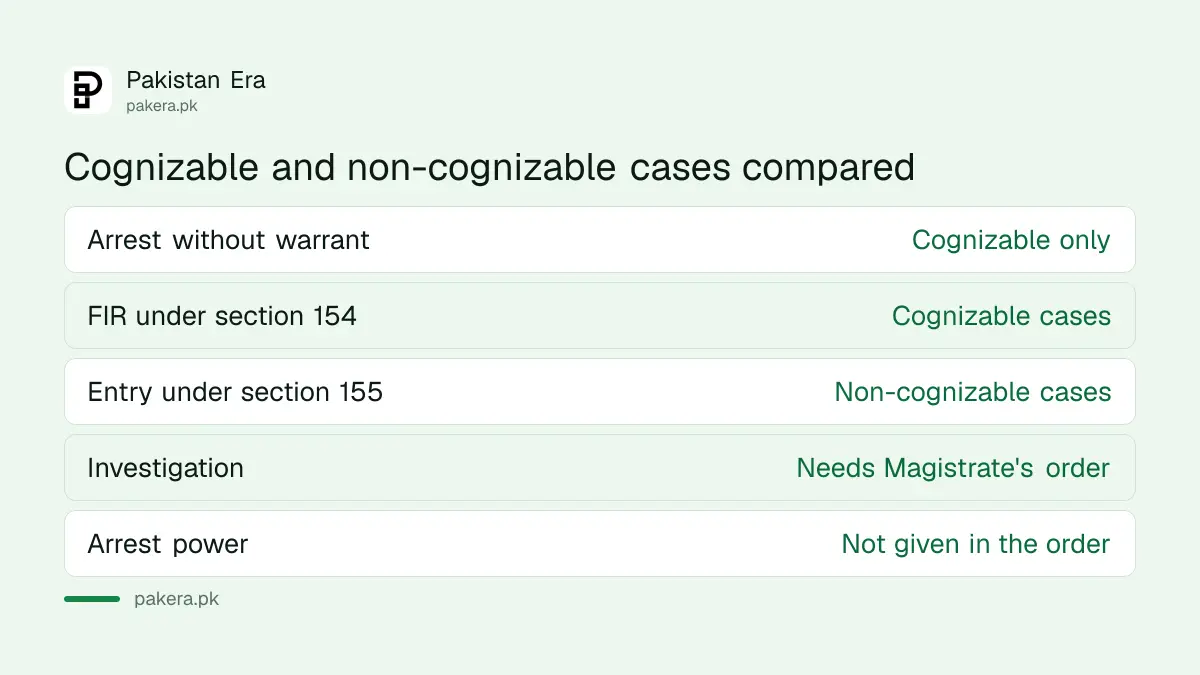
| Question | Cognizable offence | Non-cognizable offence |
|---|---|---|
| Arrest without warrant | Yes, under the Schedule or another law | No |
| Section that applies to your report | 154 | 155 |
| Can police investigate on their own? | Yes (section 156) | No, needs the Magistrate's order |
| Where to go if police refuse | Senior police and the Magistrate | The Magistrate |
You can also go straight to a Magistrate with a complaint
You can go directly to a Magistrate with a complaint. The Code defines a complaint as an allegation made orally or in writing to a Magistrate, so that he can act under the Code. It is often the next step when police will not act.
Read how to file a private criminal complaint before a Magistrate. It covers the written complaint and the sworn statement that the Magistrate takes.
If the other side is a state body or officer, keep the facts exact and leave out opinions. The Magistrate will decide on the facts. If you cannot pay a lawyer, ask about a free lawyer in Punjab.
Do not wait. Evidence fades, messages get deleted, and witnesses forget. An old complaint is harder to prove. We did not check any time limit that may apply to your offence, so ask a lawyer on the first day.
Common questions
What is a non-cognizable offence?
It is an offence for which police cannot arrest without a warrant. Section 155 deals with information about it.
Can police refuse to take my report?
In a non-cognizable case they must record the substance in their book and refer you to the Magistrate. They cannot simply send you away.
Can police investigate a non-cognizable case alone?
No. Section 155(2) needs the order of a Magistrate of the first or second class.
Can police arrest after a Magistrate's order?
Not without a warrant. Section 155(3) excludes the power to arrest without warrant.
How do I know if my offence is cognizable?
The Second Schedule of the Code lists offences. Ask a lawyer or the station officer to name the offence and the entry.
How we verified this
What we checked, where we read it, and what we could not confirm.
Last checked on 14 October 2026, Pakistan time. We read the Code of Criminal Procedure, 1898 on the Pakistan Code, including sections 4, 154, 155 and 156. We did not read the Second Schedule, provincial police rules or any amendment after 2017. This page explains the law and is not legal advice.
About the author

Senior Writer, Public Services and Technology
Shahid joined us in 2024 as an author. He is a senior contributor to Pakistan's leading technology websites. He writes detailed articles, mostly covering his expertise in the latest tech, mobiles, apps, gadgets, and step-by-step guides. His ideology is to help people understand the latest trends and explain complex methods through very easy-to-understand guides.