How to Apply for the Apna Ghar Housing Loan
Banks approved Rs 279 billion and disbursed Rs 38 billion. The deposit you need, the income test, and what the gap means for you.
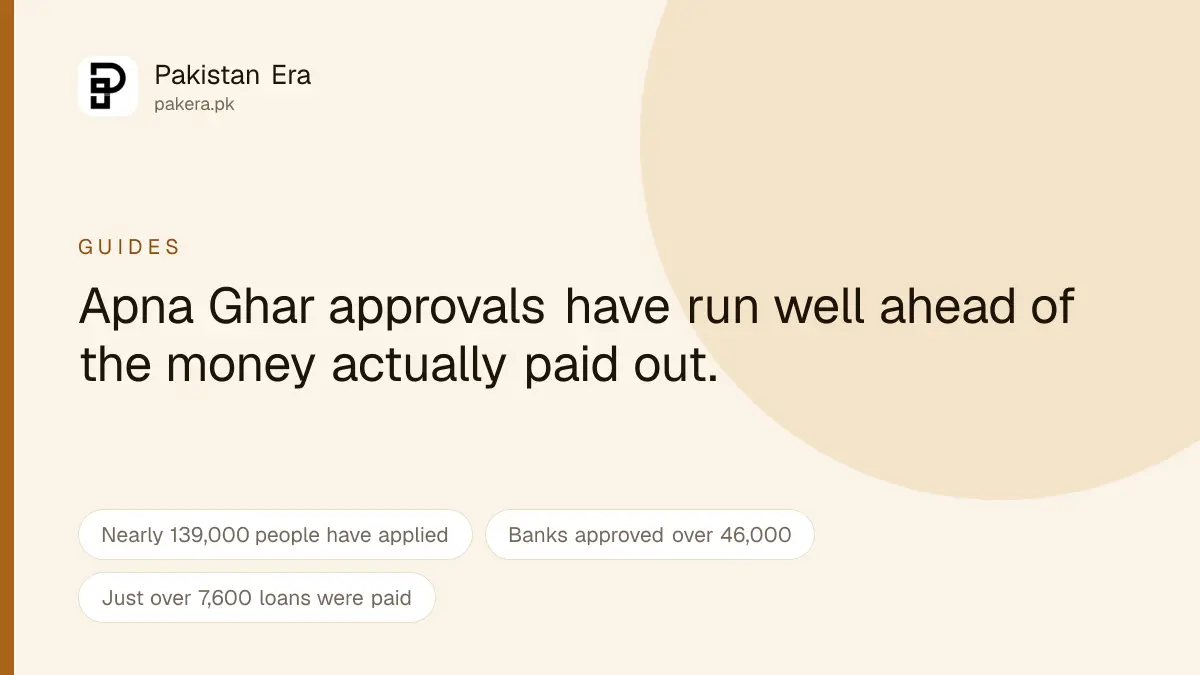
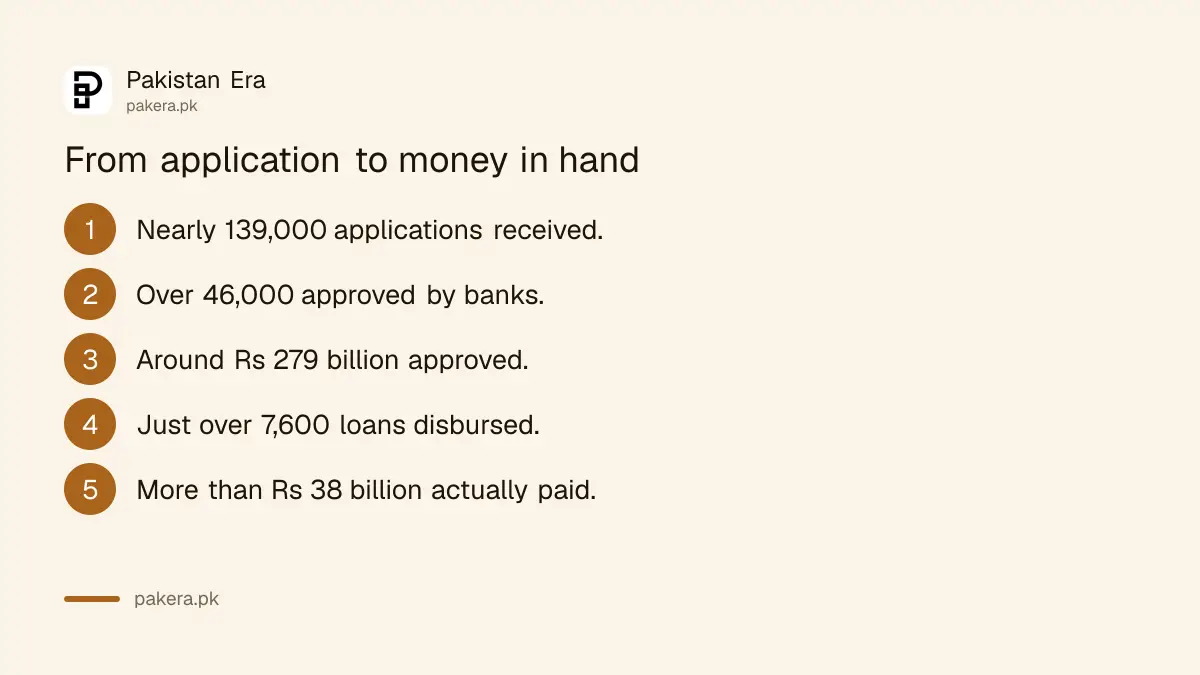
Banks have approved around Rs 279 billion under the government's housing loan programme and paid out about Rs 38 billion of it. That gap is the most useful thing to understand before you apply, because an approval letter is not money.
The scheme is the Wazir-e-Azam Apna Ghar Programme, marketed as Ghar Ho To Apna. We read the Finance Division's own progress figures at finance.gov.pk on 29 August 2026, and the numbers below come from that release.
Where the applications have got to
The release reports the position as at mid August 2026, with the change since June alongside it.
| Stage | Position in mid August | Change since June |
|---|---|---|
| Applications | Nearly 139,000 | Up about 52 per cent |
| Approvals | Over 46,000 | Up about 84 per cent |
| Financing approved | Around Rs 279 billion | Nearly doubled from Rs 144 billion |
| Loans disbursed | Over 7,600 | Up about 59 per cent |
| Amount disbursed | More than Rs 38 billion | Included in the above |
Every one of those lines is moving in the right direction and the release says so. The point is not that the programme is failing, it is that the stages are a long way apart, so plan around the stage you are actually at.
An earlier release in the same series put it more starkly. Around Rs 34.27 billion had been disbursed up to July, against over Rs 220.68 billion in loans approved by banks and described as ready for disbursement. Approved and ready is not the same as in your account.
Two numbers decide whether you qualify
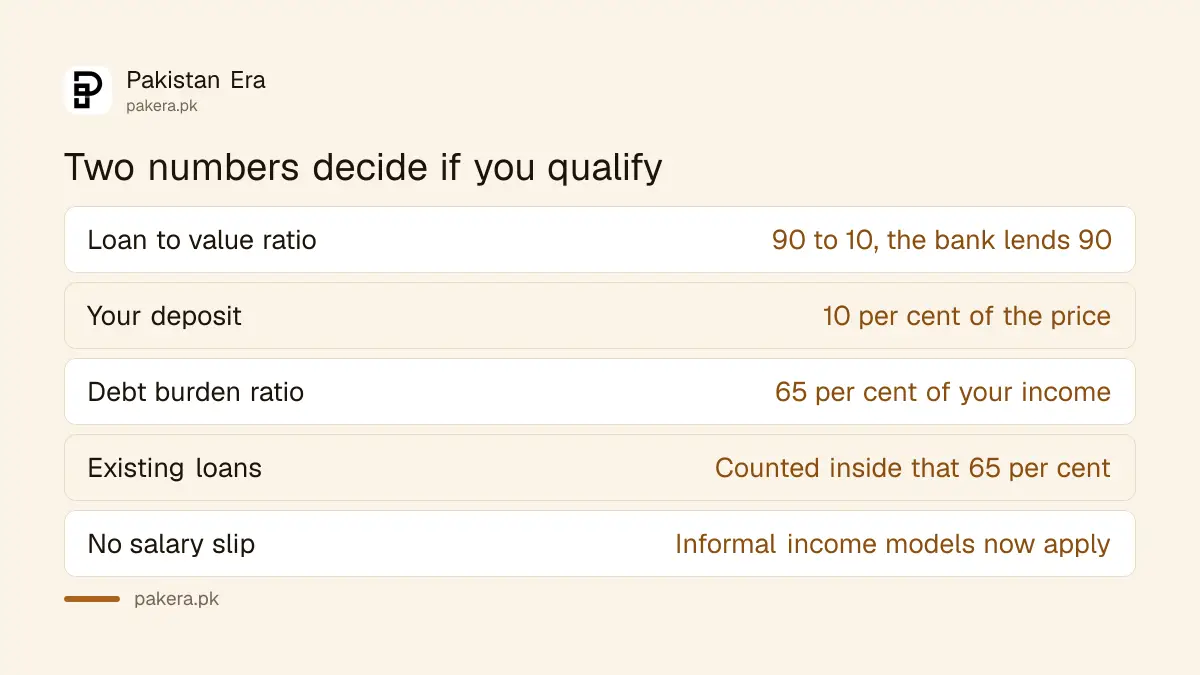
The same release describes the State Bank's revised Prudential Regulations for Housing Finance, which set the frame every partner bank works inside. Two figures in it decide most applications before anyone reads your file.
- The loan to value ratio is 90 to 10, so the bank lends up to 90 per cent.
- That leaves 10 per cent of the property price for you to find yourself.
- The debt burden ratio is 65 per cent.
- So your total loan repayments cannot exceed 65 per cent of your income.
- Work out both against your own numbers before you apply.
Run those two sums first. If the deposit is not there, or if your existing car and personal loan repayments already eat most of the 65 per cent, the application will not succeed no matter how good the rest of the file looks.
The change that matters most for the self employed
The regulations also include what the release calls informal income assessment models. That is the quiet reform in the list, and it is aimed squarely at Pakistan's largest group of borrowers.
Most working Pakistanis cannot produce a salary slip. Shopkeepers, tradesmen, drivers, tailors and small contractors earn steadily and document nothing, and under conventional mortgage rules that made them unlendable regardless of income. An assessment model that accepts informal income is what puts them inside the scheme at all.
The release also lists simplified property valuation and documentation, digital processes and longer financing tenors. If a bank has previously turned you away for want of a payslip, that is a reason to ask again rather than assume the answer is the same.
Applying, and what we could not check
The programme's site is apnaghar.gov.pk. We opened it on 29 August 2026 and it answered, but the page is built so that its content loads only in a browser, and we were not able to read its terms, eligibility text or application steps directly.
So we are not quoting a document list, a price ceiling or an income band, because we did not read one. Open the portal yourself, and treat what it says there as the authority over any figure on a blog, including this page.
Take the same care with the address. A scheme that asks for your CNIC and income details deserves the government domain typed into the bar rather than tapped from a search result, and apnaghar.gov.pk is a .gov.pk address for that reason.
What to have ready before you start
This is a bank loan with a government wrapper, so it is assessed like a loan. Your CNIC has to be valid, and if it has lapsed nothing else proceeds, which our guide to renewing an expired CNIC covers.
Gather whatever evidence of income you have, formal or not, along with your bank statements. Check your own credit record before the bank does, because an old default you have forgotten about is a common reason for refusal, and our guide to reading your ECIB credit report explains how to see what lenders see.
On the property side, establish that the title is clean before you commit to anything. For land in Punjab our guide to getting a fard online sets out the record check, and unpaid property tax attaches to the property rather than the previous owner.
Other schemes in the same series
The Finance Division release covers several programmes together, and two others may fit readers who do not fit this one.
Zarkhez-e Asaan Zarai Qarza provides financing to smallholder farmers, including tenant farmers, without collateral, and the release records more than 58,000 farmers registered. The vehicle electrification programme is covered in our guide to the PAVE electric bike scheme, where the same pattern of applications running ahead of disbursements appears again.
Common questions about the Apna Ghar loan
How much deposit do I need?
The loan to value ratio is 90 to 10, so expect to find 10 per cent of the property price yourself.
How much can I borrow against my income?
The debt burden ratio is 65 per cent, meaning total repayments across your borrowings cannot exceed 65 per cent of income.
Can I apply without a salary slip?
The regulations include informal income assessment models, so ask the bank rather than assuming you are excluded.
How long does disbursement take?
We cannot give a timeline. What the figures show is that approvals have run well ahead of disbursements, so budget for a wait after approval.
Where do I apply?
Through apnaghar.gov.pk and the partner banks. Confirm the current requirements on the portal itself.
How we verified this
What we checked, where we read it, and what we could not confirm.
Last checked 29 August 2026. The application, approval, disbursement and financing figures, and the description of the State Bank's revised Prudential Regulations for Housing Finance including the 90 to 10 loan to value ratio, the 65 per cent debt burden ratio, informal income assessment models, simplified property valuation and documentation, digital processes and longer financing tenors, were all read by us in press releases on the Finance Division site at finance.gov.pk on that date, reporting the position as at mid August 2026 and, for the Rs 34.27 billion and Rs 220.68 billion figures, up to July. We opened apnaghar.gov.pk on the same date and it responded, but its content is loaded by script and we could not read the eligibility terms, document list or application steps from it, so none are quoted here. No property price ceiling, income band, mark-up rate or document list appears on this page for that reason. Confirm all of those on the portal or with a partner bank before applying.
Work out your own figure
See the Apna Ghar instalment for years 1 to 10 and after, next to ordinary bank home loans.
Home Loan Calculator →About the author

Tax, Bills and Technology Writer
Ali Akhtar is a young and curious voice here at Pakistan Era. He is currently pursuing his A-Levels and has a growing interest in Pakistan’s changing industrial landscape and educational trends. Ali likes to write in a way that helps him explain and explore the world around him. His writing reflects the perspective of the new generation navigating the evolving trends of Pakistan where technology, youth innovation, and shifting opportunities are reshaping the country’s future.