Check If Your Savings Beat Inflation in Pakistan: Bank Savings Lose 2% a Year
Pakistan's inflation was 10.26% in September 2026. See the real return on bank savings, National Savings and T-bills after tax, and check your own in 4 steps.
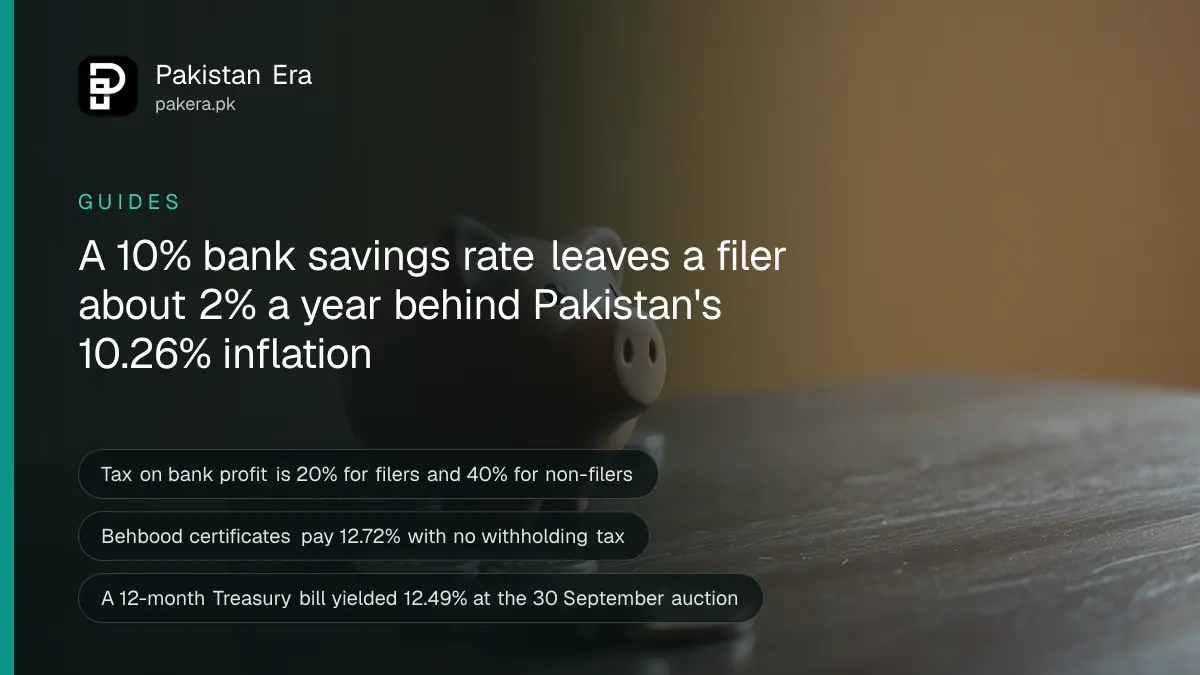
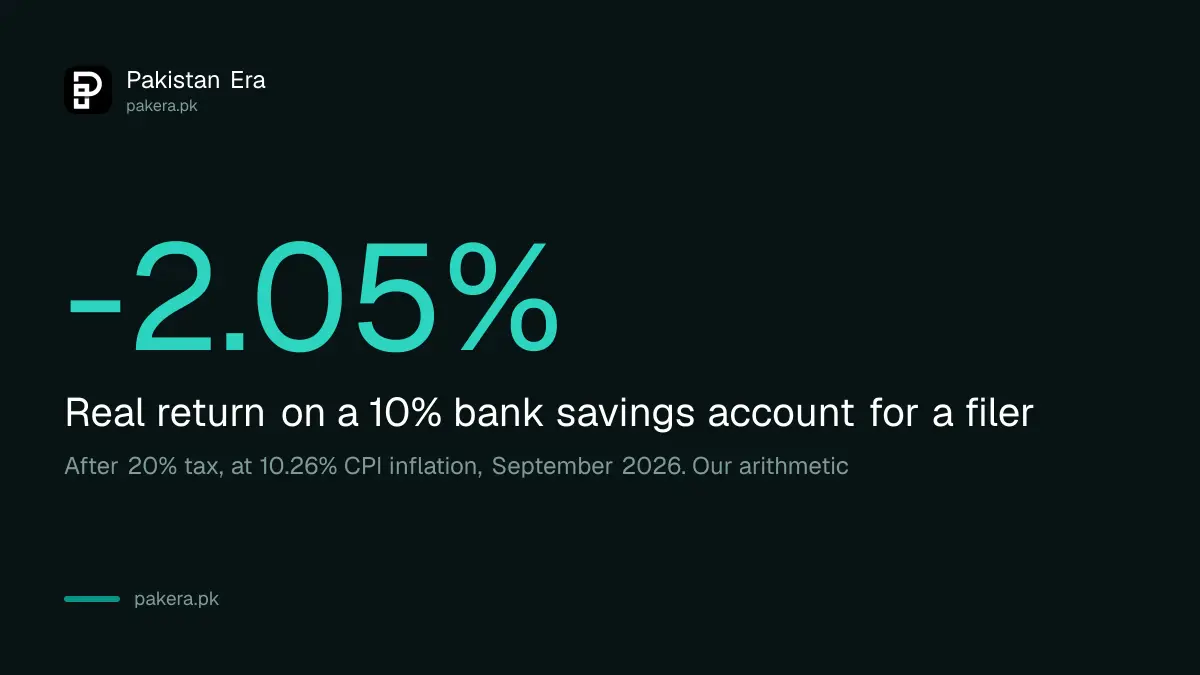
Inflation in Pakistan was 10.26 per cent in September 2026, according to the Pakistan Bureau of Statistics (PBS). A bank savings account paying 10 per cent, taxed at 20 per cent, leaves you with 8 per cent. So a filer with money in an ordinary savings account is losing about 2 per cent of its buying power a year.
That is the short answer. Below we show the one formula you need, the real return on the main places Pakistanis keep savings, and what changes if you are a non-filer. We took every rate from the official page that sets it, and did the arithmetic ourselves.
Your savings beat inflation only if the profit after tax is above 10.26 per cent
To beat inflation, your profit after tax must be higher than the rise in prices. In September 2026 prices were 10.26 per cent higher than a year earlier on the national Consumer Price Index (CPI). Anything below that loses value in real terms.
The CPI is the official measure of how much a typical basket of goods and services costs. PBS put the national index at 304.33 in September 2026, against 276.01 in September 2025. Divide one by the other and you get the 10.26 per cent rise.
A "real return" is simply your return after inflation. If it is negative, your money buys less at the end of the year than at the start, even though the number in your account went up.
Work out your real return in 4 steps
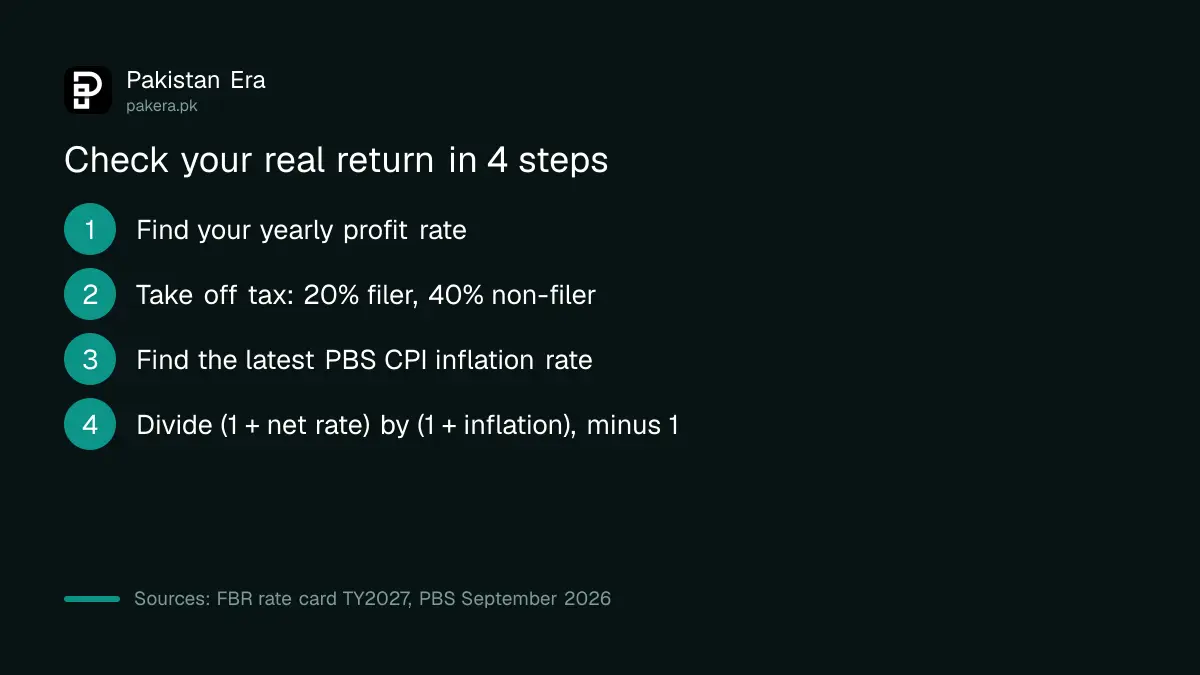
You need three numbers: your profit rate, your tax rate and the latest inflation rate. Then one division gives the answer. It takes about two minutes with a phone calculator.
- Find your profit rate on your bank's rate sheet or the National Savings rate page. Use the annual rate, for example 10 per cent.
- Take off the tax. The FBR withholding card for tax year 2027 sets tax on bank deposit profit at 20 per cent for people on the Active Taxpayers List (ATL) and 40 per cent for those not on it. So 10 per cent becomes 8 per cent for a filer and 6 per cent for a non-filer.
- Find the latest inflation rate in the PBS monthly price review. For September 2026 it is 10.26 per cent.
- Divide: (1 + after-tax rate) by (1 + inflation), then subtract 1. For a filer: 1.08 divided by 1.1026, minus 1, is minus 2.05 per cent.
Many people just subtract one number from the other. That gives almost the same answer at these levels, and it is fine for a quick check. The division is the exact version.
Here is the real return on common savings options in October 2026
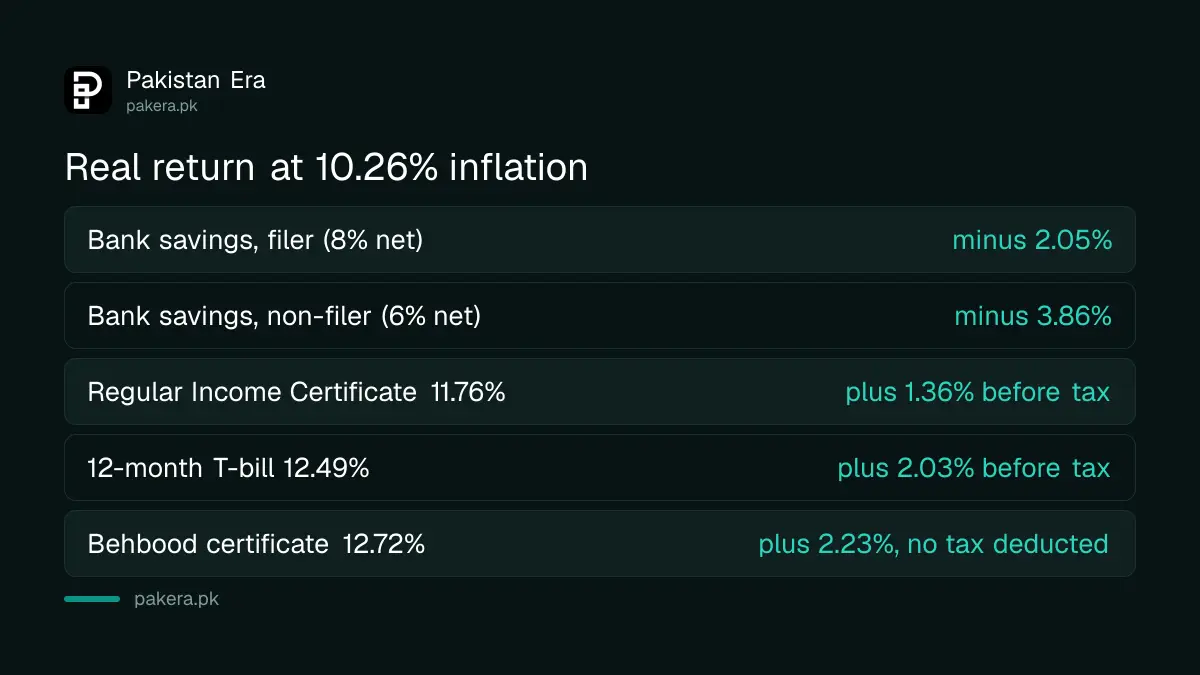
Ordinary bank savings lose money in real terms for both filers and non-filers. Behbood certificates stay about 2 per cent ahead of inflation, and Regular Income Certificates and 12-month Treasury bills are slightly ahead before tax. The table shows the numbers we worked out.
| Savings option | Rate (October 2026) | Rate after tax | Real return at 10.26% inflation |
|---|---|---|---|
| Bank savings account, filer | 10.00% | 8.00% (20% tax) | minus 2.05% |
| Bank savings account, non-filer | 10.00% | 6.00% (40% tax) | minus 3.86% |
| National Savings Account (SA) | 10.00% | Taxed, rate not stated by CDNS | minus 0.24% before tax |
| Regular Income Certificate (RIC) | 11.76% | Taxed, rate not stated by CDNS | plus 1.36% before tax |
| Behbood Savings Certificate | 12.72% | 12.72% (no withholding tax) | plus 2.23% |
| 12-month Treasury bill | 12.49% cut-off yield | Taxed at source | plus 2.03% before tax |
The bank rate is the 10 per cent that most big banks show for ordinary savings account profit rates on balances up to Rs 10 million this quarter. The National Savings figures are from the rate sheets valid from 1 October 2026 on the Central Directorate of National Savings (CDNS) website. The Treasury bill yield is the 30 September 2026 auction cut-off shown on the State Bank of Pakistan (SBP) home page.
Behbood certificates are only for senior citizens aged 60 or above, single widows and people with a disability logo on their CNIC. CDNS says no withholding tax is collected on their profit, which makes them the best real return in the table for those who qualify. Check the full list of National Savings profit rates before you move money.
A Rs 1 million deposit shows what the gap costs in rupees
On Rs 1 million in a bank savings account, a filer earns about Rs 80,000 after tax in a year. To keep up with 10.26 per cent inflation, the balance needed to grow by Rs 102,600. The shortfall is about Rs 22,600 of buying power.
For a non-filer the after-tax profit is about Rs 60,000, so the shortfall grows to about Rs 42,600. That gap alone is a strong reason to check your filer status before the bank deducts tax.
These are rough yearly figures, so your exact rupee number will differ a little.
Next year's inflation matters more than last year's
The 10.26 per cent figure looks back at the last 12 months. What decides your real return is inflation over the year you hold the money. So treat the table as a snapshot, not a forecast.
The forecasts are lower than today's rate. The World Bank expects inflation to average 8.2 per cent in FY27, the year to June 2027. The SBP said on 14 September 2026 that it expects inflation to ease towards the upper end of its 5 to 7 per cent target range by June 2027. If inflation falls that far, a 12 per cent certificate would earn a bigger real return than the table shows.
But if prices keep rising at 1.3 per cent a month, as they did in September, the picture gets worse. That is why the next SBP policy meeting matters to savers as well as borrowers. A rate rise usually lifts deposit and certificate rates a few weeks later.
Three ways to move closer to inflation
Moving from a basic savings account to a government instrument is the simplest step. Rates on Treasury bills and National Savings certificates sat about 1.8 to 2.7 percentage points above bank savings rates in early October 2026.
- Treasury bills: you can buy Treasury bills through your bank or a broker. They are short term, so you can roll over at new rates.
- National Savings certificates: available at any National Savings centre. Early encashment cuts the profit, so match the term to when you need the money.
- Get on the ATL: filing a return halves the tax on bank profit, from 40 to 20 per cent. That one step is worth 2 percentage points a year on bank savings.
Common questions
Is my bank savings account beating inflation in Pakistan?
No, not at September 2026 levels. A 10 per cent rate gives 8 per cent after tax for a filer, against 10.26 per cent inflation, a real return of about minus 2 per cent.
What is the inflation rate in Pakistan now?
The national CPI rose 10.26 per cent year on year in September 2026, the latest monthly figure from PBS. The October figure is due in early November.
How much tax is deducted on bank profit in Pakistan?
20 per cent for people on the Active Taxpayers List and 40 per cent for others, according to the FBR withholding tax card for tax year 2027.
Which savings option beats inflation right now?
The Behbood certificate does, at about 2.2 per cent above inflation, because CDNS collects no withholding tax on it. The 12-month Treasury bill and the Regular Income Certificate are slightly ahead before tax, but the margin is small or gone after tax.
How do I calculate real return?
Divide (1 plus your after-tax rate) by (1 plus inflation) and subtract 1. For example, 1.08 divided by 1.1026, minus 1, equals minus 2.05 per cent.
How we verified this
What we checked, where we read it, and what we could not confirm.
Last checked 10 October 2026, about 7:30 pm PKT. Inflation is from the PBS monthly price review for September 2026, national CPI table. National Savings rates are from the CDNS latest profit rates page, effective 1 October 2026. Tax rates are from the FBR withholding tax rate card for tax year 2027, updated to 30 June 2026. The Treasury bill yield is from the SBP home page. The real return figures and rupee examples are our own arithmetic.
About the author

Global Affairs & Political Economy Writer
Muhammad Hatim is a book lover who started writing because he enjoys it. At Pakistan Era he writes about international relations, geopolitics and the global economy, with a particular interest in South Asia and the forces behind current events.