Customs Perishable Goods List for Bonded Warehouses in Pakistan: 29 Items, 3 Months
SRO 1629 of 2026 lists 29 perishable goods allowed 3 months in a bonded warehouse. From 15 October, packaged food with an expiry date needs a certificate.

Pakistan Customs has a new list of 29 perishable goods for bonded warehouses. Goods on it, such as dates, cheese, meat, fish, onions and tea, can stay in a bonded warehouse for 3 months instead of the usual 6. From 15 October 2026, canned or packaged food with a printed expiry date is not treated as perishable for warehousing surcharge, if a storage certificate is uploaded with the goods declaration.
The list is in S.R.O. 1629(I)/2026, dated 18 September 2026, issued under section 98 of the Customs Act, 1969. It replaces a list from February 1999. We read the notification and section 98 on FBR's website on 20 October 2026. If you import food or farm goods into a bonded warehouse, check the list before you plan how long the goods will sit there.
FBR's new list names 29 perishable goods
S.R.O. 1629 lists 29 goods as perishable under section 98. It covers fresh food, dairy, dry fruit, spices, drinks, tobacco, X-ray films, hides and live plants. It supersedes S.R.O. 125(I)/1999 of 27 February 1999, so the old list no longer applies.
| Serial | Goods | Serial | Goods |
|---|---|---|---|
| 1 | Betel leaves | 16 | Live trees, plants and roots |
| 2 | Butter | 17 | Milk powder |
| 3 | Bidi leaves and bidi | 18 | Meat |
| 4 | Betel nuts | 19 | Onions |
| 5 | Cheese | 20 | Apples |
| 6 | Coconuts (seeds) | 21 | Sweets and confectionery |
| 7 | X-ray films | 22 | Soft drinks |
| 8 | Dates | 23 | Sugar |
| 9 | Dry fruits | 24 | Spices |
| 10 | Eggs | 25 | Syrups, jams, jellies, marmalades, ketchup and similar condiments |
| 11 | Non-essential oils | 26 | Tobacco other than unmanufactured processed tobacco |
| 12 | Food grains | 27 | Tea, cocoa and coffee |
| 13 | Fish | 28 | Any vegetables and fruits not named above |
| 14 | Ginger, garlic | 29 | Edible vegetable oil and oil seeds |
| 15 | Hides and skins |
Serial 28 is wide. Any fruit or vegetable not named elsewhere counts. So a shipment of oranges or potatoes falls on the list even though neither is named.
Perishable goods can stay 3 months in a bonded warehouse
Section 98 of the Customs Act lets ordinary warehoused goods stay six months from the date they enter the warehouse. Goods that FBR notifies as perishable can stay three months. An extension for perishable goods is allowed only if they are still fit for human consumption.
For goods that are not perishable, the owner can ask for more time by showing good cause and paying a surcharge in advance. The surcharge is 1 per cent a month on the duty and taxes involved, for the extra period.
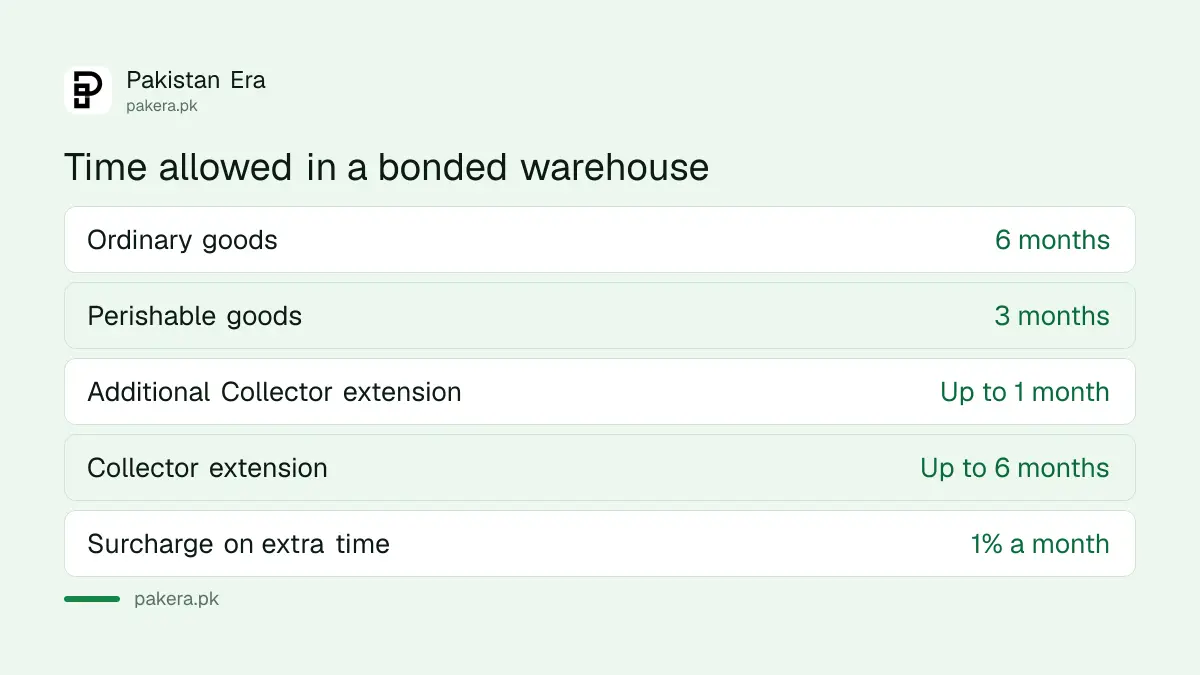
| Rule in section 98 | What it says |
|---|---|
| Ordinary goods | 6 months from entry into the warehouse |
| Notified perishable goods | 3 months from entry |
| Extension by an Additional Collector | Up to 1 month |
| Extension by a Collector | Up to 6 months |
| Extension by a Chief Collector | Any period the Chief Collector decides |
| Surcharge for extra time | 1% a month on duty and taxes, paid in advance |
Here is the cost in plain numbers. On goods carrying Rs 2 million in duty and taxes, two extra months cost Rs 40,000 in surcharge, paid before the extension. That is our own sum from the 1 per cent rate. The government, or FBR in exceptional cases, can waive all or part of the surcharge under section 98(2).
Packaged food with an expiry date is treated differently from 15 October
A proviso in S.R.O. 1629 says an edible product with a printed expiry date, imported preserved, canned, bottled or packaged, is not treated as perishable for warehousing surcharge. Two conditions apply: correct storage, and a licensee's certificate uploaded with the goods declaration.
The first condition is that the goods are stored in the bonded warehouse as the manufacturer says, so they do not become unfit during warehousing. The second is that the warehouse licensee certifies, on the form in Annex-A, that the warehouse has the storage facilities for those goods.
In our reading, this matters because the surcharge route to extra time in section 98 is written for goods that are not perishable. The notification does not spell out more than the words above, so confirm with your collectorate how it treats the warehousing period for such goods.
Upload the storage certificate when you file the in-bond declaration
The importer or the authorised clearing agent must upload the licensee's certificate when filing the into-bond goods declaration. Without it, packaged food with an expiry date keeps its place on the perishable list. The rule took effect on 15 October 2026.
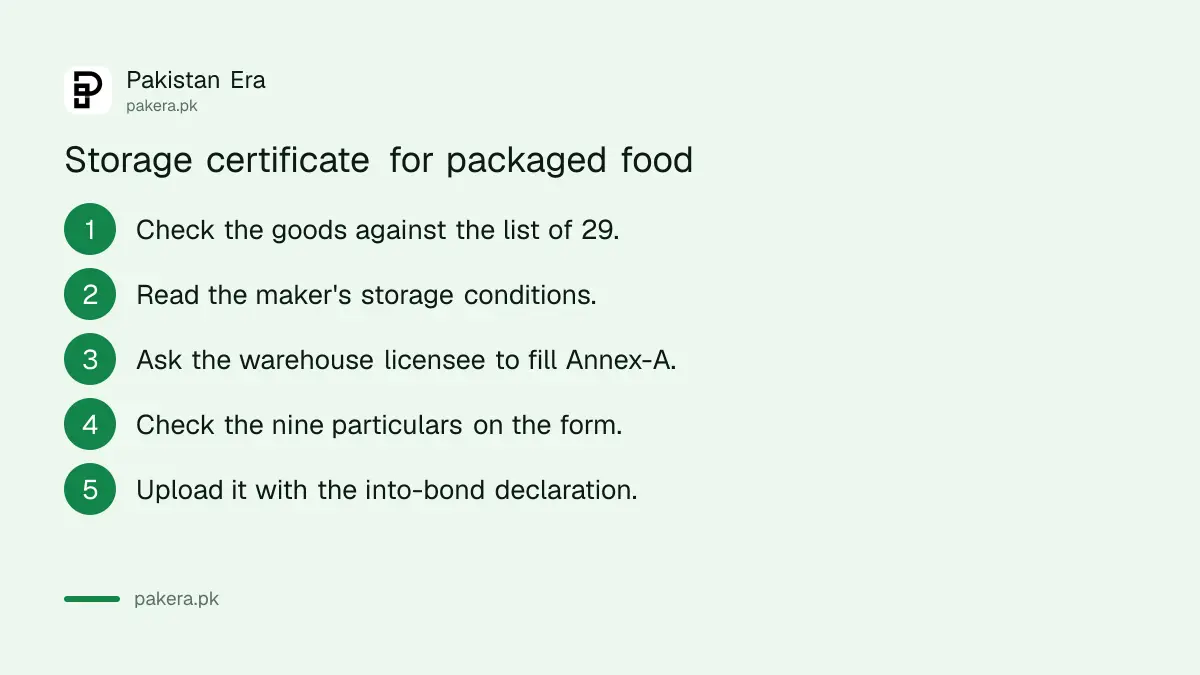
- Check whether your goods are on the list of 29, including serial 28 for any other fruit or vegetable.
- If the goods are packaged food with a printed expiry date, read the manufacturer's storage conditions.
- Ask the bonded warehouse licensee to fill Annex-A for the shipment.
- Check the nine particulars on the certificate, from licence number to quantity.
- Upload the signed certificate with the into-bond goods declaration in WeBOC.
- Note the date the goods enter the warehouse, because the 3 or 6 month clock starts then.
Annex-A asks for the warehouse name, licence number and date, address, importer name and NTN, clearing agent and licence number, goods declaration number and date, description of goods, PCT code and quantity. The licensee also accepts liability if the goods turn unfit because of poor storage. For the declaration itself, see how to file a goods declaration in WeBOC or PSW. Your PCT code decides the duty, which you can look up with the customs duty calculator.
The notification also tells the Chief Collector (South Appraisement) to arrange any system changes with the PSW and WeBOC team. We could not check whether the upload field is live yet.
Common questions
How long can perishable goods stay in a bonded warehouse?
Three months from the date they enter the warehouse, under section 98 of the Customs Act. Other goods can stay six months.
Is cheese perishable under the new list?
Yes. Cheese is serial 5 of S.R.O. 1629(I)/2026. Butter, eggs, meat and fish are also on the list.
What if my fruit is not named on the list?
Serial 28 covers any vegetables and fruits not named above, so it still counts as perishable.
When did the packaged food rule start?
On 15 October 2026, the date S.R.O. 1629 gives for its provisions to take effect.
Who signs the storage certificate?
The licensee or authorised signatory of the customs bonded warehouse. The importer or clearing agent uploads it.
What does extra time in the warehouse cost?
For goods that are not perishable, a surcharge of 1 per cent a month on the duty and taxes, paid in advance for the extended period.
How we verified this
What we checked, where we read it, and what we could not confirm.
Last checked on 20 October 2026. We read S.R.O. 1629(I)/2026 dated 18 September 2026, as text and as page images, and section 98 of the Customs Act, 1969 as amended up to 30 June 2026, both on FBR's website. The surcharge example is our own sum. We did not see the WeBOC screen, and we could not confirm how collectorates apply the expiry-date proviso to the 3 month period.
About the author

Senior Writer, Public Services and Technology
Shahid joined us in 2024 as an author. He is a senior contributor to Pakistan's leading technology websites. He writes detailed articles, mostly covering his expertise in the latest tech, mobiles, apps, gadgets, and step-by-step guides. His ideology is to help people understand the latest trends and explain complex methods through very easy-to-understand guides.