Cambridge Trust Scholarships for Pakistani Students 2027: Vicky Noon and Others, Apply by 8 December 2026
Cambridge Trust scholarships, including Pakistan's own Vicky Noon award, need a course application by 8 December 2026 or 6 January 2027. See how to be counted.
Short answer: Pakistani students can be considered for Cambridge Trust scholarships for 2027/28, including the Pakistan-only Vicky Noon Cambridge Scholarship, but only by applying to a Cambridge course by its funding deadline. The two main University funding deadlines are 8 December 2026 and 6 January 2027, at 23:59 GMT, which is 4:59 am the next morning in Pakistan. There is no separate Trust form for most awards.
Every year Pakistani applicants write to Cambridge asking where the scholarship form is. For most Cambridge Trust awards there isn't one. You tick a box in the course application, and the timing of that application decides everything. We read the Cambridge Trust's postgraduate guidance and its scholarship listings, and the University's funding page, on 20 October 2026. This is what a Pakistani applicant needs to know about Cambridge Trust scholarships, and the date to hit.
Apply by 8 December 2026 or 6 January 2027 to be considered
The University of Cambridge's main funding deadlines for 2027/28 entry are Tuesday 8 December 2026 and Wednesday 6 January 2027. Which one applies depends on your course. Your complete application, including references, must be in by 23:59 GMT on that date.
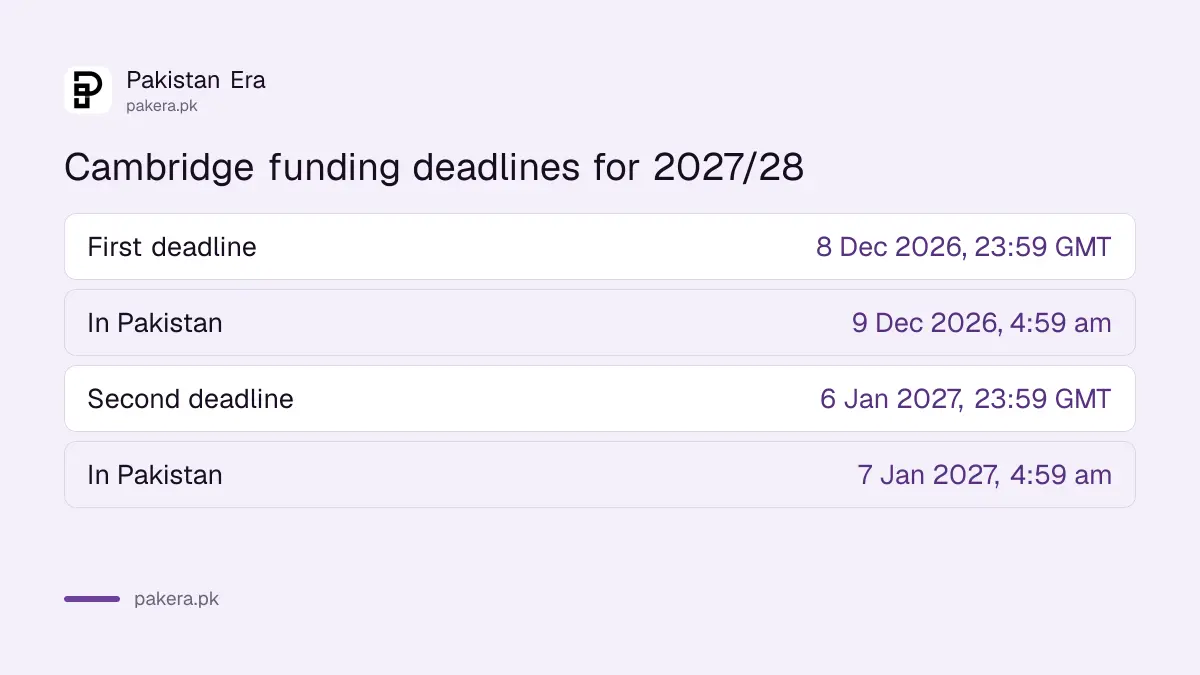
Pakistan is five hours ahead of GMT. So 23:59 GMT on 8 December is 4:59 am PKT on 9 December, and 23:59 GMT on 6 January is 4:59 am PKT on 7 January. Treat the evening before as your real deadline, because references count too.
The funding deadline is not the same as the course application deadline. The Trust says so plainly. A course may accept applications into spring, but if you apply after its funding deadline, you will not be considered for Trust money. Each course page in the University's postgraduate course directory shows its own funding deadline.
The Vicky Noon scholarship is only for Pakistani students
The Vicky Noon Cambridge Scholarship is open to undergraduate and master's applicants from Pakistan, and PhD applicants are considered on occasion. It covers Natural Sciences, Applied Sciences, and Humanities and Social Sciences at any College. It is offered with the Noon Educational Foundation and excludes premium rate courses.
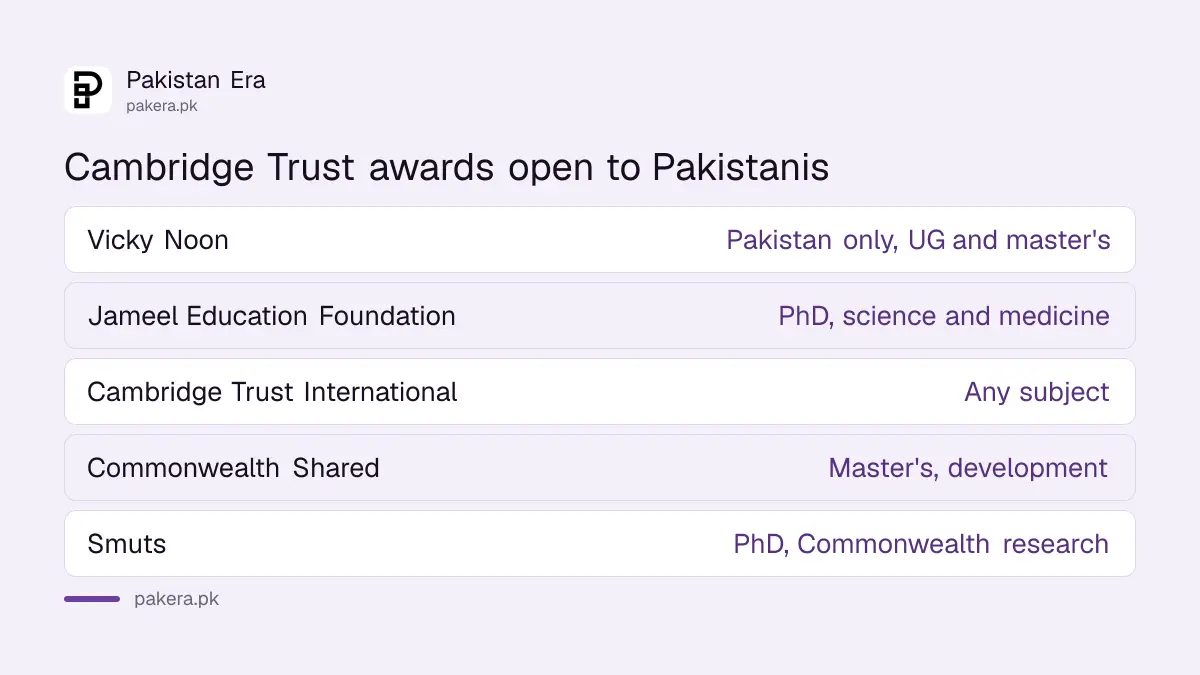
Pakistanis are also named in several wider awards. We checked every postgraduate listing the Trust publishes. These are the ones a Pakistani applicant should know:
| Scholarship | Level | Who and what |
|---|---|---|
| Vicky Noon Cambridge Scholarship | Undergraduate and master's, PhD on occasion | Pakistan only; Natural Sciences, Applied Sciences, Humanities and Social Sciences |
| Jameel Education Foundation Cambridge Scholarship | PhD | 36 countries including Pakistan; Biological Sciences, Engineering, Medicine, Physical Sciences and Technology |
| Cambridge Trust International Scholarship | Postgraduate | All countries except the UK and Ireland; any subject; highly ranked by the department |
| Commonwealth Shared Cambridge Scholarship | Master's | Certain developing Commonwealth countries; subjects relevant to your home country's development |
| Smuts Cambridge International Scholarship | PhD | Research relating to a Commonwealth country, normally arts, humanities or social sciences |
The Jameel award gives priority to research likely to help the development of your home country or region. For the Commonwealth Shared award, check the Commonwealth Scholarship Commission's country list, which the Trust points to. The Commission's other routes for Pakistanis are in the steps for the Commonwealth Scholarship through HEC.
Tick the funding box in your Cambridge application
For most Trust scholarships you apply through the University's Applicant Portal, not to the Trust. In the funding section, say you want to be considered for funding and give your income details. Some partner funded awards also need a separate application to the partner, and the listing says so.
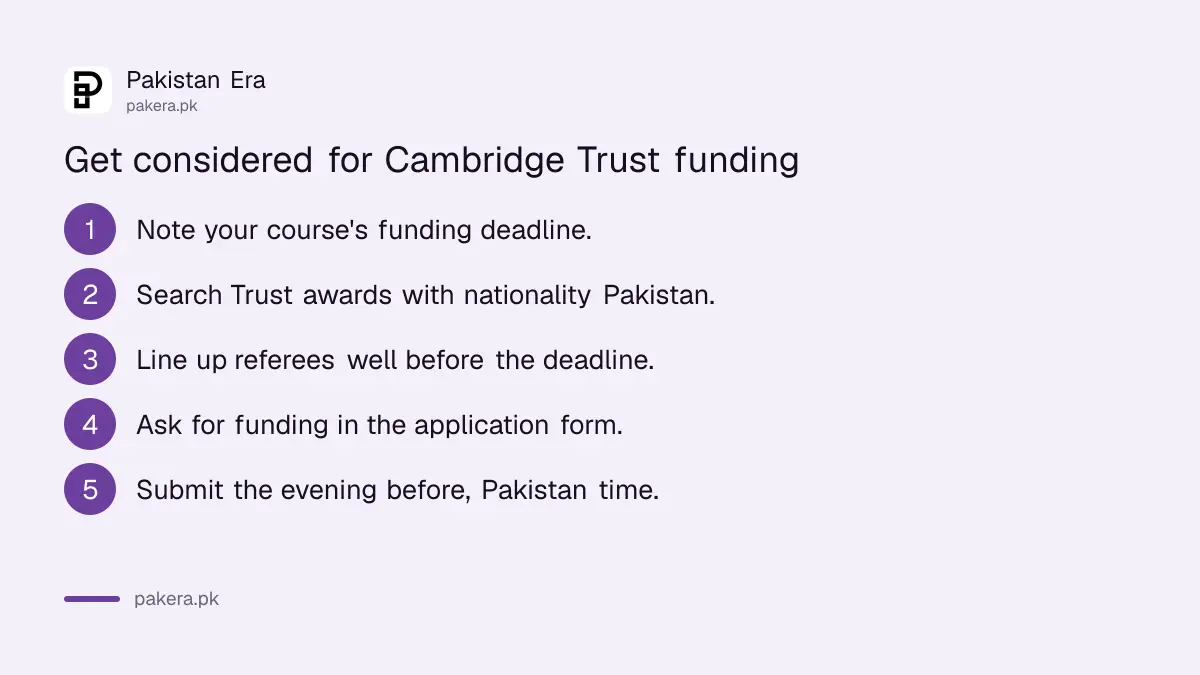
- Choose your course in the postgraduate course directory and note its funding deadline.
- Find every Trust scholarship you fit, using the Trust's search with nationality set to Pakistan.
- Start the University application early, because referees must submit before the deadline.
- Complete the funding section, ask to be considered, and list all significant income.
- Submit everything by the evening before the deadline, Pakistan time.
- Check each listing for any separate partner application.
You also need a conditional offer of admission. The Trust can only consider you if you applied by the funding deadline, asked for funding, and hold a conditional offer. A rejection from the department ends the funding question too.
Some courses and degree levels are not funded
The Trust funds master's courses such as the MPhil, MASt and LLM, with some restrictions, and the PhD. It does not fund premium courses such as the MBA and the MFin, and its table of levels lists others it does not cover. It will not fund a degree at the same or lower level than one you already hold.
That last rule catches people. If you already have a master's from a Pakistani university, a Cambridge MPhil is the same level, so the Trust will not normally fund it. The one exception is a second MPhil that your department requires before a PhD. Plan your application around this.
Funding is competitive, and the Trust advises applying for every scholarship you fit. If you are a strong candidate across the board, the Gates Cambridge Scholarship uses the same 8 December and 6 January deadlines.
Results come between February and July 2027
The Trust awards from mid-February to the end of July, with most offers in February and March. Partner awards with interviews often decide between April and June. If the Trust has not contacted you by the end of July 2027, assume you were not successful. It cannot notify everyone.
Plan the money side in parallel. A UK student visa needs proof of funds, which rose recently, as the change to UK student visa funds from 30 November 2026 explains. A full scholarship letter can change what you must show.
Common questions
What is the Cambridge Trust scholarship deadline for 2027?
It is your course's funding deadline, either 8 December 2026 or 6 January 2027, at 23:59 GMT. In Pakistan that is 4:59 am on 9 December or 7 January.
Is there a separate Cambridge Trust application form?
Not for most awards. You ask to be considered in the funding section of the University's course application. Some partner awards need an extra application, which the listing states.
Who can get the Vicky Noon Cambridge Scholarship?
Undergraduate and master's applicants from Pakistan, in Natural Sciences, Applied Sciences, or Humanities and Social Sciences. PhD applicants are considered on occasion. Premium courses are excluded.
Does the Cambridge Trust fund the MBA?
No. The Trust does not fund premium courses such as the MBA and the MFin.
Can I get a Cambridge Trust scholarship for a second master's?
Usually not, because the Trust does not fund a degree at the same level as one you hold. The exception is a second MPhil required by your department before a PhD.
When will I hear about Cambridge Trust funding?
Between mid-February and the end of July 2027. If you have not heard by the end of July, the Trust says to assume you were unsuccessful.
How we verified this
What we checked, where we read it, and what we could not confirm.
We read the Cambridge Trust's postgraduate applicants page, all 61 postgraduate and undergraduate scholarship listings in its public data, and the University of Cambridge postgraduate funding page on 20 October 2026. The Pakistan times are our conversion from GMT at UTC+5. We did not read individual course pages, the Commonwealth Scholarship Commission's country list or the Noon Educational Foundation's own terms, and the Trust listings give no amounts for these awards.
About the author

Global Affairs & Political Economy Writer
Muhammad Hatim is a book lover who started writing because he enjoys it. At Pakistan Era he writes about international relations, geopolitics and the global economy, with a particular interest in South Asia and the forces behind current events.