When Motorway Police Can Arrest You Without a Warrant in Pakistan: 9 Offences
Check the nine offences for which NHMP can arrest without a warrant on Pakistan's motorways, from fleeing a crash to racing, and what happens to your vehicle.
Under section 81 of the National Highways Safety Ordinance, a uniformed motorway police officer can arrest a driver without a warrant for nine offences, including fleeing an accident, racing, reckless driving and going 30 per cent over the speed limit. Everything else is a fine or a charge sheet. We read the section on 22 October 2026.
Most motorway stops end with a ticket. A few end with handcuffs. The difference is a short list in section 81 of the ordinance that governs the roads patrolled by the National Highways and Motorway Police (NHMP). We read the Gazette copy that NHMP publishes on nhmp.gov.pk. It is the 2000 text, so a later amendment could change a detail.
Section 81 lists nine offences where arrest needs no warrant
An officer in uniform may arrest without a warrant anyone who commits one of nine listed offences in the officer's view. The offence has to happen in front of the officer. Outside this list, the officer writes a charge sheet instead of making an arrest.
| No. | Offence in section 81(1) | Penalty section we read |
|---|---|---|
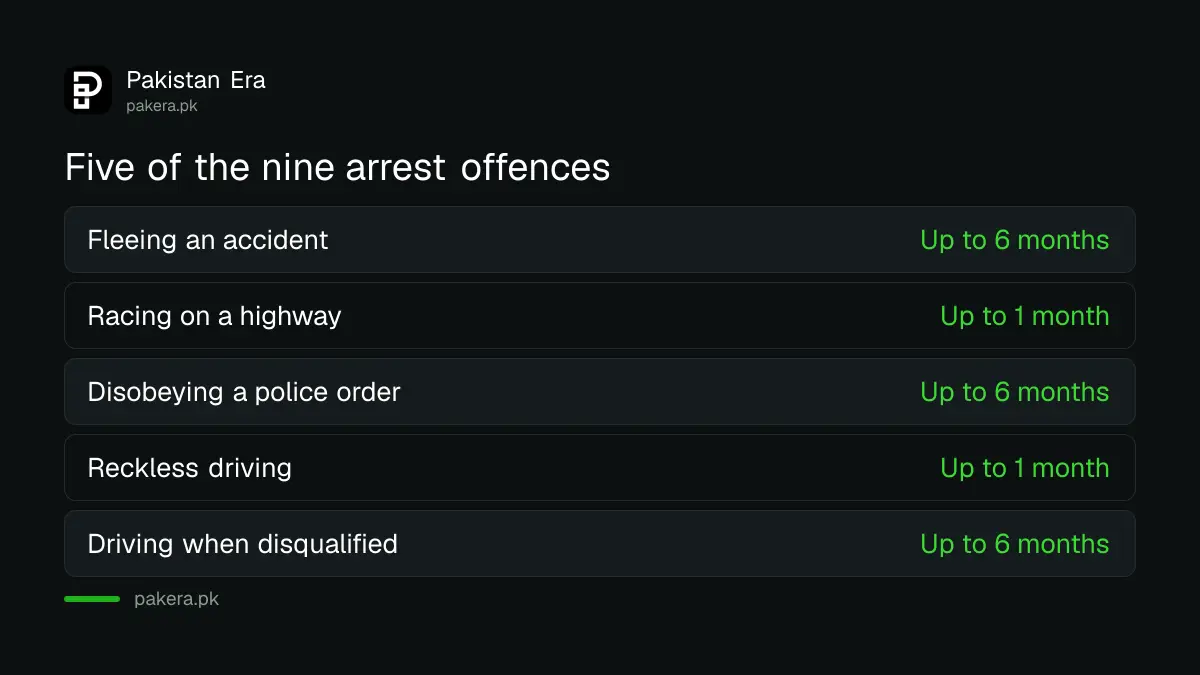
| 1 | Driving when disqualified | Section 65: up to 6 months or fine up to Rs 1,000 |
| 2 | Fleeing the scene of an accident involving your vehicle | Section 76: up to 6 months or Rs 1,000 to Rs 2,000 |
| 3 | Wilful disobedience or obstruction of lawful orders | Section 77: up to 6 months or Rs 1,000 to Rs 2,000 |
| 4 | Driving a transport vehicle without a valid licence, fitness certificate, registration, route permit or insurance | Fine set in schedules |
| 5 | Taking part in an unauthorised race or trial of speed | Section 70: up to 1 month or Rs 1,000 to Rs 2,000 |
| 6 | Overtaking dangerously or where prohibited by a heavy transport vehicle | Fine set in schedules |
| 7 | Driving 30 per cent above the speed limit | Section 66 and schedules |
| 8 | Failing to stop when directed by a uniformed officer | Section 77 and schedules |
| 9 | Driving recklessly, dangerously, or under the influence of drugs or alcohol | Sections 67 and 68 |
Going 30 per cent over the limit is an arrest offence, but only with a device reading
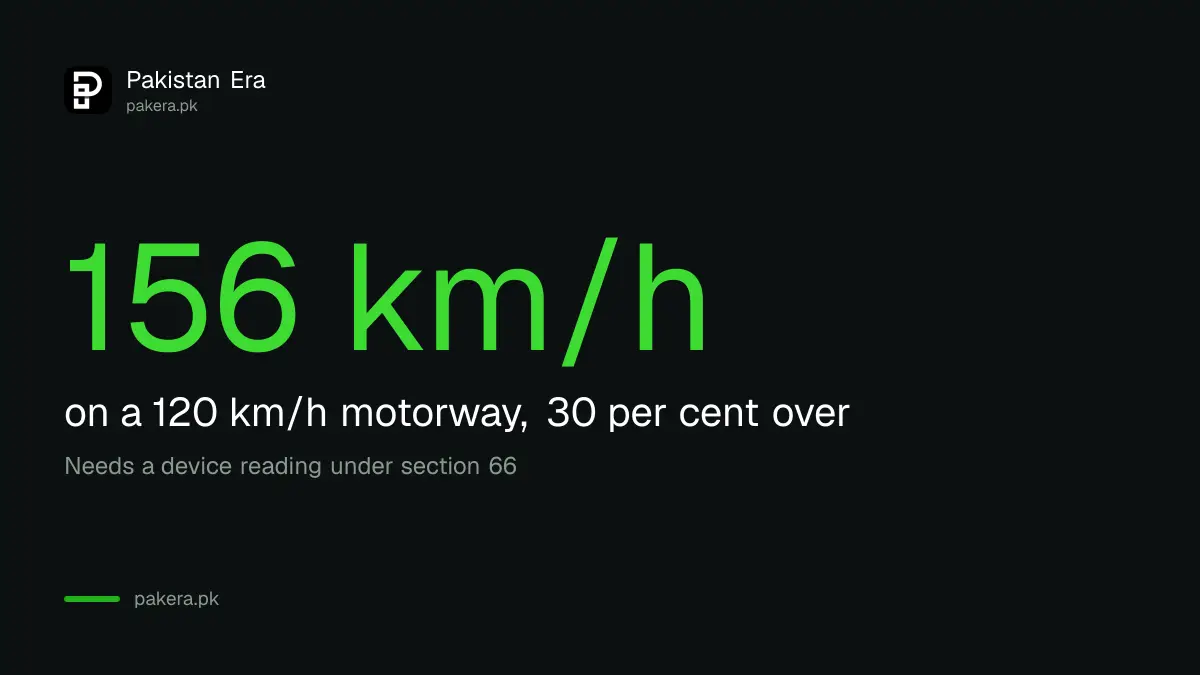
Speed alone can lead to arrest. On a road with a 120 km/h limit, 30 per cent over is 156 km/h, our own arithmetic. But section 66(2) says no one can be convicted of speeding unless the speed estimate came from a mechanical or electronic device.
That is why drivers see speed guns and cameras, not officers guessing. The limits for each vehicle type are in the guide to motorway speed limits. If an officer cannot show a reading, the conviction is not safe.
Fleeing an accident turns a collision into an arrest
Section 81 lists fleeing the scene of an accident involving your vehicle. Section 76(4) requires the driver to report the accident to the nearest patrol post and police station within 24 hours. Failing to do so carries up to one month or a fine of Rs 1,000 to Rs 2,000, or both.
The duties after a crash are covered in the guide to reporting a motorway accident within 24 hours. Stopping, helping and giving your name is safer than any alternative.
If the driver is arrested, the vehicle, goods and passengers are looked after
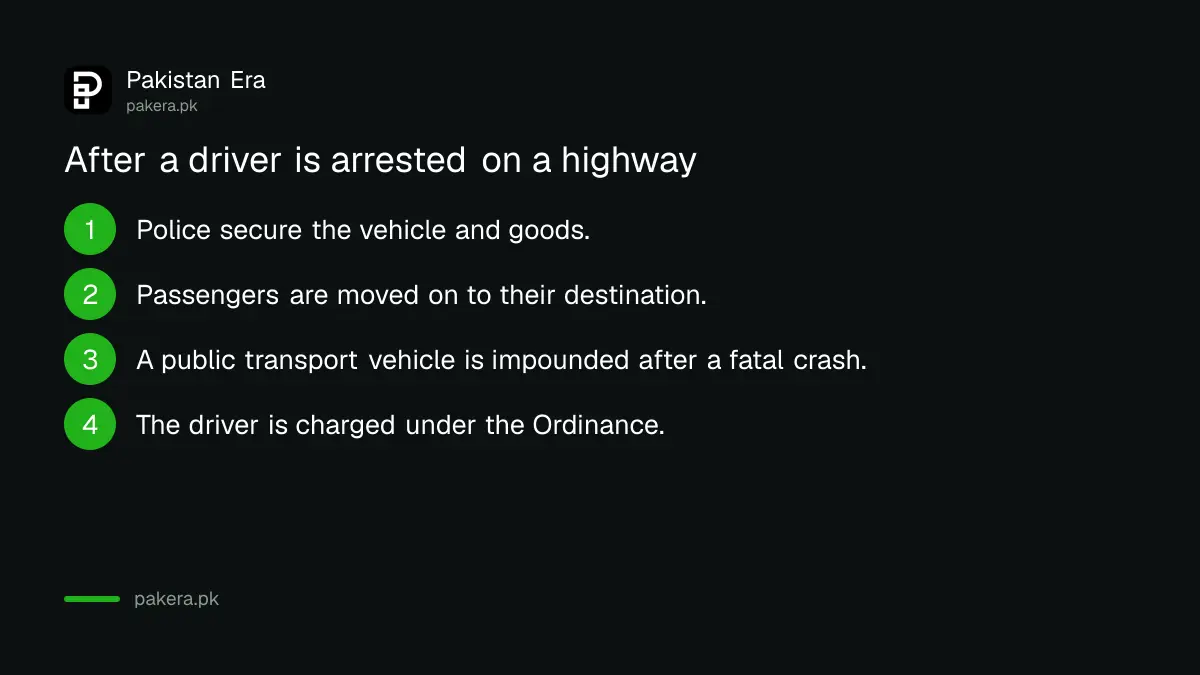
Section 81(2) says that when the police arrest the driver of a goods vehicle, the officer must take proper steps for the temporary disposal and safe custody of the vehicle and goods. Section 81(3) says that for a passenger vehicle the officer must also arrange for the passengers to be taken on in the same vehicle to their destination.
So a bus does not have to sit on the shoulder with forty people on it. This matters for families travelling by coach, and for goods owners worried about a load.
A public transport crash is presumed to be the driver's fault
Section 85 says that where a public transport vehicle causes an accident with grievous injury or loss of life, negligence by the driver is presumed unless he proves otherwise. The vehicle must be impounded by a uniformed officer and not released on a bond except in exceptional cases.
The reverse is also true. A private driver is not under that presumption, so the usual burden of proof applies. The rule for who pays after a crash is in the guide to no-fault accident insurance.
If an officer says you are being arrested, these steps protect you.
- Stop, switch off the engine and stay calm.
- Ask which offence in section 81 the officer is acting on.
- Ask the officer to secure your vehicle, goods or passengers, as section 81 requires.
- Note the officer name and number, and call NHMP on 130.
Outside the list, expect a charge sheet, not handcuffs
For other violations, section 79 tells the officer to write a charge sheet and give you a copy. You may pay the fine within ten days and the matter ends. The steps are in the guide to paying an NHMP charge sheet.
Section 82 also stops officers seizing your documents for a minor violation without a court order or a written order from an officer of Superintendent of Police rank or above. A full list of papers is in the guide to the documents NHMP can demand.
Common questions
Can NHMP arrest me for a speeding ticket?
Not for ordinary speeding. Arrest without a warrant applies at 30 per cent above the limit, and the speed must come from a device.
Do the police need a warrant to arrest me for drink driving?
No. Section 81 lists driving under the influence of drugs or alcohol. Conviction still needs a doctor's finding under section 68.
What if I drive without a licence?
If you are disqualified, yes, you can be arrested. Section 65 allows up to six months or a fine up to Rs 1,000 and the vehicle can be impounded.
Does the arrest rule apply on city roads?
No. The ordinance covers national highways and motorways. City roads follow provincial law.
Can they arrest me for refusing to stop?
Yes. Failing to stop when directed by a uniformed officer is item 8 on the list.
Where do I complain about a wrongful arrest?
Call the NHMP helpline 130, or use the numbers in our NHMP complaint guide.
How we verified this
What we checked, where we read it, and what we could not confirm.
Last checked 22 October 2026. Sections 65 to 68, 70, 76, 77, 79, 81, 82 and 85 come from the National Highways Safety Ordinance, 2000, in the Gazette copy at nhmp.gov.pk. The copy is a scan, so we read it as text and cross-checked the numbers. The 156 km/h figure is our arithmetic. We did not check for later amendments and could not confirm the fines set in the schedules, because the scanned tables were unclear.
About the author

Technology Journalist & Multimedia Producer
Ahmad Ali is a technology journalist and multimedia producer at Pakistan Era, joining the team in October 2026. He covers consumer technology and digital life for Pakistani readers, combining research with hands-on product testing.