How to Report Child Labour in Punjab: Call 1121 and Know the Law
Report child labour in Punjab: call the 1121 child helpline or file with the Labour Department. See the age limits, jail terms and fines in the 2016 Acts.
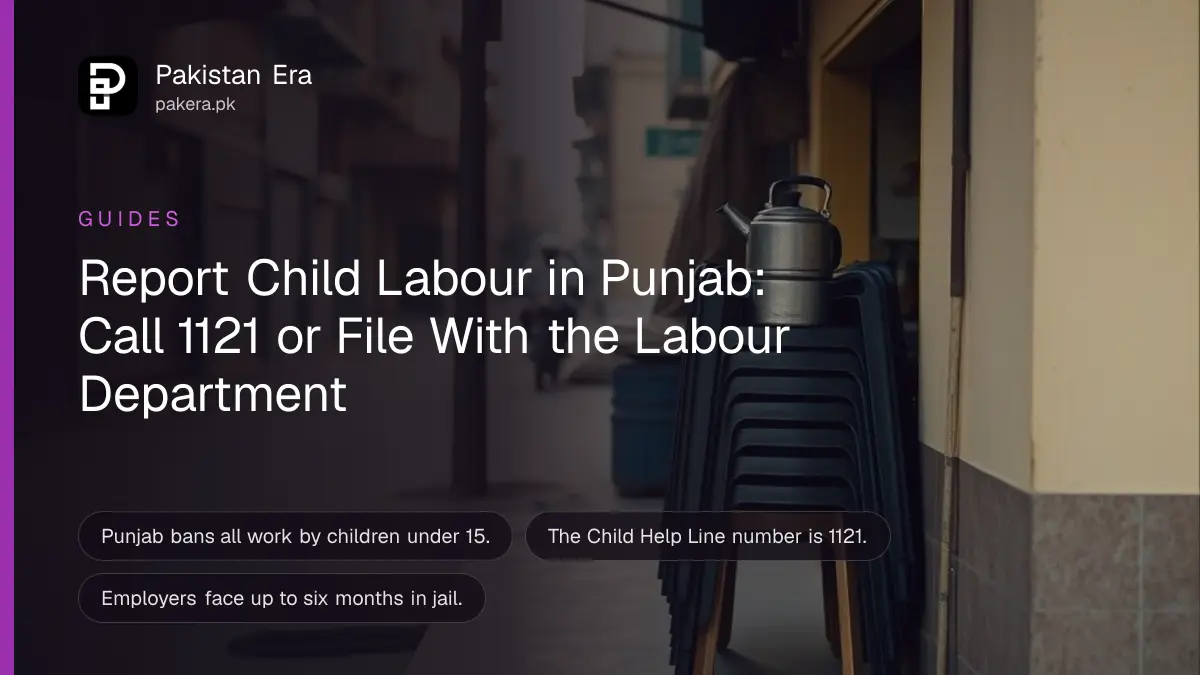
To report child labour in Punjab, call the Child Protection and Welfare Bureau helpline on 1121, or send a written complaint to the Labour and Human Resource Department. Under Punjab law a child under 15 may not be employed at all, and an employer faces up to six months in jail and a fine of Rs 10,000 to Rs 50,000.
You see it at a tea stall, a workshop door, a brick kiln or a neighbour's kitchen. A boy of 11 is carrying trays. A girl of 12 is scrubbing a floor at 9 pm. Most people look away because they do not know who to call, or whether the law even says it is wrong.
It does. We read the two Punjab Acts on child labour on the Punjab Code, the provincial government's statute website, and the contact pages of the two offices that take complaints, on 7 October 2026. This is what they say.
Call 1121 first, because it is the child helpline
The Child Protection and Welfare Bureau lists "Child Help Line: 1121" on its contact page. It also lists 042-99250276 and a WhatsApp number, 0335-5751121. The Bureau was set up by the Punjab government in 2004 to care for destitute and neglected children.
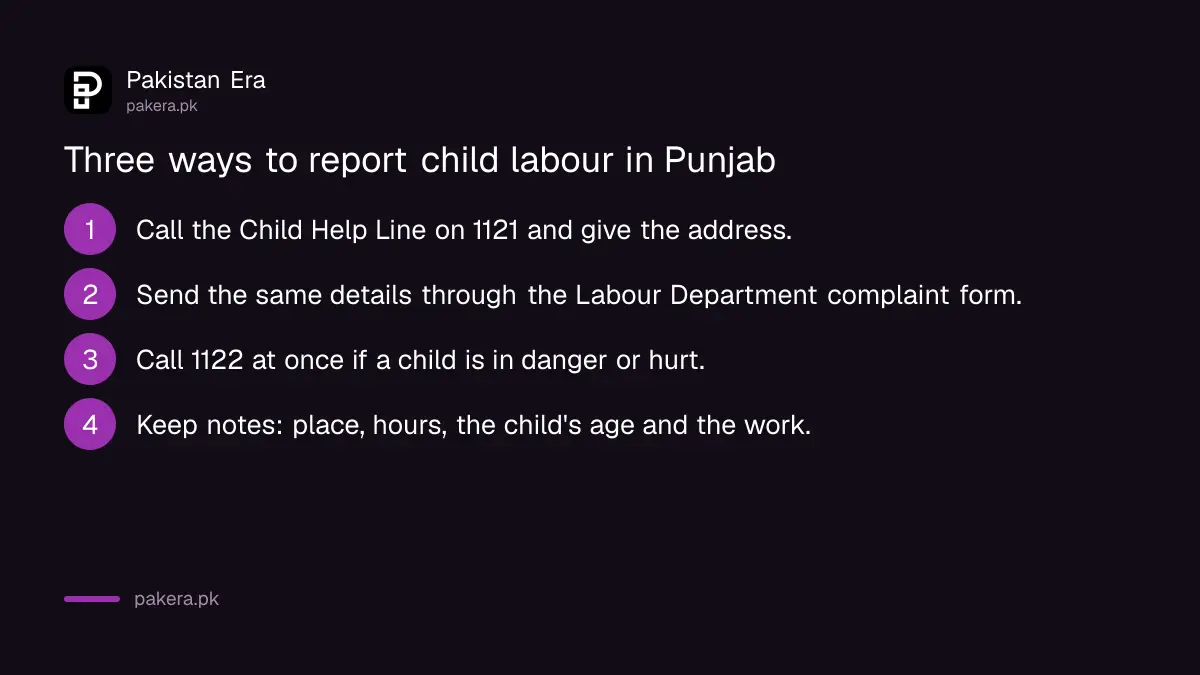
Give the operator the address, what the child is doing, how old the child looks and the name of the employer. You do not have to give your own name on the first call. Say if the child looks hurt, locked in or unfed.
If a child is in danger right now, call 1122. The Emergency Services Department lists it as the emergency number, and what Rescue 1122 does goes well beyond ambulances.
Send a written complaint to the Labour Department
Only an inspector can start a case. The Restriction on Employment of Children Act says an offence is dealt with by the police "on the complaint in writing made by the Inspector". So the Labour Department is the office that turns your report into a case.
The Labour and Human Resource Department has a complaint form at labour.punjab.gov.pk/complaint_form. Its page lists the office at 26-Main Gulberg, Lahore, phone 042-99263671 and 042-99263672, and email info@punjablabour.gov.pk. We did not submit a test complaint, so we cannot say how fast it replies.
- Write down the name and address of the workplace, with a landmark.
- Note the child's approximate age and the work being done.
- Note the hours. Work after 7 pm is banned for anyone under 18.
- Take a photo from a public place if it is safe. Never enter the premises.
- Call 1121, then send the same details through the Labour Department form.
A child under 15 cannot be employed in Punjab
The Punjab Restriction on Employment of Children Act 2016 defines a child as anyone under 15. Section 3 says an employer "shall not employ or permit a child to work in the establishment". The Act replaced the old Employment of Children Act 1991.
"Establishment" is wide. It covers any factory, shop, workshop, farm, mine, business or place of economic activity, including charities. Homes are handled separately: the rules for domestic workers in Punjab also set a minimum working age of 15.
Anyone aged 15 to 17 is an "adolescent". They may work, but not in hazardous jobs.
| Rule for adolescents (15 to 17) | What the Act says |
|---|---|
| Hazardous work | Banned. The Schedule lists 38 kinds |
| Hours in a day | 3 hours, then a 1 hour break. 7 hours in total at most |
| Night work | Not allowed between 7 pm and 8 am |
| Weekly holiday | At least one whole day |
| Age dispute | Settled by NADRA Form-B or a birth certificate |
The hazardous list includes passenger and goods transport, power-driven cutting machines, leather tanning, stone crushing, glass furnaces, carpet weaving, scavenging, construction, fireworks, and sites where LPG or CNG cylinders are filled. A boy loading a wagon or a girl weaving a carpet is covered.
Fines and jail terms are set in the law
An employer who uses a child or puts an adolescent in hazardous work faces seven days to six months in prison and a fine of Rs 10,000 to Rs 50,000. The offence is non-bailable.
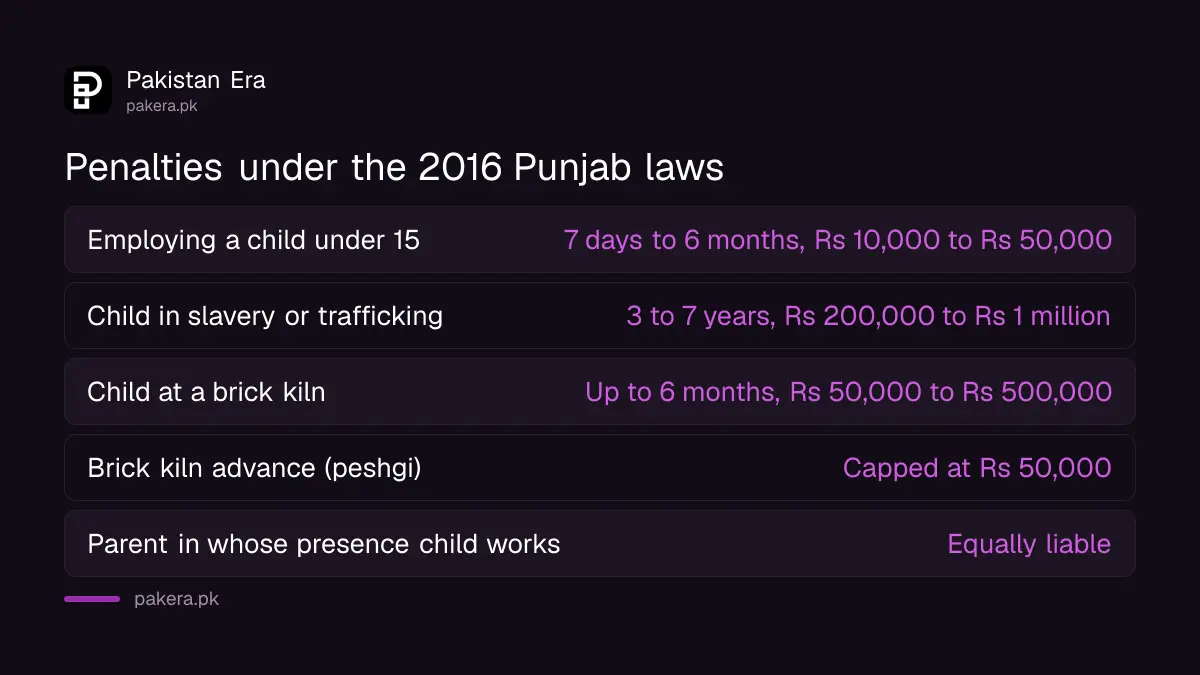
The worst cases carry far more. Using a child in slavery, debt bondage, trafficking, prostitution or the drug trade is punished with three to seven years and a fine of Rs 200,000 to Rs 1 million. A repeat offender gets at least three more months.
An inspector can also seal the workplace for up to seven days. The employer has three days to appeal.
One point surprises many families. If a child is found working in front of a parent or guardian, the parent is "equally liable". That is section 12(2). In practice an inspector's first step is usually to speak to the family, but the law lets a case reach them too.
Brick kilns have their own, stricter Act
The Punjab Prohibition of Child Labour at Brick Kilns Act 2016 bans any child under 14 from a kiln. It also presumes a child over five found at a kiln during school hours is working there, unless the owner proves otherwise.
- Fines run from Rs 50,000 to Rs 500,000, with up to six months in jail.
- A kiln worker must have a written contract.
- An advance (peshgi) cannot be more than Rs 50,000.
- A worker without a written contract is treated as a bonded labourer.
- Kilns can be sealed for seven days.
If the family is trapped in debt, say so on the call. Bonded labour is a separate offence and the helpline can pass it on. Wages owed to a kiln worker are a different matter, covered in how to claim unpaid wages in Punjab.
A new Labour Code will replace both Acts, but its start date is unclear
The Punjab Labour Code 2026 (Act IX of 2026, dated 10 February 2026) repeals both child labour Acts. It sets 16 as the age under which a child cannot work, and allows light work from age 14 for at most four hours a day and 20 hours a week. Its section 1 says it starts on a date the government notifies in the Gazette.
We could not find that notification on the Punjab Code or on the Labour Department site. Press reports in May 2026 said it was in force, but we could not confirm that on an official page, so reports differ. Until you see a Gazette notice, treat the 2016 Acts as the working law. A complaint made today stays valid either way, because the Code keeps actions taken under the old laws alive.
Common questions
What is the child labour helpline in Punjab?
It is 1121. The Child Protection and Welfare Bureau lists it as its Child Help Line, and its office number is 042-99250276.
What is the legal working age in Punjab?
Under the 2016 Act, no child under 15 may be employed. Anyone aged 15 to 17 can do only non-hazardous work, for limited hours.
Can I report child labour without giving my name?
The helpline page does not say, so ask the operator at the start of the call. Give the full address and details of the work either way.
Is a child helping in a family shop breaking the law?
The Act bans work in any "establishment", and its family exemption covers only the holiday, notice and age-dispute sections. The ban in section 3 still applies, so a child under 15 may not work there.
Can a parent be punished too?
Yes. The Act makes a parent or guardian equally liable if the child is found working in their presence, and the kiln Act says the same.
How we verified this
What we checked, where we read it, and what we could not confirm.
Last checked 7 October 2026. We read the Punjab Restriction on Employment of Children Act 2016, the Punjab Prohibition of Child Labour at Brick Kilns Act 2016 and the Punjab Labour Code 2026 on punjablaws.punjab.gov.pk. We read the contact pages of the Child Protection and Welfare Bureau (cpwb.punjab.gov.pk), the Labour and Human Resource Department (labour.punjab.gov.pk) and the Emergency Services Department (rescue.gov.pk). We did not call 1121 or submit a form. Other provinces and Islamabad have their own laws, which this page does not cover. For other emergency numbers, see the verified list of helplines.
About the author

Tax, Bills and Technology Writer
Ali Akhtar is a young and curious voice here at Pakistan Era. He is currently pursuing his A-Levels and has a growing interest in Pakistan’s changing industrial landscape and educational trends. Ali likes to write in a way that helps him explain and explore the world around him. His writing reflects the perspective of the new generation navigating the evolving trends of Pakistan where technology, youth innovation, and shifting opportunities are reshaping the country’s future.