Claim Unpaid Domestic Worker Wages in Islamabad: 30 Day Dispute Route Under the 2022 Act
An Islamabad domestic worker must raise a dispute within 30 days. See the five day wage rule, the fine for underpayment and how to get belongings back.
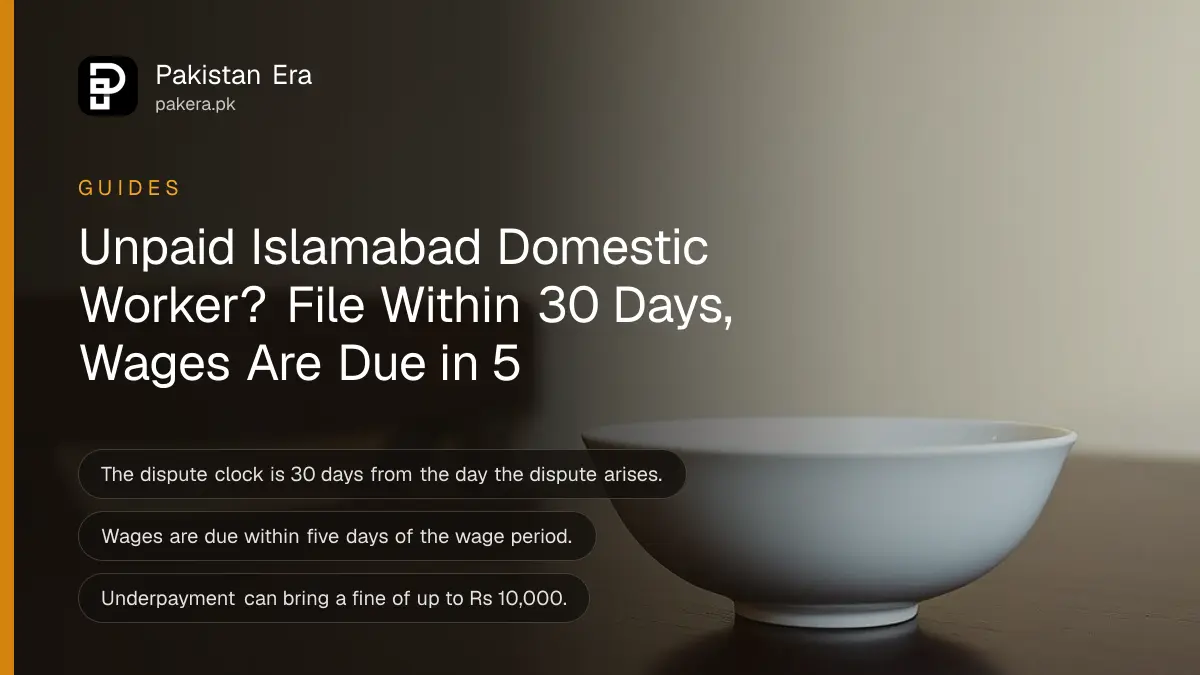
A domestic worker in Islamabad who is unpaid, underpaid or denied belongings can raise a dispute with the Dispute Resolution Committee within 30 days, and an appeal against its award must be filed within another 30 days. That is the route in the Islamabad Capital Territory Domestic Workers Act 2022.
Most maids, cooks and drivers in Islamabad homes have no contract and do not know a special law exists. We read the Act as published in the Gazette of Pakistan on 25 October 2022, on 21 October 2026. The Act extends only to the Islamabad Capital Territory. It does not apply in Punjab, where a separate law governs. For that, see domestic worker rights across provinces.
The 30 day clock starts the day the dispute arises
Section 23(3) says every dispute must be presented to the Dispute Resolution Committee within 30 days from the date it arises. The Committee is headed by the Assistant Commissioner or another officer the Government notifies. Wait too long and the claim may be refused.
So write down the date wages were missed, the date you were sent away, or the date your documents were kept. Count 30 days from that day. We could not find the Committee's address or phone number in the Act, so ask the Assistant Commissioner's office in your area.
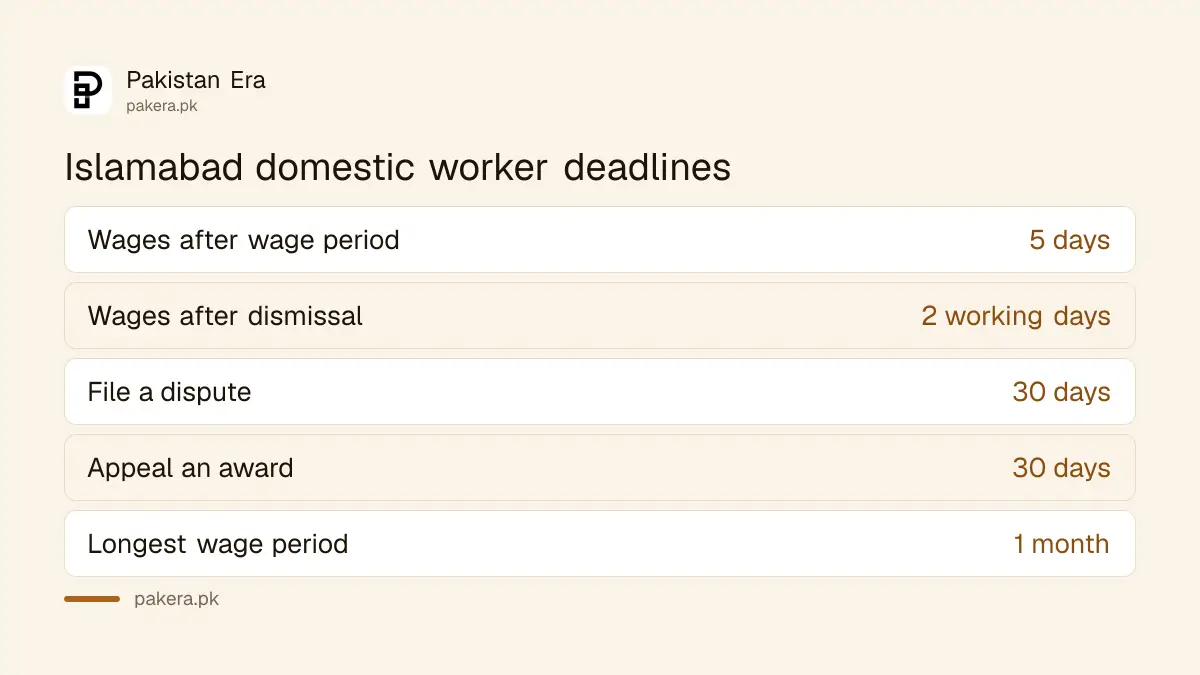
Wages are due within five days of the wage period and two days after you leave
Section 18 says wages must be paid before the expiry of the fifth day after the wage period ends, and no wage period can exceed one month. If the employer ends the job, wages earned must be paid before the end of the second working day after termination.
| Problem | What the Act says | Section |
|---|---|---|
| Late wages | Pay within 5 days of the wage period | 18(1) |
| Wages after dismissal | Pay within 2 working days | 18(3) |
| Below minimum wage | Fine up to Rs 10,000 plus the shortfall | 19(2) |
| Belongings or documents kept | Apply to the Committee, fine up to Rs 10,000 | 14 |
| Dispute not raised in time | 30 days from the dispute | 23(3) |
Wages must be paid on a working day, in coins or notes. The wage cannot be lower than the minimum rate the Government declares for domestic workers. A claim about wages or deductions is settled in the way the Minimum Wages Ordinance, 1961 provides. For the current Islamabad wage floor, see the Islamabad minimum wage and how to claim a shortfall.
The 30 day limit is strict, so act early. A worker who is unsure of the date should file anyway and explain the delay. Keep any message that shows when the dispute began, because the Committee will ask for it.
Employers must return belongings and identity documents when the job ends
Section 14 says personal belongings and identity documents of the worker or family must not be kept after termination. If they are, the worker can apply to the Committee, which can order them returned within a set time. An employer who fails faces a fine up to Rs 10,000.
An employer may keep a copy of the worker's identity documents during the job, but not the originals after it ends. That matters because retained CNICs are often used to hold workers in place.
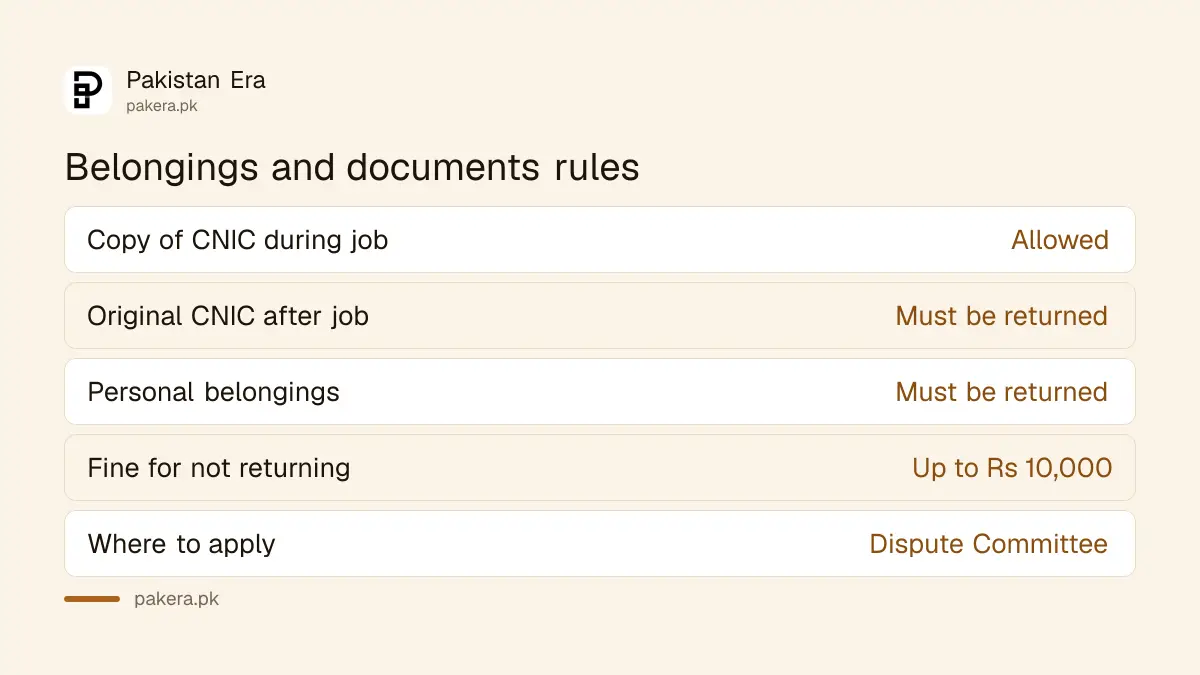
The Committee has civil court powers and can be appealed within 30 days
Under section 25, the Committee and the Appellate Authority can summon people, examine them on oath and order documents produced, like a civil court. Either side can appeal the award within 30 days to the Appellate Authority, appointed for each district under section 24.
For a wage claim, an employer who must pay more than Rs 20,000 appealing to the Labour Court must first deposit the amount. The Act says that decision is final. A prosecution under the Act needs the Committee's prior sanction and is tried by a First Class Magistrate.
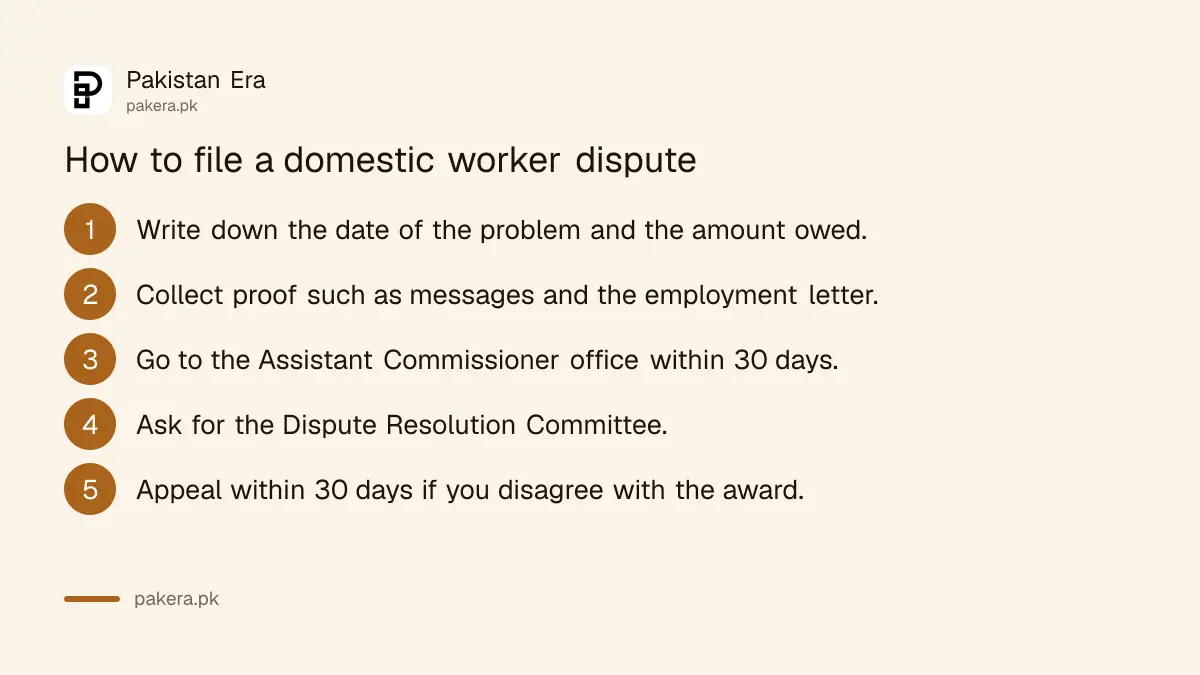
- Write down the date of the problem and what you are owed.
- Collect proof: messages, the employment letter, witnesses.
- Go to the Assistant Commissioner's office within 30 days.
- Ask for the Dispute Resolution Committee and file the dispute.
- If you lose or win, note the award date and appeal within 30 days.
Common questions about Islamabad domestic worker claims
Who can file a dispute under the Act?
Either the domestic worker or the employer, for any dispute connected with the terms of employment.
Is there a time limit?
Yes. Thirty days from the date the dispute arises, under section 23(3).
Can an employer keep my CNIC?
Only a copy during the job. After termination, originals and belongings must be returned, under section 14.
Can a child under 16 work in a home?
No. Section 3 bans any child under 16 from household work. Employing a child under 12 can bring up to one month in prison.
What is the fine for paying below the minimum wage?
Up to Rs 10,000, plus the court can order the shortfall paid. See section 19(2).
Does the Act apply in Lahore or Karachi?
No. It extends only to the Islamabad Capital Territory.
How we verified this
What we checked, where we read it, and what we could not confirm.
Last checked 21 October 2026. We read sections 1 to 36 of the Islamabad Capital Territory Domestic Workers Act 2022, assented on 21 October 2022 and published in the Gazette of Pakistan (Extraordinary) on 25 October 2022, from a copy of the Gazette text. The official Pakistan Code copy did not open for us. We did not find the Committee's contact details, any rules under the Act or the current notified domestic worker wage, so confirm them with the Islamabad administration.
About the author

Tax, Bills and Technology Writer
Ali Akhtar is a young and curious voice here at Pakistan Era. He is currently pursuing his A-Levels and has a growing interest in Pakistan’s changing industrial landscape and educational trends. Ali likes to write in a way that helps him explain and explore the world around him. His writing reflects the perspective of the new generation navigating the evolving trends of Pakistan where technology, youth innovation, and shifting opportunities are reshaping the country’s future.