DRAP Tells Medical Device Importers in Pakistan to File Through PSW, Keeps OIES Only as a Fallback
DRAP's 16 October 2026 letter moves medical device imports to the Pakistan Single Window, with OIES kept only for those who cannot use it. See what to update.
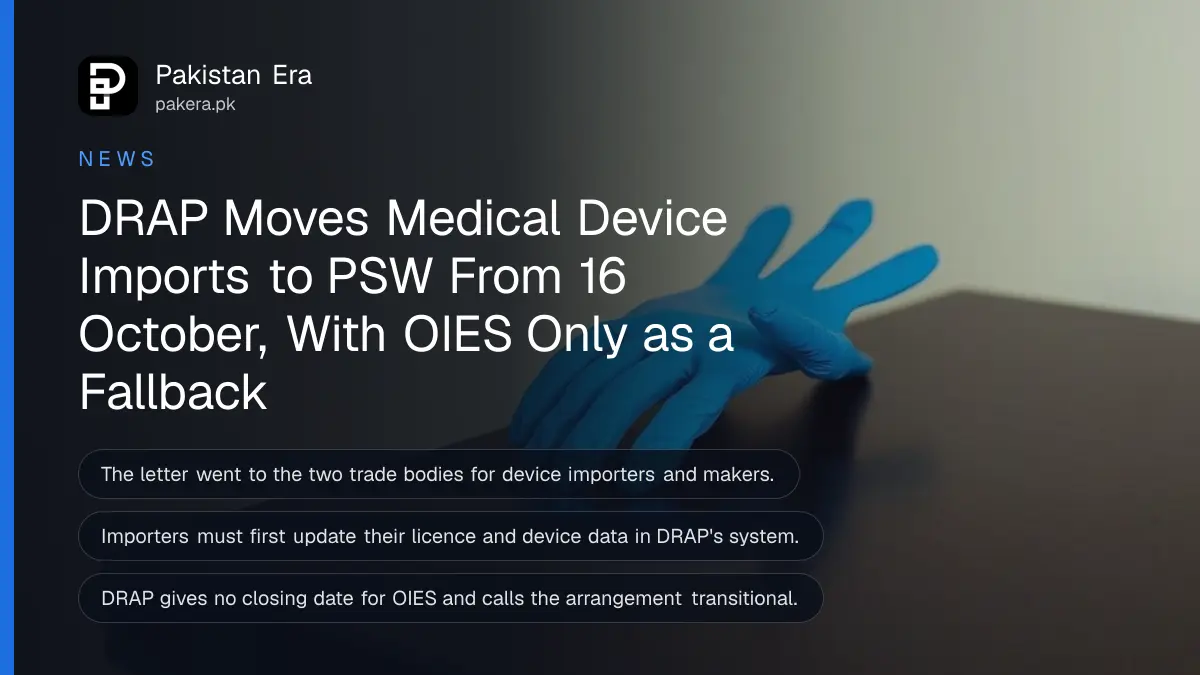
Short answer: The Drug Regulatory Authority of Pakistan (DRAP) told medical device importers on 16 October 2026 that its old Online Import and Export System (OIES) will stay open only for importers who cannot yet file through the Pakistan Single Window (PSW). Everyone else must apply through PSW. Importers who have not updated their establishment licence and device registration data in DRAP's system are told to do so at once.
We read the letter, number 6-14/2025DDQA(VII)-0002, on DRAP's site on 19 October 2026. DRAP posted it on 17 October. It is addressed to the two trade bodies for the sector, the Healthcare Devices Association of Pakistan and the Pakistan Electromedical Equipment Manufacturers and Distributors Association, and it follows an earlier letter of 17 July 2026 on the same subject.
DRAP's 16 October letter keeps OIES open only for importers who cannot use PSW
The letter says a number of importers are still updating their data in the DRAP Medical Devices Licensing and Registration System so that it can be linked with PSW. To avoid delays in clearing device consignments during this transition, OIES will remain available only to applicants who are unable to submit import applications through PSW. All other applicants must use PSW.
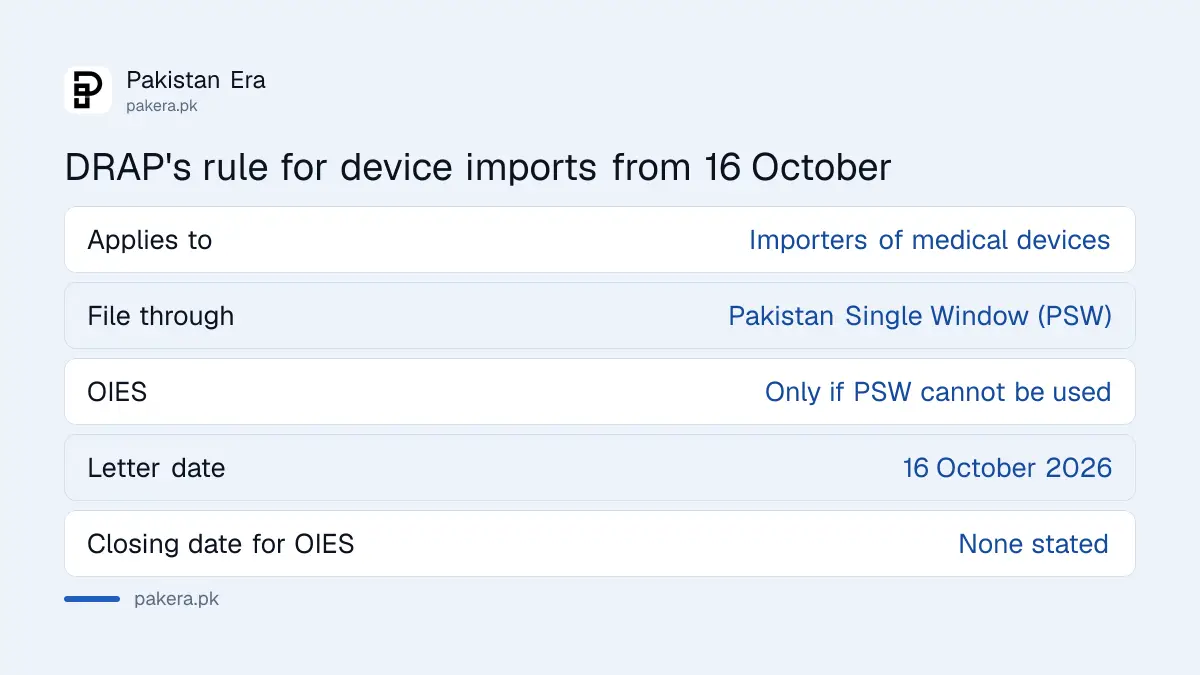
DRAP calls this a facilitation during the transitional period, not a permanent choice. The letter says every importer must complete the data update at the earliest so that the switch to PSW becomes smooth and permanent. It was issued with the approval of DRAP's chief executive and copied to the quality assurance director and the field offices in Karachi, Lahore, Islamabad, Peshawar and Quetta.
Importers must update their licence and registration data first
PSW can only process a device import if DRAP's own system holds the importer's current establishment licence and the registration or enlistment of the device being imported. That is the data DRAP wants updated. Until an importer's record is complete, PSW cannot see it, which is why DRAP is keeping OIES open as a fallback for that group alone.
An importer of medical devices in Pakistan needs two things from DRAP. The first is an establishment licence to import, which covers the firm and its storage premises. The second is a registration, for Class B, C and D devices, or an enlistment, for low-risk Class A devices, for each product. The lists of licensed importers and makers, and how to search them, are in the guide on how to check a medical device importer is DRAP licensed.
| Step | What the importer must hold | Where it sits |
|---|---|---|
| 1 | Establishment licence to import medical devices | DRAP Medical Devices Licensing and Registration System |
| 2 | Registration or enlistment of each device | DRAP Medical Devices Licensing and Registration System |
| 3 | PSW subscription and user ID | Pakistan Single Window |
| 4 | Import application for each consignment | PSW, or OIES only if PSW cannot be used |
| 5 | Customs goods declaration | PSW |
The table is our summary of the letter and DRAP's device pages, not a form DRAP publishes. How a goods declaration is filed through PSW rather than the older customs system is explained in the guide on WeBOC or PSW.
DRAP has moved imports to PSW in stages since 2022
PSW is the single online gateway through which importers deal with customs and every regulator at once. DRAP signed its agreement with PSW in November 2022. Drug imports at Karachi's seaport and airport moved from OIES to PSW from 15 August 2024, and Peshawar and Islamabad followed from 8 October 2024. In November 2025 DRAP added a pre-import clearance step for drug raw materials and finished products.
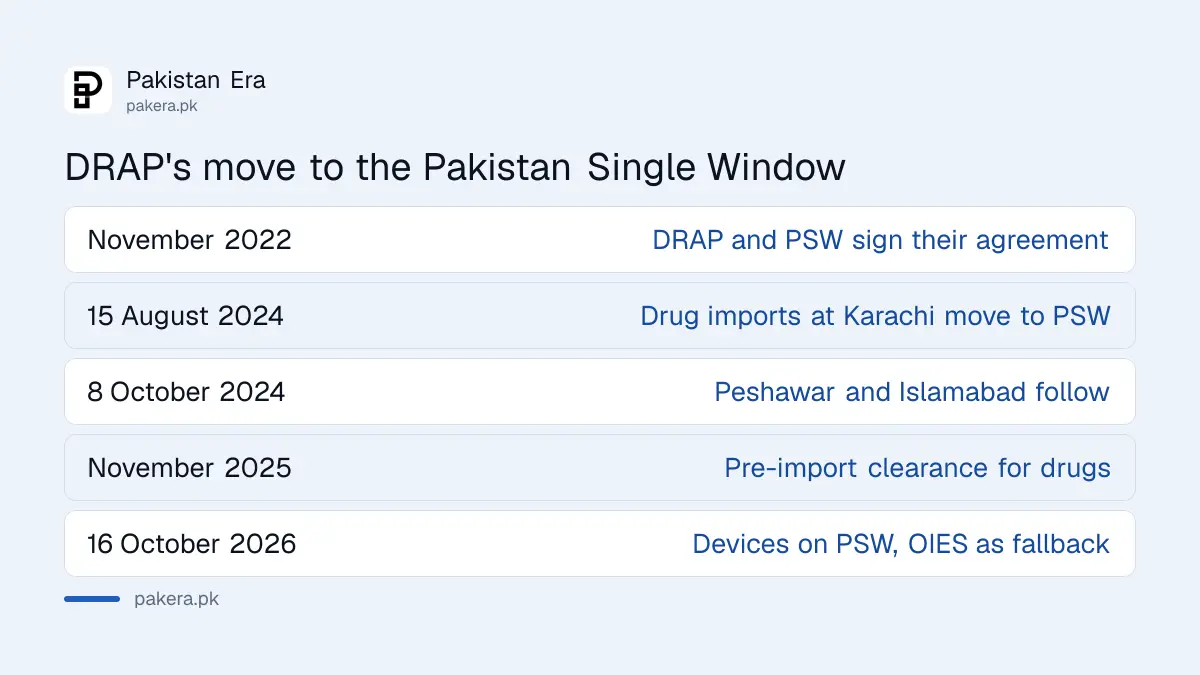
Medical devices are the last large category to make the move. The July 2026 letter started the data update, and the October letter sets the rule for the overlap period. DRAP has not published a date on which OIES closes for devices. The letter says only that OIES is for those who cannot use PSW, and that the arrangement is transitional.
What hospitals, dealers and patients should expect
For a hospital or dealer buying imported devices, the practical effect is on timing. A consignment from an importer whose DRAP record is incomplete may wait while the data is fixed, because neither PSW nor a fallback filing can clear it without a valid licence and registration. DRAP's stated aim is the opposite, to avoid delays, but the letter exists because some importers are behind.
For a patient, nothing changes at the counter. The protection is the same as before: a device sold in Pakistan should come from a licensed importer or maker, and the product itself should be registered or enlisted. A supplier who cannot show both is the risk, not the filing system. DRAP has been tightening the paper trail on medicines in the same way, with the 2D barcode rule for medicine packs that took effect on 9 October 2026.
How to check an importer before you buy
These steps are ours, built on DRAP's published lists and the letter.
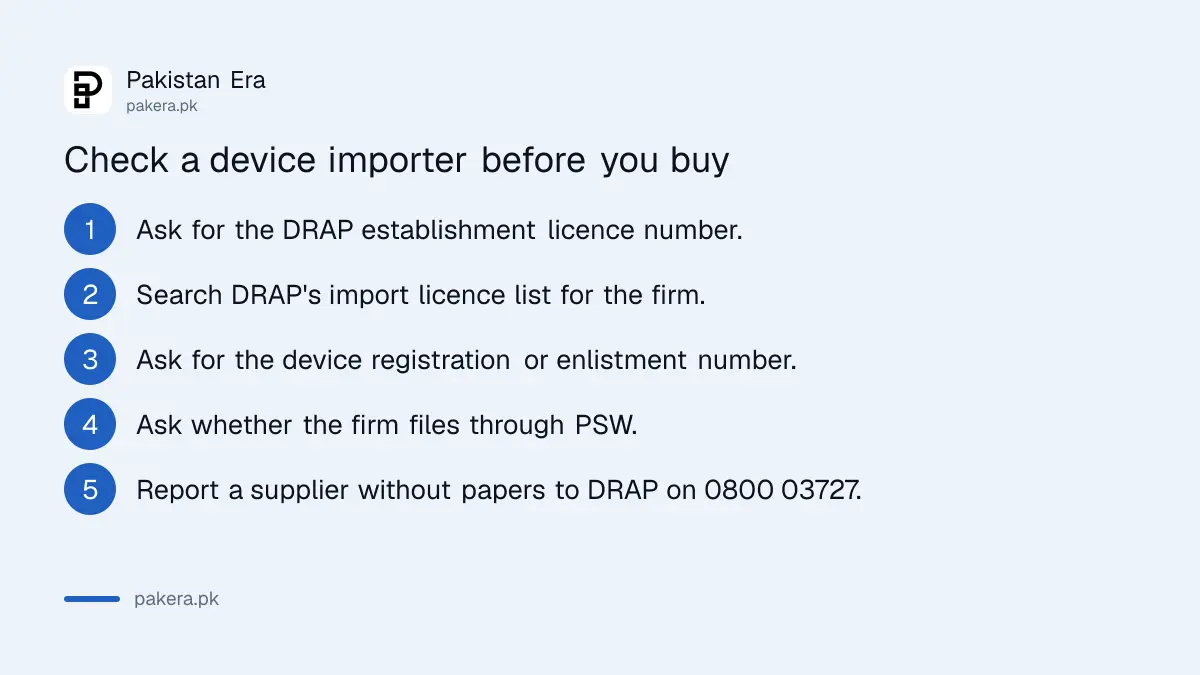
- Ask the supplier for its DRAP establishment licence number. Import licences carry an ELI prefix, local makers an ELM prefix.
- Open DRAP's list of establishment licences for import and search for the firm's name and number.
- Ask for the registration or enlistment number of the specific device and check it against the DRAP device list.
- For a hospital tender, ask whether the importer files through PSW. A firm still on OIES has a data update pending.
- Report a supplier that cannot produce either number to DRAP on 0800 03727.
Common questions about the DRAP PSW letter
What did DRAP announce on 16 October 2026?
That medical device import applications must go through the Pakistan Single Window, and that the old OIES stays open only for importers who cannot yet use PSW because their DRAP data is incomplete.
Who does the letter apply to?
Importers of medical devices. It was sent to the two trade associations for the sector and copied to DRAP's field offices.
Is there a deadline?
No date is given. DRAP says importers must complete their data update at the earliest and that the OIES arrangement is transitional.
Does this affect medicine imports?
No. Drug imports moved to PSW in 2024 and gained a pre-import clearance step in November 2025. This letter is about devices.
What is PSW?
The Pakistan Single Window, a single online portal through which importers file with customs and every regulator, including DRAP, instead of separately.
Will device prices change?
The letter says nothing about prices, and we have no basis to say so. It concerns how an import is filed, not what it costs.
How we verified this
What we checked, where we read it, and what we could not confirm.
Last checked 19 October 2026. The letter is on DRAP's page Development of Medical Devices Module on PSW, posted 17 October 2026, as the PDF Medical devices import clearance, dated 16 October 2026, which we read in full. The 2022 agreement, the August and October 2024 switchovers and the November 2025 pre-import clearance are from DRAP's own regulatory update pages, which we listed on 19 October. The licence prefixes come from DRAP's published licence lists read for our earlier guide. We could not verify when OIES will close for devices or how many importers are still updating data, because the letter does not say.
About the author

Tax, Bills and Technology Writer
Ali Akhtar is a young and curious voice here at Pakistan Era. He is currently pursuing his A-Levels and has a growing interest in Pakistan’s changing industrial landscape and educational trends. Ali likes to write in a way that helps him explain and explore the world around him. His writing reflects the perspective of the new generation navigating the evolving trends of Pakistan where technology, youth innovation, and shifting opportunities are reshaping the country’s future.