DRAP Makes 2D Barcodes Compulsory on Medicine Packs in Pakistan From 9 October
DRAP says all registered medicines made or imported from 9 October 2026 need a 2D barcode and serial number. See what changes and what stays legal in shops.
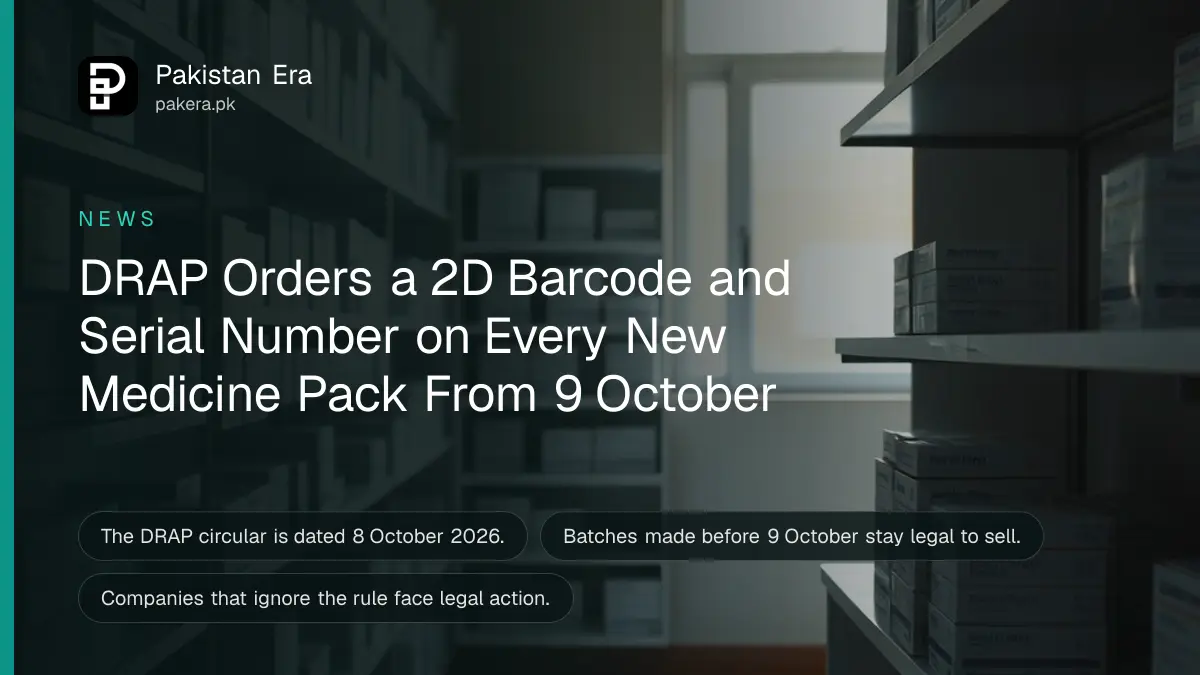
From 9 October 2026, every registered medicine made in Pakistan or brought in from abroad must carry a unique 2D Data Matrix barcode and a serial number. The Drug Regulatory Authority of Pakistan (DRAP) confirmed the date in a circular dated 8 October 2026.
The change targets fake and unregistered medicines. It does not change what you pay or how you buy. The packs already on pharmacy shelves are not affected, and DRAP says they stay legal to sell. So for now you will see old packs and new packs side by side.
DRAP made the 2D barcode compulsory from 9 October
The DRAP circular says all registered drug products made locally or imported on or after 9 October 2026 must carry a 2D barcode and serial numbers. DRAP calls this its Pharmaceutical Track and Trace System. Phase 1 covers every locally made and imported pharmaceutical product.
We read the circular itself on DRAP's website on 8 October 2026. It is a two page notice signed by the Director MIS and issued with the approval of the Chief Executive Officer. It places the system inside DRAP's Strategic Plan of National Regulatory System 2026 to 2030. It also follows earlier directives, including an August 2025 order asking industry to send its details for the barcode project.
A 2D Data Matrix is the small square dot pattern, different from the thin vertical lines on a shop barcode. It can hold much more data in a small space. A serial number makes each box different from every other box of the same medicine.
Packs made before 9 October stay legal to sell
DRAP says batches made locally or imported with a manufacturing date before 9 October 2026 are exempt. They remain permitted for distribution and sale. A pharmacist who sells you an older pack without a barcode is not breaking this rule.
That matters for buyers, because a missing barcode is not proof that a medicine is fake. Most stock in shops today was made before the deadline. The new code will appear only as new batches reach shops, which will take weeks or months, depending on how fast each medicine sells.
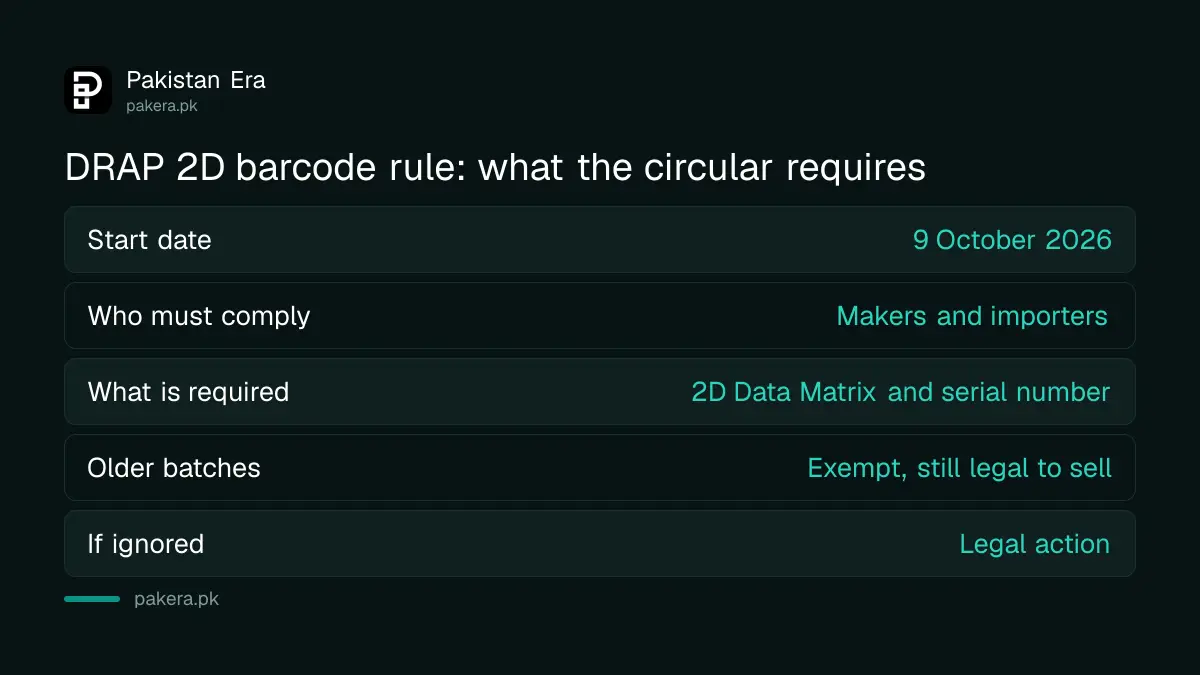
| Question | What the DRAP circular says |
|---|---|
| Start date | 9 October 2026 |
| Who must comply | Manufacturers and importers of registered drug products |
| What is required | Unique 2D Data Matrix barcode and serial numbers |
| Batches made before 9 October | Exempt, still allowed for distribution and sale |
| If a company does not comply | Legal action under the relevant law |
The rule aims at fake medicines and faster recalls
DRAP says the system will help curb spurious, falsified, counterfeit and unregistered medicines. It also says recalls will be linked to the system, and that the supply chain across Pakistan will become more transparent.
Recalls matter because they are slow today. When a batch is found to be bad, officials have to tell shops and distributors by notice. We covered one such case in the Punjab recall of DryGlit, Trezine, Zinad and Bemin batches. A serial number on each box could let regulators find a bad batch faster. That is the goal. The circular does not say how fast the system will work in practice.
- A company makes a batch and gets serial numbers for each box.
- The serial numbers are printed in the 2D code on each pack.
- The data goes into DRAP's Track and Trace system as the batch moves through distribution.
- If a batch is recalled, the system can point to the affected serials.
The list above is our plain summary of how such systems work and what DRAP says it wants. DRAP's circular does not describe each step.
What the circular does not say about patients
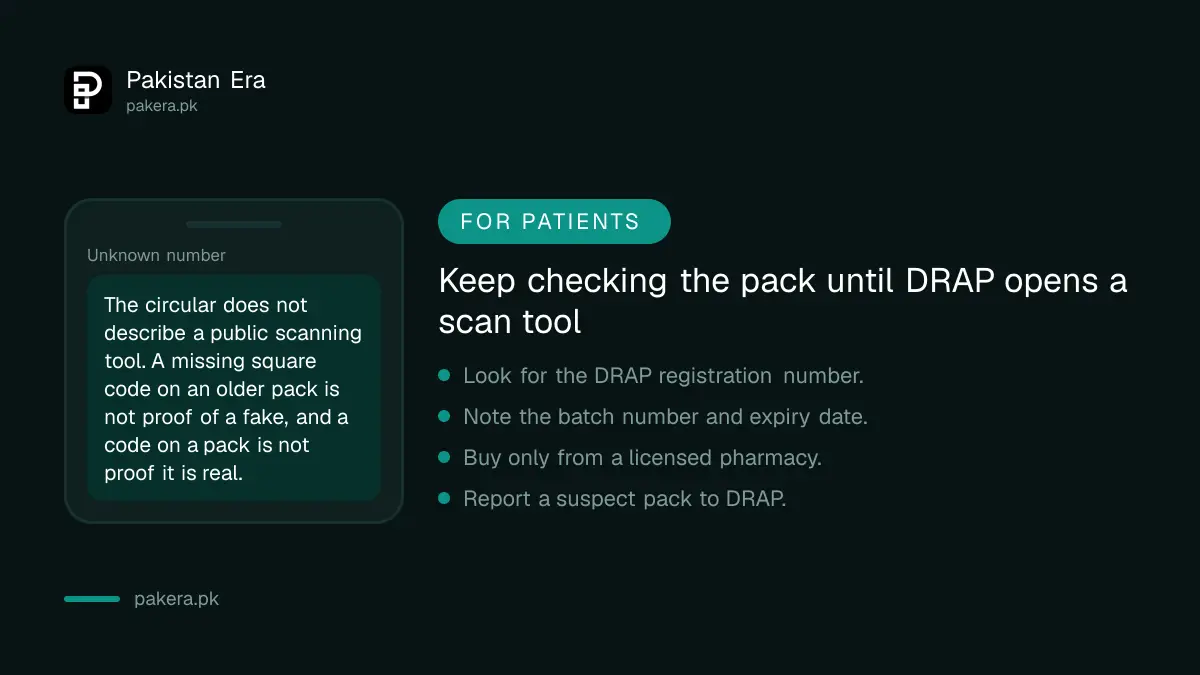
The circular is addressed to manufacturers and importers. It does not say how a patient can scan a code and check a medicine. We found no public scanning app or portal described in it. We also could not read the technical guideline that DRAP published in July 2026, because its page shows only a download link.
Some press reports have said that consumers will be able to scan the code to see the expiry date, usage instructions and official price. That is reported, not confirmed by DRAP's circular. Do not rely on it until DRAP publishes a public check tool.
Until then, the existing checks still apply. The steps to check a medicine is registered and priced right with DRAP show the registration number check. If you think a pack is fake, report counterfeit medicine to DRAP with the batch number and the shop name.
One date in the circular does not match
The circular names the rule as S.R.O. 963(I)/2026, which amends the Drugs (Labelling and Packaging) Rules, 1978. Paragraph 2 gives its date as 9 June 2026. Paragraph 4 gives it as 9 July 2026. Both cannot be right.
We have not found the notification itself, so we cannot say which date is correct. It does not change the 9 October start date, which the circular states clearly. We will update this page if DRAP corrects the circular.
What you should do now
Nothing changes for your next purchase. Keep buying from a licensed pharmacy, and keep the receipt. Look at the pack for the DRAP registration number, the batch number and the expiry date. If a new pack shows a square code, that is the new system arriving. If an old pack has none, that alone is fine.
Be careful with a medicine that has a code but no registration number, or a price far below the usual one. The barcode is not a guarantee. A copied code can be printed on a fake box, which is why the data behind the code matters more than the picture. To check that a shop is licensed first, see how to check if a pharmacy is licensed in Punjab.
Common questions about the medicine barcode rule
When does the 2D barcode rule start?
It starts on 9 October 2026. DRAP's circular of 8 October says all registered drug products made locally or imported on or after that date must carry it.
Are medicines already in shops still legal?
Yes. DRAP says batches with a manufacturing date before 9 October 2026 are exempt and may still be distributed and sold.
Can I scan the code with my phone to check a medicine?
DRAP's circular does not describe a public check tool. Some reports say one is planned. Until DRAP publishes it, check the registration number and batch number instead.
Does the rule cover veterinary medicines?
The circular is addressed to makers and importers of pharmaceutical, biological and veterinary products. Phase 1 is described as covering all locally made and imported pharmaceutical products.
Will medicine prices change because of the barcode?
The circular says nothing about prices. Price changes need a separate DRAP notification, as seen when DRAP had not notified a 15 per cent medicine price rise.
What happens to a company that ignores the rule?
DRAP says legal action under the relevant legislation will be started in case of non-compliance. It does not name a fine or a penalty in the circular.
Sources and what we could not verify
Last checked 8 October 2026. The main source is DRAP's own circular, F. No. 1-2/2026-CEO(DRAP), dated 8 October 2026, on dra.gov.pk. We could not read DRAP's technical guideline on GS1 Data Matrix barcodes, which was published in July 2026. The claim that consumers will scan codes for expiry, usage and price comes from press reports and is not in the circular. The date mismatch for S.R.O. 963(I)/2026 is in the circular as published.
About the author

Senior Writer, Public Services and Technology
Shahid joined us in 2024 as an author. He is a senior contributor to Pakistan's leading technology websites. He writes detailed articles, mostly covering his expertise in the latest tech, mobiles, apps, gadgets, and step-by-step guides. His ideology is to help people understand the latest trends and explain complex methods through very easy-to-understand guides.