DRAP Orders Medicine Makers to Match Pack Data With Track and Trace, Inspectors to Check Batches
DRAP says batch, expiry, MRP and serial data in its Track and Trace system must match each medicine pack. Inspectors will check batches. Old stock stays legal.
DRAP has told every medicine maker and importer in Pakistan that the data they upload to its Track and Trace system must match what is printed on each pack: the batch number, the manufacturing and expiry dates, the MRP and the serial number. A mismatch will be treated as misreporting, and Federal Inspectors of Drugs will now check packs against the system during visits.
The Drug Regulatory Authority of Pakistan (DRAP) posted the letter on its website on 16 November 2026. It is dated 10 November and signed by the Director of Quality Assurance and Lab Testing. It is the first enforcement step since the 2D barcode rule started on 9 October, and it changes nothing at the pharmacy counter for now. Older packs without a code are still legal.
DRAP says pack data must match the Track and Trace record
The DRAP letter of 10 November says every entry a company sends to the Track and Trace system must be correct, verified and a true copy of the printed pack. Any gap between the digital record and the label counts as misreporting and a direct violation.
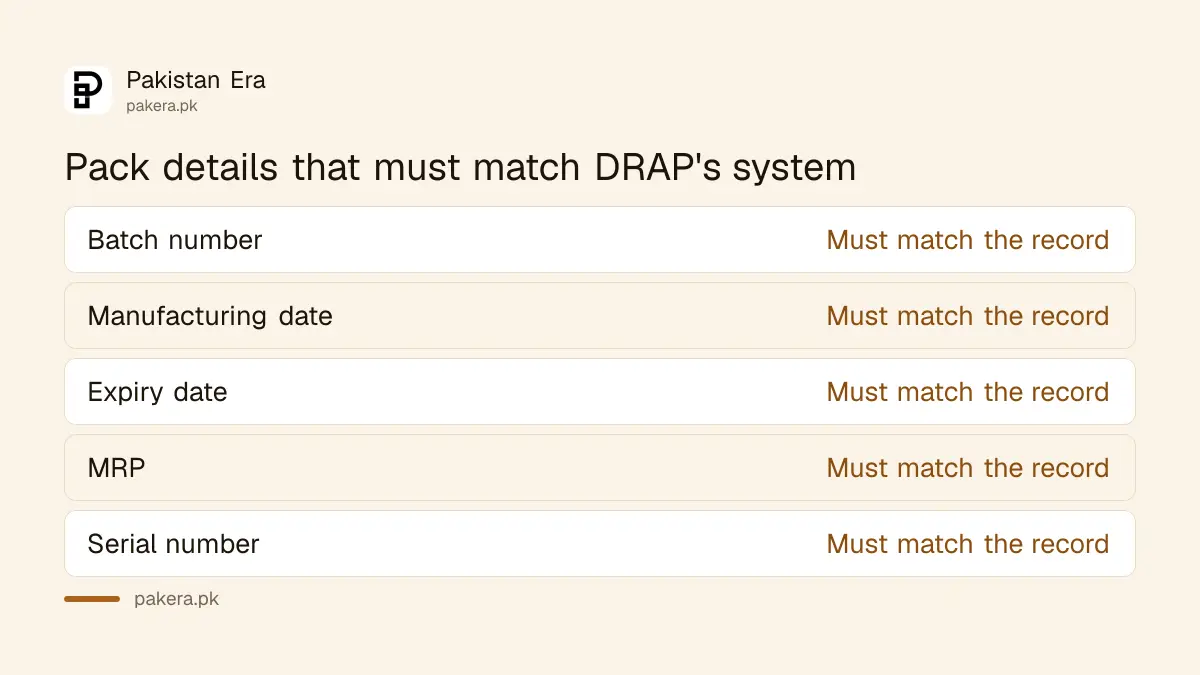
The letter names five details that have to match. These are the same details you can read on the side of a medicine box today.
| Detail on the pack | What DRAP requires |
|---|---|
| Batch number | Must match the Track and Trace entry |
| Manufacturing date | Must match the Track and Trace entry |
| Expiry date | Must match the Track and Trace entry |
| MRP (maximum retail price) | Must match the Track and Trace entry |
| Serial number | Must match the Track and Trace entry |
The registration holder, meaning the company whose name the medicine is registered under, is responsible for the data. That puts the duty on the maker or importer, not on the pharmacy that sells the box.
Inspectors will cross-check real batches against the system
Federal Inspectors of Drugs and DRAP field offices will visit factories, importers' premises and supply chain channels. They will look at physical batches and compare them with the data in the system. DRAP has directed legal action for any non-compliance, wrong data or falsification.
The letter cites three laws for that action: the DRAP Act 2012, the Drugs Act 1976 and the rules made under them. Copies went to DRAP's field offices in Islamabad, Lahore, Karachi, Peshawar and Quetta, which are told to enforce it through their field staff and pass the letter to every maker and importer in their area.
Inspection powers are also being rewritten. DRAP published draft rules for federal inspectors and government analysts on 11 November, which set out how samples are taken and goods seized.
- A company prints the 2D code, batch, dates, MRP and serial on each pack.
- It uploads the same details to DRAP's Track and Trace system.
- An inspector visits and picks physical packs from a batch.
- The inspector compares the printed details with the system record.
- Any mismatch can lead to legal action against the registration holder.
Packs made before 9 October can still be sold
DRAP repeats that stock made before 9 October 2026 is exempt and can be sold until it runs out. A medicine without a 2D barcode is not fake for that reason alone. Check the manufacturing date on the box first.
Every finished medicine made in Pakistan or imported on or after 9 October must carry the 2D Data Matrix code and a serial number. The Data Matrix is the small square of dots, not the line barcode used in shops. The rule comes from SRO 963(I)/2026, which amended the Drugs (Labelling and Packaging) Rules 1978, and from DRAP's circular of 8 October. That was the day DRAP made 2D barcodes compulsory on medicine packs.
So for a few months you will see both kinds of packs on the same shelf. That is expected.
What the letter means for patients and pharmacies
For patients, nothing changes at the counter today. The letter is addressed to manufacturers, importers and their trade bodies. It does not launch a public scanning app, and it does not change any medicine price.
The benefit is indirect. When the printed MRP has to match a central record, a pack with a changed price or a reused batch number is easier to catch. That matters in a year when DRAP has issued dozens of alerts; the recall of seven batches on 16 November was the latest.
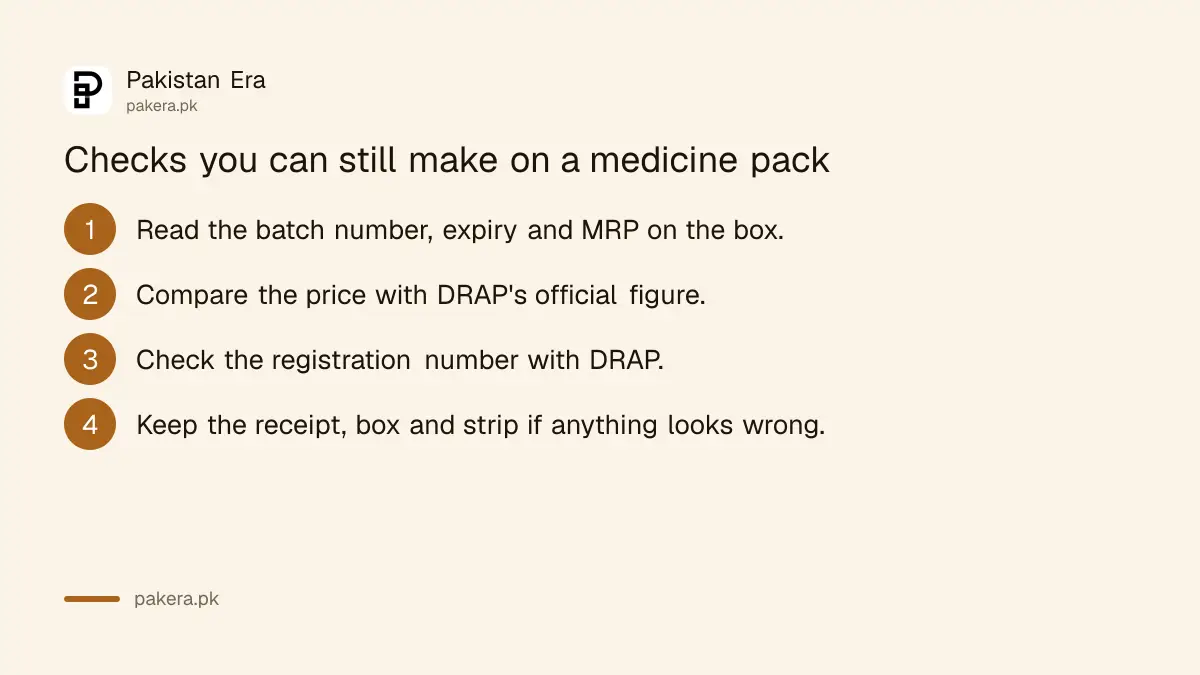
Until a public check exists, keep using the checks that already work:
- Read the batch number, expiry and MRP on the box before you pay.
- Compare the price with DRAP's figure on the PharmaPrice index.
- Look for the registration number and check it with DRAP.
- Keep the receipt, the box and the strip if anything looks wrong.
Pharmacies and distributors are copied in through the Pakistan Chemist and Druggist Association. They do not upload the data, but inspections will include supply chain channels, so a shop may see an inspector checking stock.
If a printed price or batch looks wrong, report it
If the MRP on a box is higher than DRAP's price, or a batch number looks altered, report it to DRAP with a photo of the pack, the batch number and the shop's name and address. Keep the pack sealed if you can.
DRAP's own complaint page and its safety reporting form both take public reports. The steps to report counterfeit medicine to DRAP cover the documents to keep. A report helps inspectors find the batch quickly, and the serial number now gives them one more detail to trace.
Common questions
Is a medicine without a 2D barcode fake?
Not by itself. DRAP says packs made before 9 October 2026 are exempt and can be sold until stock runs out. Check the manufacturing date first.
What did DRAP announce on 16 November 2026?
It posted a letter dated 10 November telling makers and importers that Track and Trace data must match the printed pack, and that inspectors will check batches against the system.
Which details must match?
The batch number, manufacturing date, expiry date, MRP and serial number printed on the commercial pack.
Who is responsible if the data is wrong?
The registration holder, which is the company the medicine is registered to. DRAP treats a mismatch as misreporting.
Can I scan the code to check my medicine?
DRAP's letter does not mention a public scanning tool. For now, check the registration number and the official price on DRAP's own pages.
Does this change medicine prices?
No. The letter is about data accuracy and inspections. It sets no new price.
How we verified this
What we checked and where we read it.
We read the DRAP notification page "Mandatory Compliance, Data Accuracy, System Verification for 2D barcoding and Serialization Requirements", posted on 16 November 2026 at 10:24 am on the DRAP notifications list, and the signed two page letter attached to it (Dy. No. 419/2026-E-DIR (QA<), dated 10 November 2026), on 17 November 2026. The PDF is a scanned image with a "16 November 2026" upload stamp. We also checked the 16 November recall alerts in DRAP's recall alert list.
About the author

Public Services and Education Journalist
Fajr Riaz is a journalist and content writer at Pakistan Era, based in Lahore. She covers the questions people meet in everyday life in Pakistan: how a public service works, what a change in the rules means, and where to find a reliable answer.