DRAP Draft Inspector Rules 2026: What They Mean for Pharmacies and Distributors, and Comments Within 15 Days
DRAP's draft inspector rules of 11 November 2026 set sampling, seizure and sealing forms and a 60 day lab deadline. What sellers must do and how to comment.
DRAP has published draft rules for its federal drug inspectors and laboratories, dated 11 November 2026. Objections and suggestions go to the Drug Regulatory Authority of Pakistan within 15 days of publication, which from the notice date is around 26 November. The draft replaces rules from 1976 and sets new forms for sampling, seizure and sealing.
The draft is called the Therapeutic Goods (Federal Inspectors, Federal Government Analysts and Federal Quality Control Laboratories) Rules, 2026. Therapeutic goods is the law's term for medicines, vaccines, medical devices and similar products. If you own a medical store, a distribution business, an import house or a factory, these are the rules an inspector will follow on your premises.
This page sets out what changes, what an inspector can do, the forms you will be handed, and how to send comments before the window closes.
What the draft rules replace and when they start
The draft repeals the Drugs (Federal Inspectors, Federal Drug Laboratory and Federal Government Analysts) Rules, 1976, and would come into force at once when final. Cases already started under the 1976 rules finish under them, and inspectors already notified keep their powers until further orders.
| Point | What the draft says |
|---|---|
| Notice date | 11 November 2026 |
| Comment window | 15 days from publication |
| Made under | Section 23, DRAP Act 2012 |
| Replaces | Drugs (Federal Inspectors, Federal Drug Laboratory and Federal Government Analysts) Rules, 1976 |
| Start date | At once, once finalised |
| Inspector qualification | Pharmacy degree and at least 10 years' experience |
| Lab report deadline | Within 60 days of receiving a sample |
The draft also brings in "risk based inspection". That means inspections are planned by product type, compliance history and safety signals, rather than only on a fixed calendar.
What a federal inspector can do on your premises
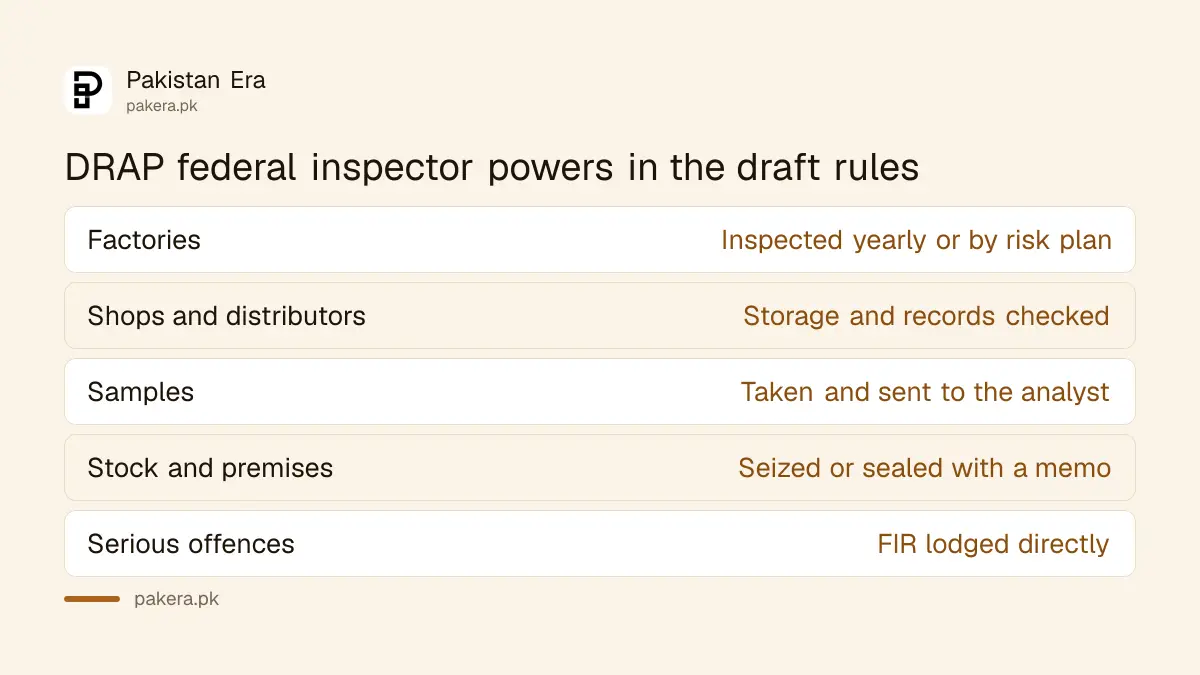
Under the draft, a federal inspector inspects licensed factories at least once a year or under a risk-based plan, and inspects import, export, distribution and sales premises from time to time. The inspector can take samples, investigate complaints, lodge an FIR for serious offences and help with recalls, pricing and shortage surveys.
- Manufacturers: inspection of the plant, testing methods, storage, records and licence conditions, at least yearly or as the risk plan sets.
- Importers, distributors and sellers: checks on storage, handling, distribution records and market surveillance.
- Samples: the inspector can sample any product believed to be made, imported, stocked or sold against the law, and send it for testing.
- FIR: for cognisable offences under the DRAP Act, the inspector can lodge an FIR directly and inform the board or committee within five working days.
- Complaints: the inspector investigates complaints about therapeutic goods sent directly or referred by DRAP.
To be a federal inspector, a person needs a pharmacy degree and at least ten years of experience in regulation, pharmacy services, manufacturing, quality work or drug administration. DRAP can relax the experience by up to two years if suitable candidates are not available.
The seven forms you may be handed
The draft sets out seven forms. The ones a shopkeeper or distributor is most likely to see are Form 1, an order not to sell stock; Form 2, a seizure receipt; Form 3, a notice that a sample was taken; and Form 7, a sealing memo fixed on a sealed area.
| Form | What it is | What to check |
|---|---|---|
| Form 1 | Order not to dispose of stock for a set number of days | Product, batch, expiry, quantity and the reason are filled in |
| Form 2 | Receipt for stock seized | Every item seized is listed, with witnesses and CNICs |
| Form 3 | Notice that a sample was taken | You get a copy and a sealed portion of the sample |
| Form 4 | Memo sending the sample to the government analyst | Kept by the inspector and lab |
| Form 5 | Lab test certificate | Result, protocol and whether the sample passed |
| Form 6 | Memo to the appellate laboratory | Used when a result is challenged |
| Form 7 | Sealing memo | Fixed on the sealed area, and a copy given to you |
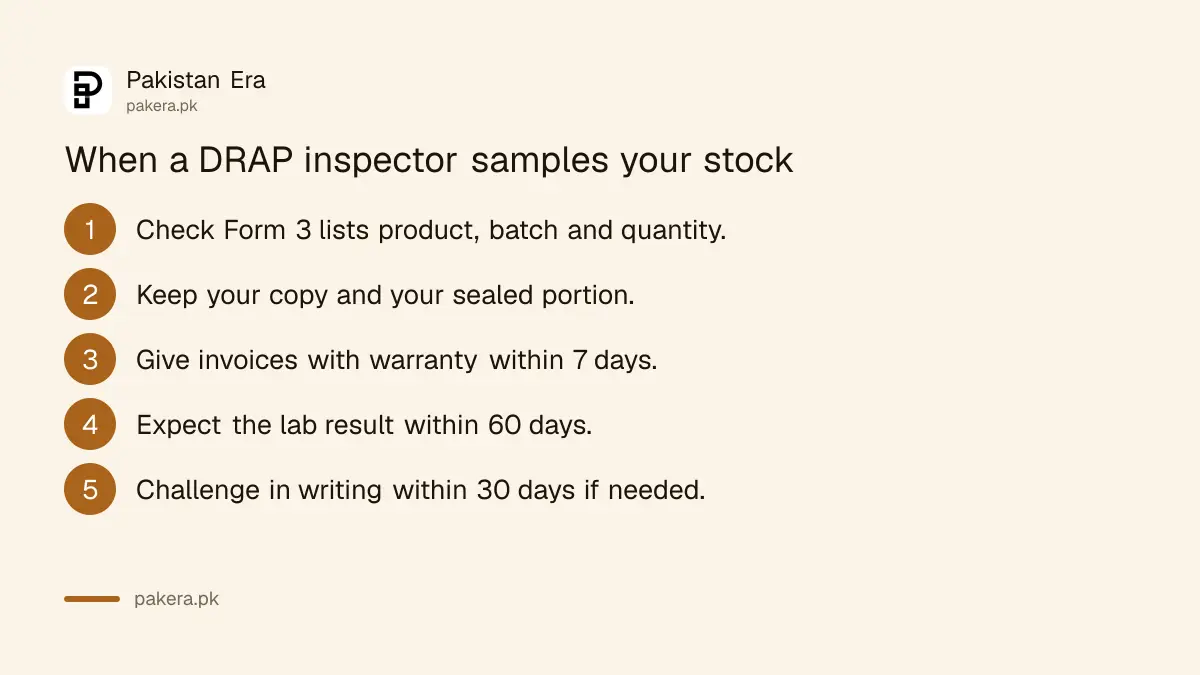
Form 3 carries a line that matters for sellers. The person whose stock is sampled certifies they will provide the bills or invoices, with the warranty, for the sampled products within 7 days. Keep purchase invoices from licensed suppliers filed by product and batch so you can meet that.
Lab results come within 60 days, and you can challenge them
The federal government analyst should report within 60 days of receiving a sample. If that is not possible, the analyst must give reasons in writing, and the board or committee can extend the period by up to 30 days. You have 30 days from receiving the report to say you will challenge it.
- Report issued. The analyst sends the result on Form 5, with the test protocols, to the inspector and the board or committee.
- Your challenge. Within 30 days of receiving a copy, notify the sender in writing that you will bring evidence against the report.
- Appellate laboratory. The board or committee may send the retained sample to the appellate laboratory, on its own or at your request.
- Final result. The appellate laboratory's report is conclusive evidence of the facts in it.
If you do not challenge within 30 days, the analyst's signed report is admissible as evidence without formal proof, and conclusive. Test fees will be set by DRAP under its fee rules and paid by the registration holder or the body asking for the test.
How to send objections or suggestions
The notice invites anyone likely to be affected to send objections or suggestions to the Drug Regulatory Authority of Pakistan within 15 days of publication. DRAP says every comment received in time will be considered before the rules are finalised. Send yours in writing and keep proof of when you sent it.
- Quote the rule number you are commenting on, for example rule 17(3) on the 60 day report.
- Say what problem it causes in practice and suggest exact wording.
- Associations of chemists, distributors and manufacturers can send joint comments.
Once the rules are final, sellers should also watch DRAP's recall and alert lists. Our pages on DRAP recall alerts in 2026 and checking a medicine is registered with DRAP show how. Doctors who keep a medical store in Islamabad have a separate licence rule, covered in Islamabad's drug sale licence for doctors.
Common questions
What are DRAP's draft inspector rules 2026?
Draft rules dated 11 November 2026 for federal drug inspectors, government analysts and federal quality control laboratories. They replace the 1976 rules and set sampling, seizure, sealing and testing procedures.
What is the last date for comments on DRAP's draft rules?
The notice allows 15 days from publication. From the notice date of 11 November 2026, that is around 26 November 2026.
Can a DRAP inspector seal my medical store?
The DRAP Act gives inspectors sealing powers. The draft says the inspector must fill a sealing memo on Form 7, fix it on the sealed area and give you a copy.
How long does a DRAP lab test take?
The draft asks the analyst to report within 60 days of receiving the sample. A delay must be explained in writing, and the extension cannot go beyond 30 days.
Can I challenge a failed sample result?
Yes. Notify the sender in writing within 30 days of receiving the report that you will contest it. The sample can then go to the appellate laboratory.
How we verified this
What we checked and where we read it.
Last checked 15 November 2026. Everything on this page comes from DRAP's notice of the draft Therapeutic Goods (Federal Inspectors, Federal Government Analysts and Federal Quality Control Laboratories) Rules, 2026 and the attached PDF, notification No. F.13-3/2025-LA dated 11 November 2026. The notice gives the 15 day window but no postal or email address for comments. The rules are a draft and can change before they are final.
About the author

Public Services and Education Journalist
Fajr Riaz is a journalist and content writer at Pakistan Era, based in Lahore. She covers the questions people meet in everyday life in Pakistan: how a public service works, what a change in the rules means, and where to find a reliable answer.