Islamabad Doctors Must Get a Drug Sale Licence to Run a Medical Store
Islamabad doctors who run a pharmacy must get a Drug Sale Licence after a Federal Constitutional Court ruling. See what is exempt and how to check medicine.
Doctors in Islamabad who run a pharmacy or medical store must now hold a Drug Sale Licence, the federal health ministry's drug control wing has told them. Medicines a doctor keeps in the clinic for their own patients are still allowed without one. The advisory, reported on 7 October 2026, follows a Federal Constitutional Court ruling.
For patients, the change is simple. A shop counter selling medicines, even one inside a clinic, needs a licence. Unlicensed outlets have been told to apply now or face legal action, and distributors have been told to stop supplying them.
Islamabad doctors need a licence to run a medical store
The advisory comes from Pharmacy Services and Drug Control, a wing of the Ministry of National Health Services, Regulations and Coordination. It covers registered medical practitioners in Islamabad Capital Territory who run a pharmacy or medical store. Each must hold a valid Drug Sale Licence, known as a DSL.
Three instructions are reported in the advisory:
- Doctors running a pharmacy or medical store must get a Drug Sale Licence.
- Unlicensed pharmacies and medical stores must apply at once to avoid legal action.
- Drug distributors must not supply medicines to any unlicensed pharmacy or medical store.
We did not find the advisory itself on the health ministry's website on 9 October 2026. Its contents above are as reported, so read them as the ministry's position until the text is published.
Medicines for a doctor's own patients stay exempt
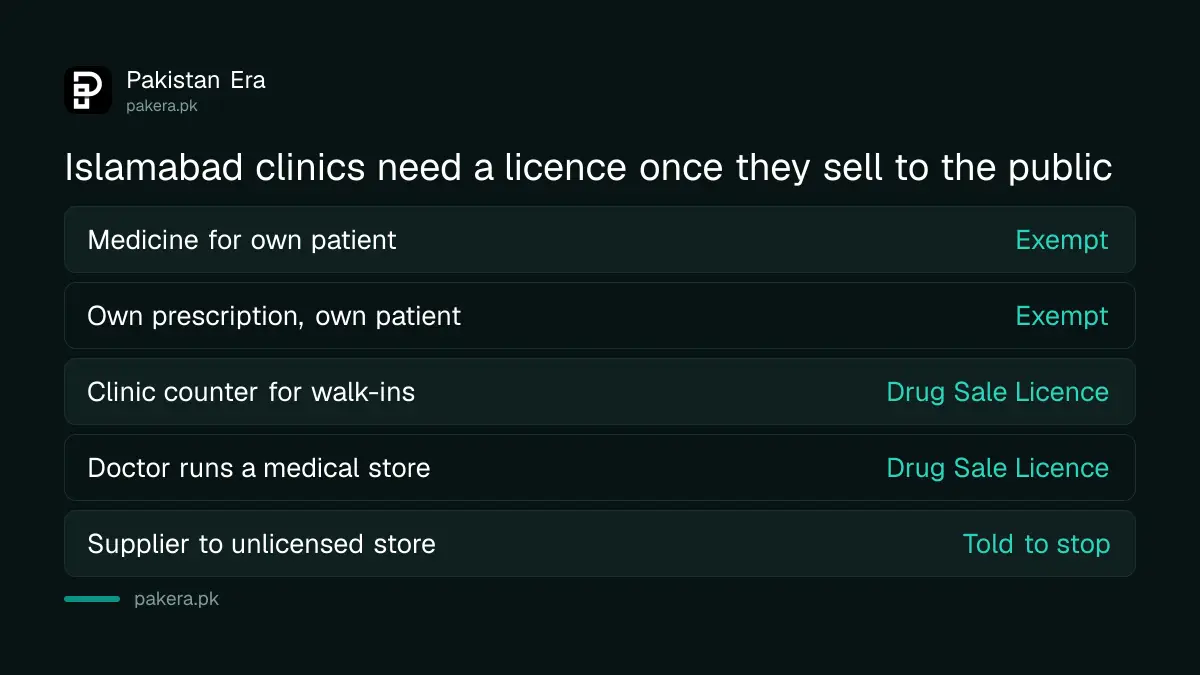
The advisory does not stop a doctor giving medicine to the patient in front of them. Medicines kept in a clinic for the doctor's own patients remain exempt, as long as the clinic is not working as a commercial pharmacy or medical store.
The line is between treating and trading. A doctor who gives a patient a strip of tablets after a consultation is treating. A counter at the clinic door that sells to anyone who walks in, or fills other doctors' prescriptions, is trading.
| Situation | Licence needed? |
|---|---|
| Doctor gives medicine to own patient after a check-up | No, exempt |
| Doctor fills own prescription for own patient | No, exempt |
| Clinic counter selling to walk-in buyers | Yes, a Drug Sale Licence |
| Doctor owns or runs a medical store | Yes, a Drug Sale Licence |
| Distributor supplying an unlicensed store | Told to stop |
The Federal Constitutional Court drew the line
The advisory follows a ruling of the Federal Constitutional Court. The court held that a doctor's registration does not exempt them from the licensing rules for selling medicines. A two-member bench of Chief Justice Aminuddin Khan and Justice Ali Baqar Najafi decided it, as reported.
The case began in Khyber Pakhtunkhwa. Drug inspectors there had started proceedings against doctors accused of storing and selling medicines without a licence. The Peshawar High Court's Dera Ismail Khan bench stopped those proceedings in June 2023. The Khyber Pakhtunkhwa health department appealed, and the court set the High Court order aside, so the cases can continue.
The court read two laws side by side. The Pharmacy Act, 1967 lets a registered doctor supply medicines to their own patients. The Drugs Act, 1976 bars anyone from selling medicines without a licence and gives no special exemption to doctors. The court said the first law is not a general escape from the second.
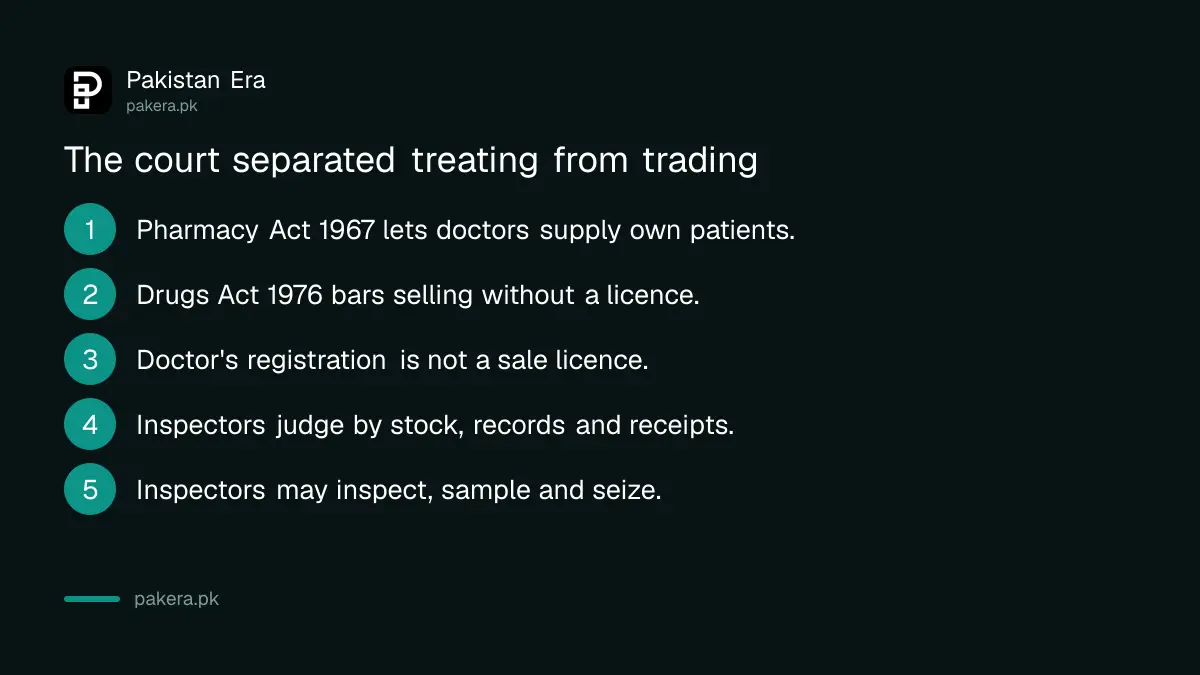
Whether a clinic has crossed into trading is a matter of evidence, the court said. Inspectors can look at how much medicine is stocked, what kind, purchase and supply records, sales receipts and prescriptions. The ruling also upheld drug inspectors' power to inspect premises, take samples and seize medicines.
What this means when you buy medicine
A licensed outlet has a named person responsible for how medicines are stored and sold. That matters for heat-sensitive medicines such as insulin and some antibiotics, and for checking that a pack is genuine. The rule is about safety, not paperwork.
You can protect yourself in four steps, at any pharmacy, in Islamabad or elsewhere:
- Buy from a pharmacy or medical store, and ask for a printed or written receipt with the shop's name.
- Check the medicine's registration number and price on the pack against DRAP's records.
- Check the batch number and expiry date before you leave the counter.
- If the medicine looks wrong, keep the pack and the receipt and report it.
The registration check takes a few minutes and is explained in checking a medicine is registered and priced right with DRAP. If a pack looks fake, reporting counterfeit medicine to DRAP sets out what to send. The doctor's own registration can be confirmed through a PMDC registration check.
Other provinces apply the same law
The Drugs Act, 1976 is a federal law, and the court's reading of it is not limited to Islamabad. The case itself came from Khyber Pakhtunkhwa. Each province licenses its own pharmacies through its health department, so the advisory reported this week applies in Islamabad, but the legal point applies in the provinces too.
Punjab, for example, runs its own licence system for drug sellers, and you can check if a pharmacy is licensed in Punjab online. We have not seen a new provincial advisory after the ruling.
Common questions
Can a doctor in Islamabad still give me medicine at the clinic?
Yes. A doctor can give medicine to their own patient. The licence is needed only when the clinic runs a pharmacy or sells to the public.
What is a Drug Sale Licence?
It is the licence any shop needs to sell medicines under the Drugs Act, 1976. In Islamabad it is issued by the federal health ministry's drug control wing.
What happens to an unlicensed medical store?
It has been told to apply at once or face legal action. Distributors have been told not to supply it.
Does this ruling apply outside Islamabad?
The court's reading of the Drugs Act applies across Pakistan. The advisory reported this week is for Islamabad Capital Territory.
How do I know a pharmacy is licensed?
Ask to see the licence, which should be displayed. In Punjab you can check it online. Elsewhere, ask the district drug inspector.
How we verified this
What we checked, where we read it, and what we could not confirm.
Last checked 9 October 2026. The advisory's three instructions and the clinic exemption were reported on 7 October 2026 and attributed to the Pharmacy Services and Drug Control wing of the Ministry of National Health Services, Regulations and Coordination. We did not find the advisory on the ministry's website. The court ruling's details, including the bench, the Khyber Pakhtunkhwa appeal and the evidence test, were also reported; the judgment was not available to us on the Federal Constitutional Court's judgments page on 9 October 2026. Nothing here is legal or medical advice.
About the author
Public Services and Education Journalist
Fajr Riaz is a journalist and content writer at Pakistan Era, based in Lahore. She covers the questions people meet in everyday life in Pakistan: how a public service works, what a change in the rules means, and where to find a reliable answer.