DRAP Has Not Notified a 15% Medicine Price Rise in 2026
DRAP has not notified a 15% medicine price rise in 2026. See what changed in July, the 7% cap on essential drugs, how to check an MRP and report overcharging
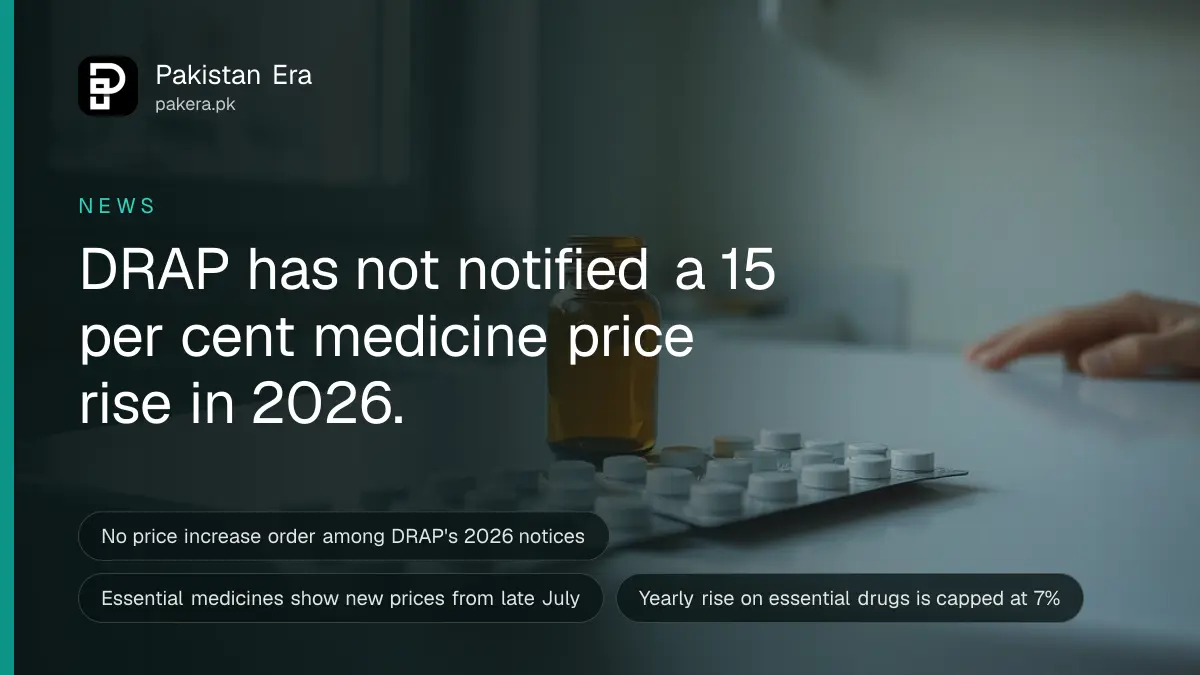
DRAP has not notified a 15 per cent rise in medicine prices in 2026. We read every notice DRAP posted on its website from 1 January to 30 September 2026 and found no price increase order. What did change is quieter: many essential medicines now show new prices dated late July 2026 in DRAP's own price index.
A message saying "DRAP notifies up to 15 per cent increase in medicine prices" has been shared again this month. The same wording and the same 15 per cent figure appeared in reports from January 2019. It is not a 2026 decision. So if a pharmacy tells you a new 15 per cent rise came in September, ask to see the price printed on the pack.
The Drug Regulatory Authority of Pakistan (DRAP) is the federal body that registers medicines and sets their maximum retail price, or MRP. The MRP is the highest price any shop may charge for a pack.
DRAP has published no medicine price increase in 2026
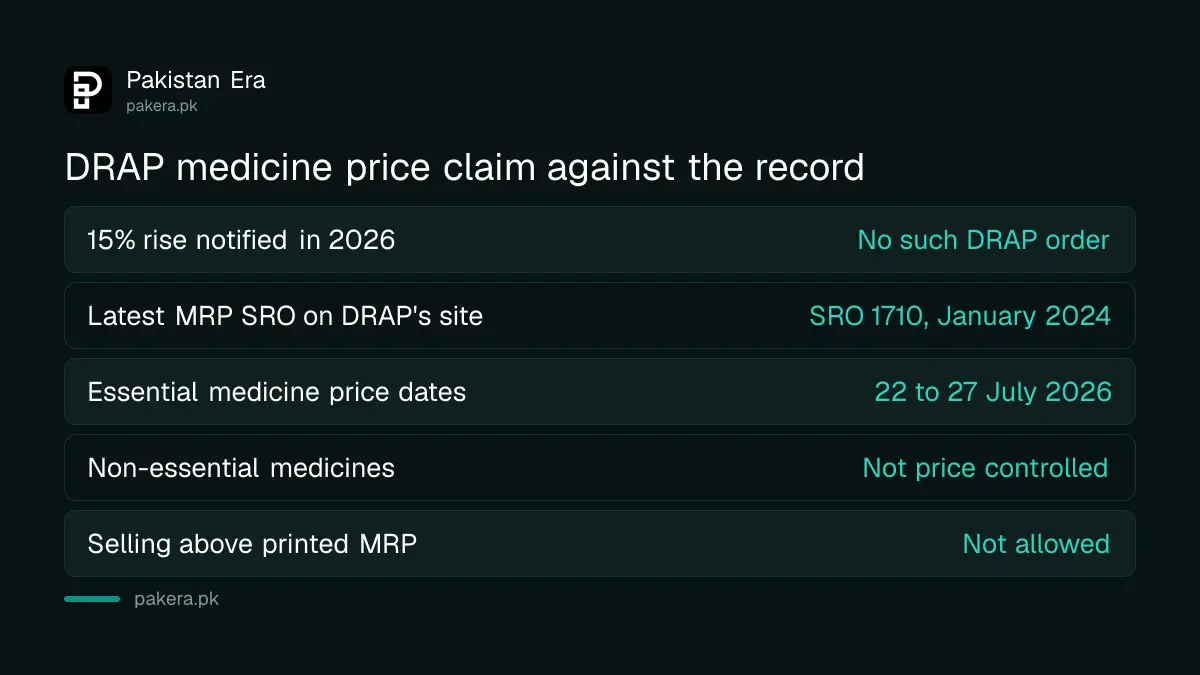
DRAP's website lists no notification in 2026 that raises medicine prices across the board. The latest price fixing order (SRO) in its online list is SRO 1710, posted on 8 January 2024. Its 2026 notices cover barcodes, registration rules, recalls and fees, not price rises.
We went through the full list of posts on dra.gov.pk dated from 1 January to 30 September 2026. There were 144 of them, recall alerts and tenders included. They cover the track and trace barcode rules, medical device regulations, registration board minutes and a new fee schedule for DRAP's own services. None of them is a price increase order.
In March 2026, DRAP was reported to have denied an earlier claim of higher prices. We could not find that statement on its own website, so treat it as reported. The absence of any 2026 price order on the site is the stronger point, and we checked it ourselves.
Essential medicine prices in DRAP's index show late July 2026 dates
DRAP's online PharmaPrice Index shows new prices dated 22 to 27 July 2026 for many common essential medicines. The index does not say why those dates changed. The timing fits the yearly price adjustment allowed under DRAP's pricing policy.
We searched the index on 30 September 2026 for well known brands. This is what it showed:
| Medicine and pack | DRAP category | Price in index | Effective from |
|---|---|---|---|
| Panadol tablets 500 mg, 200's | Essential | Rs 762.93 | 23 July 2026 |
| Glucophage 500 mg, 5x10's | Essential | Rs 221.45 | 23 July 2026 |
| Augmentin suspension 156.25 mg, 60 ml | Essential | Rs 196.89 | 23 July 2026 |
| Brufen DS suspension, 120 ml | Essential | Rs 135.06 | 22 July 2026 |
| Risek 20 mg capsules, 2x7's | Essential | Rs 991.14 | 27 July 2026 |
| Disprin 300 mg, 100's | Low price | Rs 334.13 | 23 July 2026 |
Not every entry changed. Clarinac tablets, for example, still show a date of 1 July 2024. So the dates are set medicine by medicine. They are not one blanket order.
We do not know the old price of each item from DRAP's own records, so we cannot tell you the size of each change. What the policy does tell us is the limit, which is explained next.
The yearly rise for essential medicines is capped at 7 per cent
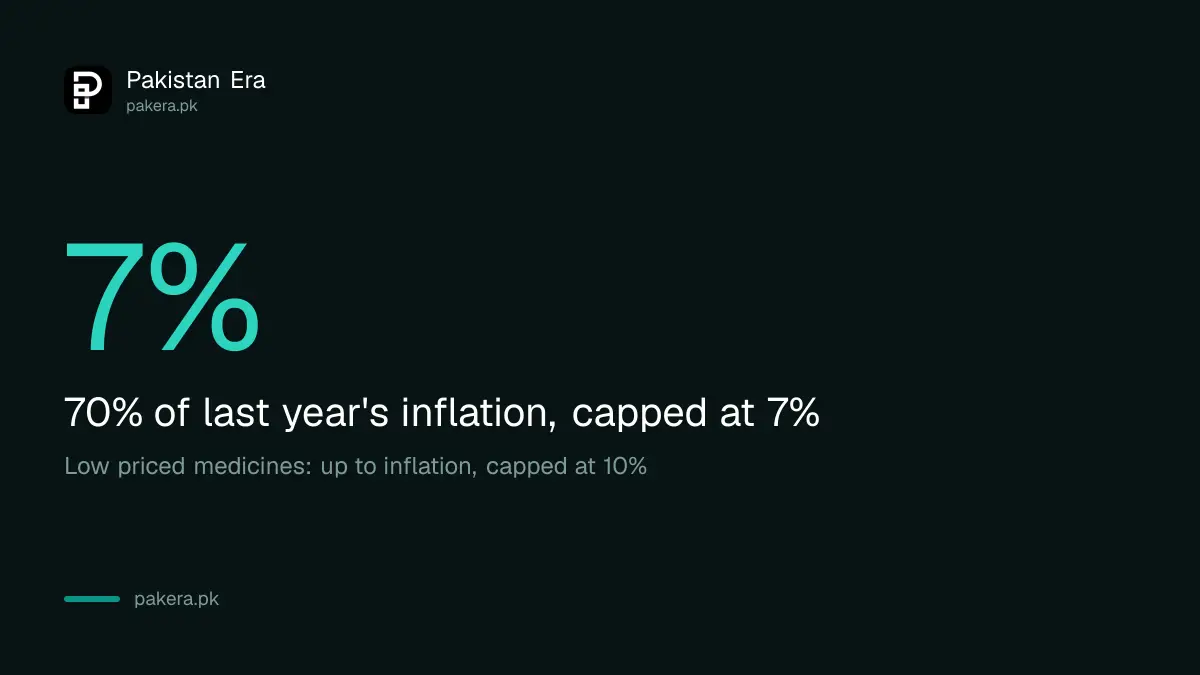
Under the Drug Pricing Policy 2018, as amended, companies may raise the MRP of essential medicines once a year by 70 per cent of the previous year's inflation, with a cap of 7 per cent. Low priced medicines may rise by up to the full inflation rate, capped at 10 per cent.
The company has to send its new price calculation to DRAP first. DRAP then issues the revised price, and the policy says revised price lists are to be put on DRAP's website. A higher price also cannot be applied to batches made before the increase.
So a general 15 per cent rise on essential medicines would break the policy's own yearly cap. A single medicine can go higher only through a separate "hardship" case, where a company proves its costs are no longer covered. That is decided product by product.
Medicines outside the essential list are not price controlled
Since a notification dated 30 September 2024, medicines not on the National Essential Medicines List are exempt from the price control section of the Drugs Act, 1976. Their makers set their own prices. That is why some vitamins and branded products can rise with no DRAP order at all.
This is the part most people miss. If a cough syrup or a multivitamin costs more this month, it may be legal even though DRAP notified nothing. The essential list, which follows the World Health Organization's model list, is where DRAP still fixes prices.
One rule applies to every medicine, controlled or not. Nobody may sell a medicine above the price printed on its pack. The policy also bans stickers that cover or change the printed price.
How to check a medicine's MRP and report overcharging
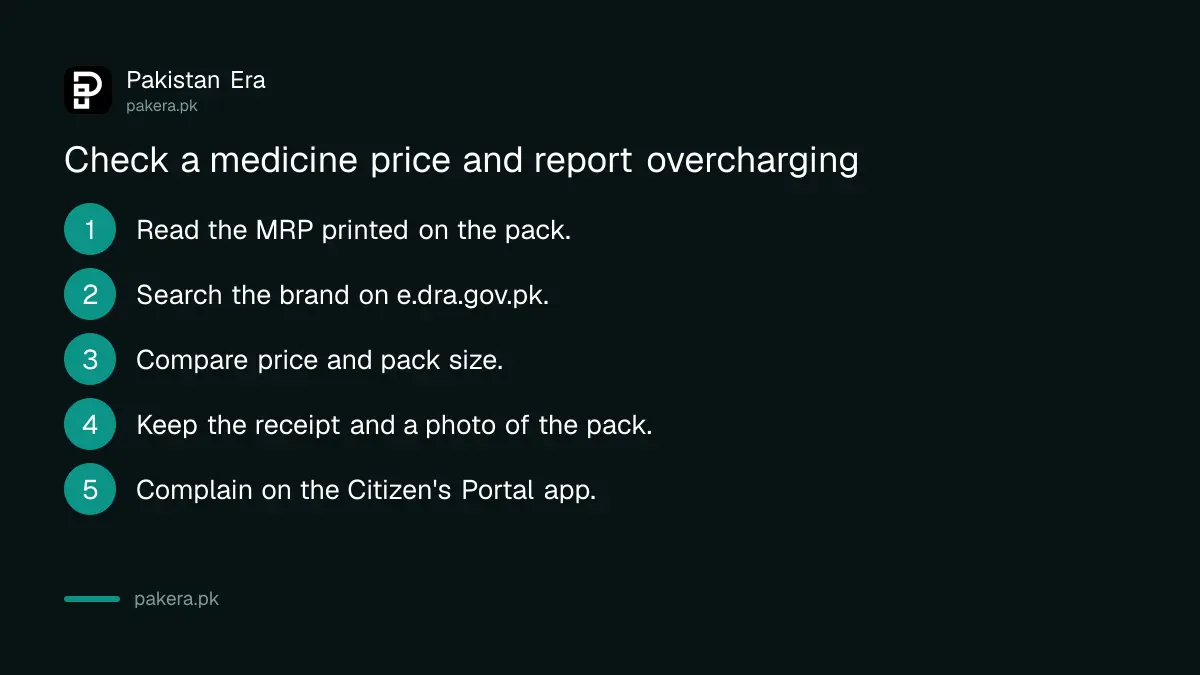
Check the MRP printed on the pack, then search the medicine by name in DRAP's PharmaPrice Index at e.dra.gov.pk. If a shop charges more than the printed price, keep the receipt and complain through DRAP's complaint channels or the Pakistan Citizen's Portal.
- Read the maximum retail price printed on the box or strip. The shop cannot charge more than this.
- For loose tablets, work out the share of the pack price. The policy says loose sales must not go above the pro rata price.
- Open the DRAP PharmaPrice Index and search by brand name or registration number. Compare the price and the pack size.
- If the shop charges more, ask for a receipt and photograph the pack showing the printed price and batch number.
- File a complaint through the Pakistan Citizen's Portal app, which DRAP lists on its complaints page, or use DRAP's own complaints page.
If DRAP does not deal with your complaint, its complaints page also points to the Federal Ombudsman. The Wafaqi Mohtasib handles complaints about how federal bodies treat the public. For a refund from the shop itself, a consumer court complaint is another route.
Common questions
Did DRAP raise medicine prices by 15 per cent in September 2026?
No. DRAP's website shows no such notification in 2026. The same 15 per cent claim was reported in January 2019.
Why is my medicine more expensive this month?
It may be an essential medicine with a new price from late July 2026, or a non-essential medicine whose maker sets its own price.
How much can essential medicine prices rise each year?
Up to 70 per cent of the previous year's inflation, capped at 7 per cent, under DRAP's pricing policy. Low priced medicines are capped at 10 per cent.
Where can I check the official price of a medicine?
On DRAP's PharmaPrice Index at e.dra.gov.pk. Search by the brand name or the registration number on the pack.
Can a pharmacy charge more than the printed price?
No. DRAP's policy bans selling any medicine above the MRP printed on the pack, and bans price stickers over the printed price.
Are new medicine prices waiting for approval?
Some are. 52 life-saving medicines had prices approved in July 2026 but still needed a formal notification.
How we verified this
What we checked, where we read it, and what we could not confirm.
Last checked on 30 September 2026. The list of DRAP notices for 2026 and the SRO 1710 date were read on DRAP's website. The prices and effective dates were read in DRAP's PharmaPrice Index on the same day. The 7 and 10 per cent caps, the exemption for non-essential medicines, the ban on selling above the printed price and the complaint routes were read in DRAP's amended Drug Pricing Policy 2018 and its complaints page. DRAP's reported March 2026 denial could not be found on its site. We did not test any pharmacy's prices.
About the author

Tax, Bills and Technology Writer
Ali Akhtar is a young and curious voice here at Pakistan Era. He is currently pursuing his A-Levels and has a growing interest in Pakistan’s changing industrial landscape and educational trends. Ali likes to write in a way that helps him explain and explore the world around him. His writing reflects the perspective of the new generation navigating the evolving trends of Pakistan where technology, youth innovation, and shifting opportunities are reshaping the country’s future.