Drink-Driving Fines in Pakistan Could Rise to Rs 25,000 on Motorways and Rs 100,000 for Repeat Offences in Islamabad
Two Senate-passed bills on the NA agenda on 20 October 2026 would raise drink-driving fines to Rs 25,000 on motorways and Rs 100,000 in Islamabad for repeats.
Short answer: Two Senate-passed bills listed in the National Assembly on 20 October 2026 would raise Pakistan's federal drink-driving penalties. On national highways and motorways, the fine would rise from Rs 5,000 to Rs 10,000 today to Rs 10,000 to Rs 25,000, with a breathalyser test and a 2 year licence suspension for repeat offenders. In Islamabad, the top fine would rise from Rs 1,000 to Rs 25,000.
We read both bills as passed by the Senate, and the current laws on the Pakistan Code, on 20 October 2026. The bills were items 9, 10, 13 and 14 on the National Assembly's orders of the day for its 20 October sitting, each with amendments listed separately. They amend federal laws, so they apply on national highways across Pakistan and on roads in Islamabad Capital Territory, not on provincial roads in Lahore, Karachi or Peshawar.
Today's motorway penalty is a fine of Rs 5,000 to Rs 10,000
Section 68 of the National Highways Safety Ordinance, 2000 punishes driving on a national highway under the influence of alcohol or a drug with up to 1 month in jail, a fine of Rs 5,000 to Rs 10,000, or both. A doctor must confirm the level of influence.
That last condition matters. Section 68(2) says no one can be convicted "unless the extent of the influence is determined by a medical practitioner authorized by the Government". There is no breathalyser rule in the current text, so a roadside reading alone does not convict.
The highways bill raises fines and adds a breathalyser test
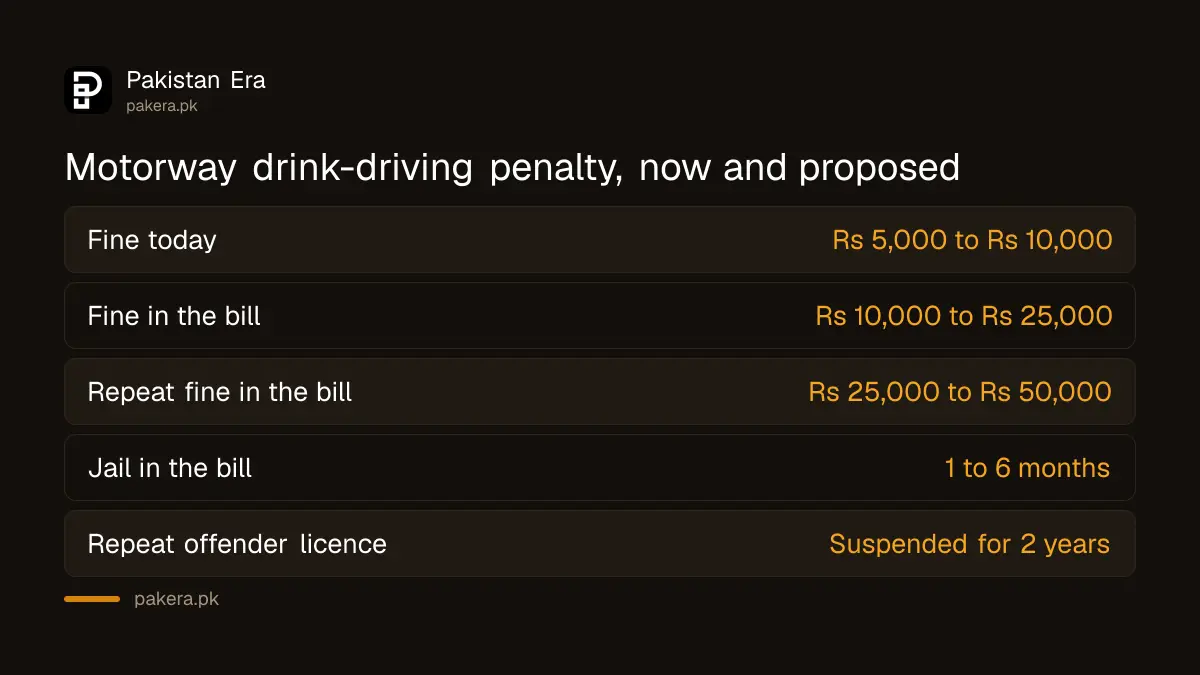
The National Highways Safety (Amendment) Bill, 2025 replaces section 68. A first offence would carry a fine of Rs 10,000 to Rs 25,000, or 1 to 6 months in jail, or both. A repeat offence would carry Rs 25,000 to Rs 50,000, or 6 months to 2 years, or both.
| National highways and motorways | Law today, section 68 | Senate-passed bill |
|---|---|---|
| First offence, fine | Rs 5,000 to Rs 10,000 | Rs 10,000 to Rs 25,000 |
| First offence, jail | Up to 1 month | 1 to 6 months |
| Repeat offence | Same as first | Rs 25,000 to Rs 50,000, or 6 months to 2 years |
| Driving licence | No suspension in section 68 | Suspended for 2 years on a second conviction |
| Test | Authorised doctor only | Breathalyser, then a doctor to verify |
| Refusing the test | Not covered | Same penalty as the offence |
Under the bill, a police officer who reasonably suspects a driver may give a breathalyser test on an approved device. If it is positive, the driver goes with the officer to an authorised medical officer to verify the result. A driver who refuses the test, or refuses to go to the doctor, faces the same penalty as a drink-driver.
The device specifications would be set by rules under section 89 of the Ordinance. Those rules do not exist yet, so a breathalyser regime could not start the day the law passes. Motorway licence penalties already work through points, as set out in the NHMP licence points system.
Islamabad's fine would rise from Rs 1,000 to Rs 25,000
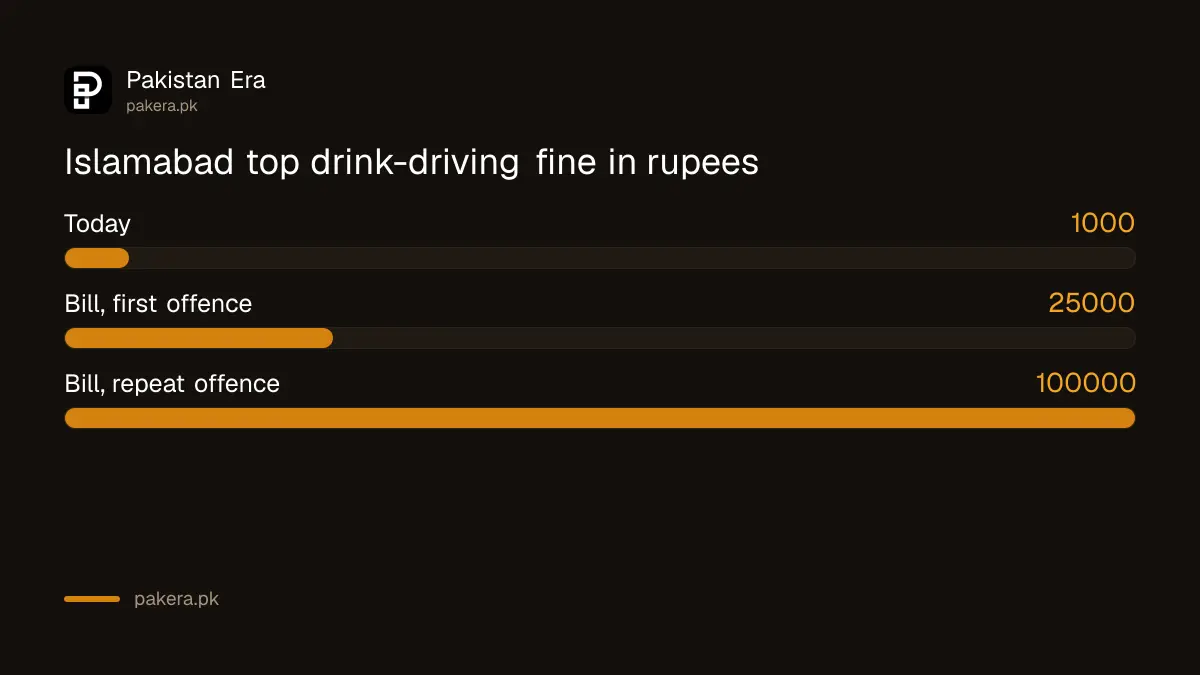
On Islamabad roads, section 100 of the Provincial Motor Vehicles Ordinance, 1965 applies. It allows up to 6 months in jail or a fine of up to Rs 1,000, or both. A repeat offence allows up to 2 years, but the fine is still capped at Rs 1,000.
The Provincial Motor Vehicles (Amendment) Bill, 2025 would replace section 100 for Islamabad Capital Territory. A first offence would carry up to 6 months in jail and a fine of up to Rs 25,000, or both. A repeat offence would carry up to 3 years or a fine of up to Rs 100,000, or both.
This bill also sets the proof. No one would be convicted unless an authorised medical practitioner, or a breathalyser test by a police officer, determines the level of influence. The current section 100 has no such proof clause in the text we read.
Both bills were moved by the same senator
Senator Mohsin Aziz is the member in charge of both bills. Their statement of objects says drivers, "especially public transport", have been found under the influence, and proposes higher penalties and a medical check to make convictions "transparent".
The Senate list of passed bills records both as passed on 19 May 2025. In the National Assembly, Ms. Shandana Gulzar Khan was listed to move them on 20 October 2026. Because amendments were listed, any bill the Assembly passes in a changed form must go back to the Senate before it can reach the President, as set out in how a bill becomes law in Pakistan.
What changes for drivers, and when
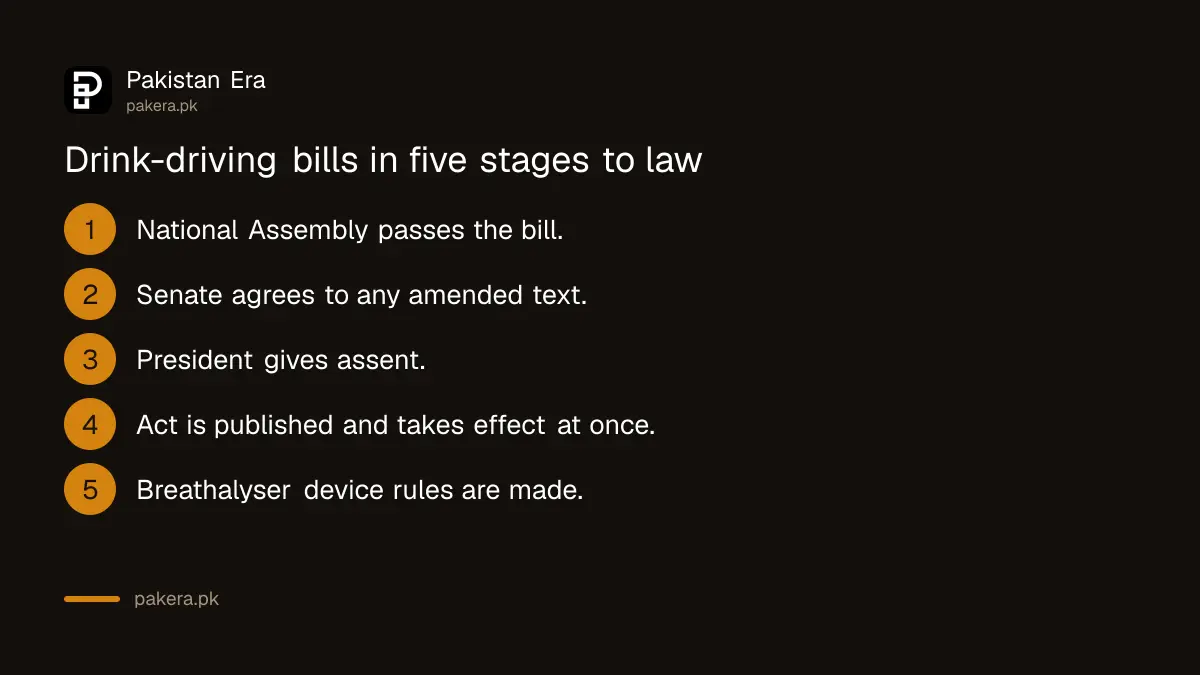
Nothing changes until a bill passes both Houses in the same form, gets the President's assent and is published as an Act. Until then, the current section 68 and section 100 apply, with their lower fines.
- The National Assembly considers and passes the bill, with or without amendments.
- If amended, the Senate must agree to the changed text.
- The President assents, and the Act is published in the Gazette.
- Each bill says it comes into force at once on enactment.
- Rules for breathalyser devices are then needed for the highways test.
Provincial roads stay under provincial law. Punjab, Sindh, Khyber Pakhtunkhwa and Balochistan each run their own version of the motor vehicles law, and these two bills do not change them.
Common questions
What is the fine for drink driving on a motorway in Pakistan?
Rs 5,000 to Rs 10,000, or up to 1 month in jail, or both, under section 68 of the National Highways Safety Ordinance today.
What is the drink-driving fine in Islamabad?
Up to Rs 1,000, or up to 6 months in jail, or both, under section 100 of the Provincial Motor Vehicles Ordinance as it applies in Islamabad.
Can police in Pakistan use a breathalyser?
The current section 68 requires an authorised doctor to confirm influence. The Senate-passed bills would add a breathalyser test.
Will a drink-driver lose their licence?
Under the highways bill, a driver convicted a second time would have the licence suspended for 2 years. The current section 68 has no such suspension.
Do these bills apply in Lahore or Karachi?
Only on national highways and motorways passing through. City roads in the provinces follow provincial law.
How we verified this
What we checked, where we read it, and what we could not confirm.
Last checked 20 October 2026. We read section 68 of the National Highways Safety Ordinance, 2000 and section 100 of the Provincial Motor Vehicles Ordinance, 1965 on the Pakistan Code, and the National Highways Safety (Amendment) Bill, 2025 and the Provincial Motor Vehicles (Amendment) Bill, 2025 as passed by the Senate, on 20 October 2026. The agenda items come from the National Assembly's orders of the day for 20 October 2026, read on na.gov.pk. The amendments listed for the Assembly were not published with the agenda, and the Assembly had not published the outcome of the sitting when we last checked.
About the author

Global Affairs & Political Economy Writer
Muhammad Hatim is a book lover who started writing because he enjoys it. At Pakistan Era he writes about international relations, geopolitics and the global economy, with a particular interest in South Asia and the forces behind current events.