How a Bill Becomes Law in Pakistan: 6 Stages From the National Assembly to the Gazette
A federal bill in Pakistan passes six stages: introduction, committee, both Houses, the President's assent in 10 days and the Gazette. Learn to track any bill.
Short answer: A federal bill in Pakistan becomes law in six stages. It is introduced in one House, reviewed by a committee, passed by that House, passed by the other House, assented to by the President within 10 days, and then published in the Gazette. Only the commencement clause tells you when it takes effect.
When a headline says "bill passed", ask which House passed it. On 19 October 2026 the National Assembly passed two bills and had three more introduced. None of them is law yet. We set out the stages below from Articles 70, 73, 75 and 76 of the Constitution, which we read on Pakistan Code on 20 October 2026, and from the bill lists the National Assembly and Senate publish.
A bill can start in either House and must pass both
Under Article 70, a bill on a subject in the Federal Legislative List can start in the National Assembly or the Senate. Once the first House passes it, it goes to the other House. If both pass the same text, it goes to the President.
If the second House changes the bill, it goes back to the first House. If the first House accepts the changes, the bill goes to the President. Bills come from two sources. A government bill is moved by a minister. A private member's bill is moved by any member, and the Assembly sets aside certain days for them.
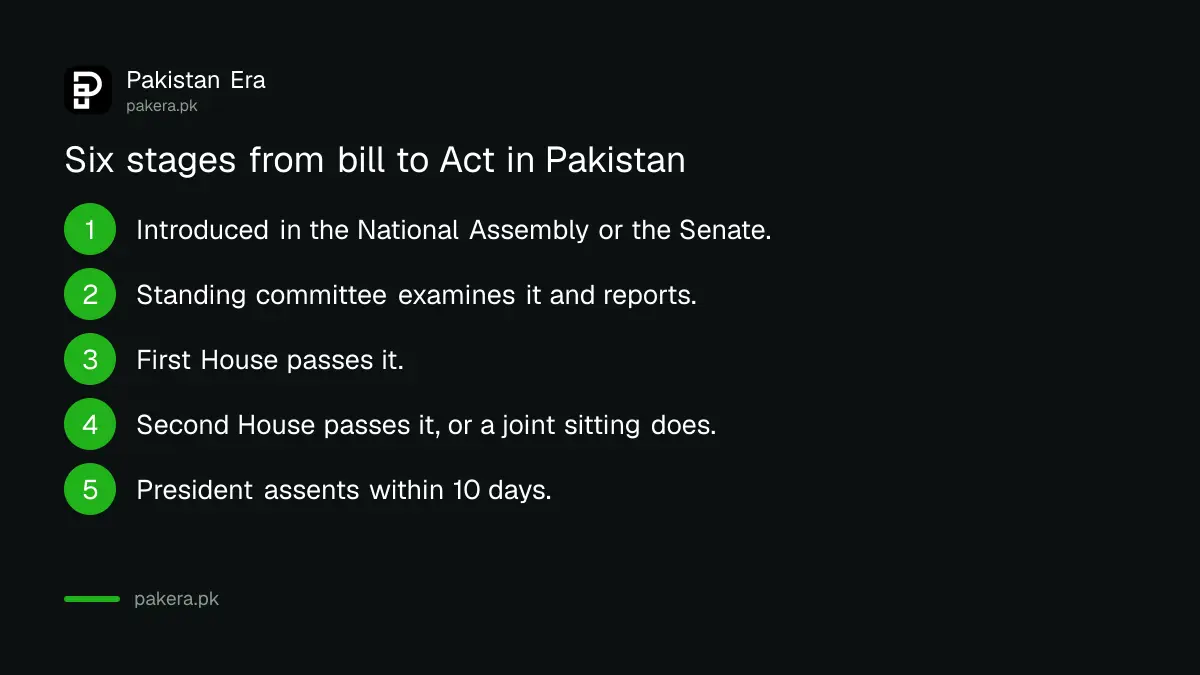
Six stages take a bill from introduction to the Gazette
Each stage has a different meaning for you. Introduced means proposed. Passed by one House means half done. Assented means it is law. In force means the date it starts to apply, which may be later than assent if the Act says so.
| Stage | What happens | Is it law yet? |
|---|---|---|
| 1. Introduced (tabled) | A minister or member presents the bill in one House | No |
| 2. Committee | A standing committee examines it and reports back | No |
| 3. Passed by first House | The House considers it clause by clause and votes | No |
| 4. Passed by second House | The other House passes it, amends it, or lets it go to a joint sitting | No |
| 5. President's assent | Within 10 days; it then becomes an Act of Majlis-e-Shoora (Parliament) | Yes |
| 6. Gazette and commencement | Published with an Act number; starts on the date the Act sets | Yes, from that date |
The committee stage is where most bills slow down. On 20 October 2026 the Senate's agenda alone carried motions to give two committees another 60 days on bills introduced in August.
The second House has 90 days before a joint sitting
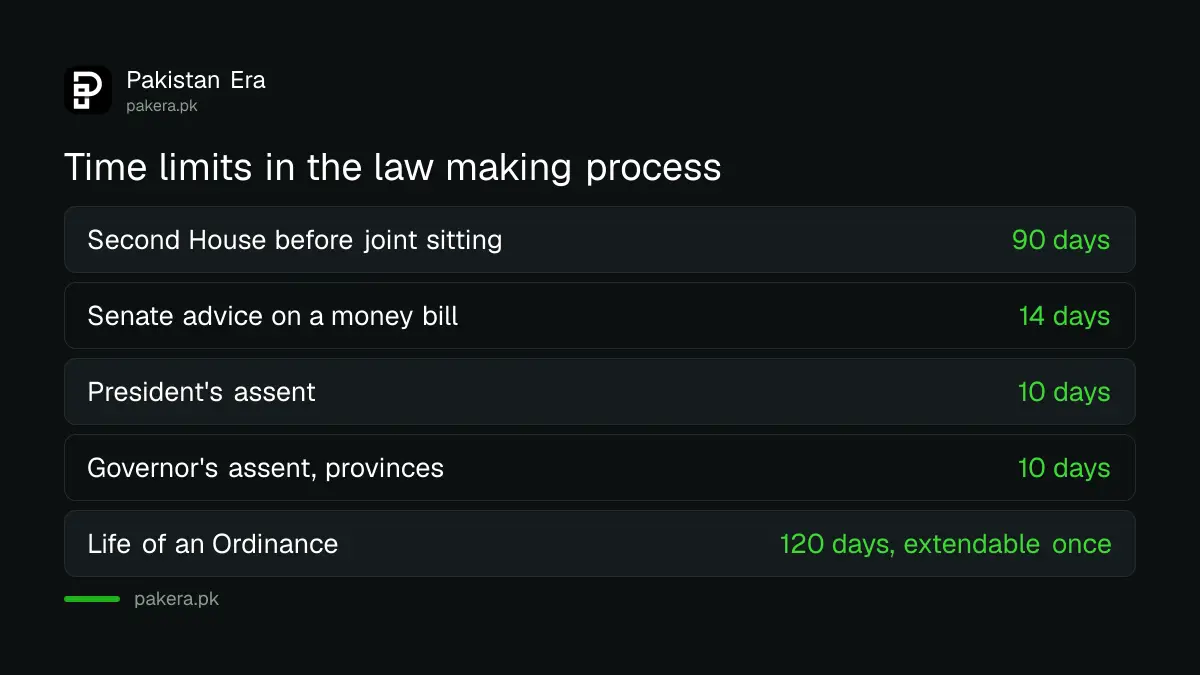
If the second House rejects a bill, or does not pass it within 90 days of it being laid there, the first House can ask for a joint sitting. A majority of members present and voting there sends it to the President.
The same joint sitting route applies when the first House refuses the second House's amendments. A joint sitting is chaired by the Speaker of the National Assembly. Parliament met in a joint sitting on 15 October 2026, to approve the Khyber Pakhtunkhwa emergency proclamation, which is explained in what Article 232 allows.
Money bills follow a shorter path under Article 73. They start only in the National Assembly. The Senate gets a copy and may send recommendations within 14 days, but the Assembly decides alone. The Speaker's certificate settles whether a bill is a money bill.
The President has 10 days to sign or send it back
Under Article 75, the President must assent within 10 days or return a non-money bill with a message asking for reconsideration. If a joint sitting passes it again, the President must assent within 10 days or assent is deemed given.
So the President can delay a bill once but cannot block it. After assent, or deemed assent, it is an Act of Majlis-e-Shoora (Parliament). It gets an Act number for the year. For example, the Defense Forces of Pakistan Act, 2026 is Act No. XLVII of 2026.

That Act is also a useful example of speed. The National Assembly and the Senate lists both show the Defense Forces of Pakistan Bill passed on 20 August 2026, and the Acts of Parliament list dates the Act the same day.
A bill can lapse and an Ordinance expires in 120 days
Under Article 76, a bill pending in the National Assembly, or passed by it and pending in the Senate, lapses when the Assembly is dissolved. A bill pending in the Senate that the Assembly has not passed does not lapse. Prorogation ends no bill.
An Ordinance is different. Under Article 89, the President can make one when a House is not in session. It has the force of an Act but stands repealed after 120 days unless a House extends it once for another 120 days, or passes a resolution against it sooner.
Provinces follow the same pattern. Under Article 116, a bill passed by a Provincial Assembly goes to the Governor, who has 10 days to assent or return it.
You can track any federal bill on the Assembly and Senate websites
The National Assembly site lists government and private members' bills introduced, bills passed, and Acts of Parliament, each with a date and the bill text. The Senate site has matching lists. Pakistan Code later carries the Act in its updated form.
- Open na.gov.pk and choose Bills Introduced in NA. Find the bill and its date. Download the text as introduced.
- Read the last page first. The statement of objects and reasons says why the bill exists.
- Check the Orders of the Day for later sittings. "As reported by the Standing Committee" means the committee has finished.
- Check Bills Passed By NA for the passage date, then the Senate's Bills Passed list for the other House.
- Check Acts of Parliament for the Act number and date.
- Read section 1 of the Act. "Shall come into force at once" means it applies from assent. Otherwise look for a commencement notification.
Two bills from 19 October show the early stages. The Emigration (Amendment) Bill is at stage 1. The Archival Material and Abandoned Properties bills are at stage 3. Once an Act is out, the way to read its current text is in how to check a federal law on Pakistan Code.
Common questions
When does a bill become law in Pakistan?
When the President assents, or is deemed to assent, after both Houses pass it. It applies from the date its commencement clause sets.
How long does the President have to sign a bill?
Ten days. The President can return a non-money bill once, but after a joint sitting passes it again, assent is deemed after 10 days.
Can the Senate block a bill?
No. If it rejects a bill or sits on it for 90 days, the originating House can take it to a joint sitting.
What is the difference between tabled and passed?
Tabled, or introduced, means the bill has been presented. Passed means a House has voted for it. Both Houses must pass it.
Does a bill lapse when the National Assembly is dissolved?
A bill pending in the Assembly, or passed by it and pending in the Senate, lapses. A Senate bill not yet passed by the Assembly does not.
How long does an Ordinance last?
120 days from promulgation, extendable once by a House resolution for another 120 days.
How we verified this
What we checked, where we read it, and what we could not confirm.
Last checked 20 October 2026. We read Articles 70, 72, 73, 75, 76, 89 and 116 in the Constitution on Pakistan Code, which includes the 2025 amendments. We read the National Assembly's Acts of Parliament list, its bills introduced and passed lists, and the Senate's bills passed list and Orders of the Day. We did not read the Assembly's Rules of Procedure, so the committee stage is described from the Orders of the Day, not from the rules.
About the author

Global Affairs & Political Economy Writer
Muhammad Hatim is a book lover who started writing because he enjoys it. At Pakistan Era he writes about international relations, geopolitics and the global economy, with a particular interest in South Asia and the forces behind current events.