Emigration Amendment Bill Tabled in National Assembly: 7 Years and a Rs 1 Million Minimum Fine for Illegal Recruiters
The Emigration (Amendment) Bill 2026, tabled on 19 October, sets 7 years and a Rs 1 million minimum fine for illegal recruiters. See each change and its status.

Short answer: The federal government tabled the Emigration (Amendment) Bill, 2026 in the National Assembly on Monday, 19 October 2026. It proposes up to 7 years in prison and a fine of at least Rs 1 million for recruiting or sending people abroad outside the rules. It is a bill, not yet law.
Chaudhry Salik Hussain, the Minister for Overseas Pakistanis and Human Resource Development, introduced it. We read the bill as introduced on the National Assembly website on 20 October 2026, and compared each clause with the current text of the Emigration Ordinance, 1979 on Pakistan Code, the Law Ministry's official site for federal laws.
The bill also touches workers. A Pakistani who walks out of a job abroad could face a fine of at least Rs 100,000 after coming home, up from a maximum of Rs 10,000 today.
The bill makes jail and a fine compulsory for illegal recruitment
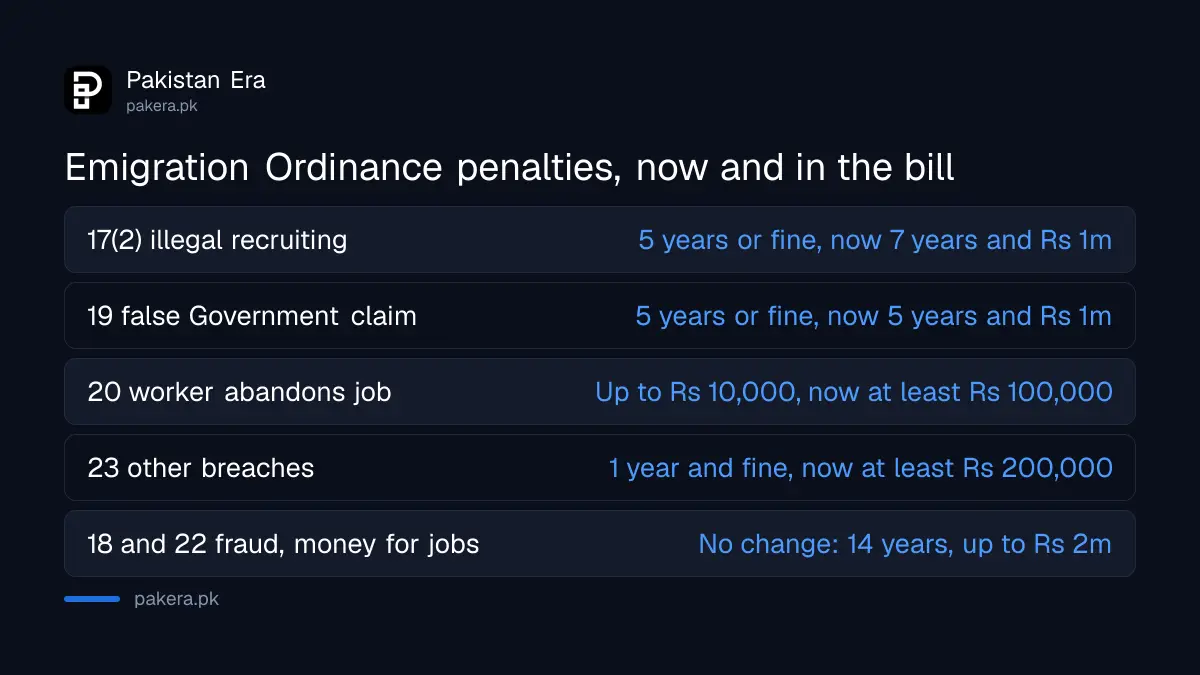
Today a court can punish a first offence under section 17(2) with up to 5 years, or a fine, or both. The bill changes that to up to 7 years and a fine of at least Rs 1 million, for every offence, first or repeat.
Section 17(2) covers three things done outside the Ordinance and its rules. Making an agreement to send someone abroad. Helping someone emigrate or leave for that purpose. And a licensed promoter sending a recruit off without the required appearance before the Protector of Emigrants.
The word "and" matters here. Under the current wording a judge can choose a fine alone. Under the bill, a conviction brings both a prison term and a fine, and the fine cannot go below Rs 1 million.

Five sections change and two stay the same
The bill amends sections 17, 19, 20 and 23 of the Ordinance. Sections 18 and 22, which cover forged papers, fraud and taking money for a foreign job, keep their current maximum of 14 years and a fine of up to Rs 2 million.
| Section and offence | Penalty now | Penalty in the bill |
|---|---|---|
| 17(2) recruiting or sending people abroad outside the rules | Up to 5 years, or fine, or both (7 years for a repeat) | Up to 7 years and a fine of at least Rs 1 million |
| 17(4) unlawful job adverts and their publishers | Same as 17(2), newspapers only | Same as 17(2), and print, TV and social media accounts |
| 19 falsely saying the Government wants a worker | Up to 5 years, or fine, or both | Up to 5 years and a fine of at least Rs 1 million |
| 20 worker abandoning a foreign job | Fine up to Rs 10,000 | Fine of at least Rs 100,000 |
| 23 any other breach of the Ordinance or rules | Up to 1 year and fine | Up to 1 year and a fine of at least Rs 200,000 |
| 18 and 22 forgery, fraud, taking money for a job | Up to 14 years and fine up to Rs 2 million | No change |
The current figures for sections 17(1), 18 and 22 already reflect Act VIII of 2025, which Pakistan Code marks against those sections. If you were cheated by an agent, the route to complain is in our walk-through on how to report an unlicensed job agent who took your money.
Social media job adverts are brought under the law
Section 17(4) now punishes the editor, printer and publisher of a newspaper that runs an unlawful recruitment advert. The bill widens this to print, electronic and social media, including the account holder or operator of any social media page.
That is a real change. Job adverts today are often posted on Facebook pages, WhatsApp groups and TikTok accounts, not only in newspapers. Under the bill, the person running the account that posts an advert without permission from the Bureau of Emigration could face the same 7 years and Rs 1 million minimum fine as the recruiter.
Section 9 is the rule behind this. Only the Overseas Employment Corporation, or someone with prior permission from the Director-General or the Protector of Emigrants, may recruit, interview or advertise for jobs abroad. The bill does not change section 9 itself.
Workers who abandon a job abroad would be fined at least Rs 100,000
Section 20 punishes an emigrant who breaks the agreement with a foreign employer, such as by abandoning the job. Today the fine is at most Rs 10,000, charged after return. The bill sets the fine at not less than Rs 100,000, with no upper limit.
This part is easy to miss in a bill presented as a crackdown on agents. It applies to the worker, not the promoter. Section 21, which is unchanged, already lets the Government recover the cost of bringing a convicted worker home as an arrear of land revenue.
Before you sign a foreign contract, read it with this in mind. The registration step at the Protectorate is covered in how emigrant protection works before you go abroad.
The bill now goes to a committee before any vote
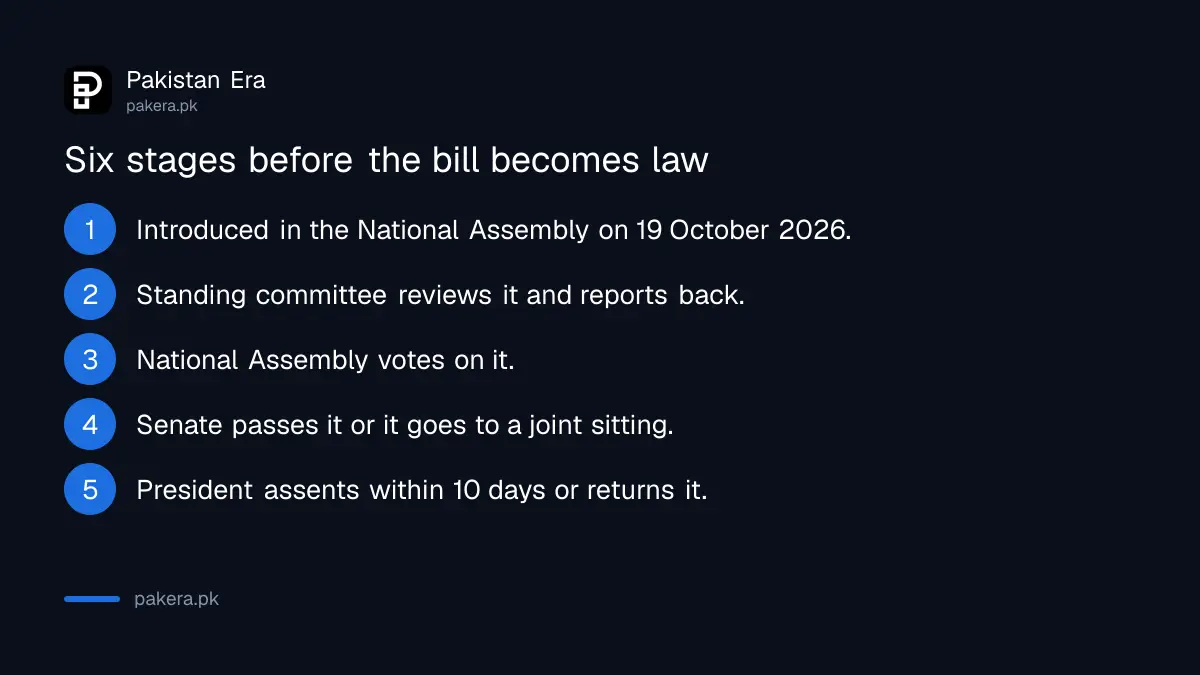
Introduction is the first stage only. The bill normally goes to the National Assembly's standing committee, then returns for a vote. If the Assembly passes it, the Senate must pass it too, and the President must assent before it becomes an Act.
- Introduced in the National Assembly on 19 October 2026.
- Referred to the standing committee for review and a report.
- Considered and passed by the National Assembly, with or without changes.
- Sent to the Senate, which can pass it, amend it or let it go to a joint sitting.
- Presented to the President, who has 10 days to assent or return it.
- Published in the Gazette as the Emigration (Amendment) Act, 2026. The bill says it takes effect at once.
Until then, the current penalties apply. The stages are explained in more detail in how a bill becomes law in Pakistan.
The Prime Minister's Office asked for the change in 2024
The bill's statement of objects says the Prime Minister's Office told the ministry on 10 May 2024 to review the Ordinance's penalties. The aim was to deter exploitation of would-be emigrants and make it easier to prosecute licensed promoters who break the rules.
The statement lists who was consulted: the Bureau of Emigration and Overseas Employment, the Overseas Employment Corporation, the Pakistan Overseas Employment Promoters Association and the FIA. The Law and Justice Division vetted the draft. The Cabinet Committee for Disposal of Legislative Cases decided on it on 5 August 2026, and the federal cabinet approved it.
At the same sitting the minister also introduced an Industrial Relations (Amendment) Bill, which shifts routine powers from the "Government" to the ministry. Recent numbers on workers going abroad are in the January to September 2026 emigration figures.
Common questions
Is the Emigration Amendment Bill 2026 law now?
No. It was introduced in the National Assembly on 19 October 2026. It must pass both Houses and get presidential assent first.
What is the new minimum fine for illegal recruiters?
Rs 1 million under the bill, together with a prison term of up to 7 years, for offences under section 17(2).
Can a worker be fined for leaving a job abroad?
Yes, under section 20. The fine is now up to Rs 10,000. The bill would make it at least Rs 100,000.
Does the bill cover Facebook and WhatsApp job adverts?
Yes. It extends section 17(4) to print, electronic and social media, including the account holder or operator.
Does the bill change the punishment for taking money for a fake job?
No. Section 22 stays at up to 14 years and a fine of up to Rs 2 million.
Who introduced the bill?
Chaudhry Salik Hussain, Minister for Overseas Pakistanis and Human Resource Development, on 19 October 2026.
How we verified this
What we checked, where we read it, and what we could not confirm.
Last checked 20 October 2026. We read the bill as introduced on the National Assembly's list of government bills introduced, which dates it Monday, 19 October 2026, and the Orders of the Day for that sitting. We compared it with the Emigration Ordinance, 1979 on Pakistan Code. We could not confirm which standing committee received the bill or when it will be taken up, because the Assembly had not published the 19 October proceedings when we checked.
About the author

Global Affairs & Political Economy Writer
Muhammad Hatim is a book lover who started writing because he enjoys it. At Pakistan Era he writes about international relations, geopolitics and the global economy, with a particular interest in South Asia and the forces behind current events.