Article 232 Emergency and Article 234 Governor's Rule in Pakistan Explained
Article 232 and Article 234 explained: when Pakistan's President can proclaim an emergency or governor's rule, the role of Parliament, and the time limits.
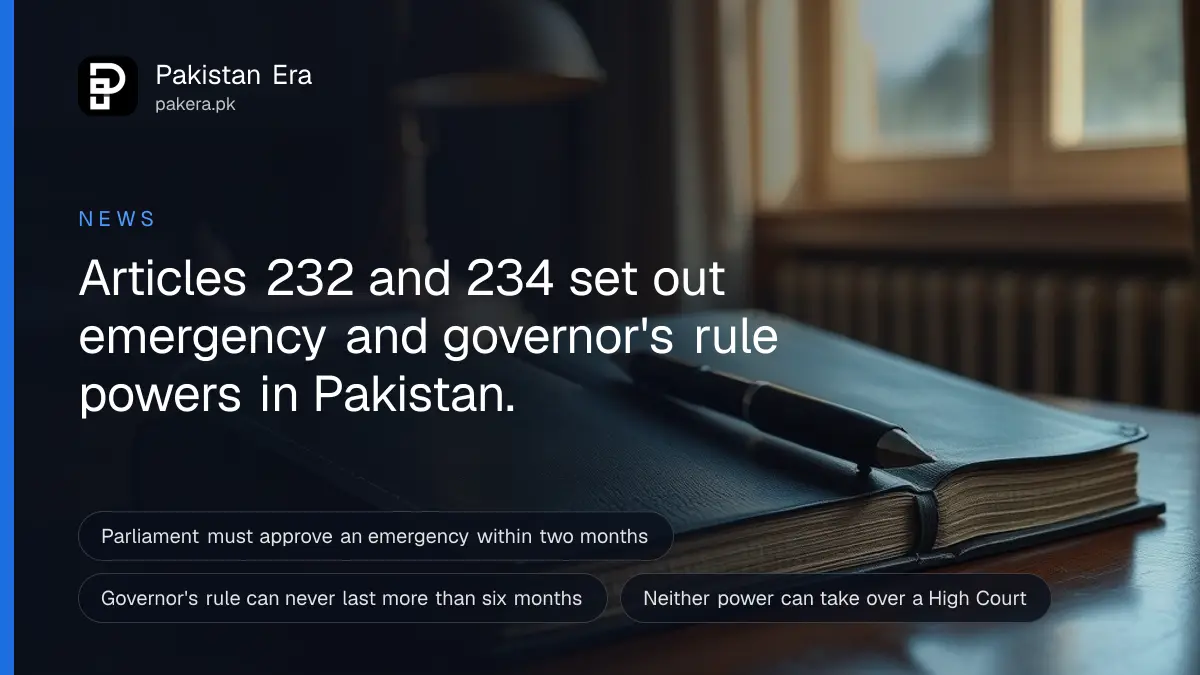
Article 232 of Pakistan's Constitution lets the President proclaim an emergency when war, external aggression or an internal disturbance threatens the country's security. Article 234 is a separate power, usually called governor's rule. It applies when a province's government cannot be run under the Constitution.
Update, 17 October 2026: see the reported Peshawar High Court petitions on the KP emergency.
Both articles sit in Part X of the Constitution, headed "Emergency Provisions". We read the text as published on the Pakistan Code, the Ministry of Law and Justice's statute site, on 1 October 2026. That copy includes every amendment up to the Twenty-seventh Amendment of 2025.
Federal ministers were reported in late September 2026 as saying an emergency in Khyber Pakhtunkhwa was being discussed. As of 1 October 2026, we found no Proclamation for the province on an official government site.
Article 232 lets the President proclaim an emergency
Under Article 232, the President may issue a Proclamation of Emergency if satisfied that Pakistan's security, or any part of it, is threatened by war, external aggression, or an internal disturbance that the provincial government cannot control.
The Eighteenth Amendment of 2010 added two conditions to clause (1). For an emergency based on internal disturbance, the text says "a resolution from the Provincial Assembly of that Province shall be required". The second condition says that if the President acts on his own, the Proclamation must go before both Houses of Parliament for approval by each House within ten days.
Article 48 says the President acts on the advice of the Cabinet or the Prime Minister, except where the Constitution gives him a discretion.
An emergency moves provincial powers to the federation
While an Article 232 emergency is in force, Parliament can make laws for the province on provincial subjects. The federal government can give the province binding directions and take over its functions. It cannot take over the powers of a High Court.
Under clause (2), the federal government can also tell the Governor to do this on its behalf. The Provincial Assembly is left out.
Article 233 adds a further layer. During an emergency, the rights in Articles 15, 16, 17, 18, 19 and 24 do not limit the state's power to make laws or take action. Those cover movement, assembly, association, trade, speech and property. The President may also, by Order, suspend the right to go to court to enforce named fundamental rights.
This is far wider than a Section 144 order, which a district or provincial authority issues under the criminal procedure law for a set place and time.
Parliament must approve an Article 232 emergency within two months
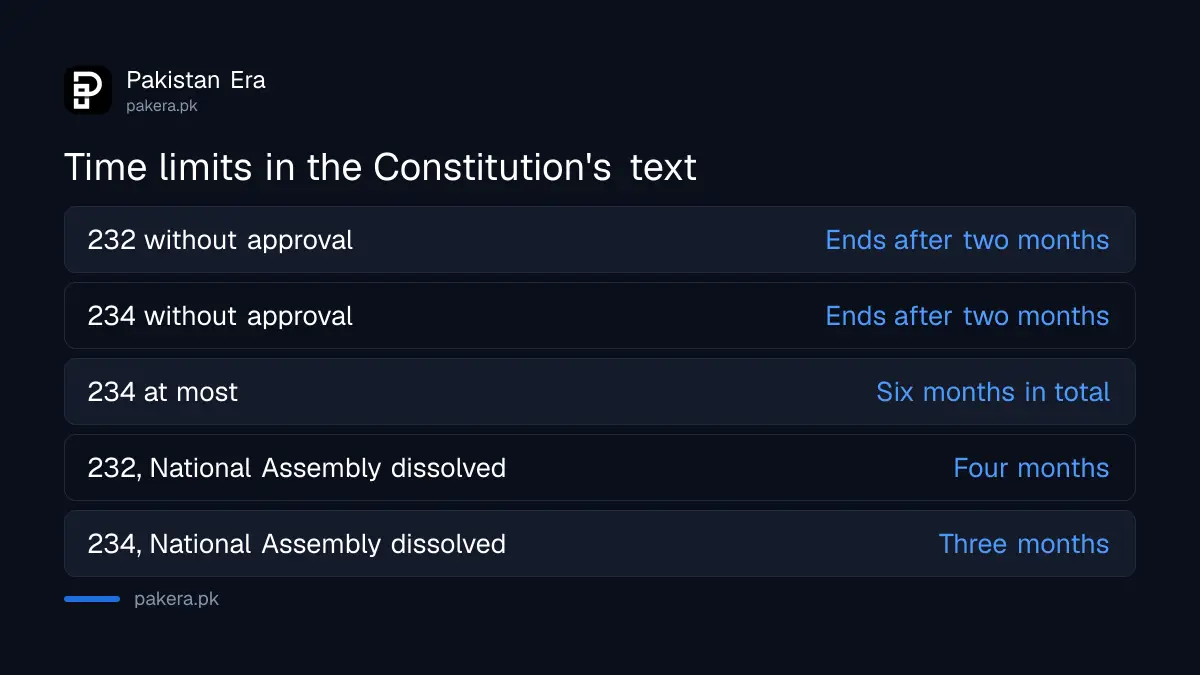
A Proclamation under Article 232 goes before a joint sitting of both Houses, which the President must summon within 30 days. It ends after two months unless the joint sitting approves it by resolution before then.
| Rule in the text | Article 232 emergency | Article 234 governor's rule |
|---|---|---|
| Laid before | Joint sitting, summoned within 30 days | Joint sitting |
| Ends unless approved | After two months | After two months |
| Longest it can run | No fixed maximum in the text | Six months, extended two months at a time |
| If the National Assembly is dissolved | Four months, unless the Senate approves it earlier | Three months, unless the Senate approves it earlier |
| Laws made because of it | Lapse six months after it ends | Lapse six months after it ends |
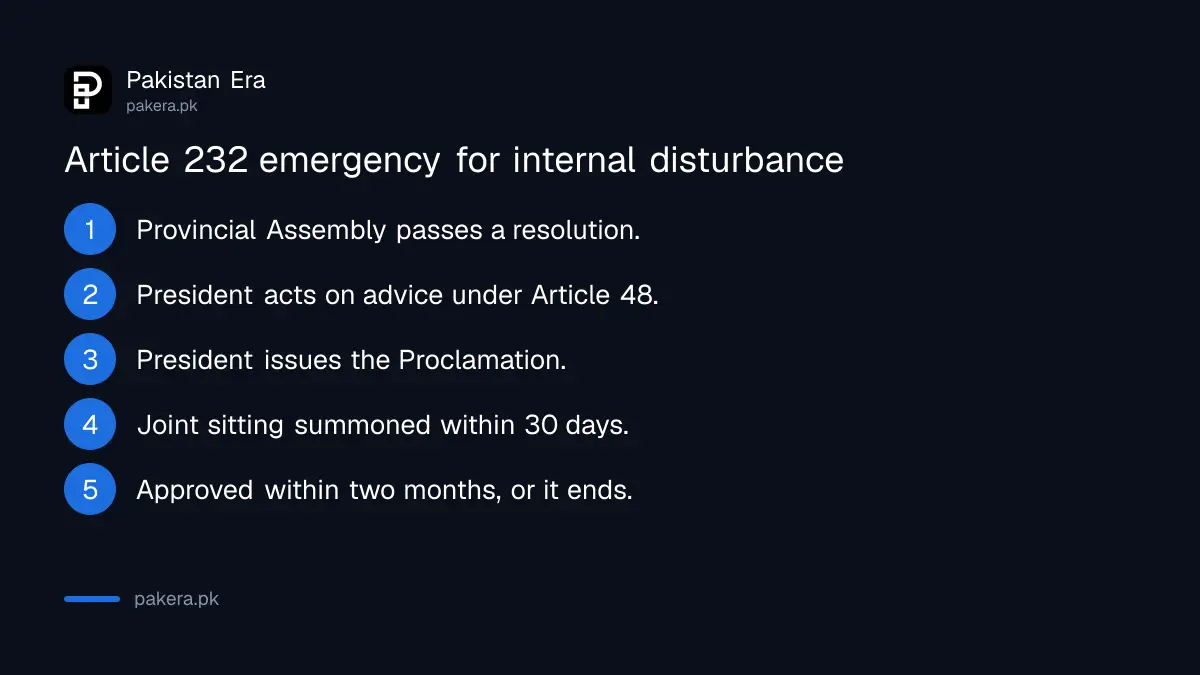
The text sets out the path for an emergency based on internal disturbance in this order:
- The Provincial Assembly of the province passes a resolution.
- The President, acting on advice under Article 48, is satisfied that a grave emergency exists.
- The President issues a Proclamation of Emergency.
- The President summons a joint sitting within 30 days.
- The joint sitting approves the Proclamation within two months, or it ends.
A joint sitting can also end an Article 232 emergency. That needs a resolution disapproving it, passed by a majority of the total membership of the two Houses.
Clause (6) lets Parliament, by law, extend the National Assembly's term during an emergency, by up to one year. Article 236 says the validity of a Proclamation "shall not be called in question in any court".
Article 234 is the governor's rule provision
Article 234 applies when the President, after a report from the province's Governor, is satisfied that its government cannot be carried on under the Constitution. The President may then take over its functions, and must do so if both Houses separately pass a resolution.
The words "governor's rule" do not appear in the Constitution. Under clause (1), the Proclamation can:
- take over all or any functions of the provincial government, other than the Provincial Assembly;
- declare that the Provincial Assembly's law-making powers will be used by, or under the authority of, Parliament;
- suspend parts of the Constitution about any provincial body, except those about High Courts.
Clause (2) says Article 105 does not apply here. That article normally makes the Governor act on the advice of the provincial cabinet or Chief Minister.
Governor's rule under Article 234 cannot last more than six months
An Article 234 Proclamation ends after two months unless a joint sitting approves it. The joint sitting can extend it by two months at a time, but the text says it can never stay in force for more than six months.
If the National Assembly is dissolved at the time, the Proclamation stays in force for three months. If no general election is held by then, it ends, unless the Senate has already approved it.
Past emergencies recorded in the Constitution's own footnotes
The Pakistan Code footnotes to Articles 232 and 233 record emergencies proclaimed on 23 November 1971 and 28 May 1998. They also record federal orders for the North-West Frontier Province in 1975 and Balochistan in 1976, both later rescinded.
| Date | What the footnote records |
|---|---|
| 23 November 1971 | Proclamation of Emergency, approved by a joint sitting on 5 September 1973 |
| 14 August 1973 | Order under Article 233 suspending court enforcement of some rights, rescinded on 14 August 1974 |
| 16 February 1975 | Order under Article 232 for the North-West Frontier Province, rescinded on 3 May 1975 |
| 30 June 1976 | Order under Article 232 for Balochistan, rescinded on 6 December 1976 |
| 28 May 1998 | Proclamation of Emergency and an Order under Article 233, both approved by a joint sitting on 10 June 1998 |
The footnotes to Article 234 do not list any Proclamation. We have kept to what the official text records, so we do not list governor's rule cases here.
Changing these articles would need a constitutional amendment under Article 239, which needs a two-thirds majority of the total membership in each House. The same rule applies to any plan for creating a new province, a subject Parliament is due to debate in October.
Common questions
Who can impose an emergency under Article 232?
The President, by Proclamation. Under Article 48, the President normally acts on the advice of the Cabinet or the Prime Minister.
Does an Article 232 emergency need the Provincial Assembly's consent?
For an emergency based on internal disturbance, the text requires a resolution from that Provincial Assembly. A second proviso covers a President acting on his own, who must seek approval from both Houses within ten days.
What is the difference between Article 232 and Article 234?
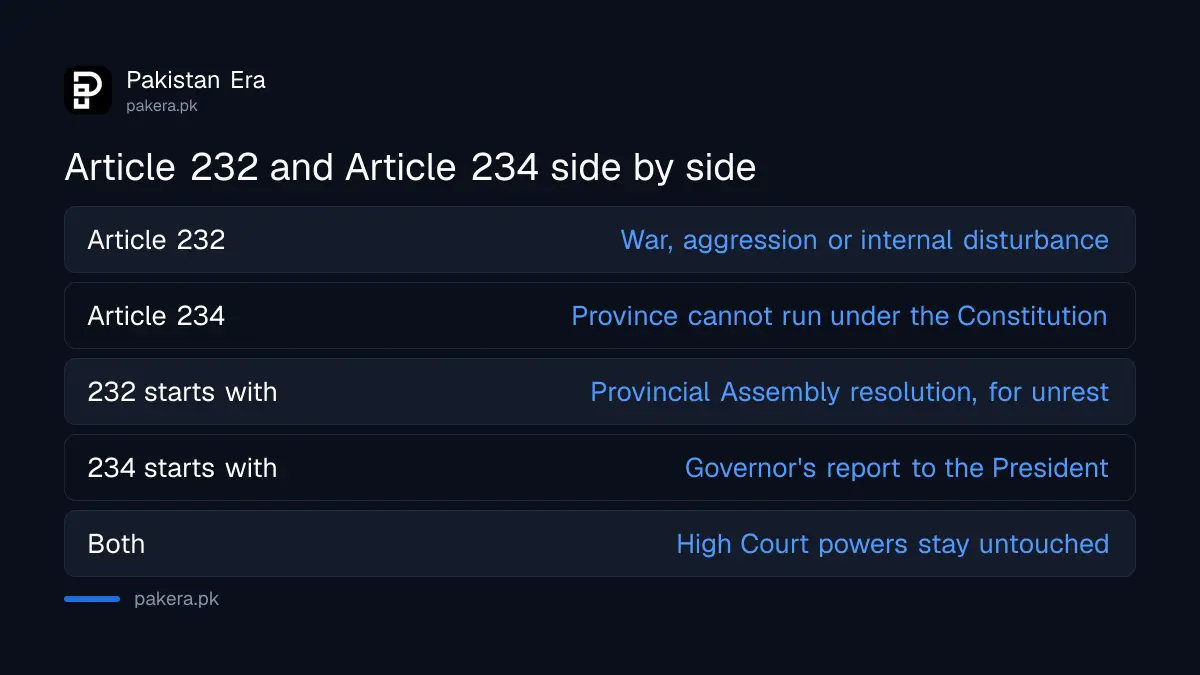
Article 232 covers security threats from war, aggression or internal disturbance. Article 234 covers a provincial government that cannot be run under the Constitution, and starts with the Governor's report.
How long can governor's rule last in Pakistan?
Two months without approval, then two-month extensions by a joint sitting, up to six months in total.
Can a court challenge an emergency Proclamation?
Article 236 says the validity of a Proclamation or Order under Part X "shall not be called in question in any court".
How we verified this
What we checked, where we read it, and what we could not confirm.
Last checked on 1 October 2026. Articles 48, 105, 232, 233, 234, 236 and 239, and the footnotes listing past Proclamations and Orders, are read in the Constitution of the Islamic Republic of Pakistan as published on the Pakistan Code by the Ministry of Law and Justice, which states that the Gazette is the original source in case of doubt. Reports of ministers' remarks on Khyber Pakhtunkhwa could not be confirmed on an official site, so we have described them as reported. This is general information about the constitutional text, not legal advice.
About the author

Senior Writer, Public Services and Technology
Shahid joined us in 2024 as an author. He is a senior contributor to Pakistan's leading technology websites. He writes detailed articles, mostly covering his expertise in the latest tech, mobiles, apps, gadgets, and step-by-step guides. His ideology is to help people understand the latest trends and explain complex methods through very easy-to-understand guides.