How a New Province Is Actually Created in Pakistan
Two thirds of both Houses is not enough. The assembly of the province being divided must also pass it, by two thirds of total membership.
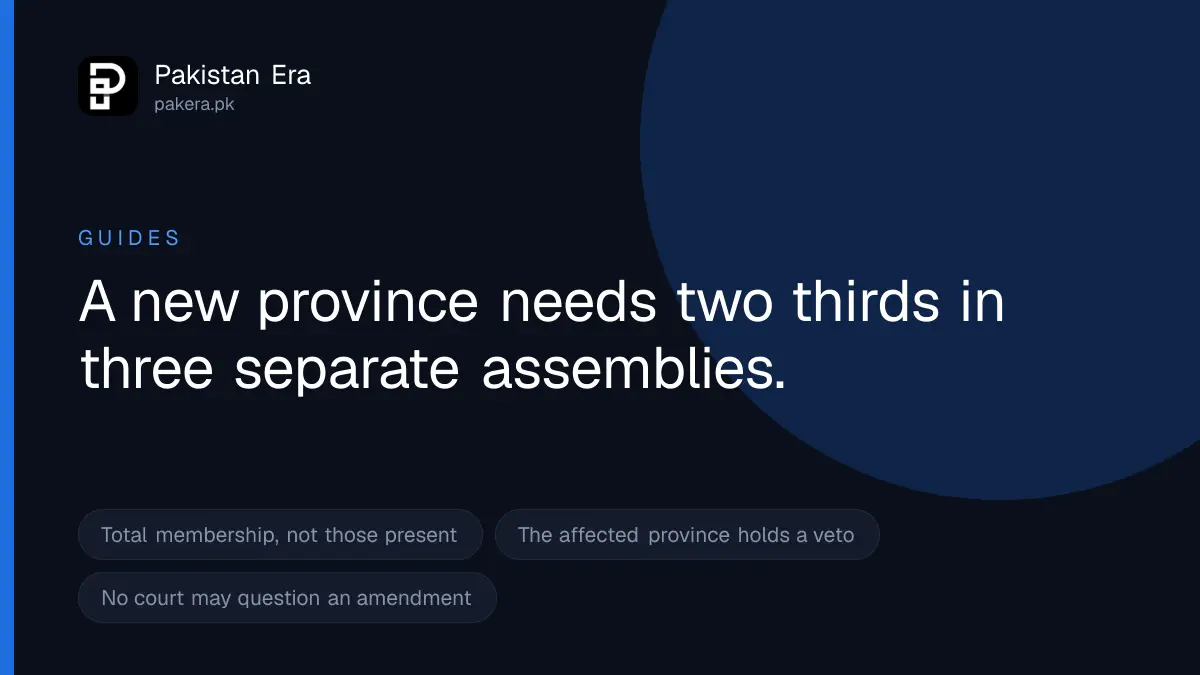
Creating a new province in Pakistan does not need a two thirds majority. It needs three of them, in three separate houses, and the province being divided holds a veto over the whole thing.
That last part is why the subject returns every few years and never moves. Parliament cannot do it alone, however large its majority.
We read Article 239 of the Constitution on 10 September 2026, in the text published by the National Assembly of Pakistan.
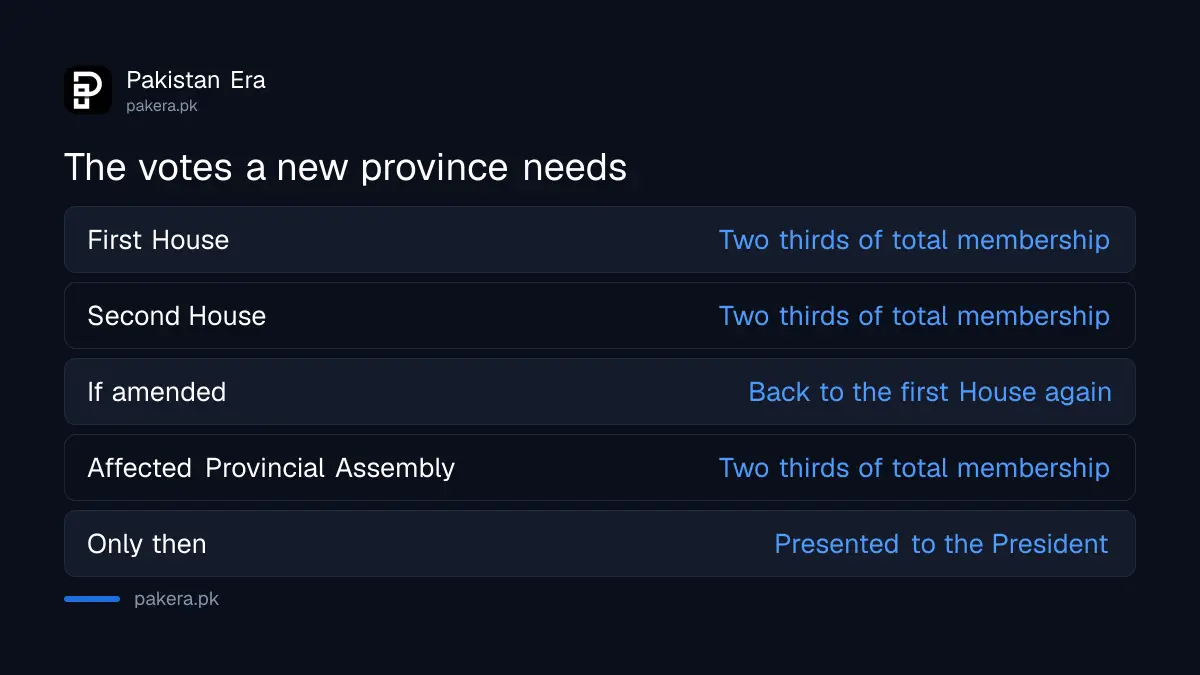
The three votes a new province needs
| Stage | What Article 239 requires |
|---|---|
| House where the Bill starts | Two thirds of total membership |
| The other House | Two thirds of total membership |
| If the second House amends it | Back to the first House, two thirds again |
| Provincial Assembly of the affected province | Two thirds of total membership |
| Only then | Presented to the President for assent |
A Bill to amend the Constitution may start in either House, so it can begin in the Senate rather than the National Assembly.
Total membership, not those who turn up
This is the phrase that decides these Bills, and most coverage skips it.
Article 239 says two thirds of the total membership of the House. It does not say two thirds of the members present and voting.
The difference is everything. Under a present and voting rule, absences and abstentions shrink the denominator and make the threshold easier. Under a total membership rule they do not. A member who stays away, walks out, abstains or is abroad counts exactly the same as a member who votes against.
So the arithmetic is not about persuading the chamber in the room. It is about producing a fixed number of physical yes votes, three times over.
The provincial veto
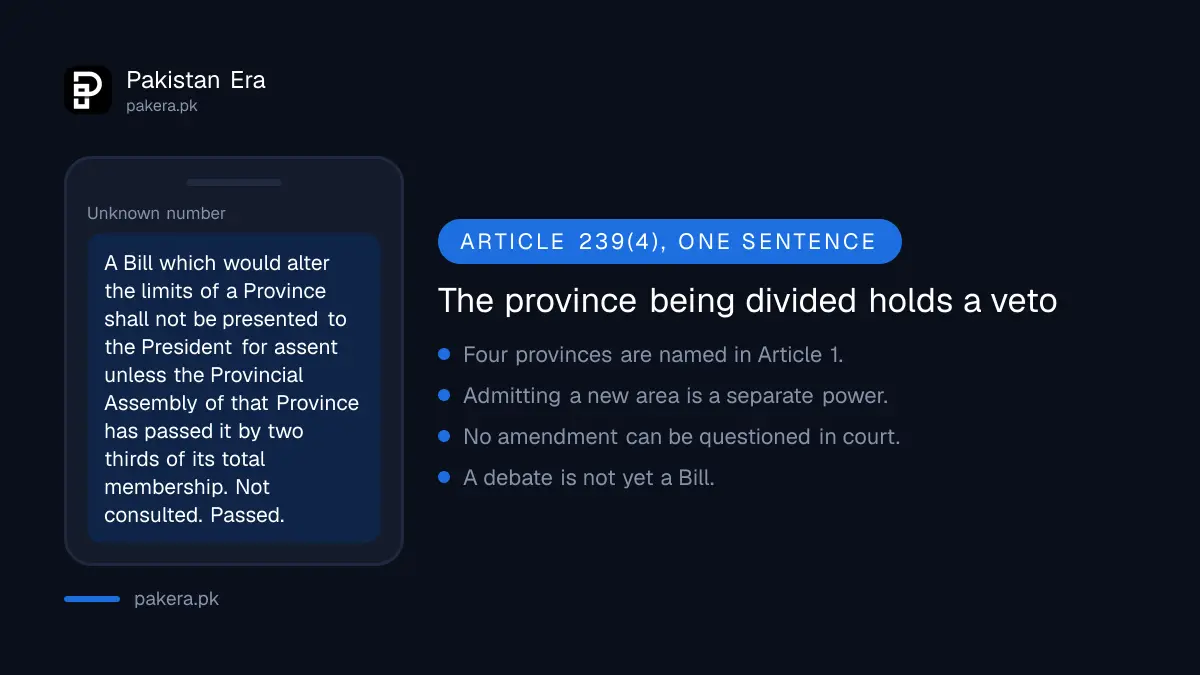
Article 239(4) is one sentence and it is the whole story.
A Bill to amend the Constitution which would have the effect of altering the limits of a Province shall not be presented to the President for assent unless it has been passed by the Provincial Assembly of that Province by the votes of not less than two thirds of its total membership.
Read the mechanism carefully. It does not say the provincial assembly is consulted, and it does not say its view is considered. It says the Bill shall not be presented for assent without that vote.
So a province cannot be divided against the will of its own assembly. Whatever passes in Islamabad stops at that point.
The clause is drafted around altering the limits of a Province, which is what creating a new province out of an existing one does. It is the boundary change, not the label, that triggers the requirement.
Which provinces exist now
Article 1 sets out the territories of Pakistan, and names four provinces: Balochistan, Khyber Pakhtunkhwa, the Punjab and Sindh. It also covers the Islamabad Capital Territory as the Federal Capital.
Article 1(3) does something separate that is often confused with the province question. It says Parliament may by law admit into the Federation new States or areas on such terms and conditions as it thinks fit.
Admitting a new area into the Federation is not the same act as carving a new province out of an existing one. The first is an addition from outside. The second changes the limits of a province that already exists, and that is the one Article 239(4) governs.
What cannot be challenged afterwards
Two more clauses shape how this plays out, and both point the same way.
Article 239(5) says no amendment of the Constitution shall be called in question in any court on any ground whatsoever. Article 239(6) declares, for the removal of doubt, that there is no limitation whatever on the power of Parliament to amend any of the provisions of the Constitution.
Taken together, the procedure is the safeguard. There is no later stage at which a court reviews whether a completed amendment was wise or fair, so everything rests on the votes being obtained in the manner the Article sets out.
Why proposals stall
- A two thirds federal majority is rare on its own.
- It has to be repeated in the second House.
- Any amendment in the second House sends it back for a third vote.
- The affected provincial assembly must then reach two thirds itself.
- Every one of those thresholds is measured against total membership.
A party that controls a provincial assembly has little reason to vote for its own province to be reduced, and a party that does not control it cannot supply the votes. That is the structural reason these Bills are announced more often than they are passed.
None of that makes a new province impossible. It makes it a question of assembling a specific set of majorities rather than of winning an argument.
What is actually happening now
Reporting on 10 September 2026 said the federal government has announced that the National Assembly and the Senate will debate the creation of new provinces during their October sessions.
We could not confirm that on a parliamentary page, so we are describing it as reported rather than stating it as fact.
A debate is also not a Bill. Under Article 239 the process begins when a constitutional amendment Bill is introduced in one of the Houses, and a scheduled discussion is a stage before that rather than part of it.
Our guide to getting a domicile certificate covers the document that ties a person to a province in practice, and our guide to your rights when you are arrested covers another part of the same Constitution that people meet far more often. Our guide to the Pakistan Citizen Portal covers the federal complaint channel.
Common questions
How is a new province created in Pakistan?
By a constitutional amendment Bill under Article 239, passed by two thirds of the total membership of both Houses and of the affected Provincial Assembly.
Can Parliament do it alone?
No. A Bill altering the limits of a Province cannot be presented to the President without the affected Provincial Assembly passing it by two thirds.
Does two thirds mean of those voting?
No. Article 239 measures it against the total membership of the House, so absences count against the threshold.
How many provinces does the Constitution name?
Four: Balochistan, Khyber Pakhtunkhwa, the Punjab and Sindh, alongside the Islamabad Capital Territory.
Can a completed amendment be challenged in court?
Article 239(5) says no amendment shall be called in question in any court on any ground whatsoever.
Is a parliamentary debate the same as a Bill?
No. The Article 239 process starts when an amendment Bill is introduced in one of the Houses.
How we verified this
What we checked, where we read it, and what we could not confirm.
Last checked 10 September 2026. We read the Constitution of the Islamic Republic of Pakistan as published by the National Assembly of Pakistan at na.gov.pk. Article 239(1) providing that a Bill to amend the Constitution may originate in either House and must be passed by the votes of not less than two thirds of the total membership of that House before transmission to the other; Article 239(2) and 239(3) requiring the same two thirds of total membership in the second House and, where the Bill is returned amended, in the originating House again, in each case subject to clause (4); Article 239(4) providing that a Bill which would have the effect of altering the limits of a Province shall not be presented to the President for assent unless it has been passed by the Provincial Assembly of that Province by the votes of not less than two thirds of its total membership; Article 239(5) providing that no amendment of the Constitution shall be called in question in any court on any ground whatsoever; and Article 239(6) declaring that there is no limitation whatever on the power of Parliament to amend any provision, are all quoted from that text. Article 1(2) naming the Provinces of Balochistan, Khyber Pakhtunkhwa, the Punjab and Sindh together with the Islamabad Capital Territory, and Article 1(3) allowing Parliament by law to admit new States or areas into the Federation, are from the same source. A note on the edition, because it matters: the copy published on that site is the Sixth Edition, stated as modified up to 28 February 2012, and its Article 1 territory list therefore predates the merger of the Federally Administered Tribal Areas into Khyber Pakhtunkhwa by the Twenty-fifth Amendment in 2018. Article 239 itself was last substituted in 1985 and its requirements are unchanged, which is why we have quoted it from that edition; the territory list is reported here only for the four provinces it names, which are not affected. The statement that the National Assembly and Senate will debate the creation of new provinces in their October sessions comes from news reporting of 10 September 2026 and we could not confirm it on a parliamentary page, so it is described as reported. Nothing here is legal advice, and nothing here takes a position on whether any new province should be created.
About the author

Tax, Bills and Technology Writer
Ali Akhtar is a young and curious voice here at Pakistan Era. He is currently pursuing his A-Levels and has a growing interest in Pakistan’s changing industrial landscape and educational trends. Ali likes to write in a way that helps him explain and explore the world around him. His writing reflects the perspective of the new generation navigating the evolving trends of Pakistan where technology, youth innovation, and shifting opportunities are reshaping the country’s future.