New Provinces in Pakistan: Parliament Debate Due in October, No Bill Yet
The government says Parliament will debate new provinces in October 2026, but no session is summoned and no bill exists. What was proposed and what comes next.
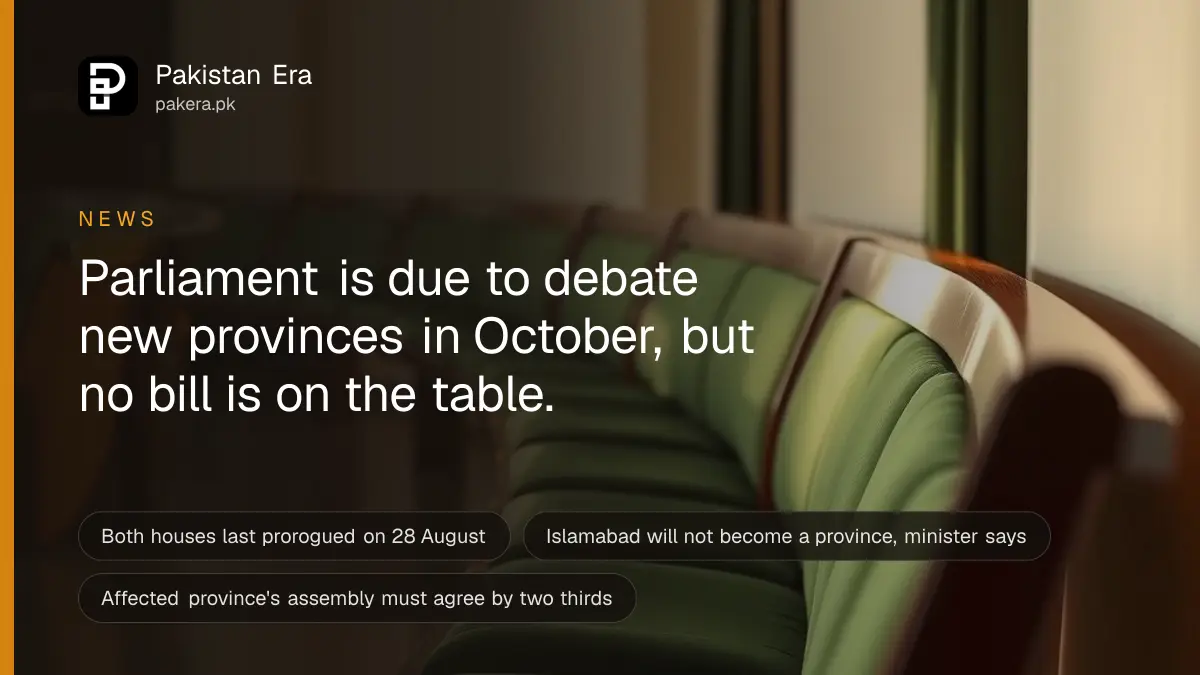
The federal government says Parliament will debate creating new provinces in Pakistan when the National Assembly and Senate meet in October 2026. As of Monday 28 September, neither house had been called into session, and the government had not put a bill to create a province before either of them.
The plan was first announced on 10 September by the Federal Minister for Parliamentary Affairs, Dr Tariq Fazal Chaudhry, speaking to journalists. We could not find his remarks on a government website, so they are as reported by national news outlets, which quote him consistently.
We checked the National Assembly and Senate websites on 28 September. Both houses were last prorogued on 28 August 2026, which means that session was formally closed. Neither site listed a date for the next one.
The government says the debate will come in October
Dr Tariq Fazal Chaudhry said on 10 September that neither house would sit in September, and that the proposal for new provinces would be formally discussed when both houses meet in October. He called Parliament the proper place for the debate.
He was reported as saying the question was already being argued across the country, by the media, academics and business groups. His point was that the argument should move into Parliament rather than stay outside it.
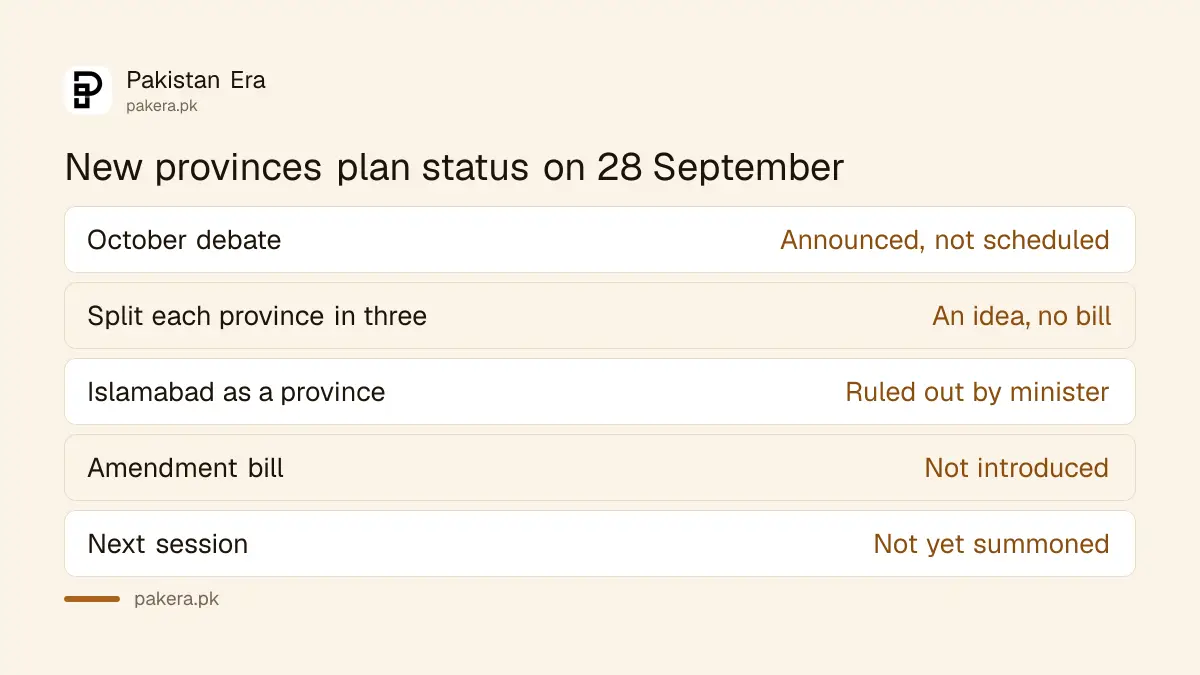
That is a promise of a debate, not a plan to vote on anything. No minister has said a bill is ready. No draft has been published for comment.
What has actually been proposed so far
No formal proposal exists yet. The main idea in public came from the Planning Minister, Ahsan Iqbal, who reportedly suggested splitting each of the four provinces into three and forming a review committee, while saying any change needs political consensus.
Reports put the total at 15 provinces, although four provinces split three ways makes 12, and the reports did not explain the difference. Reports also said the debate picked up after the Interior Minister, Mohsin Naqvi, spoke about weaknesses in the current system. We could not read either minister's remarks on an official page.
The same 10 September remarks settled one question. Dr Tariq Fazal Chaudhry said Islamabad is not being made a province. He said the capital is being considered for a new governance model instead. No details of that model have been published.
| Claim | Who said it | Status on 28 September |
|---|---|---|
| Parliament to debate new provinces in October | Parliamentary Affairs Minister, 10 September | Reported; no session summoned yet |
| Split each province into three | Planning Minister, reported | An idea only; no bill |
| Review committee on the idea | Planning Minister, reported | No committee notified that we could find |
| Islamabad will not become a province | Parliamentary Affairs Minister, 10 September | Reported; new governance model not published |
| Constitutional amendment bill | Nobody | Not introduced |
A debate in Parliament is not a bill
A debate lets members speak on the subject, and can end with nothing more than speeches or a resolution. A new province can only be made by a constitutional amendment bill, and the government has not introduced one in either house.
This difference is easy to miss in the headlines. A resolution expresses the view of a house. It does not change the law. The steps that actually create a province start only when a bill to amend the Constitution is moved in the National Assembly or the Senate.
So if you see a report in October that "Parliament has approved new provinces", check which of these happened. A debate, a resolution and a passed amendment are three very different things.
The Constitution needs three two thirds votes
Under Article 239, an amendment needs two thirds of the total membership of the National Assembly and of the Senate. If it changes a province's borders, that province's own assembly must also pass it by two thirds before it goes to the President.
The key phrase is "total membership". Absent members count the same as a no vote. That makes the bar harder than it first looks. We explain the full rule, including the difference from Article 1(3), in how a new province is created in Pakistan.
Clause 239(4) is the part that decides most of this debate. A bill that changes the limits of a province cannot be presented to the President for assent unless that province's assembly has passed it by two thirds of its total membership. In practice, the province being divided holds a veto.
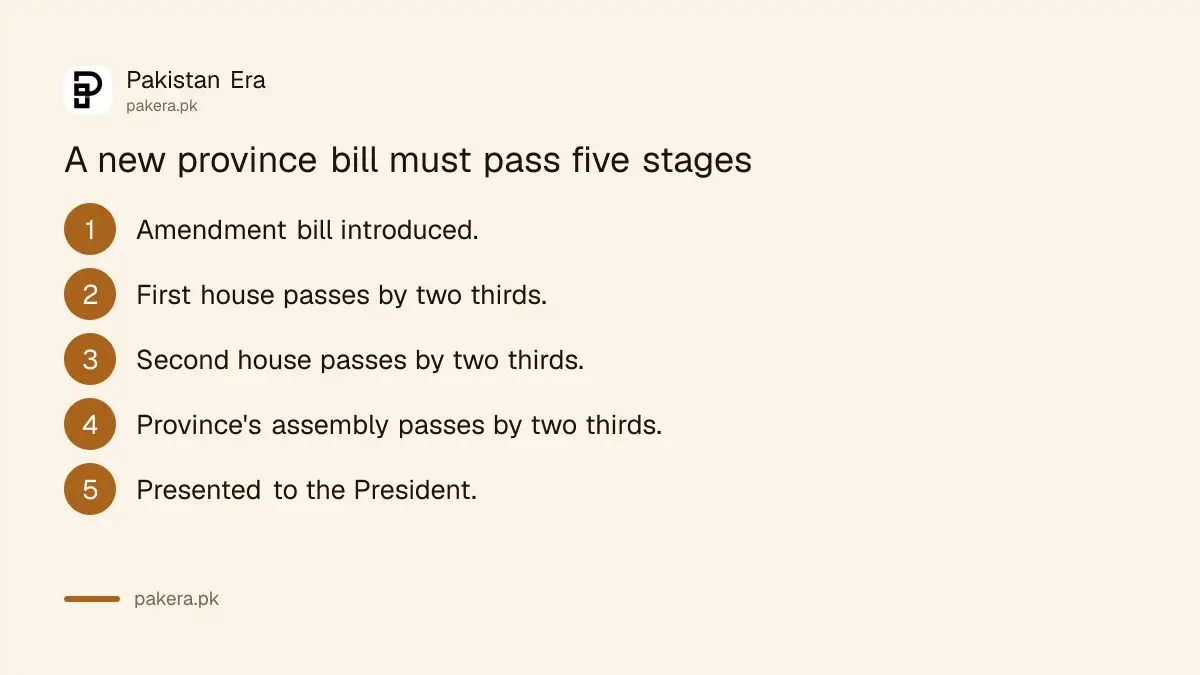
The stages, in order, are:
- A bill to amend the Constitution is introduced in either house.
- That house passes it by two thirds of its total membership.
- The other house passes it by two thirds of its total membership.
- The assembly of the affected province passes it by two thirds of its total membership.
- Only then is it presented to the President for assent.
What happens next, and what to watch for
The next step is a summons for the National Assembly and Senate sessions. After that, watch the Orders of the Day, which list the business for each sitting. That is where a debate, a resolution or a bill on new provinces would first appear.
The Senate publishes its summoning and prorogation dates on its Summoning and Prorogation page. Its last session, the 363rd, ran from 17 August to 28 August 2026. The National Assembly website also said on 28 September that its last session was prorogued on 28 August.
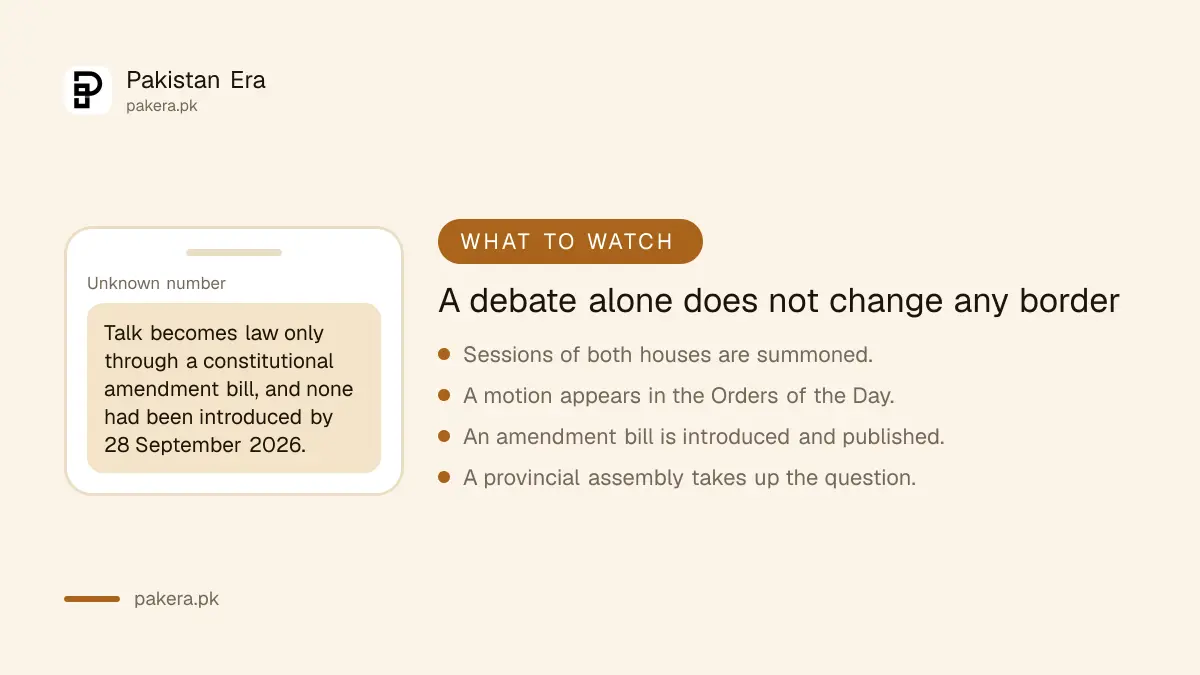
Three things would show the plan is moving from talk to law:
- A motion or resolution on new provinces listed in the Orders of the Day.
- A constitutional amendment bill introduced, with its text published.
- A provincial assembly taking up the question, since its two thirds vote is required.
Until one of those happens, nothing about any province's borders has changed. Your domicile, your district and your provincial rights stay exactly as they are. If you need a domicile certificate for a job or admission, apply as normal.
Common questions
Is Pakistan getting new provinces in October 2026?
No decision has been made. The government says Parliament will debate the idea in October, but it has not introduced a bill to create a province.
When will the National Assembly and Senate meet?
No date had been announced as of 28 September 2026. Both houses were last prorogued on 28 August, and the minister said they would return in October.
How many provinces has the government proposed?
None formally. The Planning Minister reportedly floated splitting each of the four provinces into three, but that is an idea, not a proposal before Parliament.
Will Islamabad become a province?
No, according to the Parliamentary Affairs Minister on 10 September. He said the capital is being considered for a new governance model instead.
Can Parliament create a province without the province's consent?
No. Article 239(4) requires the affected province's assembly to pass the amendment by two thirds of its total membership before it can go to the President.
How we verified this
What we checked, where we read it, and what we could not confirm.
We last checked this on Monday 28 September 2026 at about 02:00 PKT. We read the Senate of Pakistan's Summoning and Prorogation page and its Orders of the Day page, which showed the 363rd session from 17 to 28 August 2026 as the latest, and the National Assembly home page, which said its session was prorogued on 28 August 2026. Article 239 is quoted from the Constitution as published by the National Assembly, as read on 10 September 2026. The ministers' remarks are as reported by national news outlets on 10 September; we could not find them on a government website. We will update this page when the sessions are summoned or a bill is introduced.
About the author

Senior Writer, Public Services and Technology
Shahid joined us in 2024 as an author. He is a senior contributor to Pakistan's leading technology websites. He writes detailed articles, mostly covering his expertise in the latest tech, mobiles, apps, gadgets, and step-by-step guides. His ideology is to help people understand the latest trends and explain complex methods through very easy-to-understand guides.