Section 144 in Karachi, Punjab, Balochistan and Islamabad: What Is Banned and Until When
Section 144 now bans public gatherings in Karachi, Punjab, Balochistan and Islamabad. See what each order bans, how long it runs and the Section 188 penalty.
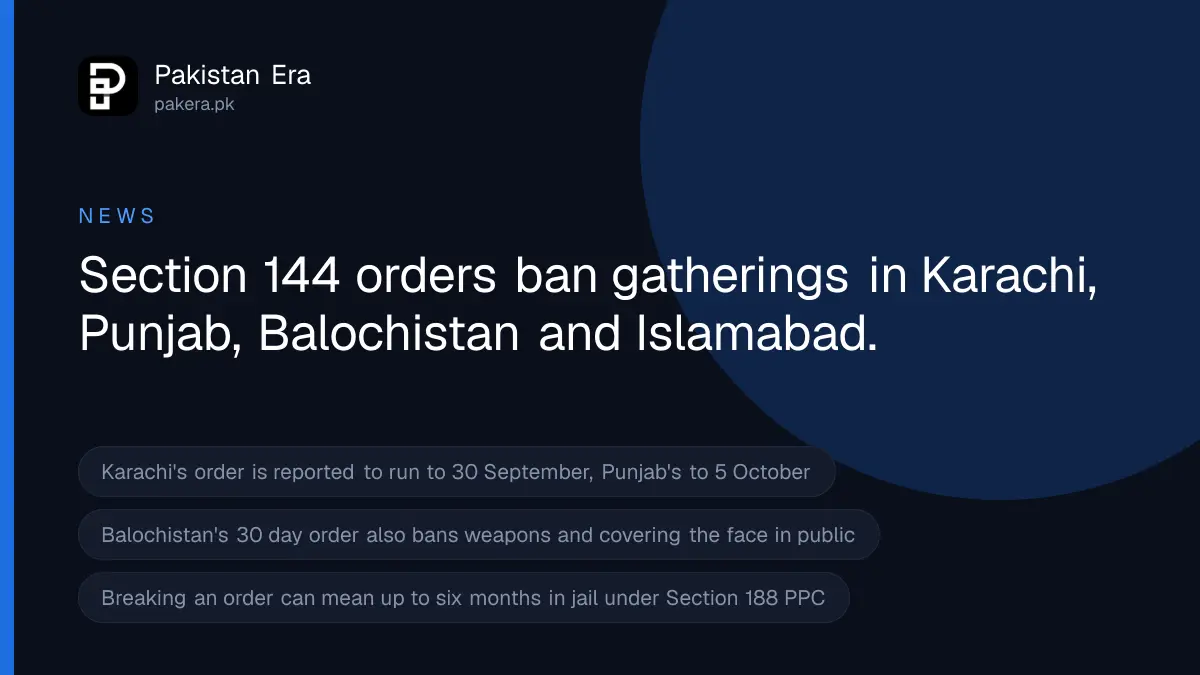
Section 144 orders now ban public gatherings in Karachi, Hyderabad, all of Punjab, all of Balochistan and Islamabad. The end dates are different in each place: 29 September in Hyderabad, 30 September in Karachi, 5 October in Punjab, about 22 October in Balochistan and about mid November in Islamabad, going by the dates reported for each order.
Update, 7 October 2026: Punjab has extended its own ban on gatherings until 15 October. Read what the extended Punjab order covers.
Most of these orders came in during the same week, ahead of the march on Islamabad that Pakistan Tehreek-e-Insaf (PTI) has called for 27 September. Each one is a separate legal order, with its own wording, its own officer and its own end date. So a rule you read about for Lahore may not be the rule in Quetta.
Everything below is as of 01:15 PKT on Friday 25 September 2026. We read Section 144 of the Code of Criminal Procedure and Section 188 of the Pakistan Penal Code on the government's own Pakistan Code website that night, so the penalty section comes from the law itself. Most of the order details come from press reports, because only one of the issuing offices has a public notifications page and the new order was not on it yet.
Five Section 144 orders cover Karachi, Hyderabad, Punjab, Balochistan and Islamabad
As of 25 September 2026, Section 144 bans gatherings in Karachi to 30 September, Hyderabad to 29 September, Punjab to 5 October, Balochistan for 30 days from 23 September and Islamabad for two months from 18 September, according to news reports of each order. None of the order texts was on an official site we could open, so every date in this table is as reported.
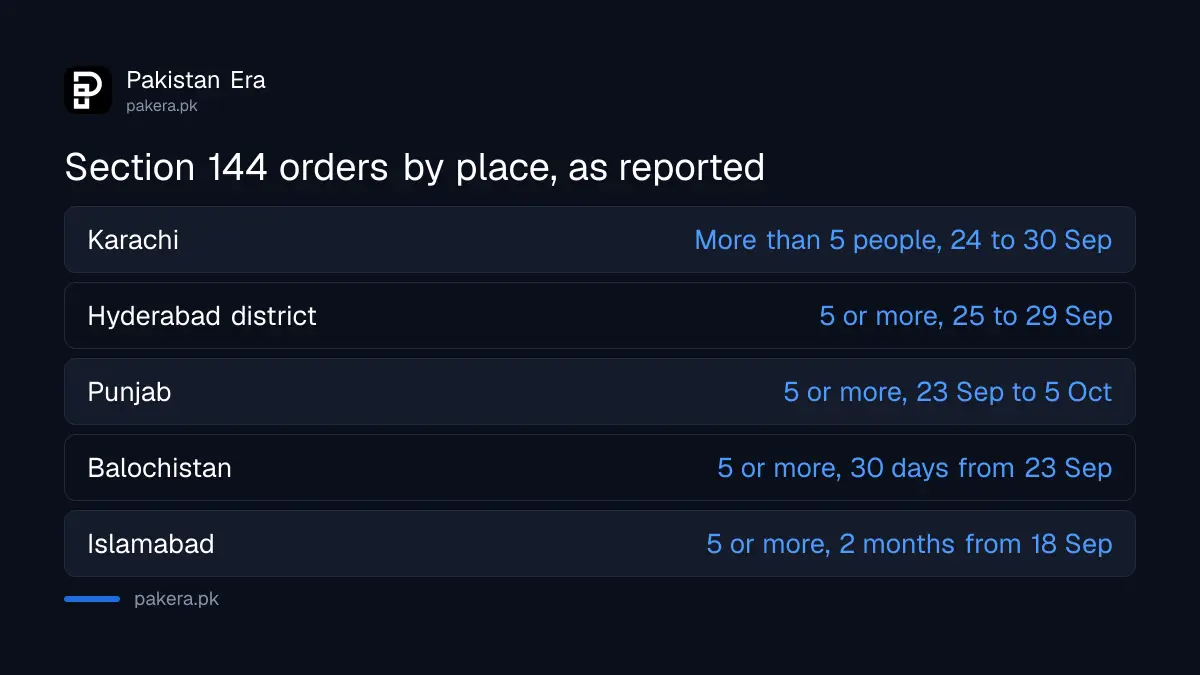
| Place | What is banned | From | Until | Issued by |
|---|---|---|---|---|
| Karachi | Gatherings of more than five people, protests, sit-ins, rallies, processions | 24 September | 30 September | Karachi Commissioner Hassan Naqvi |
| Hyderabad district | Gatherings of five or more people | 25 September | 29 September | Hyderabad Commissioner Fayaz Hussain Abbasi |
| Punjab, whole province | Gatherings of five or more, rallies, sit-ins, carrying weapons | 23 September | 5 October | Punjab Home Department |
| Balochistan, whole province | Gatherings of five or more, weapons, covering the face in public | 23 September | 30 days, about 22 October | Additional Chief Secretary (Home) Muhammad Hamza Shafqaat |
| Islamabad district | Gatherings of five or more, processions, rallies, demonstrations | 18 September | Two months, about 17 November | Additional District Magistrate Dr Anam Fatima |
The Balochistan and Islamabad end dates are our own count from the length each order was reported to run. The order text would settle the exact last day. A Section 144 order in Sukkur until 29 September has also been reported, but with no further detail, so we have left it out of the table.
Karachi's order bans gatherings of more than five people until 30 September
Karachi Commissioner Hassan Naqvi signed a Section 144 order on 24 September 2026. It bans gatherings of more than five people, including protests, sit-ins, rallies and processions, across Karachi until 30 September, according to news reports just after midnight on 25 September.
The order cites police letters. According to the reports, those letters said protests and sit-ins on major roads were causing severe traffic jams, blocking emergency services and restricting access to hospitals.
Note the wording. Karachi's limit is reported as "more than five" people, which means six or more. Every other order in this list is reported as "five or more". One extra person is the difference, and only the order text settles which it is.
When we opened the Commissioner Karachi notifications page at 01:15 PKT on 25 September, it listed earlier Section 144 orders on swimming, cattle markets and heavy traffic, but the newest item was dated 3 July 2026. The 24 September order was not there yet.
In Hyderabad district, Commissioner Fayaz Hussain Abbasi banned gatherings of five or more people from 25 to 29 September, according to news reports. The notice, as reported, cited possible attacks on public gatherings and the security situation, and said violations fall under Section 188 of the Pakistan Penal Code.
Punjab and Balochistan orders run across the whole province for weeks
Punjab's order runs from 23 September to 5 October and Balochistan's for 30 days from 23 September. Both were issued by the provincial home department under Section 144(6), the part of the law that lets a province keep an order running longer.
The Punjab Home Department order bans gatherings of five or more people "in any public place, street, road, highway, motorway or open space", according to reports quoting it. Reports add that it bans carrying and displaying weapons and encouraging others to join unlawful gatherings. The reasons given in the order, as quoted in the reports, were a "serious and imminent threat to public peace" from militant groups and "Hostile Intelligence Agencies".
The reports do not say whether holders of a Punjab arms licence are exempt from the weapons ban, so do not assume they are.
Punjab also asked for Rangers in four districts until 5 October: Rawalpindi, Attock, Jhelum and Mianwali, according to news reports.
In Balochistan, Additional Chief Secretary (Home) Muhammad Hamza Shafqaat signed the order on 23 September, according to news reports. It bans gatherings of five or more people, including sit-ins, processions and rallies. It also bans carrying weapons in public "except where specifically authorised under the law". Reports say this is the third province-wide Section 144 order in Balochistan this year.
Balochistan's order also bans covering the face in public, and reports differ on the wording. One version says "mufflers, masks or any other means". Another says covering the face "and wearing veils". The notification was not available for us to read, so we cannot say which wording is in it.
Islamabad's order runs for two months alongside a separate assembly law
Islamabad's Section 144 order is dated 18 September 2026 and runs for two months. It bans gatherings of five or more people, processions, rallies and demonstrations anywhere public in the district, including the Red Zone, according to news reports.
The order was signed by Additional District Magistrate Dr Anam Fatima. The district administration also pointed to the Peaceful Assembly and Public Order Act 2024 and said breaking the ban carries three years in prison, according to reports.
We opened that Act on Pakistan Code. It applies only to the Islamabad Capital Territory. Section 8 says a member of an "unlawful assembly" can get up to three years, a fine, or both. But the Act's own definition of an "assembly" is a gathering of "more than fifteen persons". The Section 144 order uses five. How the two fit together in a given case is for a court to decide, not us.
The same Act lets a person affected by a ban file a revision, meaning a request to review it, before the Chief Commissioner of Islamabad within 15 days of the order. Road closures around the capital are a separate matter. The six roads into Islamabad shut since 23 September were closed by the traffic police, not by this order.
What you can still do depends on the wording of your area's order
Only the Punjab order, as reported, lists exemptions: weddings, funerals, burials, worship, courts, government offices and events with formal permission. The reports on Karachi, Hyderabad, Balochistan and Islamabad list none. That does not mean weddings are banned there. It means the reports do not say.
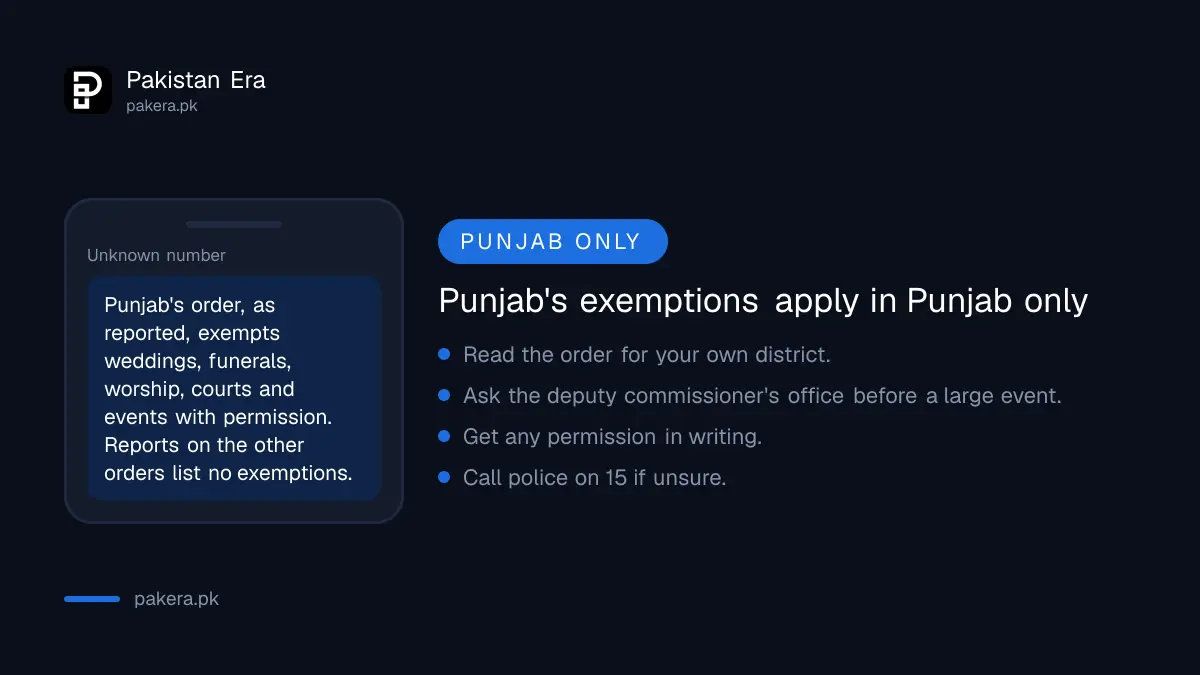
Here is what the reports say is banned, taken together:
- Gatherings in public places above the limit in your area's order.
- Rallies, processions, sit-ins and demonstrations.
- Carrying or showing weapons in public, in Punjab and Balochistan.
- Covering the face in public, in Balochistan.
None of the orders, as reported, bans going to work, shopping or travelling on your own. They target groups, weapons and, in Balochistan, face coverings. Mobile internet is a separate question too. Any data suspension around the march would need its own order, as with past internet shutdowns in Pakistan.
The Constitution sets the frame. Article 16 says every citizen has "the right to assemble peacefully and without arms, subject to any reasonable restrictions imposed by law in the interest of public order". PTI has said peaceful protest is its constitutional right. The orders say they are needed for public safety. Whether any one order is reasonable is for the courts, and we make no finding on it.
Breaking a Section 144 order is an offence under Section 188 PPC
Disobeying a Section 144 order is punished under Section 188 of the Pakistan Penal Code. The law allows up to one month in jail or a Rs 600 fine, rising to six months or Rs 3,000 where the disobedience risks life, safety or a riot.
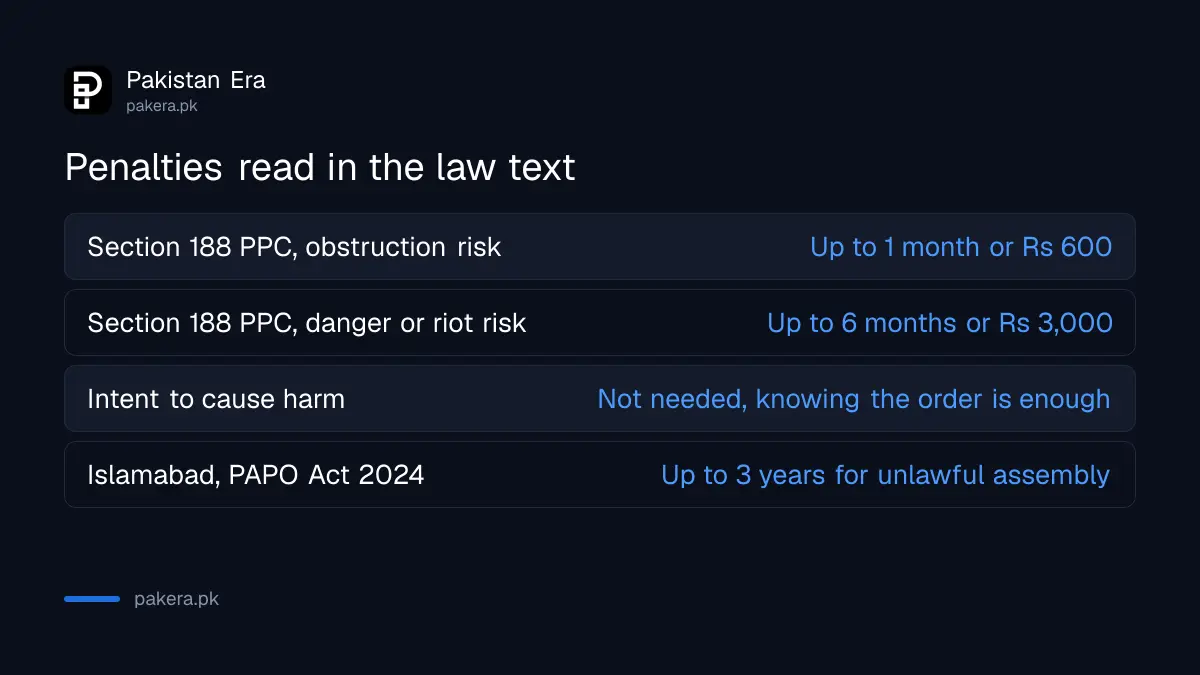
| If the disobedience | Maximum jail | Maximum fine | Law |
|---|---|---|---|
| Causes or risks obstruction, annoyance or injury | 1 month, simple imprisonment | Rs 600, or both | Section 188 PPC |
| Causes or risks danger to life, health or safety, or a riot | 6 months | Rs 3,000, or both | Section 188 PPC |
| Makes you a member of an unlawful assembly in Islamabad | 3 years | Fine, amount not fixed, or both | Section 8, PAPO Act 2024 |
Section 188 adds an explanation that matters. The person does not need to intend harm. It is enough that they know about the order and that disobeying it causes harm or is likely to. So the order must be public, which is why these orders are announced and published.
Section 144 itself allows an order "to the public generally when frequenting or visiting a particular place". It must be in writing and state the facts of the case. Section 144(6) limits an order to a few days unless, where life or safety is at risk or a riot is likely, the provincial government extends it by notification in the official Gazette. That is the sub-section Punjab and Balochistan cited.
The same section also lets any affected person apply to have an order cancelled or changed. The officer must give them an early hearing and, if they refuse, record the reasons in writing. One caution: the version on Pakistan Code still names the "Zila Nazim", a post from the 2001 local government system. The orders this week were signed by home departments, commissioners and a district magistrate, so the text that applies in each province may carry later changes we did not trace.
This is general information, not legal advice. The order for your area is what counts.
Check whether an order covers your area in five steps
Find the order for your own district, read its dates and wording, and ask the local police or deputy commissioner's office if anything is unclear. Do not rely on a report about another province, because each order is separate.
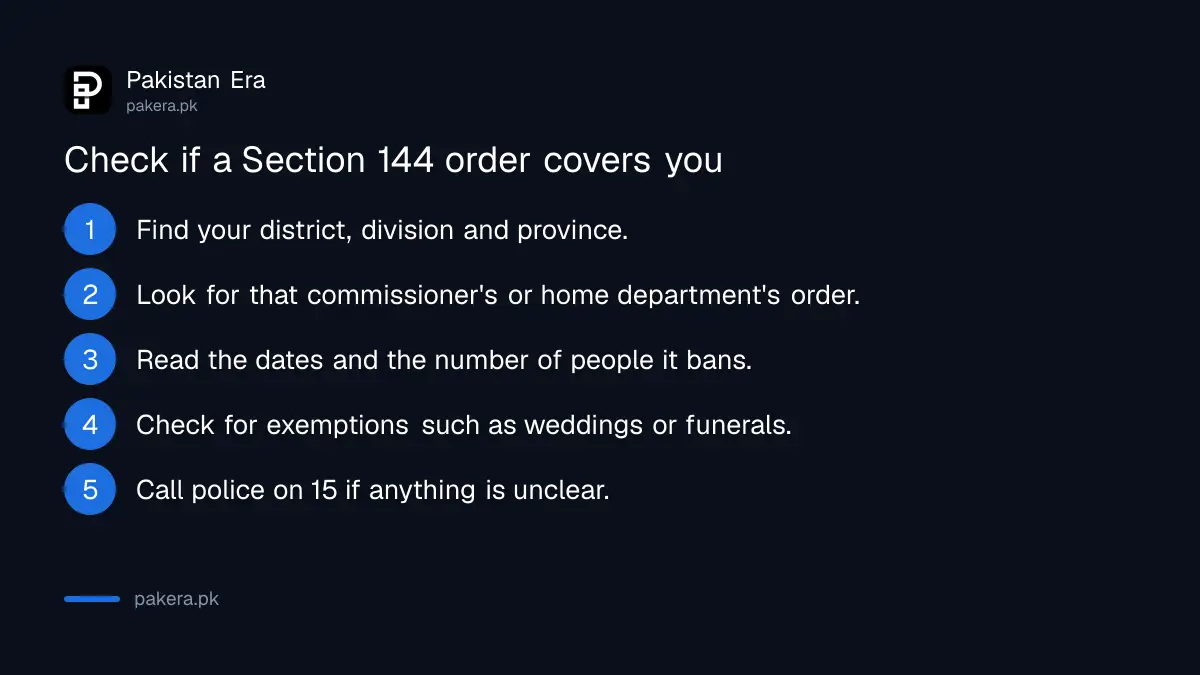
- Work out who governs your area: the district, the division and the province. Karachi and Hyderabad have separate orders even though both are in Sindh.
- Look for the order from that officer: the commissioner or deputy commissioner, or the provincial home department. The Commissioner Karachi site has a notifications page, though the new order was not on it when we checked.
- Read the start date, the end date and the number of people it bans. Check for exemptions such as weddings or funerals.
- If you are planning an event, ask the deputy commissioner's office in writing for permission before the day. Punjab's order exempts events with formal permission.
- If you are unsure, call police on 15, one of the emergency helpline numbers that work across Pakistan.
If a case is registered against someone you know under Section 188, you can check the FIR online in most provinces.
Section 144 is not only used for protests. The swimming bans in Punjab and Sindh in August used exactly the same power.
Common questions
Is Section 144 imposed in Karachi right now?
Yes. Karachi Commissioner Hassan Naqvi's order bans gatherings of more than five people from 24 to 30 September 2026, according to news reports. Hyderabad district has a separate order from 25 to 29 September.
How long does Section 144 last in Punjab?
From 23 September to 5 October 2026, across the whole province, according to news reports. The Punjab Home Department issued it under Section 144(6).
Can I hold a wedding during Section 144?
In Punjab, yes. The reported order exempts weddings, funerals and worship. For Karachi, Hyderabad, Balochistan and Islamabad the reports list no exemptions, so ask your deputy commissioner's office before a large event.
What is the punishment for breaking Section 144?
Up to one month in jail or a Rs 600 fine under Section 188 PPC, or up to six months or Rs 3,000 where there is a risk to life or of a riot. In Islamabad, the PAPO Act 2024 allows up to three years for an unlawful assembly.
Does Section 144 stop me going to work?
No order, as reported, bans going to work or travelling alone. They ban gatherings, rallies and, in some provinces, weapons. Road closures are separate and come from the traffic police.
Is face covering banned in Balochistan?
Balochistan's 30 day order bans covering the face in public, according to news reports. Reports differ on the wording, one naming masks and mufflers and another veils, and the order was not available for us to read and settle it.
How we verified this
What we checked, where we read it, and what we could not confirm.
Last checked at 01:15 PKT on 25 September 2026. We read Section 144 of the Code of Criminal Procedure 1898 and Section 188 of the Pakistan Penal Code 1860 in the official PDFs on Pakistan Code, the Ministry of Law and Justice's statute site. We read Sections 2, 5 and 8 of the Peaceful Assembly and Public Order Act 2024, and Article 16 of the Constitution, on the same site. We checked the Commissioner Karachi notifications page, where the newest item was dated 3 July 2026. The order details come from news reports: Karachi on 25 September, Hyderabad on 24 September, Punjab on 23 September, Balochistan on 24 September, and Islamabad on 23 and 24 September. We could not read the Punjab, Balochistan, Sindh or Islamabad order texts themselves, because the Punjab and Balochistan home department sites did not respond and the ICT Administration site does not publish notifications. PTI's position is as reported. Nothing here alleges wrongdoing by any official or party. These orders change quickly; if you hold an order text that differs from what we report, tell us and we will correct it openly.
About the author

Public Services and Education Journalist
Fajr Riaz is a journalist and content writer at Pakistan Era, based in Lahore. She covers the questions people meet in everyday life in Pakistan: how a public service works, what a change in the rules means, and where to find a reliable answer.