Punjab Extends Section 144 Ban on Gatherings Until 15 October
Punjab has extended Section 144 from 6 to 15 October 2026. See what is banned, which events are exempt and the Section 188 penalty for breaking the order.
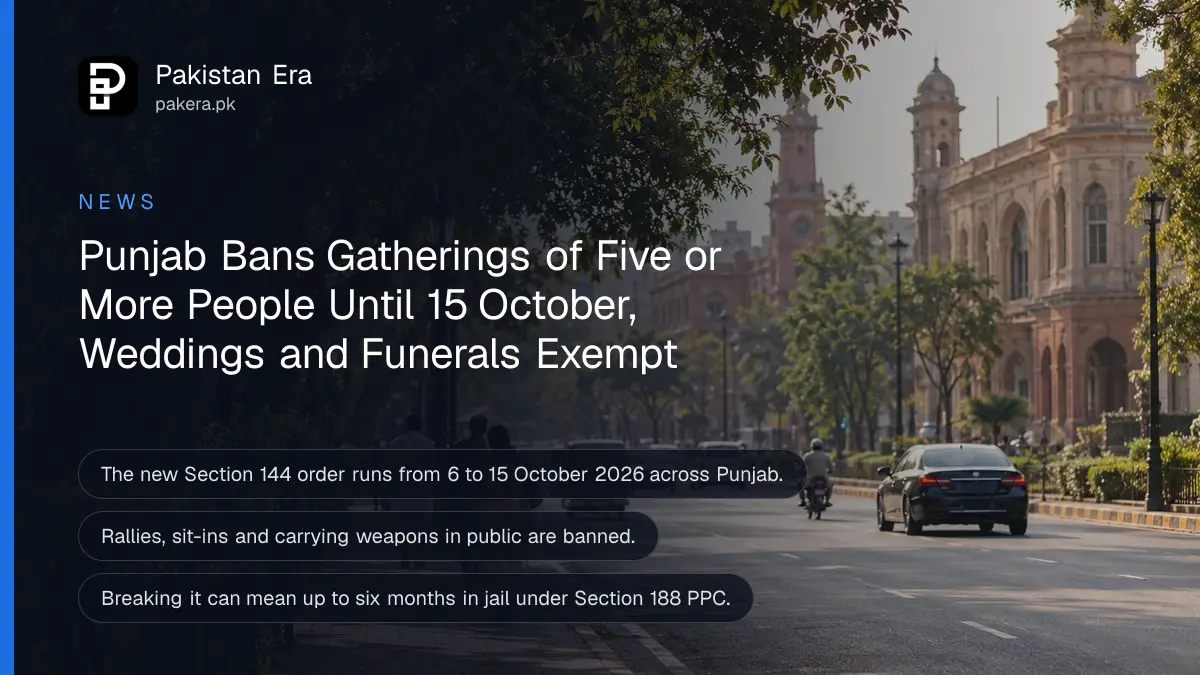
Punjab has extended its Section 144 ban on public gatherings until 15 October 2026. The new order runs from 6 to 15 October across the whole province. It bans gatherings of five or more people in public places and the public carrying of weapons. Weddings, funerals and mosques are exempt.
The Punjab Home Department issued the order on 6 October, the day after the previous ban ran out. It cites threats of terrorist activity reported by the police and intelligence agencies. So if you were planning a rally, a sit-in or a large public event anywhere in Punjab this week, it now needs formal permission or it breaks the law.
This is the second province-wide order in a row. The first ran from 23 September to 5 October 2026. The new one adds ten more days.
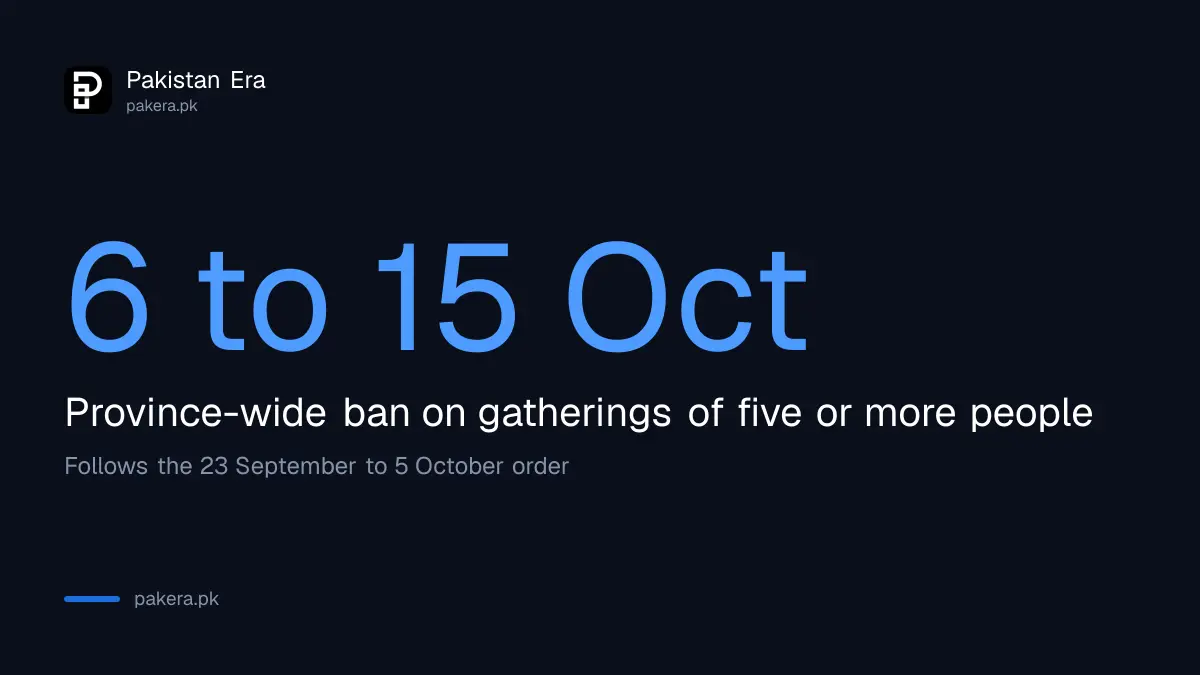
The ban now runs from 6 to 15 October 2026 across Punjab
The Section 144 order covers all of Punjab for ten days, from 6 October to 15 October 2026. It follows straight on from the earlier order that ended on 5 October, so in practice the ban has now run without a break since 23 September.
The order was issued by the Secretary of the Punjab Home Department under Section 144(6) of the Code of Criminal Procedure 1898. That sub-section is the one that lets a provincial government impose an order for longer than a district officer can.
Reports of the order do not list any district that is left out. Treat it as covering every district, from Rawalpindi and Attock in the north to Rahim Yar Khan in the south.
Gatherings of five or more people and public weapons are banned
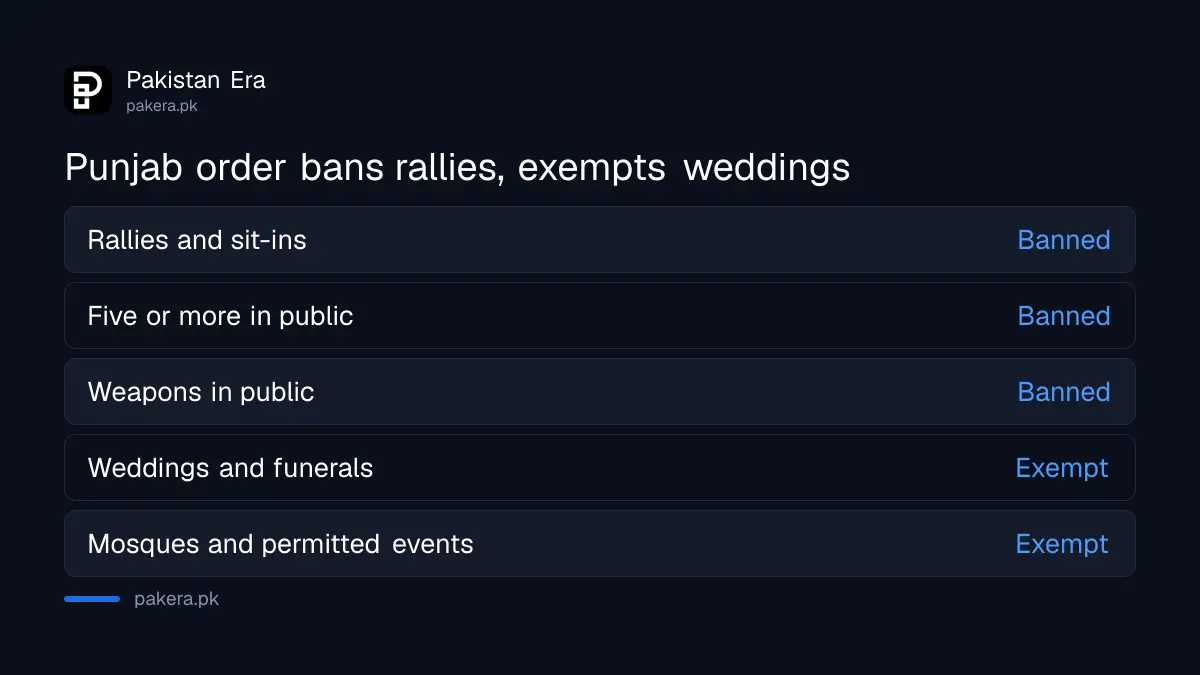
The order bans any gathering of five or more people at a public place, road, highway or open space. It also bans rallies, processions and sit-ins, carrying or showing weapons in public, and encouraging people to join an unlawful gathering.
Five people is a low number. A group of friends standing outside a shop is not the target, but a planned protest of a dozen people on a main road clearly is. Police decide on the spot, so the safe reading is that any organised public gathering needs permission.
The weapons ban, as reported, makes no exception for licence holders. The order does not say that a valid Punjab arms licence lets you carry a gun openly during these ten days, so do not assume it does.
Weddings, funerals, mosques and permitted events are exempt
The order does not apply to weddings, funeral prayers, burials, mosques and other places of worship. Courts, government offices and events held with formal permission from the administration are also outside it. Police and security staff on duty are exempt.
| Activity | Status from 6 to 15 October |
|---|---|
| Rally, procession or sit-in in a public place | Banned |
| Five or more people gathered on a road or open space | Banned |
| Carrying or showing weapons in public | Banned |
| Wedding ceremony | Exempt |
| Funeral prayer or burial | Exempt |
| Prayers at a mosque or other place of worship | Exempt |
| Court hearings and government offices | Exempt |
| Event with formal permission from the administration | Exempt |
A wedding hall is fine. A wedding procession that blocks a main road with fireworks is a grey area, and that is exactly where police use their judgement. If your event spills onto a public road, ask the Deputy Commissioner's office for written permission first.
Breaking the order is a crime under Section 188 PPC
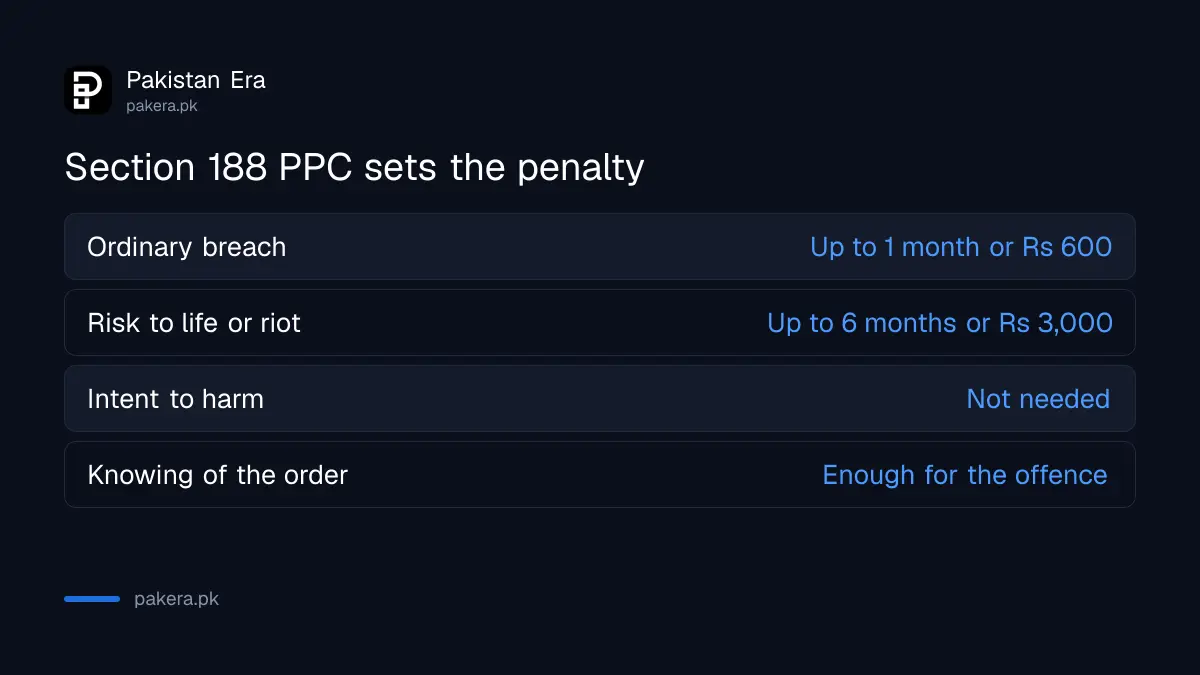
Disobeying a Section 144 order is an offence under Section 188 of the Pakistan Penal Code. The punishment is up to one month in jail or a fine of up to Rs 600, or both. Where the disobedience risks life, safety or a riot, it rises to six months or Rs 3,000.
We read Section 188 in the official text on the Pakistan Code website for our September coverage of these orders. It has an explanation that matters: the person does not need to intend harm. Knowing about the order and disobeying it is enough.
The fine looks small. The real cost is the First Information Report (FIR), the police case that starts a criminal record. If someone you know is booked, you can check the FIR online in most provinces.
The Home Department cites threats of terrorist attacks on gatherings
The Home Department says law enforcement and intelligence agencies reported serious threats to public peace and to people's lives and property. As reported, those threats include plans by terrorist groups to target public gatherings, which is why rallies and protests are singled out.
The earlier order of 23 September gave a similar reason. Punjab also asked for Rangers in Rawalpindi, Attock, Jhelum and Mianwali until 5 October, according to reports at the time. We have not seen a new Rangers request for this ten-day period.
Section 144 orders now cover large parts of the country at once. Our earlier report on Section 144 in Karachi, Balochistan and Islamabad lists each place, its end date and what it bans. Balochistan's 30-day order and Islamabad's two-month order were both still running when this extension came.
What to do if you have an event this week
Most people will notice nothing beyond extra police on main roads. If you are organising anything public, follow these steps:
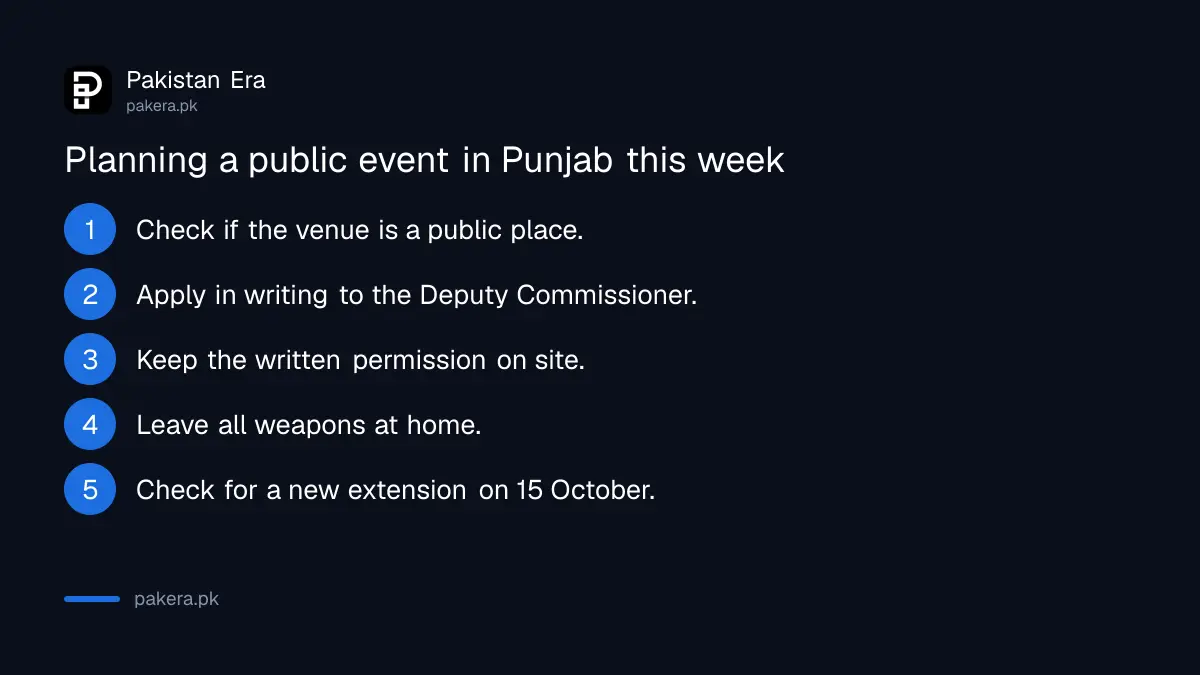
- Check whether your event is in a public place. A private hall, home or mosque is outside the order.
- If it is on a road, park or open ground, apply in writing to the Deputy Commissioner of your district for permission.
- Keep the written permission with the organiser on the day. Police at the site will ask for it.
- Do not bring weapons, licensed or not, to any public place until the order ends.
- Check for a further extension on 15 October before rescheduling anything for 16 October or later.
Many people will ask if schools or markets close. They do not. Section 144 here bans gatherings and weapons, not normal business. Swimming bans in rivers and canals used the same law in August, as our report on the Section 144 swimming bans shows, but that was a separate order.
Common questions
How long is Section 144 in force in Punjab?
Until 15 October 2026. The current order runs from 6 to 15 October and follows an earlier order that ran from 23 September to 5 October.
Are weddings allowed during Section 144 in Punjab?
Yes. Wedding ceremonies are exempt, along with funeral prayers, burials, mosques and other places of worship.
Can five friends sit together in a park?
Technically the order covers five or more people in a public place. Police usually act against organised gatherings, but a public meeting of five or more can be stopped.
What is the punishment for breaking Section 144?
Up to one month in jail or a Rs 600 fine, or both, under Section 188 PPC. Where there is a risk to life or of a riot, up to six months or Rs 3,000.
Can I carry my licensed weapon during Section 144?
Not safely. The order bans carrying and showing weapons in public places, and reports of it mention no exception for licence holders.
Will Section 144 be extended again after 15 October?
No decision has been announced. The order has already been extended once, so check on 15 October before planning any public event.
How we verified this
What we checked, where we read it, and what we could not confirm.
Last checked at about 01:45 PKT on 7 October 2026. The dates, bans, exemptions and reason come from reports of the Punjab Home Department order of 6 October 2026, including the state news agency's report. We could not read the order itself: the Home Department website, home.punjab.gov.pk, did not resolve when we tried it that night, and punjab.gov.pk did not carry the order. The Section 188 penalties come from the Pakistan Penal Code text on pakistancode.gov.pk, read for our September coverage. We will update this if the order is extended or lifted early.
About the author

Public Services and Education Journalist
Fajr Riaz is a journalist and content writer at Pakistan Era, based in Lahore. She covers the questions people meet in everyday life in Pakistan: how a public service works, what a change in the rules means, and where to find a reliable answer.