National Assembly Passes Archival Material and Abandoned Properties Amendment Bills on 19 October 2026, Moving Cabinet Powers to Named Officials
On 19 October 2026 the National Assembly passed the Archival Material and Abandoned Properties amendment bills. See what each changes and what happens next.
Short answer: The National Assembly passed two government bills on Monday, 19 October 2026: the Archival Material (Preservation and Export Control) (Amendment) Bill, 2026 and the Abandoned Properties (Management) (Amendment) Bill, 2026. Both move routine powers from the "Federal Government" to the Prime Minister, a ministry Secretary or the Division in charge. They now go to the Senate.
We checked the Assembly's list of government bills passed on 20 October 2026, which shows both bills under 19 October. We read the text of each bill "as passed by the National Assembly" and compared it with the current laws on Pakistan Code. The Minister-in-charge of the Cabinet Secretariat moved both, after the Standing Committee reported on them.
Neither bill changes what you can do with an old manuscript or a 1971 property. They change who decides.
Both bills move decisions from the cabinet to named officials
In both laws, the words "Federal Government" are replaced by "Prime Minister", the "Secretary of the Division concerned" or the "Division concerned". The Division concerned is defined as the Division to which the business of the Act is allocated under the government's rules.
That sounds technical, and it is. But it decides how quickly a file moves. Under the current wording, a decision given to the "Federal Government" has to go to the full cabinet. Under the new wording, the named official can sign it.
A 2016 Supreme Court ruling is the reason for the change
Both bills cite Mustafa Impex v Government of Pakistan, PLD 2016 SC 808. The Supreme Court held that decisions with policy, financial or administrative effect must be taken by the federal cabinet collectively, not by one office holder, unless a law authorises it.
The bills' statements say many laws still give small, procedural powers to the "Federal Government". So minor files keep going to the cabinet, which slows them down. The Cabinet Division, on the cabinet's direction, reviewed these laws and drafted amendments to give such powers to specific authorities by name.
The same idea runs through other bills this session. The Industrial Relations (Amendment) Bill, 2026, introduced the same day, swaps "Government" for "Division concerned" in about a dozen sections, citing a cabinet direction of 8 September 2017.
The archival law change gives disputes to a Secretary
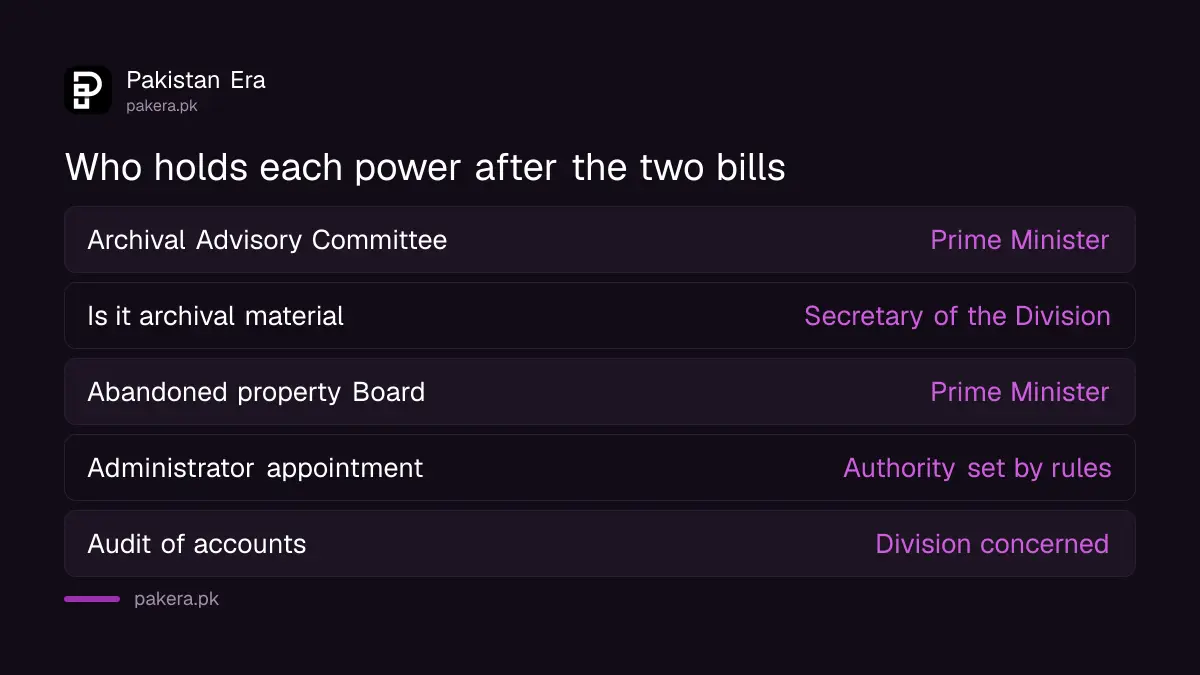
Under the Archival Material Act, 1975, the Federal Government decides whether a document counts as archival material, after asking an Advisory Committee. The bill gives that decision to the Secretary of the Division concerned, and lets the Prime Minister set up the committee.
Archival material in this law means a book, letter, file, newspaper or manuscript at least 25 years old with historical significance to Pakistan. Letters written by or to the Quaid-e-Azam or the All-India Muslim League are named in the Act.
| Archival Material Act, 1975 | Now | After the bill |
|---|---|---|
| Section 2(a): who sets up the Advisory Committee | Federal Government | Prime Minister |
| Section 3: who decides if a document is archival material | Federal Government | Secretary of the Division concerned |
| Section 5: export only under a Director's licence | Unchanged | Unchanged |
| Section 6: penalty for unlawful export | Up to 3 months or Rs 5,000, or both, plus customs confiscation | Unchanged |
The export rule stays as it is. Nobody may export archival material except under a licence from the Director of Archives, and only for temporary export for exhibition, study or preservation work.
The abandoned property law gives the Board to the Prime Minister
The Abandoned Properties (Management) Act, 1975 covers property left by people from former East Pakistan who stopped being Pakistani citizens on or after 16 December 1971. That property vests in the Federal Government and is run by a Board of Trustees and an Administrator.
The bill makes five changes, each one about who holds a power:
- Section 4(1): the Prime Minister, not the Federal Government, constitutes the Board of Trustees and fixes its size.
- Section 4(5): the Prime Minister appoints an acting Chairman when the post is vacant.
- Section 5(1): the Administrator and Deputy Administrators are appointed by an authority and in a manner set by rules, instead of by Federal Government notification.
- Section 19(3): the Division concerned arranges the audit of the Administrator's accounts, with the Auditor General.
- Section 25: the power to delegate stays, but the power to make rules under section 30 can no longer be delegated.
Two other bills on the day's agenda are not on the passed list
The Orders of the Day for 19 October also listed the Centres of Excellence (Amendment) Bill, 2026 and the Life Insurance (Nationalization) (Amendment) Bill, 2026 for passage. Neither appeared on the Assembly's passed bills list when we checked on 20 October 2026.
We could not confirm why. The Assembly had not posted the day's proceedings. A bill can be deferred, or passed and added to the list later, so treat both as pending until the Assembly publishes them.
Three new government bills were introduced at the same sitting. One raises the penalties in the Emigration (Amendment) Bill 2026. Another rewrites company meetings in the Companies (Amendment) Bill 2026. The third is the Industrial Relations bill.

The Senate must pass both bills before they become law
Both bills started in the National Assembly, so they now go to the Senate. If the Senate passes them unchanged, they go to the President, who has 10 days to assent. Each bill says it takes effect at once after it becomes an Act.
The full sequence, including what happens if the Senate does not act within 90 days, is in how a bill becomes law in Pakistan. Earlier this month the Assembly also approved the emergency in Khyber Pakhtunkhwa, explained in what Article 232 allows.
Common questions
Which bills did the National Assembly pass on 19 October 2026?
The Archival Material (Preservation and Export Control) (Amendment) Bill, 2026 and the Abandoned Properties (Management) (Amendment) Bill, 2026.
Are these bills law now?
No. They need Senate approval and the President's assent first.
Does the archival bill change export rules for old documents?
No. Export still needs a licence from the Director of Archives, and the penalty is unchanged.
What is abandoned property under the 1975 Act?
Property of people from former East Pakistan who stopped being Pakistani citizens on or after 16 December 1971.
Why do these bills replace "Federal Government"?
Because the Supreme Court held in 2016 that "Federal Government" means the cabinet acting together, which sends minor files to the full cabinet.
How we verified this
What we checked, where we read it, and what we could not confirm.
Last checked 20 October 2026. We read the National Assembly's list of government bills passed, the Orders of the Day for 19 October 2026, and both bills as passed. We compared them with the Archival Material Act, 1975 and the Abandoned Properties (Management) Act, 1975 on Pakistan Code. We could not confirm the vote count, any amendments moved on the floor, or what happened to the two other bills listed that day.
About the author

Global Affairs & Political Economy Writer
Muhammad Hatim is a book lover who started writing because he enjoys it. At Pakistan Era he writes about international relations, geopolitics and the global economy, with a particular interest in South Asia and the forces behind current events.