Companies Amendment Bill 2026 Tabled in Pakistan: Online AGMs, No Memorandum and Fewer Meetings for Private Firms
The Companies (Amendment) Bill 2026, tabled on 19 October, allows online AGMs, drops the memorandum and lets some private firms skip meetings. See what changes.
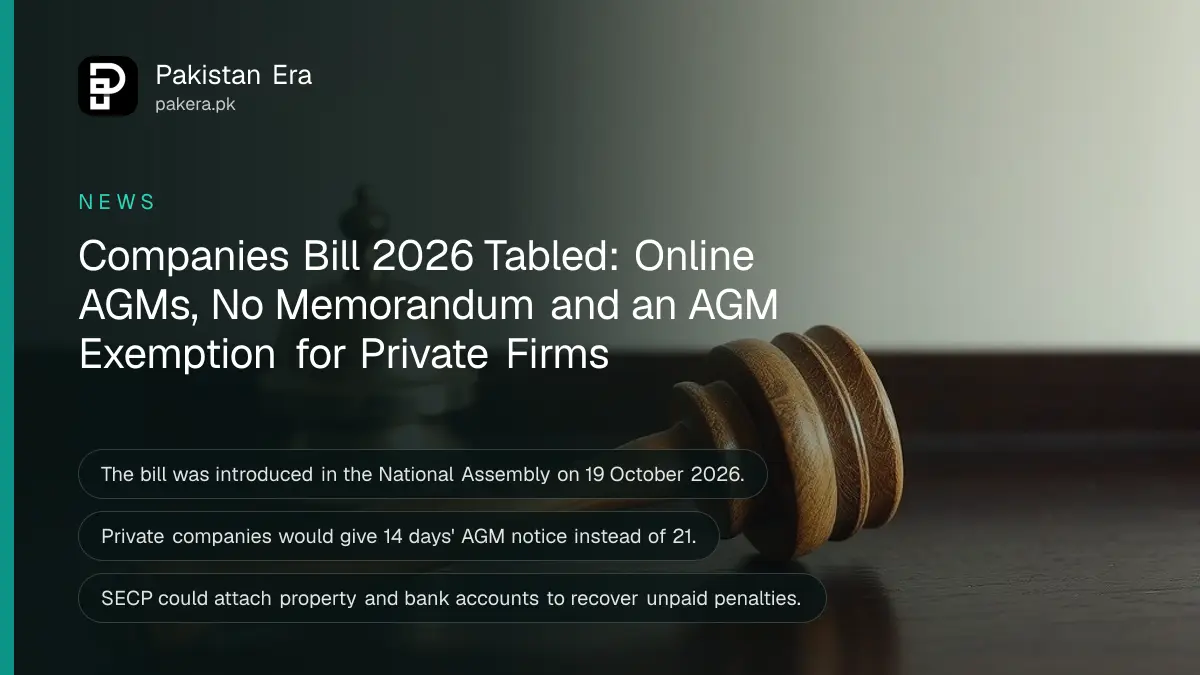
Short answer: Finance Minister Muhammad Aurangzeb tabled the Companies (Amendment) Bill, 2026 in the National Assembly on 19 October 2026. It would let companies hold general meetings online, drop the memorandum of association, and let many small private companies skip the annual general meeting. It is not law yet.
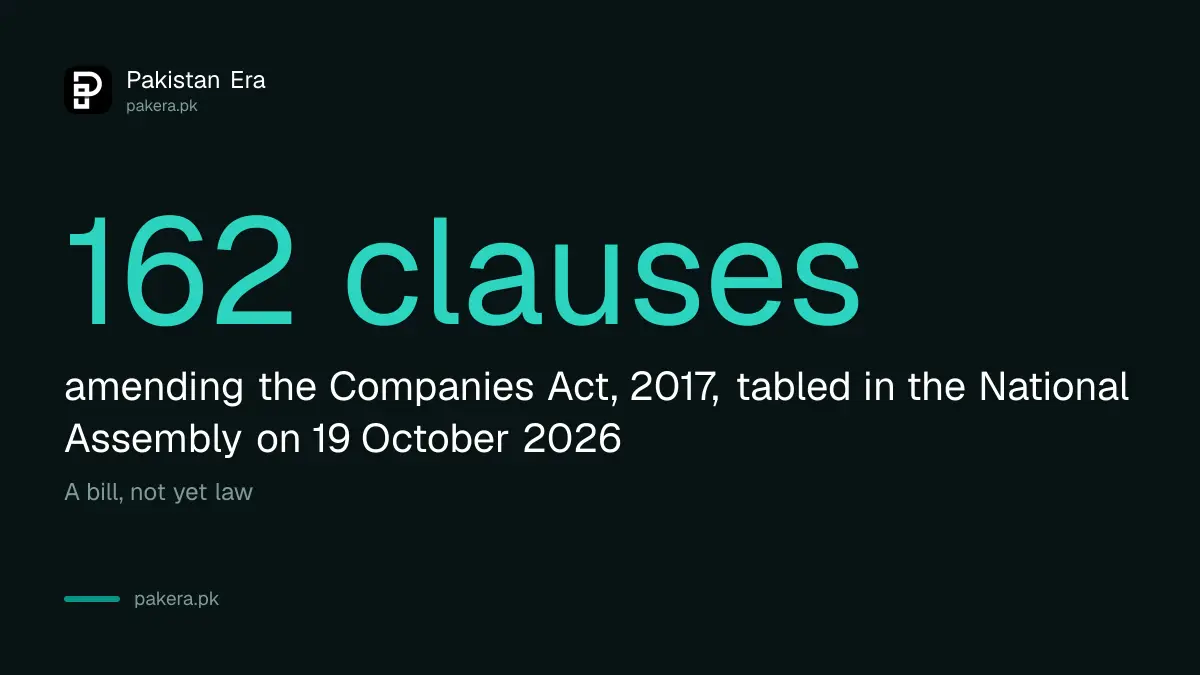
The bill has 162 clauses and rewrites large parts of the Companies Act, 2017. We read the full text as introduced, published on the National Assembly website, on 20 October 2026. Its statement of objects says the changes came from a sub-committee of the Cabinet Committee on Regulatory Reforms, with the SECP, the State Bank, the FBR, the Board of Investment and the Overseas Investors Chamber on it.
If you run a private limited company or a single member company, four of the changes would touch your yearly paperwork directly.
The bill drops the memorandum and keeps only the articles
Every company in Pakistan now has two founding documents, a memorandum and articles of association. The bill removes the memorandum. It deletes the word throughout the Act and makes the articles the single document, including for subscribers, members and changes to objects.
Sections 31 to 34 of the Act are omitted, and section 9 goes too. A new definition says a member is anyone who subscribes to the articles, holds shares, or, for a company with shares in the central depository, appears in its record. A new term, "book-entry form", covers shares held and moved electronically.
For founders, this means one document to draft and file instead of two. The bill does not say what happens to memoranda already on file. The SECP would likely set that out later, and we could not confirm it from the bill.
General meetings could be held online, in a hall or both
A new section 134(1) lets a company hold a general meeting at a physical venue, by electronic means the SECP specifies, or both at once. For listed companies, every meeting notice must tell members they can attend by video link and explain how.
The bill also lets notices of the annual general meeting go out "through electronic means as may be specified". A special resolution can now be passed by members voting in person, by proxy or through postal ballot.
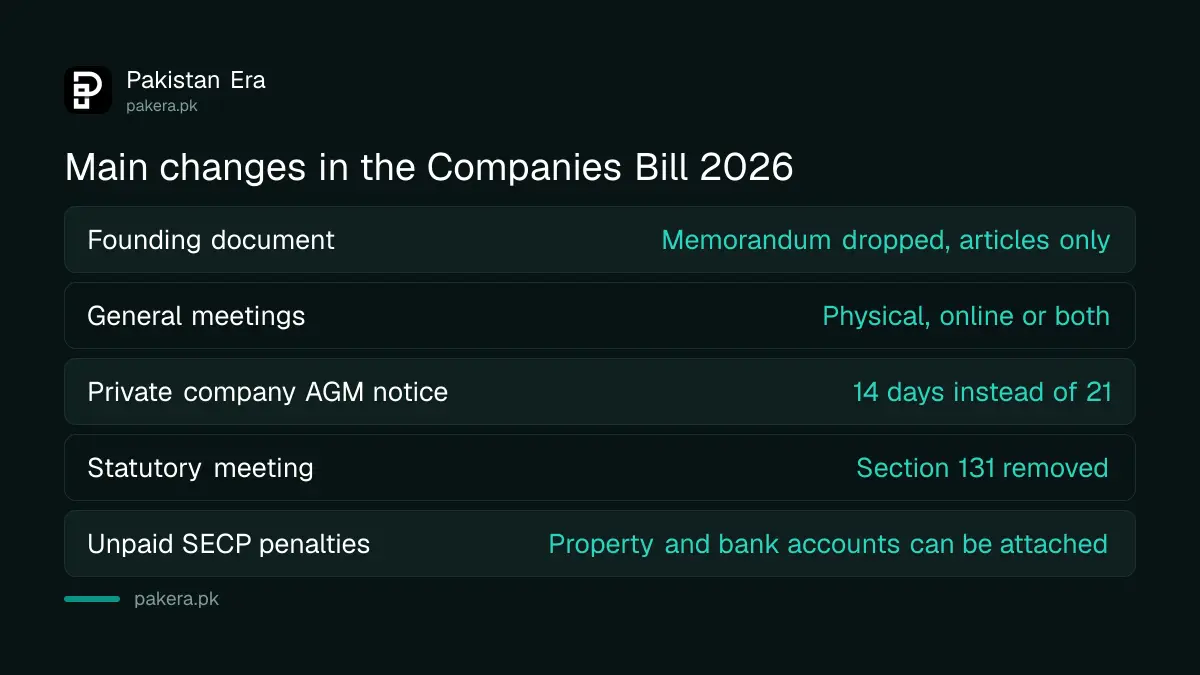
| Change | Section | What the bill says |
|---|---|---|
| Founding document | 2, 31 to 34 | Memorandum dropped, articles only |
| Meeting format | 134(1) | Physical, electronic or both |
| AGM notice | 132(3) | 14 days for private companies, 21 days for others |
| Board's time to act on a members' requisition | 133(5) | Cut from 21 days to 14 days |
| Skipping the AGM | 132(4), new 133A | Allowed for some private companies |
| Statutory meeting | 131 | Section omitted |
| Annual return | 130 | Online only, from a date SECP notifies |
| Penalty recovery | 485 | SECP can attach property and bank accounts |
Some private companies could skip the AGM with 30 days' notice
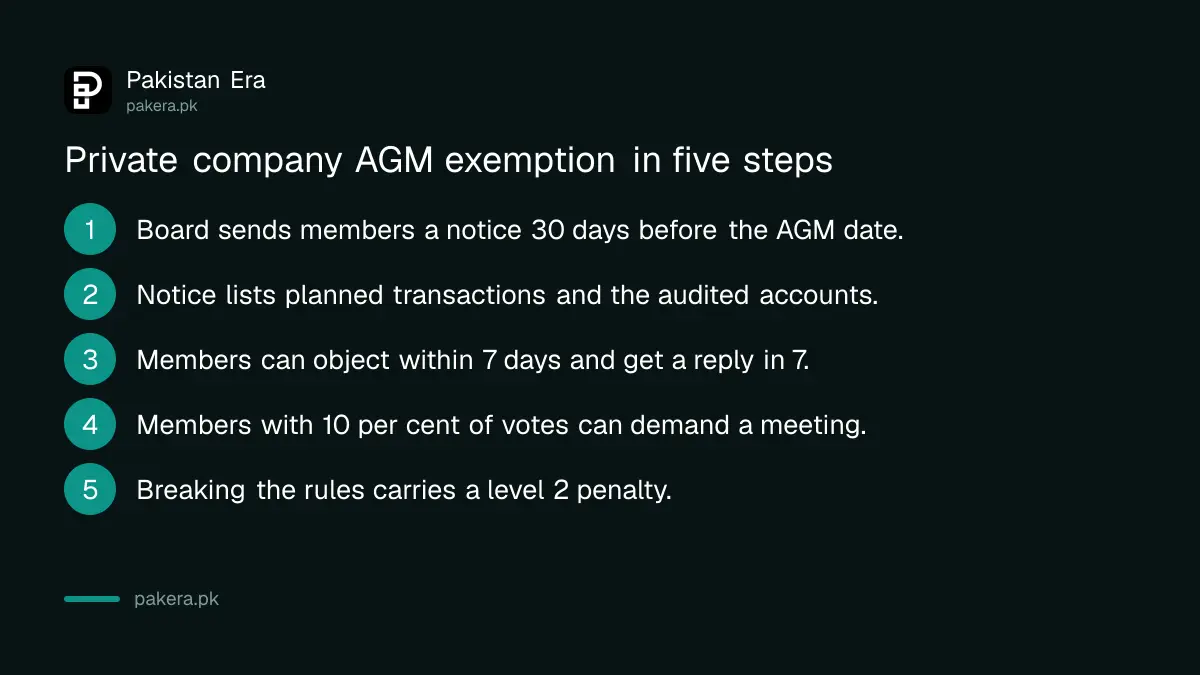
A single member company or private company could skip its annual or extraordinary general meeting if its board directly holds at least three quarters of the voting rights. Public interest companies and subsidiaries of listed companies are left out of this relief.
Single member companies are already outside the AGM section today. The bill extends the relief to qualifying private companies and puts both under a new section 133A. Skipping the meeting does not mean skipping the members.
- At least 30 days before the meeting would have been due, the board sends every member a notice saying it is using the exemption.
- The notice lists the transactions the board plans to approve, and includes the annual accounts with the auditor's report.
- Any member can object or ask for information in writing within 7 days. The company must reply within 7 days.
- Members holding at least 10 per cent of the votes can demand a real meeting, and the board must hold it before the AGM date.
- Breaking these rules is an offence with a level 2 penalty on the standard scale.
The notice and replies can go by email or other electronic means once the SECP specifies them. For this year's meeting, the current law still applies, and our page on the 28 October 2026 AGM deadline for June year end companies explains it.
Notice periods get shorter and the statutory meeting goes
AGM notice is 21 days for every company today. The bill sets 14 days for private companies and keeps 21 for others. It also removes section 131, the statutory meeting a new public company must hold within 180 days of being entitled to start business.
When members requisition an extraordinary meeting, the board now has 21 days to act before the members can call it themselves. The bill cuts that to 14 days. Where three quarters of the members entitled to vote agree, an extraordinary meeting can be held at shorter notice. The SECP can also notify a shorter AGM notice period for any class of companies. Listed companies must still publish AGM notices in one English and one Urdu daily newspaper with national circulation.
The bill also lets the SECP require every company to file its annual return only through its e-services, from a date it notifies. If you have not used the portal yet, the steps for a company application filed online with SECP show how it works.
SECP gets new powers to recover unpaid penalties
New section 485 lets the SECP serve a notice for any unpaid penalty. If it is not paid in time, the SECP can attach or sell property, including a bank account, appoint a receiver, or order people who owe the company money to pay it.
Anyone who receives such a notice, including a bank, and fails to deduct and pay can be treated as a defaulter. The SECP would have the powers of a civil court for this recovery. That is a sharper tool than most small company owners are used to, so late filing penalties would become harder to ignore.
Other clauses remove Part XI on winding up unregistered companies and add a duty on the SECP to review and remove outdated rules. Recent registration numbers are in SECP's September 2026 company figures.
The bill is at the first stage and is not law yet
Introduction on 19 October is only the first step. The bill goes to a National Assembly committee, then a vote, then the Senate and the President. It says it takes effect at once after it becomes an Act, so dates would move quickly once passed.
Until then, keep following the current Companies Act, 2017. The full route is set out in how a bill becomes law in Pakistan.
Common questions
Can a company in Pakistan hold its AGM online now?
The bill would let any company hold a general meeting electronically or in hybrid form. It is not yet law.
Will private companies still need a memorandum of association?
Not if the bill passes. It removes the memorandum and keeps the articles of association as the single founding document.
Which companies could skip the AGM?
Single member and private companies whose board directly holds at least three quarters of the votes, if they are not public interest companies or listed subsidiaries.
What notice must a private company give for its AGM under the bill?
At least 14 days. Other companies would keep 21 days.
Who introduced the Companies Amendment Bill 2026?
Senator Muhammad Aurangzeb, Minister for Finance and Revenue, in the National Assembly on 19 October 2026.
How we verified this
What we checked, where we read it, and what we could not confirm.
Last checked 20 October 2026. We read the bill as introduced, listed on the National Assembly's government bills page under Monday, 19 October 2026, and item 4 of that day's Orders of the Day. We read the current Companies Act, 2017 on Pakistan Code for the sections being changed. We could not confirm which committee received the bill, what happens to memoranda already filed, or when the SECP would issue rules on electronic meetings.
About the author

Global Affairs & Political Economy Writer
Muhammad Hatim is a book lover who started writing because he enjoys it. At Pakistan Era he writes about international relations, geopolitics and the global economy, with a particular interest in South Asia and the forces behind current events.