Electricity Load by Plot Size in a Pakistani Housing Scheme: 3.15 kW to 17.74 kW
NEPRA assumes 3.15 kW to 17.74 kW of electric load for a plot in a housing scheme. See the table by plot size, shop rates and what it means for your deposit.
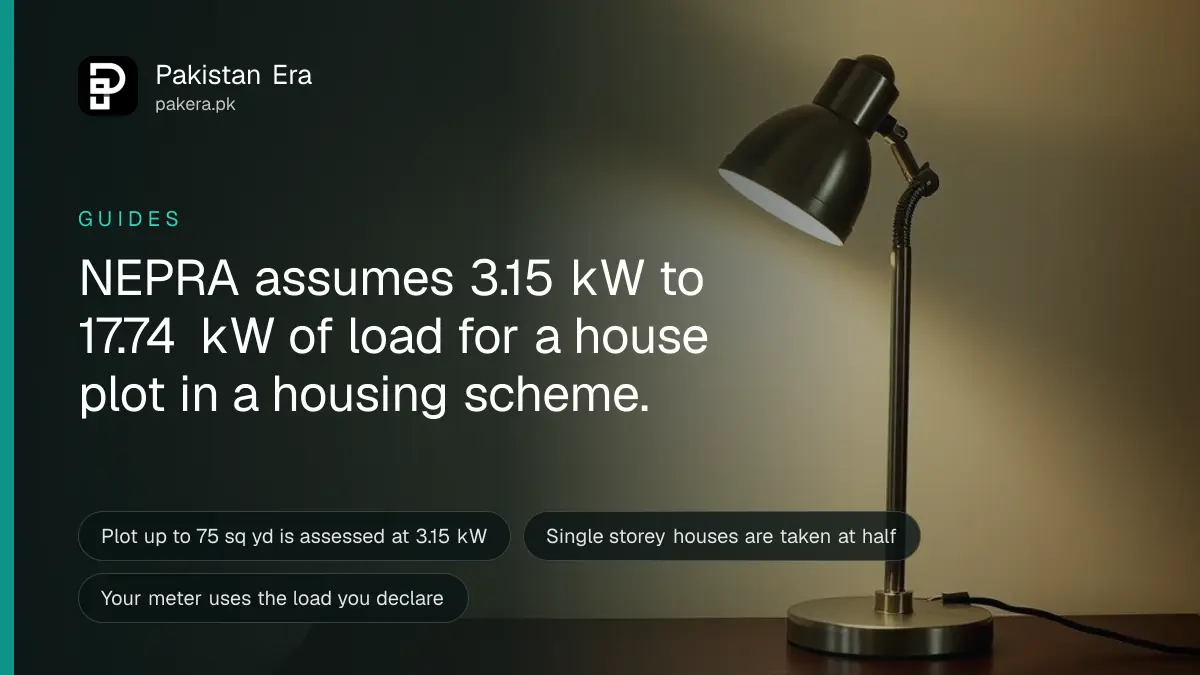
When a housing scheme in Pakistan is electrified, NEPRA's rulebook assumes a fixed load for each plot: 3.15 kW for a plot up to 75 square yards, rising to 17.74 kW for a plot of 600 to 1,000 square yards. These figures plan the network. Your own meter is sanctioned on the load you declare and your wiring test report supports.
A buyer in a new society often hears "your plot has 7 kW" and does not know where that came from. The number comes from Annexure VI of NEPRA's Consumer Service Manual, the rulebook the electricity companies follow. We read it and set it out below, with the one rule that stops it from being misused.
The company plans a scheme with a standard load per plot
Clause 2.11.2 of the manual says that for housing schemes, societies, colonies, high rise buildings and commercial plazas, the ultimate load for electrification is assessed as per Annexure VI. It is a planning figure. It tells the company how big the transformers and cables must be.
The clause then adds the key point. When individual connections are given, the load declared in the application form counts as the connected load. It must be backed by a test report from the Electric Inspector or his authorised wiring contractor, and the company verifies it.
So Annexure VI sizes the network, and your own paperwork sizes your meter. A developer cannot force the Annexure VI figure onto your connection.
Plot size sets the assumed load for a house
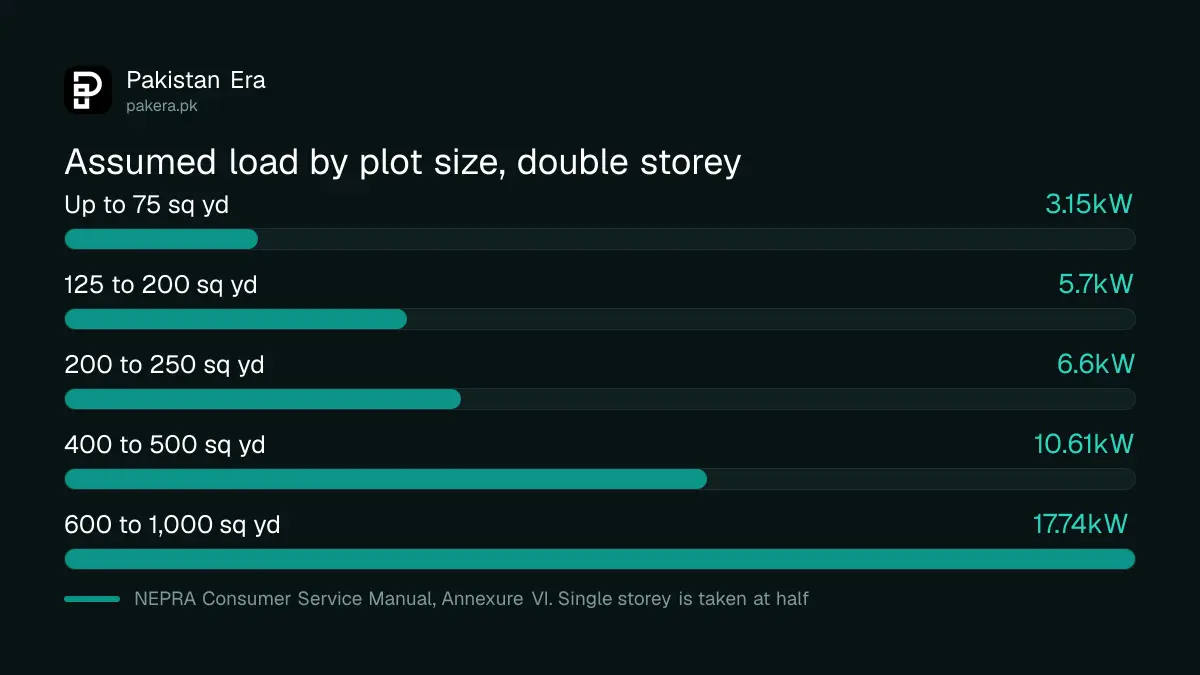
For individual houses in housing schemes, the manual gives ten bands of plot size in square yards. The figures are for a double storey house, ground plus one. For a single storey house, the load is taken as half.
| Plot size (square yards) | Assumed load, double storey |
|---|---|
| Up to 75 | 3.15 kW |
| Above 75 up to 125 | 5.0 kW |
| Above 125 up to 200 | 5.70 kW |
| Above 200 up to 250 | 6.60 kW |
| Above 250 up to 300 | 7.45 kW |
| Above 300 up to 350 | 8.75 kW |
| Above 350 up to 400 | 9.5 kW |
| Above 400 up to 500 | 10.61 kW |
| Above 500 up to 600 | 13 kW |
| Above 600 up to 1,000 | 17.74 kW |
A plot of about 9 marla is near 227 square yards. A double storey house there is assessed at 6.60 kW. A single storey house on the same plot is assessed at half, 3.30 kW. The band figures are the manual's. The marla conversion is our rough guide.
Shops, offices and halls are assessed by floor area
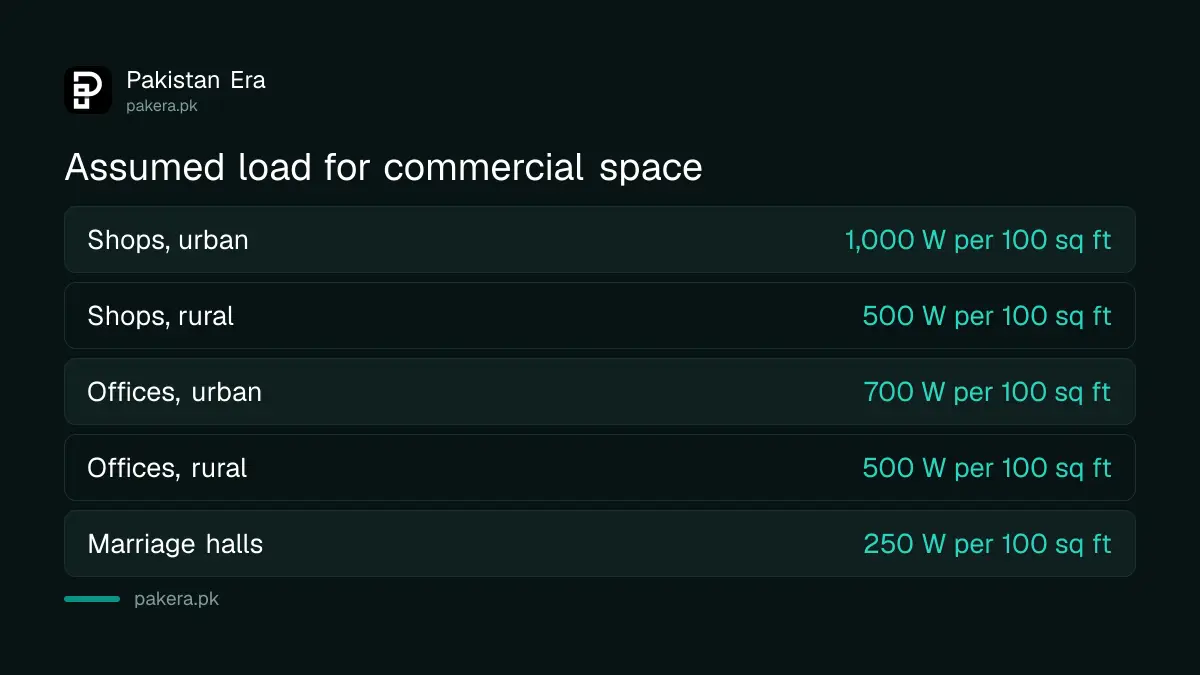
Commercial buildings use watts per 100 square feet of covered area, not plot size. The manual gives one figure for urban and upper areas and a lower one for rural and lower areas. Air conditioning load is included in the figure for shops, clinics and offices.
| Type of space | Urban or upper areas | Rural or lower areas |
|---|---|---|
| Shops and clinics | 1,000 W per 100 sq ft | 500 W per 100 sq ft |
| Offices | 700 W per 100 sq ft | 500 W per 100 sq ft |
| Marriage halls | 250 W per 100 sq ft | 250 W per 100 sq ft |
Take a clinic of 400 square feet in a city. That is four blocks of 100 square feet at 1,000 W each, so 4,000 W or 4 kW. This is our arithmetic from the table, not a figure printed in the manual.
For apartments, the manual also assesses load by flat size, with extra load for flats that have air conditioners. A flat of up to 700 square feet in an urban area is assessed at 125 W per 100 square feet, plus an assumption that half the flats have one 1.5 kW AC. A note says AC load is not added for buildings that are centrally air conditioned with no individual units.
What the load figure does to your deposit
Your sanctioned load sets your security deposit. For an urban home the rate is Rs 1,220 a kW. The manual rounds half a kW or more up to a full kW, and ignores a smaller fraction.
If you accepted 6.60 kW for a 227 square yard double storey house, that rounds to 7 kW. At Rs 1,220 a kW, the deposit would be Rs 8,540. If you declare 5 kW with a test report, it would be Rs 6,100. Those are our sums at the current urban rate. Ask the sub division for the exact demand notice.
A lower declared load saves deposit money, but a load you exceed brings a notice on your bill. See how that works in our guide to raising your sanctioned load, and how to go the other way in lowering it and recovering the deposit difference.
Check these four things before you pay a demand notice
- Ask whether the load on the notice is your declared load or the scheme's assumed load.
- Ask for the wiring test report to be accepted for your declared figure.
- Work out the deposit as kilowatts, rounded, times the rate for your category.
- Keep the notice, the receipt and the contract. The company must give you a copy of the full application set.
The manual says a complete copy of the filled and signed application set, parts one to four, goes to the consumer. A complaint can be lodged if you are not given it. Our guide to the documents and demand notice for a new electricity connection covers the rest of the process.
Common questions
How many kW does a 9 marla house get in a housing scheme?
A plot of about 227 square yards (9 marla) is assessed at 6.60 kW if the house is double storey. A single storey house is assessed at half. Your own meter is sanctioned on your declared load.
Does a developer decide my electricity load?
No. For individual connections the manual says the load declared in your application counts, subject to a test report and company verification. The scheme figure is only for planning the network.
Is the load for a single storey house lower?
Yes. The manual says the plot size figures are for double storey houses and that a single storey house is taken as half.
How is a shop's load worked out?
By covered area. In urban areas it is 1,000 W per 100 square feet for shops and clinics, with air conditioning included.
What deposit do I pay per kW?
Annexure IV lists Rs 1,220 a kW for an urban home and Rs 610 a kW for a rural one. These are the rates in the manual as of November 2025.
Does the same table apply to a house outside a society?
The table is written for housing schemes and buildings. For an ordinary house, you declare your load and support it with a test report.
How we verified this
What we checked, where we read it, and what we could not confirm.
Last checked 11 October 2026. We read clause 2.11 and Annexures IV and VI of NEPRA's Consumer Service Manual, as on 26 November 2025, in a copy published by a distribution company. The Annexure VI tables were read from machine extracted text, so we left out the farm house rule and the full apartment grid, where the columns were unclear. All sums are our own arithmetic. Check your demand notice and nepra.org.pk before you pay.
About the author

Global Affairs & Political Economy Writer
Muhammad Hatim is a book lover who started writing because he enjoys it. At Pakistan Era he writes about international relations, geopolitics and the global economy, with a particular interest in South Asia and the forces behind current events.