New Electricity Connection in Pakistan: Documents Needed and Demand Notice Rules
NEPRA's rulebook lists the papers for a new electricity connection and how to pay the demand notice: 30 days, instalments, no mark-up. See the full checklist.
For a new electricity connection in Pakistan, NEPRA's rulebook asks for proof of ownership, a Rs 50 stamp paper affidavit, CNIC copies of you and one witness, and a wiring test report. The company then issues a demand notice. You have 30 days to pay it, and 30 more on request.
Many applications stall at the counter because one paper is missing. Others stall later, when a demand notice arrives and nobody knows what is fair to pay. The rulebook answers both questions, and it applies to every distribution company in the country.
We read NEPRA's revised Consumer Service Manual on 7 October 2026, chapter 2 on new connections and the annexes on time frames and security deposits. This guide covers the papers and the payment. The online steps are in the guide to applying for a new electricity connection.
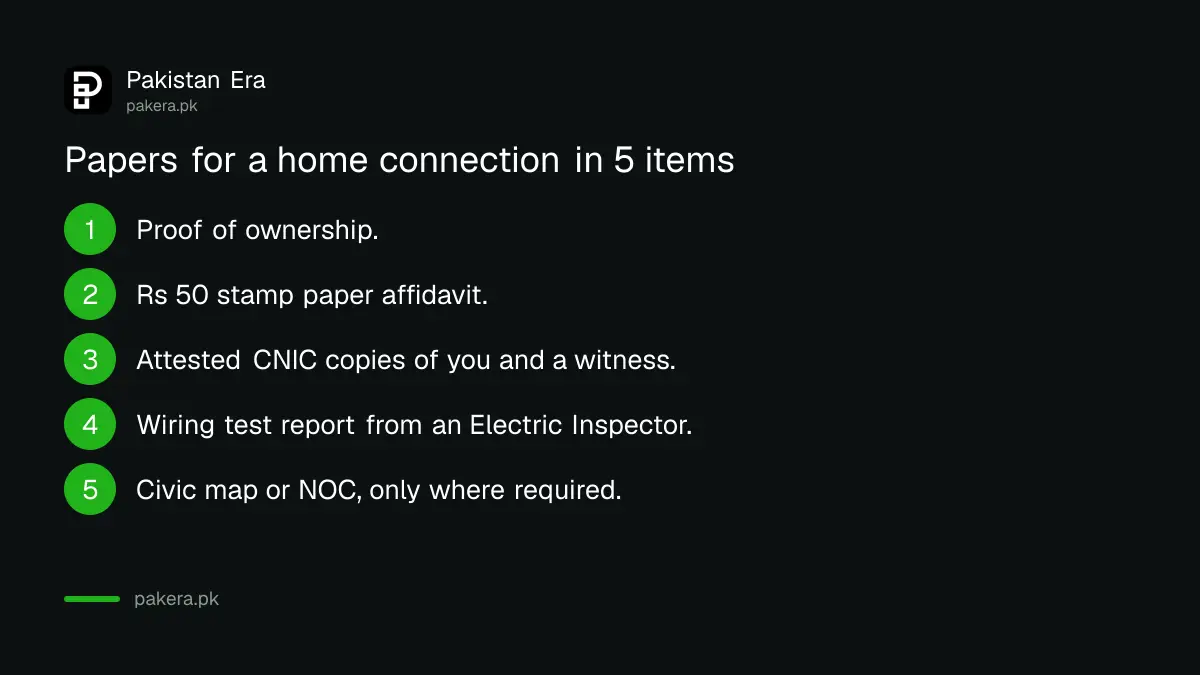
The manual lists five papers for a home connection
Clause 2.3 of the manual says what must go with the application form. For an ordinary home, the list is short, and every item is checked before the demand notice is issued.
- Proof of ownership. The company decides what counts, such as a registry, a fard or an allotment letter. The manual adds that getting a connection is not proof that you own the premises.
- An affidavit on Rs 50 stamp paper. The owner states that no connection existed before and that he or she will pay any old dues found later. It also says the applicant is not a defaulter with any electricity company.
- Attested CNIC copies. One for the applicant and one for a witness. A tenant also needs the owner's CNIC copy.
- A wiring test report. It comes from the Electric Inspector or a wiring contractor he has authorised, as clause 3.7 says.
- A civic map or NOC, in some cases. This one has many exceptions, covered below.
A company applicant adds a certificate of incorporation, a board resolution authorising a signatory, and a list of directors with their CNIC copies.
A tenant needs the owner's permission in writing
If you rent the property, you need a No Objection Certificate from the owner, plus the ownership proof and the affidavit above. The owner also signs a Rs 50 stamp paper saying he or she will pay any default by the tenant.
That has a cost for the landlord. The manual says the connection can be disconnected at the owner's request if the tenant defaults on electricity bills for three months in a row. Tell your landlord this early, because it explains why some refuse. The steps for moving an existing meter into your name are in the guide to changing the name on an electricity bill.
You often do not need a civic map or NOC
The manual requires an approved map, site plan, layout plan or a civic agency NOC for a new connection. But it lists many exceptions. Houses inside an approved housing scheme or society do not need one. Neither do old colonies and abadis on inherited land, rural houses where such maps do not exist, and areas where the civic agency has not acquired or developed the land.
A second connection at the same premises, a change of name, a change of tariff and an extension or reduction of load never need one. High rise buildings inside a society are the exception to the exception, and they still need a map or NOC.
If the counter asks for a paper the manual does not list, ask the officer to name the clause. Then complain through the route in the guide to NEPRA complaints.
The demand notice is the only bill for the connection
After the survey, the company issues demand notices for the connection charges and the security deposit together. You can collect them in person, receive them by post, courier or email, or download them from the company website with your tracking ID.
Pay online or at the bank named on the notice. Keep the receipt. The company fixes your final queue number only after the notice is paid.
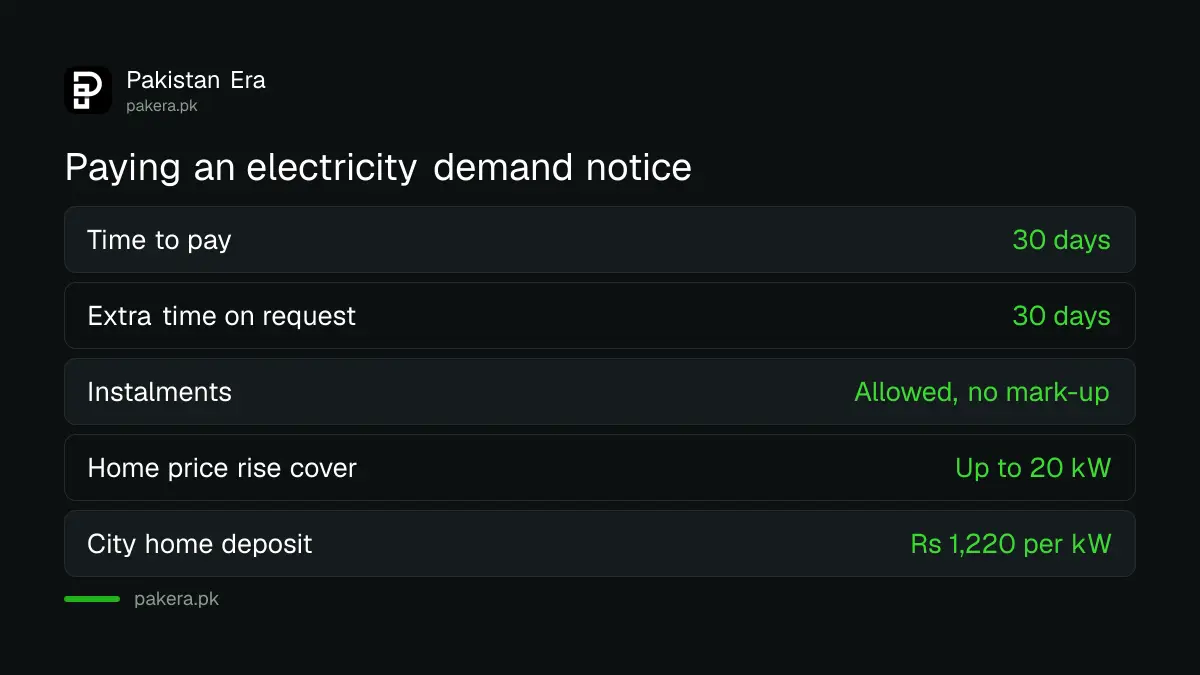
| Demand notice rule | What the manual says |
|---|---|
| Time to pay | 30 days |
| Extra time | 30 days on request, made at least 3 days before the due date |
| Instalments | Allowed on request, with no mark-up |
| Cost of material | Actual cost plus 12 percent store handling |
| Installation charge | 8 percent of the material cost |
| Price rise protection | None charged to homes up to 20 kW or shops up to 15 kW |
For work where you pay the full cost, the company must give you the estimate and bill of quantities with the notice. It may not issue a demand notice without details. If you pay in instalments and material prices rise in the meantime, you carry that rise, so paying in full is cheaper when you can.
The security deposit is set per kilowatt
Annexure IV sets the deposit. A city home pays Rs 1,220 for each kilowatt of sanctioned load, and a rural home pays Rs 610. A 5 kW house in a city therefore pays Rs 6,100 as the deposit, on top of the connection charges. A fraction of half a kilowatt or more counts as a full kilowatt.
The deposit is not a fee. It is returned when the connection is closed, as explained in the guide to getting your electricity security deposit back.
The connection charge itself depends on the poles, wire and meter your site needs, so we cannot give one number. The Power Information Technology Company runs a new connection cost estimator, and SEPCO's website links to it. It loads inside a frame that we could not read, so check the estimate against your own notice.
The company must say no in writing, within the same time
If the company decides it cannot give you a connection, it must return your form and papers and state the reason, within the same time it would have taken to issue a demand notice. For a home of up to 15 kW, that stage takes 10 days.
The whole process for such a home is set at 30 days: 4 for registration and survey, 6 for the notice, 11 to execute the work and 9 to fit the meter. Delays carry daily compensation, which is listed in the report on NEPRA's new service deadlines.
Common questions
What documents do I need for a new electricity connection in Pakistan?
Ownership proof, a Rs 50 stamp paper affidavit, attested CNIC copies of you and a witness, and a wiring test report. A map or NOC is needed in some areas only.
Can a tenant get an electricity connection?
Yes, with the owner's No Objection Certificate, the ownership proof and a stamp paper undertaking from the owner. The owner can ask for disconnection if the tenant misses three bills in a row.
How long do I have to pay the demand notice?
30 days. You can ask for 30 more days if you apply at least 3 days before the due date.
Can I pay a demand notice in instalments?
Yes, on request, and the company cannot add mark-up. Any rise in material cost during that time is yours to pay.
How much is the security deposit for a house?
Rs 1,220 per kW in a city and Rs 610 per kW in a rural area, according to Annexure IV.
Do I need a civic NOC for a house inside a housing society?
No. Houses inside approved societies are exempt, though high rise buildings inside them are not.
How we verified this
What we checked, where we read it, and what we could not confirm.
Last checked on 7 October 2026. We read NEPRA's revised Consumer Service Manual, issued to all distribution companies on 26 November 2025, as published on GEPCO's website: clauses 2.2 to 2.5, 2.10, 3.7 and Annexures III and IV. We also read the home pages of LESCO and SEPCO. Companies add their own forms, and some, such as IESCO, now take new connections through their own apps. The actual connection charge is not published in one table, so we give none. We did not apply for a connection ourselves.
About the author

Senior Writer, Public Services and Technology
Shahid joined us in 2024 as an author. He is a senior contributor to Pakistan's leading technology websites. He writes detailed articles, mostly covering his expertise in the latest tech, mobiles, apps, gadgets, and step-by-step guides. His ideology is to help people understand the latest trends and explain complex methods through very easy-to-understand guides.