Federal Cabinet Size Limit in Pakistan: 47 Ministers at Most Under Article 92, Plus Up to 7 Advisers
Pakistan's federal cabinet can have at most 47 ministers, 11 per cent of Parliament's 432 seats, plus up to 7 Advisers. Who counts, and the cap on senators.
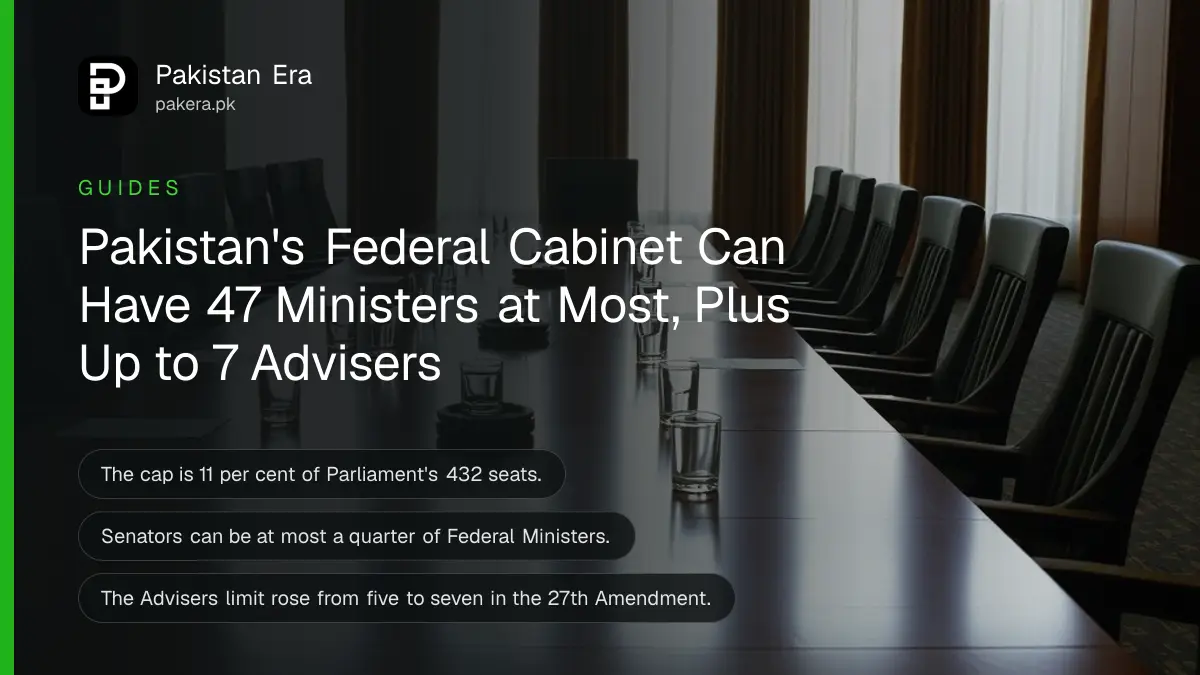
Pakistan's federal cabinet, counting Federal Ministers and Ministers of State, can have at most 47 members. Article 92 caps it at 11 per cent of Parliament's 432 seats. Senators can be no more than a quarter of Federal Ministers. Separately, the Prime Minister can have up to seven Advisers, a limit raised from five by the Twenty-seventh Amendment.
These numbers come straight from the Constitution. Special Assistants to the Prime Minister sit outside both limits: the Rules of Business allow them without naming a number. Here is who counts, who does not, and the rules each office follows.
The 11 per cent cap works out to 47
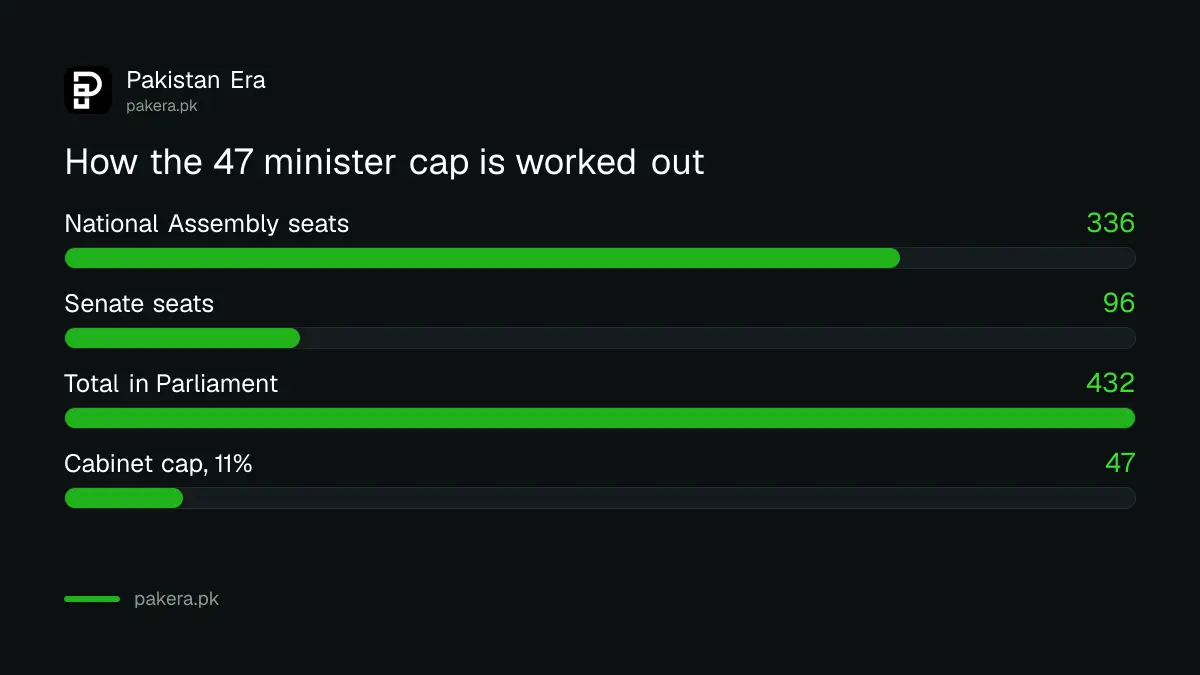
Article 92 says the total strength of the cabinet, including Ministers of State, must not exceed 11 per cent of the total membership of Parliament. Parliament has 336 National Assembly seats and 96 Senate seats, 432 in all. Eleven per cent of 432 is 47.52, so the ceiling is 47.
| Figure | Number | Where it comes from |
|---|---|---|
| National Assembly seats | 336 | Article 51 |
| Senate seats | 96 | Article 59 |
| Total membership of Parliament | 432 | 336 plus 96 |
| 11 per cent cap | 47.52, so at most 47 | Article 92(1) |
| Advisers, separate limit | 7 | Article 93 |
The 47 figure is our arithmetic from the seat numbers. Because the cap says "shall not exceed", a 48th member would go over 11 per cent, so 47 is the most allowed.
Who counts toward the cap and who does not
Federal Ministers and Ministers of State count toward the 47. Advisers have their own limit of seven under Article 93. Special Assistants to the Prime Minister are not covered by either number; Rule 4(6) of the Rules of Business allows them with whatever status the Prime Minister decides.
| Office | Counts in the 47? | Limit | Must be in Parliament? |
|---|---|---|---|
| Federal Minister | Yes | Within 47; senators at most one-fourth | Yes, appointed from members |
| Minister of State | Yes | Within 47 | Yes, appointed from members |
| Adviser to the Prime Minister | No | Up to 7 | No |
| Special Assistant to the Prime Minister | No | No number in the rules | No |
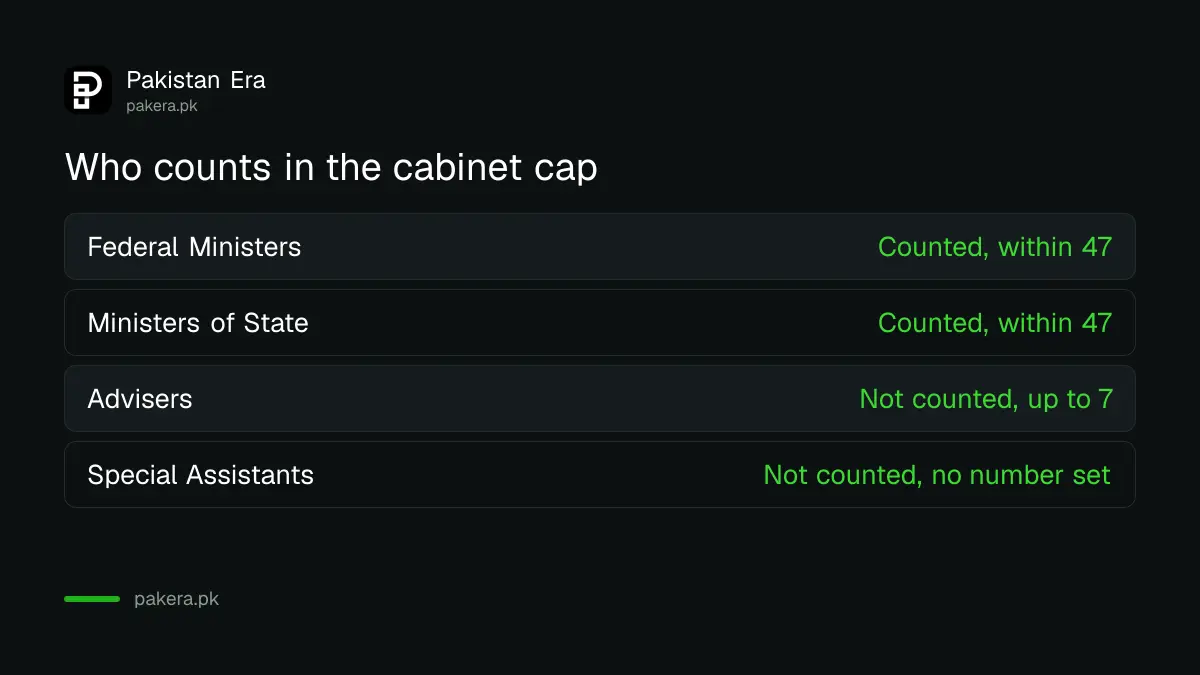
Article 92 says the President appoints Federal Ministers and Ministers of State "from amongst the members of Majlis-e-Shoora (Parliament)". Advisers and Special Assistants have no such condition in the text.
Senators can be at most a quarter of Federal Ministers
The first proviso of Article 92(1) says Federal Ministers and Ministers of State who are senators must not exceed one-fourth of the number of Federal Ministers. So most ministers must come from the National Assembly, the elected lower House.
For example, if there are 28 Federal Ministers, senators in ministerial posts can number at most seven. The example is ours, to show how the ratio works; the actual cabinet size changes as the Prime Minister appoints or removes ministers.
Senators also keep their ministerial seats more easily. Article 91(9) says a minister who is not a member of the National Assembly for six months in a row stops being a minister, but that rule does not apply to a minister who is a senator.
How ministers are appointed and removed
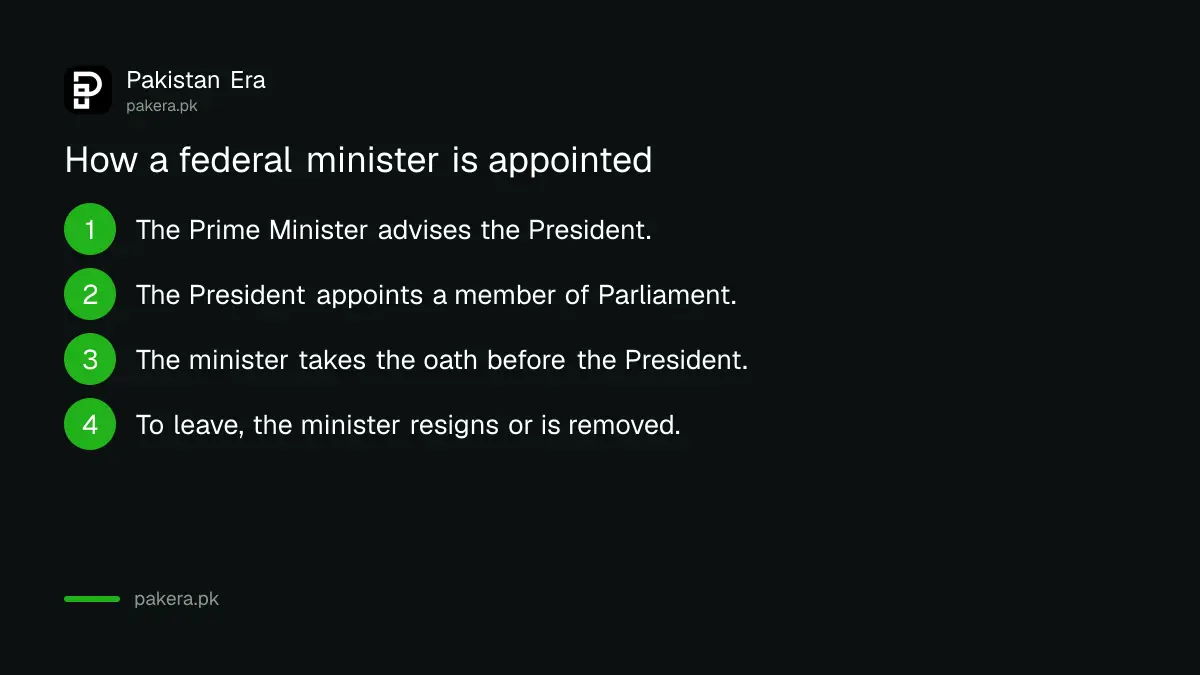
The President appoints and removes ministers on the Prime Minister's advice. Before taking office, each minister takes an oath before the President in the form set by the Third Schedule. A minister can also resign by writing to the President.
- The Prime Minister advises the President to appoint a member of Parliament as Federal Minister or Minister of State.
- The President appoints the member under Article 92(1).
- The new minister takes the oath before the President (Article 92(2)).
- The minister then joins the cabinet, which is collectively responsible to both Houses.
- To leave, the minister resigns in writing, or the President removes him on the Prime Minister's advice (Article 92(3)).
That collective responsibility to the Senate and the National Assembly is in Article 91(6), and it covers Ministers of State too.
What Advisers and Special Assistants can do
An Adviser can speak in either House and its committees, but cannot vote there, because Article 93 applies Article 57 to Advisers. Special Assistants have the status and functions the Prime Minister sets. Neither is a member of the cabinet counted under Article 92.
Article 57 gives the same right to speak, without a vote, to the Prime Minister, Federal Ministers, Ministers of State and the Attorney General. A minister who is also a member still votes as a member of his own House.
The Advisers limit changed recently. The National Assembly's 2012 edition of the Constitution says "not more than five Advisers". The current text on Pakistan Code says seven, with a footnote to the Twenty-seventh Amendment Act, 2025.
What the cabinet decides
The cabinet aids and advises the President and takes the federal government's main decisions. Under Rule 16 of the Rules of Business, proposals for laws, ordinances, the budget, new taxes and loans, and major policy cases must come before it.
Much of the detailed work goes through cabinet committees, whose decisions the cabinet ratifies. Examples are the cabinet committee decisions of 13 November 2026 and the federal government decisions of 10 November 2026. For which senators sit in Parliament now, see the Senate of Pakistan members list.
Common questions about the federal cabinet's size
How many ministers can Pakistan's federal cabinet have?
At most 47 Federal Ministers and Ministers of State together, which is 11 per cent of Parliament's 432 seats under Article 92.
How many Advisers can the Prime Minister have?
Up to seven under Article 93, as amended by the Twenty-seventh Amendment. The earlier limit was five.
Is there a limit on Special Assistants to the Prime Minister?
The Rules of Business allow Special Assistants with the status and functions the Prime Minister sets, and name no number.
Can a senator be a federal minister?
Yes, but senators can make up at most one-fourth of the number of Federal Ministers.
Can an Adviser vote in the National Assembly?
No. An Adviser may speak in either House or its committees under Article 57, but has no vote.
How we verified this
What we checked and where we read it.
Last checked 15 November 2026. Articles 51, 57, 59, 91, 92 and 93 are from the Constitution on Pakistan Code, which footnotes the Twenty-seventh Amendment for the Advisers limit. The earlier limit of five is from the National Assembly's 2012 edition of the Constitution. Rules 4(6) and 16 are from the Cabinet Division's Rules of Business, 1973, amended up to 23 July 2026, whose contents page shows a former rule 31B on Special Assistants as omitted. The 47 and the senator example are our arithmetic.
About the author

Global Affairs & Political Economy Writer
Muhammad Hatim is a book lover who started writing because he enjoys it. At Pakistan Era he writes about international relations, geopolitics and the global economy, with a particular interest in South Asia and the forces behind current events.