Huawei Nova 16 SE: An 8,500mAh Battery on 5 August
Huawei launches the nova 16 SE on 5 August with an 8,500mAh battery, alongside an 18 inch foldable laptop and a 4.7mm tablet.
Huawei is putting an 18 inch foldable laptop, a tablet thinner than most phones and a phone with an 8,500mAh battery on the same stage on 5 August.
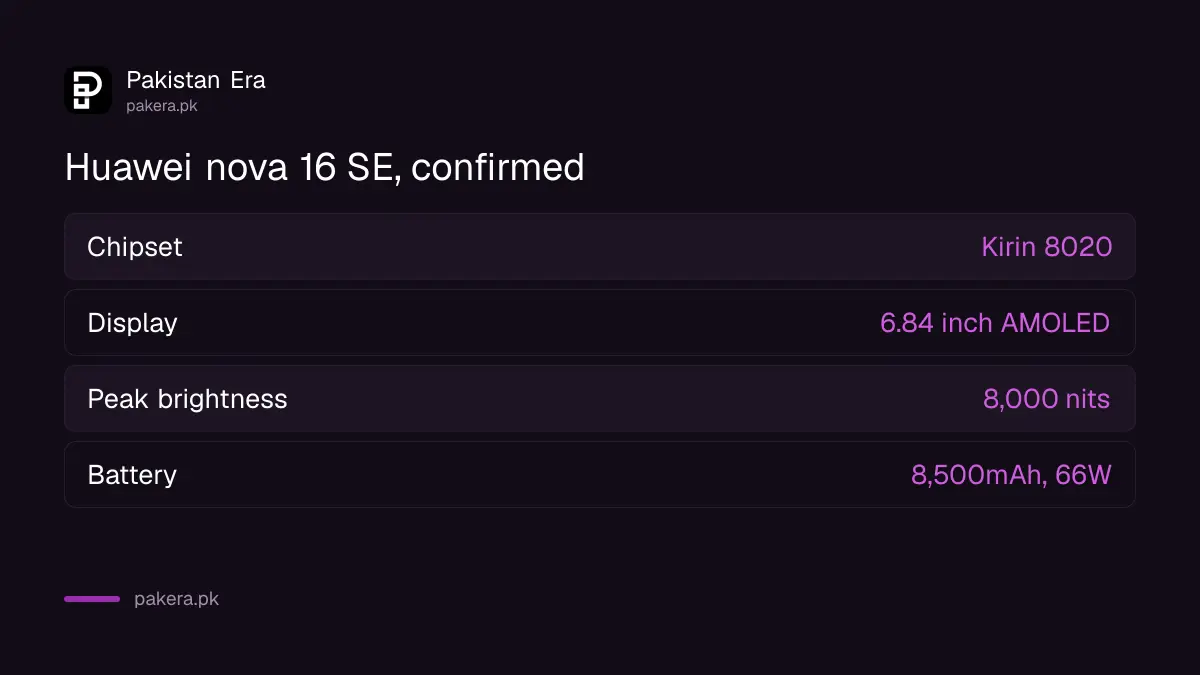
The Huawei nova 16 SE is the mainstream product in that lineup, and the specification that matters is the battery. Huawei has confirmed 8,500mAh with 66W charging, a 6.84 inch AMOLED reaching 8,000 nits, and the Kirin 8020 chipset.
There is one thing you need to know before any of that matters, and it is not on the spec sheet.
What are the nova 16 SE specifications?
Confirmed by Huawei rather than leaked, which is unusual this far ahead.
| Specification | Detail |
|---|---|
| Chipset | Kirin 8020 |
| Display | 6.84 inch AMOLED, up to 8,000 nits peak |
| Main camera | 50MP with Red Maple Imaging |
| Battery | 8,500mAh, 66W wired |
| Software | HarmonyOS |
8,000 nits is the number people will repeat, and it is genuinely useful in Pakistan where phones spend a lot of time in direct sun. Peak brightness figures are measured on small portions of the screen rather than the whole panel, so treat it as a claim about readability rather than a number you will ever see across the display.
The thing nobody puts in the headline
It runs HarmonyOS, which means no Google Mobile Services. No Play Store, no Gmail app, no Google Maps, no YouTube app as you know it.
That is not a minor caveat in Pakistan, where daily life runs on WhatsApp, Google Maps and an increasing number of banking and government apps that assume the Play Store exists. Huawei's own AppGallery covers a lot, and workarounds exist, but they are workarounds.
Buy a Huawei phone knowing this and you will be fine. Buy it because the spec sheet looked good and you will spend your first week annoyed.
What else launches on 5 August?
The more interesting hardware, frankly.
- MateBook Fold Ultimate Design, an 18 inch foldable PC with a 3.3K dual layer OLED screen, on the new Kirin X90 Plus for a claimed 25 percent performance gain.
- MatePad Pro 2026, at 4.70mm thick and about 439g, which makes it one of the slimmest flagship tablets anywhere, with stylus support aimed at creative work.
- MateBook Pro S, a 798g laptop.
- A line of RGB MiniLED televisions.
An 18 inch folding laptop is the sort of thing that exists to prove a point rather than to sell, but the engineering behind a hinge that size is real, and it tends to reach normal products a few years later.
What is the Kirin 8020 and why does it matter?
Huawei's own chip, designed in house, which is the whole reason the company still exists as a phone maker.
When Huawei lost access to American technology it lost its chip supply along with Google. Most companies would have left the market. Instead it built its own silicon line, and the Kirin series is the result. A Kirin 8020 in a mid range phone means Huawei can now ship volume products without asking anyone's permission.
What that means for a buyer is more mixed. Kirin chips are competent but the ecosystem around them is thinner: fewer developers optimise for them, and benchmark comparisons against Snapdragon and Dimensity parts are harder to find because the phones are not sold in the markets that produce those reviews.
Combined with HarmonyOS, you are buying into a stack that is entirely Huawei's. That is either impressive independence or an ecosystem with one exit, depending on how you feel about being locked in.
Is 8,500mAh the real story?
It is the most useful number here, and it lands in a market that will appreciate it. Load shedding makes battery capacity a practical concern in Pakistan rather than a spec sheet boast, and a phone that goes two days between charges solves a real problem.
Worth noting the pattern though. The Redmi Note 17 Pro Max carries 10,000mAh, and Huawei is at 8,500mAh. Large batteries have stopped being a differentiator and become the mid range arms race, which is good news regardless of which brand you buy.
Will any of this reach Pakistan?
Some of it, eventually, and unevenly. Huawei has been rebuilding its Pakistani presence, and the nova line is the part of the range aimed at markets like this one.
What to expect if you are considering one:
- Check AppGallery for the specific apps you actually use before buying, particularly banking ones.
- Confirm the model sold locally matches the one launched, since Huawei regional variants differ more than most brands.
- Price it against the Infinix and Redmi competition, which run full Android and cost less.
- If you import instead, remember registration tax is worked out on FBR's assessed value rather than what you paid.
Our piece on Huawei's return to Pakistan covers where the brand stands here, and the best phones under Rs 100,000 guide covers what the same money buys with Google services intact.
Frequently asked questions
When does the Huawei nova 16 SE launch?
5 August 2026, at an event that also brings the MateBook Fold, MatePad Pro 2026 and MateBook Pro S.
How big is the nova 16 SE battery?
8,500mAh with 66W wired charging, which is well above the 5,000mAh most phones carry.
Does the nova 16 SE have Google apps?
No. It runs HarmonyOS without Google Mobile Services, so there is no Play Store, Gmail app or Google Maps as standard.
What chipset does it use?
The Kirin 8020, Huawei's own silicon rather than a Qualcomm or MediaTek part.
What is the nova 16 SE price in Pakistan?
Not announced. Pakistani availability and pricing usually follow some weeks after a Chinese launch, if the model comes here at all.
Is 8,000 nits brightness real?
It is a peak figure measured on a small portion of the panel, not across the whole screen. Useful for sunlight readability, not a number you see everywhere.
Work out your own figure
Importing rather than waiting for local availability? Look up the assessed value first.
PTA Tax Value Checker →About the author

Tax, Bills and Technology Writer
Ali Akhtar is a young and curious voice here at Pakistan Era. He is currently pursuing his A-Levels and has a growing interest in Pakistan’s changing industrial landscape and educational trends. Ali likes to write in a way that helps him explain and explore the world around him. His writing reflects the perspective of the new generation navigating the evolving trends of Pakistan where technology, youth innovation, and shifting opportunities are reshaping the country’s future.